


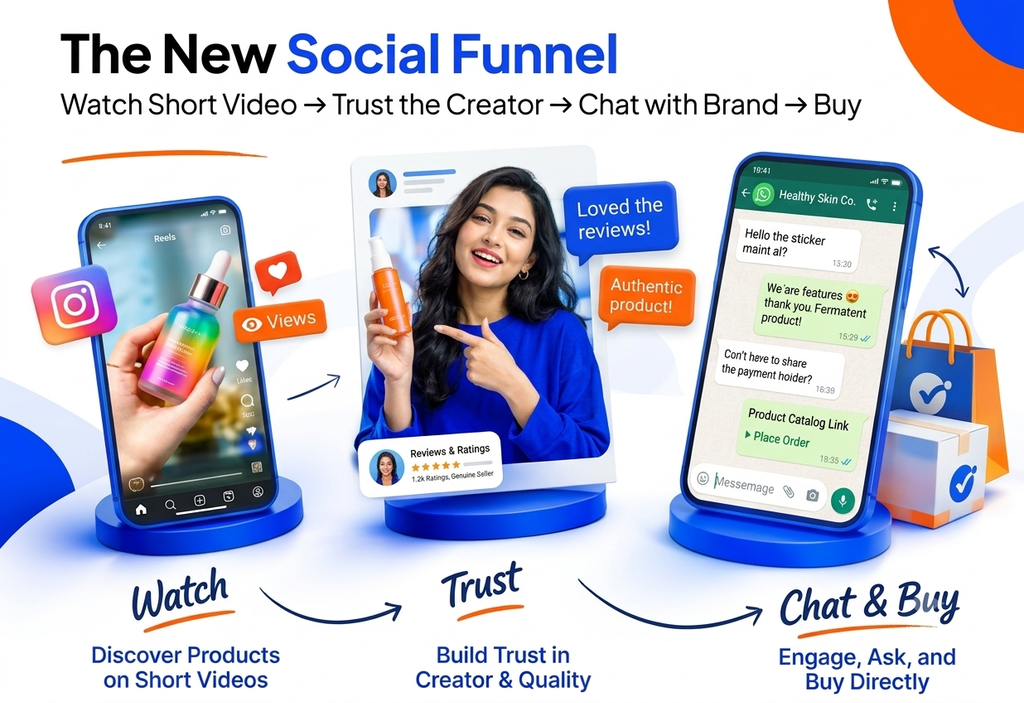
Introduction: Why the Traditional Marketing Funnel Is Changing
For years, marketers have relied on a familiar customer journey: create awareness, generate interest, encourage consideration, and convert prospects into customers. This model often assumes that people discover a brand through advertising or search, visit its website, submit a form, and eventually engage with a sales representative.
Social media has changed that journey.
Today, a potential customer might discover a product through a short video, watch several creator reviews, read comments from existing customers, send a direct message to the brand, and complete a purchase shortly afterward. The journey may happen within a single platform, without a traditional website visit or lead-generation form.
This behavior has given rise to a more conversational and content-driven approach to customer acquisition: Watch → Trust → Chat → Buy.
Each stage represents a different part of the modern buying experience:
- Watch: Capture attention through useful, entertaining, or educational content.
- Trust: Build confidence through authenticity, expertise, social proof, and consistency.
- Chat: Turn interest into a meaningful conversation through comments, direct messages, and messaging applications.
- Buy: Make purchasing simple by reducing friction and providing relevant support.
The model is particularly relevant for businesses that depend on digital discovery, community engagement, creator partnerships, and relationship-based selling. It applies to consumer brands, e-commerce companies, SaaS providers, professional services, and B2B organizations.
The central idea is straightforward: social media should not simply attract attention. It should help customers move from curiosity to confidence and eventually to a purchasing decision.
1. Watch: Turning Content Into Customer Discovery

The first stage of the new social funnel is about earning attention. People scroll through social feeds quickly, and brands have only a limited opportunity to make their content relevant.
Traditional advertising often interrupts what users are doing. Social-first marketing works differently. It creates content that people choose to watch because it answers a question, solves a problem, demonstrates something useful, or entertains them.
Short-form videos, product demonstrations, educational clips, customer stories, behind-the-scenes content, and creator collaborations can all support this stage.
However, generating views should not be the only objective. A video with thousands of views may create little business value if it attracts the wrong audience or fails to communicate why the product matters.
What Makes Social Content Worth Watching?
Effective discovery content generally has three characteristics.
Immediate relevance: The opening seconds should communicate why the content deserves attention. A software company might begin with a common operational problem, while a consumer brand could demonstrate a product’s most useful feature.
Clear value: Content should offer something meaningful, such as a practical tip, product comparison, demonstration, or answer to a frequently asked question.
Platform-native presentation: Content should feel appropriate for the platform. A short vertical video may work well on Instagram Reels or TikTok, while a detailed professional discussion may be better suited to LinkedIn or YouTube.
For example, a cybersecurity company could publish a short video explaining three common phishing warning signs. Rather than beginning with a product advertisement, it starts with a problem its target audience already understands. Viewers who find the information useful may become interested in the company’s expertise and services.
Content Formats That Support the Watch Stage
| Content format | Primary objective | Example |
|---|---|---|
| Short-form videos | Capture attention quickly | A 30-second product demonstration |
| Educational posts | Attract problem-aware audiences | Tips for improving business productivity |
| Creator collaborations | Reach relevant communities | An industry expert reviewing a product |
| Customer stories | Introduce real-world outcomes | A customer explaining how a solution helped |
| Live sessions | Encourage real-time discovery | A product walkthrough or expert Q&A |
| Behind-the-scenes content | Humanize the brand | Showing how a product is developed |
Brands should also pay attention to content retention, completion rates, shares, saves, profile visits, and meaningful audience interactions. These signals provide more insight than view counts alone.
The goal of this stage is not to sell immediately. It is to attract the right people and give them a reason to explore further.
2. Trust: Converting Attention Into Confidence

Attention does not automatically create purchasing intent. Someone may watch a product video without believing its claims, understanding its value, or feeling confident enough to consider buying.
That is why trust is the second and arguably one of the most important stages of the new social funnel.
Social platforms give customers access to more information than traditional advertising typically provides. They can compare opinions, read public comments, watch independent reviews, investigate the brand’s online presence, and evaluate how the company responds to criticism.
Consequently, brands cannot rely entirely on polished promotional messages. They need to demonstrate credibility through consistent and believable experiences.
The Role of Social Proof
Social proof helps prospective customers understand how other people experience a brand or product. It reduces uncertainty by providing evidence beyond the company’s own marketing claims.
Useful forms of social proof include:
- Customer testimonials and video reviews.
- User-generated content and product experiences.
- Case studies with measurable business outcomes.
- Expert opinions and credible creator recommendations.
- Public discussions and responses to customer questions.
- Demonstrations showing how a product performs in real situations.
For a B2B software provider, this might mean publishing a customer case study that explains how an organization reduced manual work or improved reporting efficiency. For an e-commerce company, it could involve sharing customer-created videos that show the product being used in everyday situations.
The important distinction is authenticity. Testimonials should represent genuine customer experiences, and performance claims should be supported by evidence.
Consistency Builds Familiarity
Trust is rarely established through a single post. It develops when audiences repeatedly encounter useful information, consistent brand messaging, knowledgeable representatives, and responsive customer support.
Brands should maintain consistency across their social profiles, website, advertising, and conversations with prospects. Conflicting product descriptions, exaggerated promises, unanswered questions, or inconsistent pricing information can weaken confidence.
Transparency also matters. Businesses should acknowledge product limitations, explain relevant policies, and respond professionally when customers raise concerns.
For additional guidance on building credibility in digital environments, marketers can refer to the Edelman Trust Barometer, which examines how trust influences relationships between people and organizations.
How Brands Can Strengthen Trust
A practical approach is to create content that answers the questions customers ask before making a decision:
- Does the product solve the problem it claims to solve?
- What makes it different from competing alternatives?
- What do existing customers say about it?
- Is the company knowledgeable and reliable?
- What happens if the product does not meet expectations?
- Is the price justified by the value provided?
When brands answer these questions consistently, social media becomes more than a promotional channel. It becomes a place where prospective customers can evaluate the business with greater confidence.
3. Chat: Turning Engagement Into Meaningful Conversations
The third stage is where the new social funnel becomes distinctly conversational.
In traditional digital marketing, a prospect might click an advertisement, visit a landing page, complete a form, and wait for a sales representative to contact them. In a social-first buying journey, the prospect can ask a question directly through comments, direct messages, or an integrated messaging channel.
This reduces the distance between discovering a product and receiving personalized information.
A customer interested in a skincare product might ask whether it suits a particular skin type. Someone evaluating a software platform might request pricing information, integration details, or a product demonstration. A prospective B2B buyer might ask whether a solution supports a specific business requirement.
These are not merely engagement signals. They can indicate genuine buying interest.
Why Conversational Marketing Matters
Customers often have questions that generic website content cannot fully answer. A conversation allows the business to understand the customer’s specific needs and provide relevant guidance.
For example, instead of sending every interested visitor to the same product page, a brand can use a direct-message conversation to understand the customer’s requirements, recommend an appropriate product, and clarify delivery or pricing details.
In B2B environments, conversations can be even more valuable. A prospect might ask about security certifications, implementation timelines, integrations, scalability, or enterprise support. These discussions help sales teams identify buying intent and understand the prospect’s decision-making requirements.
Building an Effective Social Chat Experience
An effective social messaging strategy needs more than quick replies. It should combine responsiveness, context, personalization, and clear next steps.
Respond quickly and naturally: Customers should not feel that they are interacting with an unhelpful automated system. Automated acknowledgements can set expectations, but complex questions should reach a knowledgeable person.
Understand intent before recommending: A brand should identify what the customer needs instead of immediately pushing a product or discount.
Maintain conversation context: If a customer has already explained their requirements in a comment or previous message, the business should avoid asking them to repeat the same information.
Use automation carefully: Chatbots and AI-powered assistants can handle frequently asked questions, collect basic requirements, route inquiries, and support after-hours engagement. Human representatives should remain available for sensitive, complex, or high-value interactions.
Create a clear next step: Depending on the customer’s intent, the conversation might lead to a product page, checkout, consultation, product demonstration, quotation, or appointment.
AI and Automation in Social Conversations
AI is making social conversations easier to manage at scale. Businesses can use conversational tools to categorize incoming messages, identify common questions, recommend relevant responses, and route qualified inquiries to the appropriate team.
However, automation should support the customer experience rather than make conversations feel impersonal.
A useful model is to automate repetitive activities while keeping human involvement available for situations requiring judgment, negotiation, or reassurance.
For example, an AI assistant could identify that a prospect is asking about enterprise pricing and route the conversation to a sales representative. The representative can then continue the discussion with the necessary business context.
Companies should also establish clear data-handling practices, obtain appropriate consent, and avoid collecting unnecessary personal information through social messaging channels.
For broader guidance on responsible AI practices, organizations can consult the NIST AI Risk Management Framework.
4. Buy: Making the Purchase Journey Simple
The final stage is conversion. After discovering a product, building confidence, and receiving relevant answers, customers need a straightforward way to complete their purchase.
A major advantage of social commerce is that it can reduce unnecessary steps between interest and transaction. Depending on the platform, business model, and available integrations, customers may be able to purchase through native shopping features, product links, messaging conversations, or connected checkout experiences.
But a smooth buying experience requires more than a purchase button.
Reduce Conversion Friction
Customers may abandon a purchase when they encounter unclear pricing, complicated checkout processes, unexpected charges, limited payment options, or unanswered questions.
Brands should therefore make the buying process as transparent as possible.
Important considerations include:
- Clear product information and pricing.
- Accessible checkout or booking links.
- Transparent shipping, delivery, and return policies.
- Relevant payment options.
- Easy access to customer support.
- Consistent product availability information.
- A clear explanation of what happens after payment.
For B2B companies, the conversion action may not be an immediate online purchase. It could be a demo request, consultation booking, proposal request, or qualified sales conversation.
The objective is to make the next step appropriate to the buyer’s readiness.
Social Commerce Is More Than a Checkout Feature
Social commerce is often associated with buying products directly through social platforms. However, its broader value lies in connecting discovery, evaluation, conversation, and purchase.
A customer might discover a product on Instagram, watch a detailed review on YouTube, ask questions through WhatsApp, and complete the transaction on the company’s website. Although the purchase happens outside the original platform, the social funnel still influences the conversion.
This is particularly important for businesses with longer decision cycles or more complex offerings. They should evaluate the complete customer journey rather than assuming that every purchase must happen inside a social application.
5. How the New Social Funnel Differs From Traditional Marketing
The traditional funnel and the new social funnel are not mutually exclusive. Businesses can use both. The difference is that the social funnel places content, trust, and direct interaction closer to the center of the buying experience.
| Dimension | Traditional marketing funnel | New social funnel |
|---|---|---|
| Discovery | Ads, search, websites | Videos, creators, communities, social feeds |
| Engagement | Landing pages and email | Comments, shares, live sessions, direct messages |
| Trust building | Brand messaging and case studies | Reviews, user-generated content, conversations, demonstrations |
| Lead capture | Forms and gated assets | Messaging, social interactions, native lead tools |
| Sales interaction | Email, calls, scheduled meetings | Direct messages, chat, video calls, consultations |
| Conversion | Website checkout or sales process | Social checkout, messaging-assisted purchase, or connected checkout |
| Measurement | Traffic, leads, conversion rates | Watch time, engagement quality, conversations, qualified intent, revenue |
The new model does not eliminate websites, email marketing, CRM systems, or traditional sales processes. Instead, it changes how customers enter and move through them.
6. Measuring Performance Across the Watch → Trust → Chat → Buy Funnel
A social funnel needs stage-specific measurement. If businesses focus only on impressions or engagement, they may overlook whether their content is attracting qualified prospects and generating revenue.
Each stage should have its own performance indicators.
Watch Metrics
These metrics help determine whether content is reaching and retaining the intended audience:
- Video views and reach.
- Average watch time.
- Video completion rate.
- Audience retention.
- Shares and saves.
- Profile visits.
Trust Metrics
Trust is more difficult to measure directly, but businesses can monitor indicators that reflect growing confidence:
- Positive customer sentiment.
- Review volume and quality.
- Repeat engagement.
- Customer testimonials and user-generated content.
- Branded search activity.
- Meaningful questions and product-related interactions.
Chat Metrics
Conversation metrics reveal whether attention is becoming actionable interest:
- Number of inbound conversations.
- Response time.
- Conversation-to-qualified-lead rate.
- Number of product or pricing inquiries.
- Demo or consultation requests.
- Conversation resolution rate.
Buy Metrics
Conversion metrics establish whether social activity contributes to business outcomes:
- Social-assisted conversions.
- Purchase conversion rate.
- Revenue attributed to social campaigns.
- Average order value.
- Cost per acquisition.
- Customer acquisition cost.
- Repeat purchase rate.
- Return on marketing investment.
Businesses should connect these indicators to their CRM, analytics, and commerce systems wherever possible. This helps teams understand which content formats and conversations contribute to qualified opportunities and actual revenue.
Attribution requires care. A customer may interact with multiple platforms and channels before purchasing. Marketers should avoid assigning all credit to the last social interaction and should consider assisted conversions, campaign tracking, and incrementality testing when evaluating performance.
7. Building a Practical Social Funnel Strategy
Implementing the new social funnel requires coordination across marketing, sales, customer support, and technology teams. Publishing content without a defined conversion path can create engagement without meaningful business results.
A practical implementation can begin with the following steps.
Step 1: Define the Target Audience and Buying Questions
Identify the audiences the business wants to reach and understand the questions they ask at each stage of the buying journey.
For example, an enterprise technology provider may target IT leaders who want to understand infrastructure challenges, evaluate solution capabilities, compare vendors, and discuss implementation requirements.
Step 2: Develop Content for Every Stage
Create content with a clear purpose.
- Watch: Educational videos, product demonstrations, industry insights, and creator collaborations.
- Trust: Customer stories, expert interviews, reviews, case studies, and transparent product explanations.
- Chat: Q&A posts, live sessions, interactive content, and direct-message invitations.
- Buy: Product links, consultation bookings, pricing information, and clear purchase instructions.
The content should work together rather than operate as disconnected campaigns.
Step 3: Establish a Messaging and Response Process
Decide which team handles incoming messages, how quickly customers should receive an initial response, and how complex inquiries should be escalated.
Create response guidelines for common questions without forcing representatives to use rigid scripts. A consistent service experience is more valuable than simply maximizing the number of automated replies.
Step 4: Connect Social Channels With Business Systems
Integrate relevant social interactions with CRM, marketing automation, customer support, and commerce systems where platform capabilities and privacy requirements allow.
This can help businesses preserve conversation history, identify qualified leads, manage follow-ups, and understand the contribution of social channels to revenue.
Step 5: Test, Measure, and Improve
Test different content formats, opening messages, calls to action, and conversation flows. Review performance across all four stages instead of optimizing for views alone.
For example, if a video attracts strong attention but generates few meaningful conversations, the content may be reaching the wrong audience or failing to communicate a clear next step. If conversations are frequent but purchases remain low, the issue may involve pricing, product fit, checkout friction, or insufficient trust.
The objective is continuous improvement across the entire journey.
8. Industry Applications of the New Social Funnel
The Watch → Trust → Chat → Buy model can support different business models, although the implementation varies by industry.
E-commerce and retail: Brands can use product videos to generate discovery, customer reviews to establish confidence, direct messages to answer product questions, and social shopping or website checkout to complete transactions.
B2B technology: Software companies can publish educational content, demonstrate product capabilities, share customer success stories, answer technical questions through messaging, and convert interested prospects into demo requests or sales opportunities.
Education and training: Institutions and training providers can share course previews, learner experiences, instructor insights, and program information. Prospective learners can then ask about eligibility, fees, schedules, and certification before enrolling.
Professional services: Consulting firms, agencies, and service providers can use expert-led content to demonstrate their knowledge, share credible case studies, answer questions, and arrange consultations with potential clients.
Healthcare and wellness services: Providers can use educational content and verified information to build awareness, answer general service questions, and guide people toward appropriate appointment channels. They must take additional care with privacy, sensitive information, and professional communication standards.
Across these industries, the principle remains consistent: content creates the opportunity for discovery, trust reduces uncertainty, conversations clarify needs, and a suitable next step enables conversion.
9. Common Mistakes Brands Should Avoid
Although the new social funnel appears simple, businesses can undermine its effectiveness through several common mistakes.
Chasing views instead of relevant audiences: Viral content is not necessarily valuable if it attracts people who have no interest in the product or service.
Treating trust as a one-time activity: A single testimonial or influencer collaboration cannot replace consistent customer experiences and credible communication.
Using automation without a human escalation path: Automated replies may handle simple questions, but customers need access to knowledgeable people when their requirements are complex.
Pushing sales too early: Asking every viewer to purchase immediately can damage the experience. Content should provide value before demanding action.
Ignoring the post-purchase experience: The funnel should not end at payment. Reviews, onboarding, support, and customer advocacy can create repeat purchases and new discovery opportunities.
Measuring every platform in isolation: Customers frequently move between social networks, websites, messaging channels, and offline interactions. Businesses need a broader view of the customer journey.
10. The Future of Social Selling: From Content Consumption to Conversational Commerce
The next phase of social marketing will likely be shaped by the growing integration of short-form content, creator communities, AI-assisted conversations, personalized recommendations, and digital commerce.
AI tools can help brands identify recurring customer questions, summarize conversation patterns, recommend relevant content, and support customer service teams. Recommendation systems can help users discover products and creators based on their interests and behavior.
At the same time, audiences are becoming more selective about the content they trust. This makes authentic expertise, transparent communication, and genuine customer experiences increasingly important.
Social selling will also become more connected to existing business systems. A customer interaction that begins with a video may eventually create a CRM record, trigger a relevant follow-up, generate a product recommendation, or initiate a sales opportunity.
However, more automation does not automatically mean better customer experiences. Businesses must balance speed with relevance, personalization with privacy, and efficiency with human judgment.
The strongest social strategies will be those that make every stage feel connected: the content attracts the right audience, the brand earns credibility, the conversation addresses real needs, and the purchasing process feels natural.
Conclusion: Social Media Is Becoming a Relationship-to-Revenue Channel
The new social funnel—Watch → Trust → Chat → Buy—represents a meaningful shift in how businesses approach digital customer acquisition. Instead of treating social media as a channel that simply generates awareness, organizations can use it to support the entire journey from discovery to conversion.
Watch captures attention. Trust creates confidence. Chat turns interest into a conversation. Buy converts that conversation into a commercial outcome.
For marketers, the opportunity is not simply to publish more content or adopt more social platforms. It is to build a connected experience in which every interaction has a clear purpose and contributes to customer progress.
As social platforms continue to evolve, the brands that succeed will be those that understand a fundamental principle: people may discover products through content, but they often make purchasing decisions when they feel informed, understood, and confident.
The future of social commerce is not just about getting people to watch your brand. It is about giving them enough confidence to start a conversation—and making that conversation valuable enough to lead to a purchase.
Frequently Asked Questions (FAQs) –
The new social funnel is a customer acquisition model based on four stages: Watch, Trust, Chat, and Buy. It describes how people discover brands through social content, build confidence through credible information, interact through conversations, and eventually make a purchase.
The traditional funnel often relies on advertising, website visits, lead forms, and follow-up campaigns. The social funnel places content discovery, social proof, direct messaging, and conversational engagement at the center of the customer journey. Both approaches can work together.
Instagram, TikTok, YouTube, Facebook, and LinkedIn can all support the model. The best platform depends on the audience, product, content format, and buying process. Messaging applications such as WhatsApp may also support the conversation and conversion stages.
Trust reduces uncertainty. Customer reviews, genuine testimonials, expert content, product demonstrations, and transparent communication help prospective customers evaluate whether a business and its offerings are credible.
AI can support content analysis, customer query classification, automated responses, lead routing, conversation summaries, and personalized recommendations. Human representatives should remain available for complex questions, sensitive interactions, and important purchasing decisions.