


Introduction –
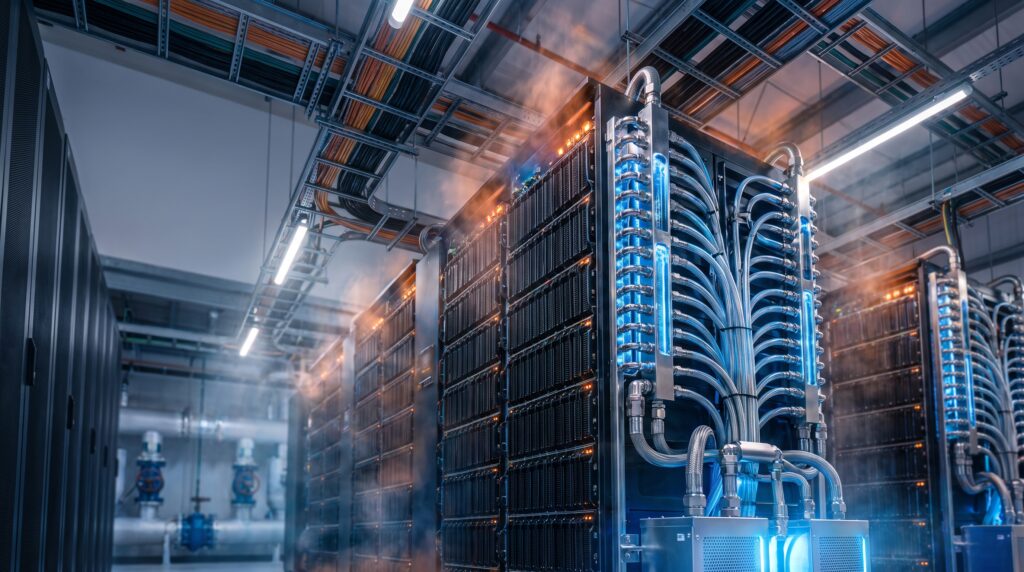
Liquid cooling for AI data centers is becoming a critical infrastructure strategy as artificial intelligence workloads push computing hardware to increasingly high levels of power and performance. Modern AI systems depend on powerful GPUs, accelerators, CPUs, networking equipment, and storage infrastructure. As these components become more powerful, they also generate more heat, creating new challenges for data center operators.
Traditional air cooling has supported data centers for decades, but high-density AI infrastructure is changing the economics and engineering requirements of thermal management. AI racks can concentrate substantially more computing power into a small physical footprint than many traditional enterprise workloads. Moving that heat efficiently is becoming essential for maintaining performance, reliability, energy efficiency, and hardware lifespan.
Liquid cooling addresses this challenge by using a liquid medium to transfer heat away from high-power computing components more efficiently than air in many high-density applications. Technologies such as direct-to-chip cooling, rear-door heat exchangers, and immersion cooling are increasingly becoming part of the conversation around AI-ready data center infrastructure.
The shift is bigger than simply replacing fans with pumps. It can require changes to rack design, cooling distribution, facility plumbing, power infrastructure, monitoring, maintenance, and data center architecture. As AI adoption accelerates, liquid cooling is becoming an important part of the infrastructure conversation behind high-density computing.
Why AI Data Centers Generate So Much Heat –
The fundamental challenge begins with computing power.
AI training and inference workloads can require large numbers of GPUs or specialized accelerators operating simultaneously. These processors perform enormous numbers of calculations and consume substantial electrical power. Almost all of that electrical energy ultimately becomes heat that must be removed from the data center.
Traditional enterprise servers often operate at lower power densities and are distributed across racks in ways that allow conventional cooling systems to manage the thermal load. AI infrastructure can be very different.
Instead of relatively moderate workloads spread across many servers, AI systems can concentrate high-performance accelerators, high-speed networking, and memory into tightly packed racks.
This creates a fundamental infrastructure question:
How can a data center remove increasing amounts of heat from increasingly dense computing environments without consuming excessive amounts of energy to cool the equipment?
Liquid cooling is one of the major answers being explored.
The Limits of Traditional Air Cooling –
Air cooling works by moving cool air across heated components and then transporting the warmed air away from the equipment. It is familiar, relatively straightforward, and already deeply integrated into most data center environments.
However, air has relatively low heat capacity compared with liquids. Moving larger amounts of heat therefore requires substantial airflow and carefully designed cooling systems.
As rack power density increases, the amount of air required to manage temperatures can also increase. This can require larger fans, more sophisticated airflow management, additional cooling infrastructure, and greater energy consumption.
The challenge becomes particularly significant when powerful processors are concentrated into dense configurations.
At a certain point, continuing to increase air cooling capacity may become less practical than introducing liquid-based heat removal closer to the source.
What Is Liquid Cooling?
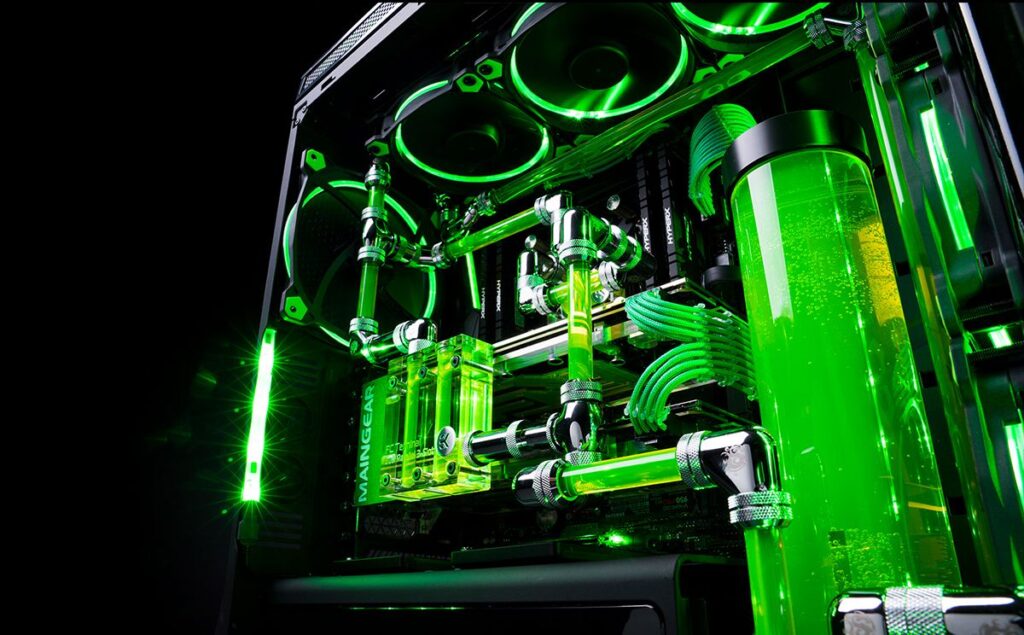
Liquid cooling uses a liquid medium to absorb and transport heat away from computing components.
Rather than depending entirely on large volumes of air moving through a server rack, liquid can be brought much closer to the components producing the heat.
There are several approaches to liquid cooling, but the basic principle is similar: capture heat efficiently at or near the computing component and transfer that heat to another part of the cooling system.
The heated liquid is then circulated through a heat exchanger or other cooling infrastructure before being returned to the equipment.
This approach can significantly change how data centers manage thermal loads.
Direct-to-Chip Cooling –
One of the most important liquid cooling approaches for AI infrastructure is direct-to-chip cooling.
In this architecture, a cold plate is placed directly against a high-power component such as a GPU or CPU. Coolant flows through the cold plate, absorbs heat from the processor, and carries that heat away.
This approach is attractive for AI infrastructure because it targets the components that generate the greatest amount of heat.
Instead of cooling the entire server environment and relying on airflow to eventually remove processor heat, direct-to-chip systems transfer heat closer to its source.
This can improve thermal management for high-density workloads while reducing some of the burden placed on conventional air-conditioning systems.
Rear-Door Heat Exchangers –
Another approach is the use of rear-door heat exchangers.
These systems are positioned at the back of a server rack and capture heat from the hot air leaving the servers. The heat is transferred into a liquid cooling loop before the air returns to the data center environment.
Rear-door systems can be attractive for organizations that want to improve cooling capacity without completely redesigning their servers.
They can provide a bridge between traditional air-cooled infrastructure and more advanced liquid-cooled environments.
However, their suitability depends on rack density, facility design, and the specific thermal requirements of the workload.
Immersion Cooling –
Immersion cooling takes a different approach by placing computing components or entire servers into a specially designed non-conductive fluid.
Instead of transferring heat through a cold plate, the liquid directly surrounds the equipment and absorbs heat from its surfaces.
Immersion cooling can support very high-density computing environments, but it can also require significant changes to hardware configuration, maintenance processes, equipment handling, and facility design.
For some organizations, direct-to-chip cooling may be easier to integrate into existing infrastructure, while immersion cooling may make more sense for specialized high-density deployments.
Major Liquid Cooling Approaches –
| Cooling Approach | How It Works | Potential Advantage | Key Consideration |
|---|---|---|---|
| Direct-to-chip | Liquid flows through cold plates attached to processors | Efficient heat removal close to source | Requires compatible server designs |
| Rear-door heat exchanger | Removes heat from hot server exhaust | Can integrate with existing racks | Depends on rack and facility design |
| Single-phase immersion | Servers are submerged in non-conductive liquid | High-density thermal management | Changes maintenance and hardware practices |
| Two-phase immersion | Fluid changes phase as it absorbs heat | Highly efficient heat transfer | More specialized infrastructure |
| Traditional air cooling | Air removes heat from components | Mature and familiar | Increasingly challenging at high density |
Why High-Density Computing Changes the Equation –
AI infrastructure is not simply about having more servers. It is about increasing computing power within a limited physical footprint.
A rack containing a large number of high-performance accelerators can create a thermal environment very different from a conventional enterprise rack.
This density affects more than cooling.
Power distribution, rack design, cabling, networking, floor loading, facility capacity, and physical layout can all become important considerations.
Liquid cooling therefore needs to be viewed as part of a broader high-density infrastructure strategy rather than an isolated mechanical system.
Liquid Cooling and Energy Efficiency –
Cooling consumes energy, and reducing the energy required to remove heat can improve overall data center efficiency.
Traditional cooling systems may require significant energy for fans, chillers, pumps, and air movement. Liquid cooling can potentially reduce some of the energy associated with moving large volumes of air.
However, liquid cooling does not automatically make every data center more energy efficient.
Efficiency depends on the complete system design, including coolant temperature, pumps, heat exchangers, chillers, facility conditions, and workload characteristics.
Data center operators should therefore evaluate cooling efficiency at the facility level rather than assuming that any liquid cooling technology will automatically deliver the same result.
The Impact on Data Center Design –
Moving to liquid cooling can require changes throughout the data center.
Facilities may need liquid distribution systems, pumps, heat exchangers, monitoring equipment, leak detection, plumbing infrastructure, and appropriate service procedures.
This can affect both new data center construction and existing facilities being upgraded for AI workloads.
New facilities can design liquid cooling into the architecture from the beginning. Existing facilities may need retrofit strategies that allow liquid cooling to coexist with legacy air-cooled equipment.
This makes infrastructure planning particularly important.
Power and Cooling Are Becoming One Conversation –
Historically, data center operators often considered electrical capacity and cooling capacity as separate infrastructure concerns.
With high-density AI systems, the relationship becomes much tighter.
More computing power means more electrical consumption. More electrical consumption generally means more heat. More heat means more cooling capacity.
As a result, organizations planning AI infrastructure need to evaluate power and thermal capacity together.
A data center may have sufficient electrical capacity but insufficient cooling capability to support a particular AI deployment. Conversely, a facility with strong cooling infrastructure may not have enough power available for high-density accelerator clusters.
The two constraints increasingly need to be planned as a connected system.
The Role of Thermal Management in AI Performance –
Cooling is not only about preventing hardware damage.
Temperature can also influence system performance and reliability. If computing components operate under thermal constraints, systems may need to reduce performance to maintain safe operating conditions.
Effective thermal management can help maintain more consistent operating conditions under sustained workloads.
This is particularly important for AI training, where workloads can run continuously for long periods. A thermal system must be capable of handling sustained rather than occasional peaks.
Liquid Cooling and Hardware Reliability –
High temperatures can place stress on electronic components. Maintaining appropriate operating conditions is therefore important for long-term reliability.
Liquid cooling can provide more direct and consistent heat removal for high-power processors.
However, introducing liquid into a data center also creates a new category of operational considerations.
Leak prevention, monitoring, maintenance procedures, coolant quality, component compatibility, and service processes become increasingly important.
Liquid cooling should therefore be implemented with appropriate engineering controls rather than treated simply as a replacement for air conditioning.
Leak Detection Becomes Critical –
One of the most obvious concerns with liquid cooling is the possibility of leaks.
Modern liquid cooling systems can be engineered with safeguards, monitoring, and leak detection, but organizations still need to treat liquid management as a critical operational function.
Sensors can help identify unusual conditions, while automated monitoring can provide alerts when a problem occurs.
Data center operators should also establish clear procedures for responding to potential coolant leaks and maintaining the cooling infrastructure.
The objective is to make liquid cooling as predictable and manageable as other critical data center systems.
Retrofitting Existing Data Centers –
Not every organization is building a new AI data center from scratch.
Many enterprises need to introduce AI infrastructure into existing facilities.
This creates a significant challenge because older data centers may have been designed around much lower rack densities and traditional air cooling.
Retrofitting may involve upgrading cooling distribution, modifying racks, introducing rear-door heat exchangers, deploying direct-to-chip systems, or creating dedicated AI zones.
A phased approach can allow organizations to increase AI capacity without rebuilding an entire facility.
Liquid Cooling Can Enable Higher Rack Density –
One of the major advantages of liquid cooling is the ability to support higher computing density.
If thermal limitations prevent a rack from hosting additional accelerators, improving heat removal can allow more computing capacity to occupy the same physical footprint.
This can be valuable when data center space is limited or expensive.
However, increasing rack density also increases power requirements and may create additional demands on networking and physical infrastructure.
Liquid cooling solves an important constraint, but it does not eliminate the other infrastructure requirements associated with high-density computing.
The Importance of Cooling Infrastructure Standardization –
As liquid cooling becomes more common, standardization will become increasingly important.
Data centers operate complex environments with equipment from multiple vendors. If cooling systems, server designs, connectors, fluids, monitoring systems, and maintenance procedures differ significantly, operating the infrastructure can become more complicated.
Standardized approaches can help organizations simplify deployment, maintenance, training, and equipment replacement.
This is particularly important for enterprises operating multiple data centers or AI environments across different locations.
AI Infrastructure Planning Needs a Long-Term View –
AI hardware is evolving quickly. Today’s accelerator configuration may not be the configuration deployed several years from now.
Organizations therefore need cooling systems that can accommodate future increases in power density.
Designing only for current requirements can result in expensive infrastructure upgrades later.
A better approach is to evaluate expected changes in processor power, rack density, workload demand, and AI adoption over the expected life of the facility.
This makes cooling capacity part of long-term AI infrastructure planning.
Liquid Cooling and Sustainability –
Sustainability is another factor driving interest in efficient cooling systems.
Data centers consume significant amounts of energy, and cooling contributes to that footprint.
Liquid cooling can potentially reduce some of the energy required for thermal management and can support higher computing density without proportionally increasing conventional air-cooling requirements.
However, sustainability needs to be evaluated holistically.
Organizations should consider electricity consumption, water usage, coolant management, equipment lifecycle, facility efficiency, and the source of electricity powering the data center.
The most sustainable cooling strategy depends on the complete operating environment.
What Enterprise IT Leaders Should Consider –
Organizations evaluating liquid cooling for AI infrastructure should consider several factors.
First, determine the expected rack power density and workload profile. Second, evaluate whether the existing facility can support the required thermal infrastructure. Third, compare different cooling technologies based on performance, cost, maintenance, scalability, and compatibility.
Organizations should also consider whether liquid cooling will be deployed across the entire facility or only in dedicated high-density zones.
For many enterprises, a hybrid strategy may be the most practical approach.
Traditional workloads can remain air cooled while specialized AI clusters use liquid cooling.
The Future of AI Data Center Cooling –
As AI workloads become more demanding, cooling will become an increasingly strategic part of computing infrastructure.
Future data centers are likely to combine multiple cooling approaches depending on workload density, hardware configuration, facility design, and geographic conditions.
Direct-to-chip cooling is likely to remain an important option for high-density accelerator systems, while immersion and other advanced technologies may serve specialized environments.
The broader trend is clear: thermal management is moving closer to the center of data center architecture.
AI performance is no longer determined solely by processors and software. It increasingly depends on whether the surrounding infrastructure can deliver sufficient power and remove the resulting heat efficiently.
Conclusion –
Liquid cooling for AI data centers represents a major infrastructure shift driven by the increasing density of modern computing. As AI workloads require more powerful processors and larger accelerator clusters, traditional air cooling can face growing thermal and energy challenges.
Direct-to-chip cooling, rear-door heat exchangers, and immersion cooling provide different approaches to addressing these challenges. Each technology has advantages and trade-offs, and the right choice depends on workload requirements, rack density, facility architecture, maintenance capabilities, and long-term infrastructure plans.
For enterprise technology leaders, liquid cooling should not be viewed simply as a mechanical upgrade. It is part of a broader transformation in how data centers are designed for AI.
The organizations preparing for future AI workloads will need to think about power, cooling, compute, networking, space, efficiency, and scalability as one connected infrastructure problem.
“The future of AI computing will not be limited only by how much compute we can install, but by how efficiently we can power and cool it.”
Frequently Asked Questions –
Liquid cooling uses a liquid coolant to remove heat from high-performance computing equipment. It can transfer heat more efficiently than air in many high-density applications and is increasingly being considered for AI servers and accelerator systems.
AI workloads can use large numbers of high-performance GPUs and other accelerators that generate significant amounts of heat. As rack power density increases, liquid cooling can provide a more direct method of removing heat from high-power components.
Direct-to-chip cooling places a cold plate directly against a processor such as a GPU or CPU. Liquid flows through the cold plate, absorbs heat from the processor, and transports that heat away from the server.
Neither approach is universally better. Air cooling is mature and effective for many workloads, while liquid cooling can be particularly useful for high-density AI environments. The appropriate solution depends on rack density, facility design, workload requirements, cost, and operational considerations.
Yes. Existing facilities can potentially be retrofitted using technologies such as rear-door heat exchangers or direct-to-chip cooling. The feasibility depends on available power, cooling capacity, rack design, plumbing infrastructure, and facility constraints.