




Introduction –
Cybersecurity Mesh Architecture is becoming increasingly important as enterprises move workloads, identities, applications, and data across multiple cloud environments. Traditional security architectures were often designed around a centralized corporate network, with security controls positioned around a relatively well-defined perimeter. Modern enterprises no longer operate that way.
Applications may run across public clouds, private clouds, SaaS platforms, data centers, remote endpoints, and edge environments. Employees, contractors, customers, applications, and machines may access resources from almost anywhere. This distributed environment creates a security challenge: how can organizations maintain consistent visibility, identity controls, threat detection, and policy enforcement when their technology environment is fragmented?
Cybersecurity Mesh Architecture addresses this challenge by connecting distributed security technologies through a coordinated architecture. Rather than attempting to place every security function behind a single centralized perimeter, it creates an integrated security ecosystem that can protect individual assets while maintaining centralized visibility and control.
Why Multi-Cloud Enterprises Need a New Security Model –
Multi-cloud adoption gives enterprises flexibility, scalability, and access to specialized services. A company might use one cloud provider for data analytics, another for application infrastructure, SaaS platforms for collaboration, and an on-premises environment for sensitive workloads.
The problem is that every environment can introduce different security controls, policies, identities, APIs, logs, and management systems.
Security teams may end up managing separate tools for cloud security, endpoint protection, identity management, application security, data protection, and network monitoring. Each tool may provide valuable information, but the information can remain isolated.
This creates security blind spots.
An organization might know that an unusual login occurred, that a cloud workload changed configuration, and that an endpoint downloaded suspicious content — but if those signals exist in separate systems, connecting them into a single incident can be difficult.
Cybersecurity Mesh Architecture is designed to reduce this fragmentation.
What Is Cybersecurity Mesh Architecture?
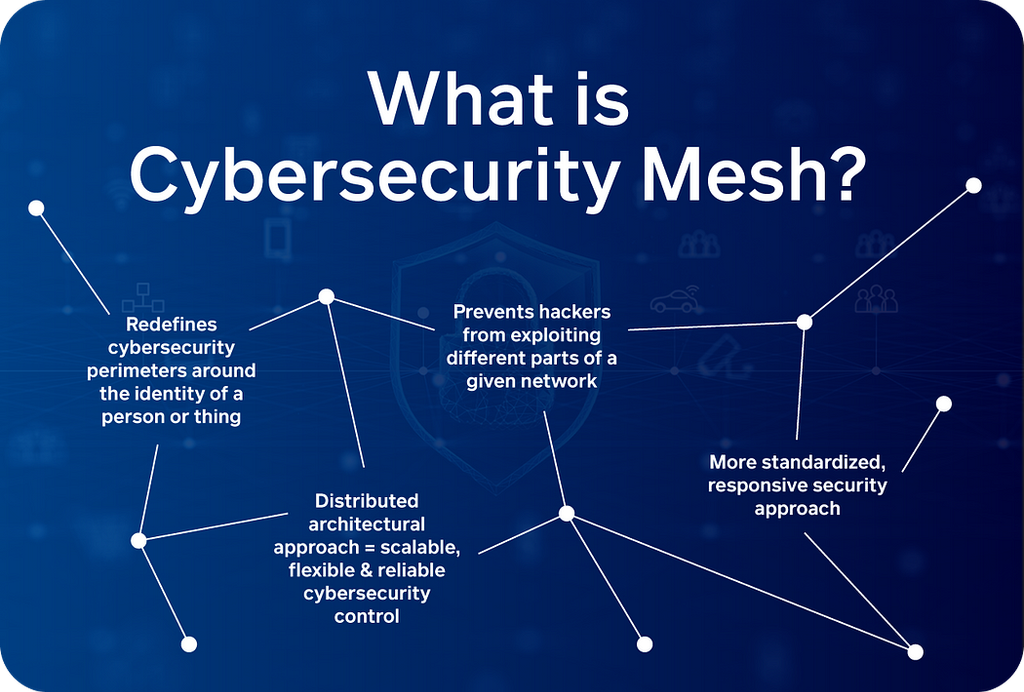
Cybersecurity Mesh Architecture, commonly abbreviated as CSMA, is an approach to security architecture that integrates distributed security controls and technologies around a centralized set of security capabilities.
Instead of assuming that security must be delivered from one physical or logical perimeter, the model recognizes that modern digital environments are distributed.
Security capabilities can exist close to the assets they protect while still participating in a broader security ecosystem.
The architecture generally focuses on areas such as identity, security intelligence and analytics, distributed policy enforcement, and consolidated security visibility.
The underlying idea is straightforward:
Security should be distributed where assets exist but coordinated wherever decisions need to be made.
From Security Perimeter to Security Mesh –
Traditional enterprise security often revolved around a perimeter. Employees entered the corporate network, applications were hosted inside controlled environments, and security systems monitored traffic crossing defined boundaries.
Cloud computing disrupted this model.
Users can connect from personal devices. Applications can communicate across cloud environments. APIs can expose services to external systems. Workloads can dynamically move between infrastructure components.
The security perimeter has therefore become increasingly difficult to define.
Cybersecurity Mesh Architecture takes a different approach. Instead of trying to create one large perimeter, it establishes interconnected security controls that can operate across distributed environments.
This approach aligns naturally with zero-trust security principles, where access decisions are based on identity, context, device posture, resource sensitivity, and other signals rather than simply assuming that something is trustworthy because it is inside a network.
The Core Components of a Cybersecurity Mesh –
A successful cybersecurity mesh is not a single product. It is an architectural approach that connects multiple security capabilities.
Identity is one of the most important components. Identity platforms can provide authentication, authorization, privileged access controls, and contextual information about users and workloads.
Security intelligence and analytics provide another layer. Security information from cloud platforms, endpoints, applications, identities, and networks can be brought together to improve detection and investigation.
Policy management is also critical. Enterprises need consistent security policies across different environments while still allowing individual systems to enforce controls appropriate to their specific context.
Finally, security orchestration and automation can connect detection with response. When multiple systems share information, organizations can potentially respond to incidents faster and with greater context.
Cybersecurity Mesh and Multi-Cloud Security –
One of the strongest use cases for Cybersecurity Mesh Architecture is multi-cloud security.
Consider an enterprise running applications across several cloud providers. Each provider may have its own identity integrations, logging mechanisms, security controls, and configuration systems.
Without an integrated architecture, security teams may need to investigate each environment separately.
With a cybersecurity mesh approach, organizations can establish common security principles while connecting the relevant controls and telemetry across environments.
This does not mean every cloud must be configured identically.
Instead, the goal is to establish consistent security outcomes.
A security policy concerning privileged access, for example, should remain enforceable even when the underlying workload moves between environments.
Cybersecurity Mesh vs. Traditional Security Architecture –
| Area | Traditional Security Architecture | Cybersecurity Mesh Architecture |
|---|---|---|
| Security model | Centralized perimeter | Distributed and interconnected |
| Identity | Often network-oriented | Identity and context-oriented |
| Cloud environments | Separate security controls | Connected security capabilities |
| Visibility | Tool-specific | Cross-environment |
| Policy | Often fragmented | Coordinated across systems |
| Threat detection | Individual security domains | Correlated security signals |
| Response | Manual or tool-specific | Increasingly orchestrated |
| Scalability | Can become complex with expansion | Designed for distributed environments |
The difference is not simply technological. It represents a change in how organizations think about security.
Connecting Identity Across the Enterprise –
Identity is becoming one of the most important links in distributed security.
A user might access a SaaS application, a cloud console, an internal application, and a data platform within the same day. A service account may communicate with several cloud resources. An application may depend on APIs operated by external providers.
The security architecture needs to understand these identities and relationships.
Cybersecurity Mesh Architecture can connect identity systems with other security technologies so that access decisions are informed by broader context.
For example, a privileged login from an unusual location combined with a suspicious device posture and abnormal application behavior may represent a significantly higher risk than any single signal suggests.
Connecting these signals can improve the organization’s ability to detect potentially compromised identities.
Breaking Down Security Silos –
Security teams often acquire specialized tools because different threats require different capabilities.
Endpoint security protects devices. Cloud security monitors cloud resources. Identity security protects access. Application security focuses on software. Data security protects sensitive information.
The problem arises when these tools operate as isolated islands.
A cybersecurity mesh aims to connect them.
This can improve security operations by providing a more complete picture of an incident. Instead of investigating an alert in isolation, analysts can potentially see related identity activity, endpoint behavior, cloud changes, application events, and network activity.
The result is greater context.
The Role of APIs and Integration –
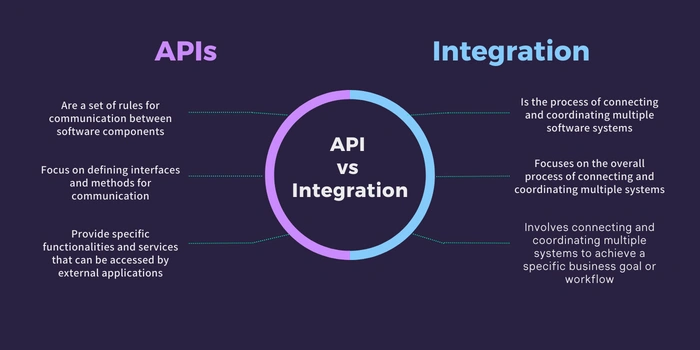
Technology integration is fundamental to cybersecurity mesh.
Modern security architectures depend heavily on APIs, connectors, identity standards, event pipelines, and shared data models.
Without integration, an organization may have dozens of security tools but still lack a unified view of risk.
APIs can allow security platforms to exchange information and trigger actions. For example, a security platform could identify a compromised identity and communicate with an identity system to restrict access while simultaneously notifying security operations teams.
The architecture therefore depends not only on having good security products but also on making those products capable of working together.
AI Can Strengthen the Security Mesh –
Artificial intelligence can add another layer to cybersecurity mesh architectures by helping security teams analyze large volumes of distributed security data.
Modern enterprises can generate enormous amounts of telemetry. Security analysts cannot manually inspect every event.
AI-assisted systems can help identify unusual behavior, correlate related signals, summarize incidents, and prioritize alerts.
For example, several seemingly low-risk events occurring across different systems might collectively indicate a coordinated attack. AI can potentially help identify relationships that are difficult to detect when security information is reviewed separately.
However, AI should complement security controls rather than become a replacement for them.
Poor-quality data, incorrect assumptions, and excessive automation can introduce new risks. Human oversight remains important for high-impact security decisions.
The Importance of Data Security –
Multi-cloud environments also create significant data security challenges.
Sensitive information can move between applications, databases, cloud services, analytics platforms, and backup environments. Security teams need to understand not only where data is stored but also how it is accessed and transferred.
A cybersecurity mesh can help connect data security controls with identity, application, cloud, and endpoint information.
This allows organizations to create more contextual security decisions.
For example, access to sensitive data may be permitted under normal circumstances but restricted when the request originates from an unmanaged device or when unusual behavior indicates potential account compromise.
Cybersecurity Mesh and Zero Trust –
Cybersecurity Mesh Architecture complements zero-trust security because both approaches recognize that traditional network boundaries are insufficient for modern enterprises.
Zero trust focuses on continuously evaluating access based on identity, context, and risk.
Cybersecurity mesh focuses on connecting security capabilities across distributed environments.
Together, they can provide a more adaptable security architecture.
Identity systems provide user and workload context. Endpoint systems provide device information. Cloud platforms provide infrastructure context. Security analytics correlate signals. Policy engines determine appropriate actions.
The mesh connects these capabilities so that security decisions can become more context-aware.
Challenges of Implementing Cybersecurity Mesh Architecture –
Despite its potential benefits, implementing cybersecurity mesh is not simply a matter of purchasing another security platform.
The first challenge is complexity.
Large enterprises may already have hundreds of security technologies, many with overlapping capabilities. Integrating them requires careful architecture and governance.
The second challenge is data consistency. Security systems may use different formats, terminology, and event structures. Creating meaningful correlation requires normalization and strong data management.
The third challenge is organizational.
Security responsibilities are often divided among infrastructure, cloud, identity, networking, application, compliance, and security operations teams. A mesh architecture requires these groups to work toward shared security outcomes.
Finally, organizations must manage automation carefully. Automated actions can improve response time, but poorly configured automation can create operational disruption.
How Enterprises Can Start Building a Cybersecurity Mesh –
Organizations do not need to replace their entire security environment to begin adopting the cybersecurity mesh model.
The first step is to map the existing security architecture. Identify major security tools, data sources, identity systems, cloud environments, and policy engines.
Next, identify the biggest visibility gaps.
Where can security teams not currently see activity?
Which systems cannot exchange security information?
Where are access policies inconsistent?
Which security processes remain heavily manual?
Once these gaps are identified, organizations can prioritize integration projects.
Identity is often a strong starting point because it connects users, applications, workloads, and access decisions across multiple environments.
From there, enterprises can integrate security analytics, cloud controls, endpoint systems, application security, and automated response capabilities.
Measuring the Success of a Security Mesh –
Security architecture should ultimately be measured by outcomes rather than the number of integrated tools.
Organizations should track metrics such as:
- Time to detect security incidents
- Time to investigate incidents
- Time to respond
- Number of unresolved security blind spots
- Percentage of critical assets covered by security controls
- Identity-related security incidents
- Policy consistency across cloud environments
- Number of manually investigated alerts
- Security control integration coverage
These metrics can help determine whether the architecture is actually reducing risk.
The Future of Enterprise Security Is Connected –
The modern enterprise is distributed, and security must become distributed as well.
Cloud adoption, remote work, SaaS applications, APIs, edge computing, connected devices, and AI-powered applications are creating environments where traditional security boundaries are increasingly difficult to maintain.
Cybersecurity Mesh Architecture provides a framework for responding to this complexity.
Its value is not simply that it connects security products. Its larger purpose is to create a security architecture where identity, intelligence, policy, and enforcement can operate together across fragmented environments.
The goal is not to create one enormous security system.
It is to create a connected security ecosystem.
Conclusion –
Cybersecurity Mesh Architecture represents an important shift in enterprise security thinking.
As organizations operate across multiple clouds, applications, endpoints, identities, and data environments, centralized security models can struggle to provide sufficient visibility and consistency. A cybersecurity mesh enables organizations to distribute security controls while connecting them through shared intelligence, policies, and identity context.
The journey will not be simple. Enterprises must address integration complexity, legacy systems, data consistency, governance, and automation risks.
But the direction is becoming increasingly clear.
Security can no longer depend on a single perimeter or a collection of disconnected tools.
The future of enterprise security is interconnected, contextual, distributed, and increasingly intelligent.
Organizations that build this connected foundation will be better positioned to protect their digital environments as multi-cloud architectures continue to expand.
FAQ –
Cybersecurity Mesh Architecture is a security approach that connects distributed security controls and technologies across an organization’s digital environment. It is designed to improve visibility, policy consistency, identity management, threat detection, and security response across distributed systems.
Multi-cloud enterprises often have different security controls, identities, logs, and policies across cloud environments. Cybersecurity mesh helps connect these capabilities so security teams can achieve greater visibility and more consistent security outcomes.
No. They are related but different concepts. Zero trust focuses on continuously verifying access and minimizing implicit trust, while cybersecurity mesh focuses on integrating security capabilities across distributed environments. The two approaches can complement each other.
Identity is a central component because users, applications, workloads, and machines increasingly access resources across different environments. Connecting identity information with other security signals can improve contextual access decisions and threat detection.
Yes. AI can help analyze distributed security telemetry, correlate events, prioritize alerts, summarize incidents, and identify potentially suspicious patterns. However, organizations should maintain appropriate human oversight for important security decisions.