


Introduction –
The ATS vs. AI Candidate Problem is becoming one of the most important questions in modern recruitment. Applicant Tracking Systems (ATS) were introduced to help recruiters manage growing volumes of applications, organize candidate information, automate administrative work, and create more structured hiring workflows. Today, however, recruitment teams are facing a new reality: candidates are increasingly using AI to write resumes, tailor applications, prepare for interviews, and communicate with employers.
This creates an unusual technology race. Employers use AI and ATS platforms to process candidates faster, while candidates use AI to optimize themselves for those same systems. The result is a hiring environment where both sides are increasingly assisted by algorithms.
The question is no longer whether technology can make hiring more efficient. The bigger question is whether ATS vs. AI Candidate dynamics could make recruitment less human — and whether companies can redesign hiring technology without losing the human judgment that makes good hiring possible.
The ATS Was Designed for a Different Hiring World –
Applicant Tracking Systems solved a real problem. As organizations began receiving hundreds or thousands of applications for certain roles, recruiters needed a way to organize resumes, track candidates, schedule interviews, manage communication, and maintain hiring records.
The ATS became a central operating system for recruitment.
Keyword matching and structured candidate information also made it easier for recruiters to narrow large applicant pools. A recruiter could search for skills, job titles, certifications, years of experience, locations, or other criteria and identify candidates who appeared relevant.
But the hiring environment has changed significantly since many of these processes were designed.
Candidates now understand that resumes may be scanned electronically before a recruiter reviews them. They know certain keywords can improve discoverability. They can use AI tools to rewrite professional summaries, match job descriptions, identify missing keywords, and generate customized applications.
The system has therefore become increasingly visible to the people being evaluated by it.
Candidates Are Learning to Optimize for the Algorithm –
The modern candidate is no longer simply submitting a resume.
AI can help candidates analyze a job description, identify important skills, rewrite experience statements, create multiple versions of a resume, generate cover letters, prepare interview questions, and even simulate conversations.
This can be beneficial. A qualified candidate who struggles with resume writing can communicate their experience more effectively. Someone changing careers can better translate transferable skills into language recruiters understand. Candidates who are unfamiliar with applicant tracking systems can create more structured applications.
But there is also a downside.
When candidates optimize too aggressively for automated screening, resumes can start to look remarkably similar. Generic AI-generated language can replace authentic descriptions of experience. Candidates may prioritize keywords over context, creating documents that are technically optimized but difficult for humans to evaluate.
The hiring process can become a contest between two optimization systems rather than a conversation between an employer and a person.
The ATS vs. AI Candidate Problem Creates a Feedback Loop –
This is where the ATS vs. AI Candidate Problem becomes particularly interesting.
Recruiters use automation to process applications.
Candidates use AI to optimize applications.
Employers respond by improving automated screening.
Candidates respond by improving their AI-generated applications.
The cycle continues.
Over time, both sides become better at optimizing for the system itself.
The problem is that optimization does not necessarily equal better hiring.
An ATS may identify a resume containing the right terminology. An AI system may generate a highly polished resume containing those terms. But neither automatically proves that the candidate can perform the job effectively.
The technology can become extremely good at recognizing signals without necessarily determining whether those signals represent genuine capability.
When Every Resume Starts Looking Perfect –
One of the emerging problems with AI-assisted applications is the disappearance of obvious weaknesses.
Traditional resumes often contain imperfect writing, inconsistent formatting, vague descriptions, or other clues about the candidate’s communication style. Those weaknesses are not necessarily indicators of poor job performance, but they can provide a degree of individuality.
AI can remove many of them instantly.
Candidates can produce polished resumes with strong verbs, measurable achievements, concise summaries, and terminology closely aligned with job descriptions.
This creates a paradox.
The better AI becomes at improving resumes, the less useful the resume may become as a differentiator.
If thousands of candidates submit highly optimized documents, recruiters may need additional methods to distinguish genuine capability from effective application optimization.
The Resume May Become Less Important –
The future of hiring may therefore involve less dependence on the traditional resume.
Instead of asking only, “Does this candidate’s resume match the job description?” organizations may increasingly ask:
- Can this person demonstrate the required skills?
- Can they solve a realistic problem?
- Can they explain their decisions?
- Have they delivered similar outcomes before?
- Can references or work samples validate their claims?
- How do they collaborate?
- Can they learn and adapt?
This moves hiring toward evidence-based assessment.
A resume can still provide useful context, but it becomes one signal among many rather than the entire representation of a candidate.
Technology Can Make Hiring Less Human — If Used Incorrectly
Technology itself is not necessarily making hiring less human.
Poorly designed processes are.
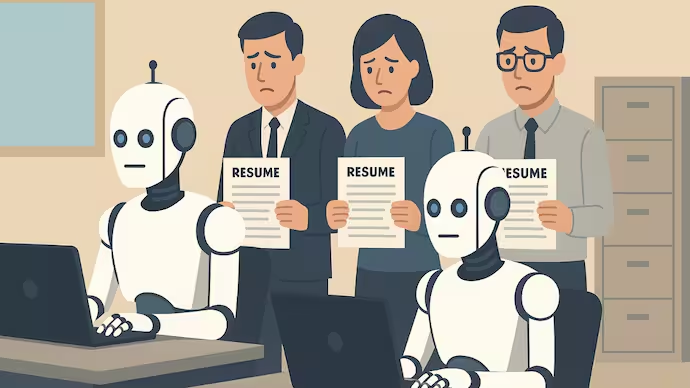
Automation becomes problematic when organizations treat candidates as data records rather than people. If an applicant is rejected without meaningful evaluation because a keyword was missing, the organization may lose a potentially strong candidate.
Similarly, if AI-generated candidate summaries become more important than direct interaction with candidates, recruiters may gradually outsource judgment to systems that cannot fully understand organizational context.
The goal should not be to eliminate technology from hiring.
The goal should be to use technology for administrative efficiency while preserving human judgment where judgment matters most.
Where AI Can Actually Make Hiring More Human –
There is another side to the debate.
AI can potentially make hiring more human by removing repetitive administrative work.
Recruiters spend significant time reviewing applications, scheduling interviews, writing routine communication, updating records, preparing interview materials, and coordinating stakeholders. Automating some of these tasks can create more time for conversations with candidates and hiring managers.
AI can also help recruiters identify potentially overlooked candidates.
For example, an automated system could identify transferable skills that a simple keyword search might miss. Someone with a different job title may have performed nearly identical responsibilities. Someone coming from another industry may possess highly relevant skills that are expressed using different terminology.
Used correctly, technology can expand human judgment rather than replace it.
The Real Problem Is Over-Automation –
The distinction between useful automation and harmful automation is critical.
| Hiring Approach | Technology’s Role | Human Role | Main Risk |
|---|---|---|---|
| Traditional hiring | Administrative support | High | Slow and inconsistent processes |
| ATS-driven hiring | Screening and workflow automation | Moderate | Over-reliance on keywords |
| AI-assisted hiring | Candidate analysis and recommendations | Shared | Algorithmic bias and overconfidence |
| Evidence-based hiring | Skills and evidence evaluation | High-value judgment | Requires better assessment design |
| Human-centered AI hiring | Automation + decision support | Final judgment and relationship building | Poor implementation can still create automation bias |
The objective should be to move toward the final model rather than simply adding more AI to the existing ATS workflow.
AI Should Help Recruiters Ask Better Questions –
One of the strongest applications of AI in recruitment may not be deciding who gets hired.
It may be helping recruiters determine what they need to know before making the decision.
Imagine an AI system identifying that a candidate has strong experience in the technical requirements but limited evidence of managing large-scale projects. Instead of automatically rejecting the candidate, the system could recommend a targeted interview question or assessment.
That changes the role of AI.
Rather than saying, “Reject this candidate,” the technology says, “Here is an uncertainty worth investigating.”
That is a much healthier model for human-centered hiring.
Candidates Need Transparency Too –
Technology-driven hiring also creates an important responsibility for employers: transparency.
Candidates increasingly want to know how their applications are evaluated. If automated systems are involved in screening, ranking, assessment, or communication, organizations need to think carefully about how much information candidates should receive about those processes.
Transparency does not necessarily mean revealing proprietary algorithms.
It means communicating clearly about the hiring process, what skills matter, how candidates will be assessed, and where technology is being used.
This can make the process feel more predictable and respectful.
AI Detection Is Not the Same as Candidate Evaluation –
As AI-generated applications become common, employers may be tempted to introduce AI-content detection as another screening layer.
That approach comes with significant risks.
A candidate using AI to improve grammar or structure is not necessarily misrepresenting their qualifications. Likewise, detecting AI-generated language does not prove that a candidate lacks the skills required for a job.
The more useful question is not:
“Did AI help create this application?”
It is:
“Does the candidate possess the capabilities represented in this application?”
That distinction will become increasingly important as AI assistance becomes a normal part of professional communication.
Skills-Based Hiring Could Break the Cycle –
Skills-based hiring offers a potential way out of the ATS vs. AI Candidate problem.
Instead of relying heavily on resumes and job titles, employers can evaluate candidates against clearly defined capabilities. Candidates can demonstrate those capabilities through assessments, portfolios, work samples, structured interviews, simulations, and previous outcomes.
This makes the hiring process harder to game through simple keyword optimization.
It also benefits candidates who have nontraditional backgrounds.
Someone may not have the exact job title listed in a vacancy but could still possess the required skills. A good assessment system can discover that.
The Human Interview Becomes More Valuable –
Ironically, as AI makes applications more standardized, human conversations may become more valuable.
A thoughtful interview can explore motivation, judgment, communication, problem-solving, adaptability, and collaboration. Recruiters can ask follow-up questions based on a candidate’s answers rather than simply checking boxes.
The challenge is ensuring that interviews are structured enough to reduce arbitrary decision-making.
Human-centered hiring does not mean returning to completely subjective recruitment.
It means combining structured processes with human interaction.
Recruiters Will Become Decision Designers –
The role of recruiters is likely to evolve.
Recruiters will increasingly need to understand how ATS platforms, AI systems, assessments, job descriptions, candidate data, and human decision-making interact.
Their value will not simply come from manually reading resumes faster.
It will come from designing better hiring systems.
A recruiter may need to determine which parts of the process should be automated, where human review is essential, which signals actually predict performance, and how candidates can be evaluated consistently.
This makes recruitment increasingly similar to an operational discipline involving data, technology, psychology, and communication.
Companies Need to Redesign the Candidate Journey –
Organizations should evaluate their hiring process from the candidate’s perspective.
How many automated messages does a candidate receive?
How many stages are required before speaking to a person?
Can candidates understand why they are being assessed?
Are applications evaluated consistently?
Does the company provide opportunities to demonstrate skills that a resume cannot communicate?
Most importantly, does the candidate feel like they are interacting with an organization or submitting information into a machine?
The answer to that final question may become an important differentiator in competitive hiring markets.
The Future Is Not ATS vs. Humans –
The future of recruitment should not be framed as technology versus people.
It should be about determining where technology is better and where humans are better.
Machines are excellent at organizing information, identifying patterns, automating repetitive tasks, and supporting structured workflows. Humans remain essential for contextual judgment, empathy, relationship building, nuanced evaluation, and understanding organizational culture.
The best hiring systems will combine both.
The ATS can organize the journey.
AI can surface useful signals.
Assessments can provide evidence.
Recruiters can investigate uncertainty.
Hiring managers can evaluate role-specific capability.
And candidates can have meaningful opportunities to demonstrate who they are beyond a collection of keywords.
How Companies Can Make AI-Assisted Hiring More Human
Organizations should begin by auditing where automation currently influences hiring decisions. Not every automated step needs to be removed, but every high-impact decision should have a clear rationale and appropriate human oversight.
Companies should also separate screening from decision-making. Technology can help prioritize applications or identify relevant experience, but final decisions should consider multiple sources of evidence.
Job descriptions should focus on genuine requirements rather than inflated lists of keywords. Assessments should test capabilities that actually matter for the role. Interviews should provide candidates with opportunities to explain their thinking and demonstrate relevant experience.
Finally, organizations should continuously evaluate outcomes. If an automated process consistently excludes certain types of qualified candidates, the problem is not solved simply because the system is efficient.
Efficiency is valuable only when it produces better outcomes.
The New Definition of a Human Hiring Process –
A human hiring process does not mean recruiters manually read every resume or avoid automation.
It means technology serves the hiring decision rather than becoming the hiring decision.
The most effective model will likely be one where automation handles repetitive work, AI helps recruiters understand information, assessments generate evidence, and people remain accountable for consequential decisions.
In that model, candidates are not reduced to scores.
Recruiters are not reduced to system operators.
And AI is not treated as an infallible judge.
Instead, each component performs the task it is best suited to perform.
Conclusion –
The ATS vs. AI Candidate Problem reveals something bigger about the future of recruitment: both employers and candidates are becoming increasingly sophisticated users of technology.
Companies use ATS platforms and AI to process candidates.
Candidates use AI to optimize themselves for those systems.
If this cycle continues without redesigning the underlying process, hiring could become increasingly optimized while becoming less informative and less personal.
But the outcome does not have to be negative.
Organizations can use AI to reduce administrative work, uncover transferable skills, improve consistency, and help recruiters focus on higher-value conversations. Candidates can use AI to communicate their experience more effectively without allowing automated optimization to replace authenticity.
The future of hiring should not be about choosing between technology and humanity.
It should be about using technology to create more opportunities for meaningful human judgment.
The best hiring technology should not make candidates look more like data. It should help employers understand the people behind the data.
FAQ –
The ATS vs. AI Candidate Problem describes the growing tension between automated recruitment systems used by employers and AI tools used by candidates. Employers use technology to screen and evaluate applicants, while candidates use AI to optimize resumes, applications, and interview preparation for those systems.
AI-generated resumes can make traditional screening less distinctive because many candidates can produce highly optimized applications. This can reduce the usefulness of superficial signals such as formatting, keywords, and polished summaries and increase the importance of skills assessments and other evidence.
Not necessarily. Using AI to improve grammar, structure, or clarity does not automatically indicate that a candidate lacks the skills represented in the application. Employers should focus on verifying qualifications and capabilities rather than simply determining whether AI was used.
Yes. AI can automate repetitive administrative work, help recruiters identify relevant candidates, summarize information, and suggest useful interview questions. When used as decision support rather than an autonomous decision-maker, it can give recruiters more time for meaningful candidate interactions.
Resumes are unlikely to disappear completely, but their role may change. They may increasingly function as an entry point into a broader evaluation process involving skills assessments, work samples, structured interviews, portfolios, and verified experience.