

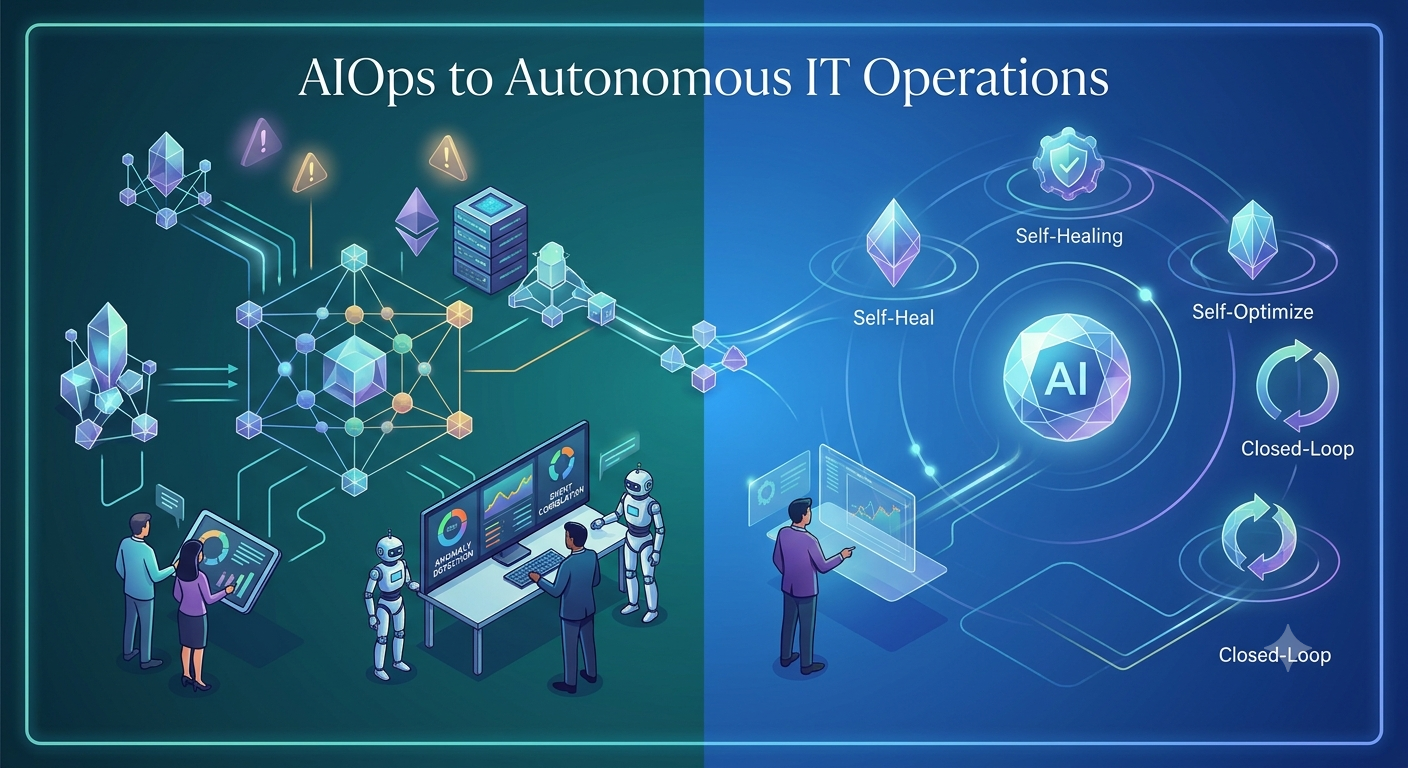

AIOps to autonomous IT operations represents a major shift in how enterprises monitor, manage, and maintain their technology environments. As organizations adopt cloud computing, microservices, distributed applications, hybrid infrastructure, and AI-powered business systems, traditional IT operations are becoming increasingly difficult to manage. IT teams must process enormous volumes of logs, metrics, events, and alerts while maintaining application availability, security, and performance. Manual monitoring and incident response processes are no longer sufficient for the scale and complexity of modern enterprise environments.
Artificial Intelligence for IT Operations (AIOps) addresses this challenge by using machine learning, analytics, and automation to identify anomalies, correlate events, predict potential failures, and accelerate incident resolution. However, the next stage of this evolution goes beyond intelligent monitoring. Autonomous IT operations aim to create systems that can detect problems, understand their context, make decisions, execute corrective actions, and continuously improve with minimal human intervention.
This transition raises an important question: how far can enterprise automation go? Can organizations build IT environments that manage themselves, recover from failures automatically, optimize resources continuously, and prevent incidents before users notice them? While autonomous IT operations are becoming more achievable, reaching full autonomy requires more than advanced AI models. It demands reliable data, integrated infrastructure, strong governance, security controls, and human oversight.
Understanding AIOps and Autonomous IT Operations –
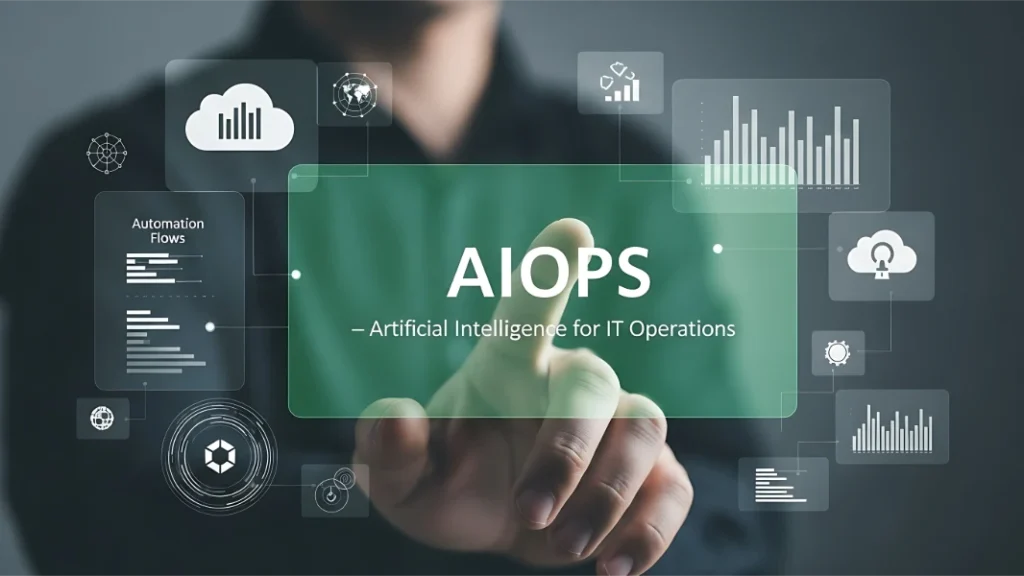
AIOps refers to the application of artificial intelligence and machine learning to IT operations. It helps organizations analyze operational data, identify unusual patterns, reduce alert noise, and automate selected incident management activities.
Traditional IT operations rely heavily on predefined monitoring thresholds and manual troubleshooting. When an application becomes slow or a server experiences high resource utilization, monitoring systems generate alerts. Engineers then investigate logs, examine infrastructure metrics, identify the root cause, and apply a fix.
AIOps improves this process by analyzing information from multiple systems simultaneously. It can identify relationships between events, recognize abnormal behavior, and help IT teams determine which incidents require immediate attention.
Autonomous IT operations take this concept further. Instead of simply recommending actions or triggering predefined scripts, autonomous systems can evaluate operational conditions, select appropriate responses, execute approved actions, and verify whether the issue has been resolved.
For example, an AIOps platform may detect that a cloud application is experiencing increasing latency because of resource constraints. It can correlate infrastructure metrics with application logs and identify a likely cause. An autonomous operations system may then increase capacity, restart an unhealthy service, or adjust traffic distribution within predefined operational boundaries.
The difference is the level of decision-making and execution. AIOps primarily enhances operational intelligence, while autonomous IT operations combine intelligence with controlled action.
The Evolution From Traditional IT Operations to Autonomous Operations –
Enterprise IT operations have evolved through several stages as infrastructure complexity and automation capabilities have increased.
1. Traditional IT Operations: Manual Monitoring and Incident Response –
Traditional IT operations depend on monitoring tools, operational dashboards, predefined thresholds, and human-led troubleshooting.
Engineers receive alerts when infrastructure or applications experience performance issues. They investigate the problem, identify dependencies, and execute corrective actions manually or through basic scripts.
Although this approach works for relatively simple environments, it becomes difficult to scale when organizations operate hundreds of applications across multiple cloud platforms and data centers.
2. Automated IT Operations: Rule-Based Workflows –
The next stage introduces scripts, automation tools, and predefined workflows to handle repetitive operational activities.
For example, a system may automatically restart a service when it becomes unresponsive or scale an application when CPU utilization crosses a defined threshold.
These workflows reduce manual effort, but they depend heavily on predefined conditions. They may not respond effectively to unexpected situations or complex incidents involving multiple systems.
3. AIOps: Intelligent Monitoring and Predictive Insights –
AIOps introduces machine learning and advanced analytics into IT operations.
Instead of simply detecting threshold violations, AIOps platforms analyze historical and real-time operational data to identify anomalies, correlate related alerts, and predict potential failures.
This helps IT teams move from reactive monitoring toward proactive incident management.
4. Autonomous IT Operations: Intelligent Decision-Making and Execution –
Autonomous operations combine AI-driven analysis, automated workflows, policy controls, and continuous feedback.
The system can detect an operational issue, investigate possible causes, select an approved response, execute corrective actions, and evaluate the outcome.
Human engineers remain responsible for governance, exception handling, architecture decisions, and high-impact operational changes.
The objective is not to eliminate IT teams but to reduce repetitive operational work and allow engineers to focus on reliability, security, innovation, and strategic infrastructure improvements.
Core Technologies Powering Autonomous IT Operations –
Autonomous IT operations require multiple technologies working together. No single AI model or automation platform can independently manage an entire enterprise technology environment.
1. Artificial Intelligence and Machine Learning –
AI and machine learning provide the analytical foundation for intelligent IT operations.
These technologies analyze historical and real-time operational data to identify patterns, detect anomalies, and estimate the likelihood of future incidents.
For example, machine learning models can recognize unusual memory consumption patterns that may indicate a memory leak before an application becomes unavailable.
Common analytical approaches include anomaly detection, classification, clustering, time-series forecasting, and predictive modeling.
2. Observability and Telemetry –
Modern enterprise applications generate operational information across infrastructure, applications, networks, databases, containers, and cloud services.
Observability platforms collect and analyze three important categories of telemetry:
- Metrics: Numerical measurements such as CPU utilization, memory consumption, request latency, and network throughput.
- Logs: Detailed records of application events, system activities, errors, and transactions.
- Traces: Information showing how requests move across distributed services and application dependencies.
Combining these data sources gives AIOps platforms a more complete understanding of system behavior.
For example, an application latency problem may appear to originate in one service, while distributed traces reveal that the actual bottleneck is a downstream database dependency.
3. Event Correlation and Root Cause Analysis –
Large enterprise environments can generate thousands of monitoring alerts during a single incident.
Many alerts may represent symptoms of the same underlying problem. Without event correlation, engineers may waste time investigating each alert separately.
AIOps platforms use statistical analysis, machine learning, dependency mapping, and topology information to group related events.
This helps identify the likely root cause and distinguish major incidents from secondary symptoms.
4. Intelligent Automation and Orchestration –
Automation platforms execute operational workflows across infrastructure and applications.
They can perform tasks such as restarting services, scaling workloads, provisioning resources, updating configurations, and executing recovery procedures.
Orchestration connects these activities across multiple systems so that complex workflows can be completed in a coordinated manner.
For example, resolving a failed application deployment may involve rolling back a release, restoring a previous configuration, validating service health, and notifying the appropriate engineering team.
5. Generative AI and AI Agents –
Generative AI is expanding how engineers interact with operational systems.
AI copilots can summarize incidents, explain error messages, generate troubleshooting recommendations, and help engineers understand complex infrastructure relationships.
AI agents can potentially perform multi-step operational tasks by interacting with monitoring systems, configuration tools, ticketing platforms, and approved automation workflows.
For example, an operations agent could investigate an alert, retrieve relevant logs, review recent deployments, identify a likely cause, and propose an approved remediation plan.
However, access to production infrastructure must be carefully controlled. An agent should not receive unrestricted authority to execute high-impact commands simply because it can generate technically valid instructions.
6. Policy Engines and Governance Controls –
Autonomous operations require clearly defined boundaries.
Policy engines help determine which actions can be performed automatically, which require approval, and which must always be handled by authorized personnel.
For example, automatically restarting a non-critical service may be acceptable, while changing production network access rules or deleting infrastructure resources may require human approval.
Governance controls help ensure that automation remains aligned with business requirements, security policies, and operational risk tolerance.
AIOps vs. Autonomous IT Operations: Understanding the Difference –
Although AIOps and autonomous IT operations are closely related, they differ in their capabilities and level of operational independence.
| Comparison Area | Traditional IT Operations | AIOps | Autonomous IT Operations |
|---|---|---|---|
| Monitoring | Threshold-based monitoring | AI-assisted monitoring | Continuous context-aware monitoring |
| Incident Detection | Manual or rule-based alerts | Anomaly detection and event correlation | Continuous detection with contextual analysis |
| Root Cause Analysis | Engineer-led investigation | AI-assisted diagnosis | Automated investigation within defined boundaries |
| Decision-Making | Human-driven | Recommendations and predefined automation | AI-driven decisions under approved policies |
| Remediation | Mostly manual | Script-based or partially automated | Automated execution and verification |
| Predictive Capabilities | Limited | Predictive analytics | Predictive and adaptive operational responses |
| Human Involvement | High | Moderate to high | Risk-based oversight and exception handling |
The progression is not always linear. Many organizations operate a combination of traditional monitoring, rule-based automation, and AIOps capabilities. Full autonomy is not necessary or appropriate for every operational activity.
How Autonomous IT Operations Work in an Enterprise Environment –
Autonomous IT operations follow a continuous cycle of observation, analysis, decision-making, execution, and verification.
A typical workflow involves the following stages.
Step 1: Continuous Monitoring –
The system collects telemetry from applications, servers, databases, containers, networks, cloud platforms, and security tools.
This information provides visibility into the current state of the IT environment.
Step 2: Anomaly Detection –
Machine learning models analyze operational patterns and identify behavior that differs from expected baselines.
For example, the system may detect an unusual increase in database query latency or unexpected network traffic.
Step 3: Contextual Investigation –
The platform correlates the anomaly with related logs, traces, infrastructure events, recent deployments, and service dependencies.
This helps identify possible causes rather than treating each alert as an isolated problem.
Step 4: Decision and Policy Evaluation –
The system evaluates possible remediation actions against predefined policies, operational limits, and business impact.
If the proposed action falls within an approved automation boundary, it may proceed automatically. Otherwise, the system requests human approval or escalates the incident.
Step 5: Automated Remediation –
The automation platform executes the selected response.
Depending on the issue, this could involve restarting a service, scaling infrastructure, rolling back a deployment, shifting traffic, or applying an approved configuration change.
Step 6: Verification and Learning –
The system checks whether the action resolved the original problem without creating additional issues.
The results are recorded for operational analysis and future improvement. Failed or uncertain remediation attempts should trigger escalation rather than repeated uncontrolled actions.
This creates a feedback loop in which operational systems become more effective at detecting and responding to recurring issues.
Enterprise Use Cases of Autonomous IT Operations –
Autonomous operations can support multiple enterprise IT functions. Their practical value depends on the complexity of the environment, the reliability of available data, and the organization’s automation maturity.
1. Automated Incident Detection and Resolution –
Incident management is one of the most valuable applications of AIOps.
Traditional monitoring systems can generate large numbers of alerts, many of which are related to the same underlying issue.
AIOps platforms can correlate these alerts, identify probable root causes, and prioritize incidents based on operational impact.
Autonomous systems can then execute approved remediation workflows.
For example, if an application instance becomes unhealthy, the system may remove it from the traffic pool, replace the instance, and verify whether the application has recovered.
This can reduce manual intervention and improve service availability.
2. Predictive Infrastructure Maintenance –
Unexpected infrastructure failures can disrupt business operations and increase recovery costs.
Machine learning models can analyze historical performance patterns, hardware telemetry, storage behavior, and system events to identify potential failure indicators.
For example, unusual disk error patterns or steadily increasing resource consumption may indicate an emerging infrastructure problem.
Predictive insights can help operations teams schedule maintenance, replace components, or redistribute workloads before failures affect critical services.
Predictions should be treated as risk indicators rather than guaranteed forecasts.
3. Intelligent Cloud Resource Optimization –
Cloud environments can experience fluctuating workloads, making resource allocation difficult.
Autonomous operations platforms can analyze usage patterns and adjust infrastructure capacity according to approved policies.
For example, an application may automatically scale out during periods of high traffic and scale down when demand decreases.
More advanced systems can evaluate workload placement, instance sizing, and resource utilization to identify cost optimization opportunities.
This creates opportunities to improve infrastructure efficiency while maintaining application performance.
4. Automated Network Operations –
Enterprise networks support communication across data centers, cloud environments, branch offices, and remote users.
Network issues can affect application availability and user experience across multiple locations.
AIOps can analyze network telemetry, detect abnormal traffic patterns, identify congestion, and correlate connectivity issues with application performance.
Autonomous network operations can execute approved actions such as rerouting traffic, adjusting configurations, or triggering recovery workflows.
However, changes to routing, access policies, and network segmentation require strict validation because incorrect automation can create widespread connectivity or security problems.
5. Self-Healing Application Environments –
Modern applications often consist of distributed services running across containers, Kubernetes clusters, and cloud infrastructure.
Failures in one component can affect multiple dependent services.
Self-healing systems use monitoring and automation to restore expected operating conditions.
For example, Kubernetes can restart failed containers and maintain desired workload replicas based on configured health checks and controllers.
AIOps can complement these capabilities by providing broader operational context, detecting complex patterns, and coordinating remediation across multiple systems.
The combination of platform-native recovery and intelligent orchestration can reduce the need for manual intervention in recurring incidents.
6. Automated Security Operations –
Security operations teams process large volumes of alerts from endpoint protection, identity systems, firewalls, cloud security platforms, and threat detection tools.
AI-powered security operations can correlate signals, identify suspicious behavior, and prioritize incidents.
Automation can support approved response activities such as isolating a compromised endpoint, disabling a suspicious session, or creating an incident ticket.
However, security automation must be carefully governed. Incorrectly blocking legitimate users or changing critical access controls can disrupt business operations.
High-impact actions should follow established approval and escalation procedures.
7. Automated Configuration and Compliance Management –
Enterprise infrastructure must maintain consistent configurations across applications, servers, cloud resources, and network environments.
Configuration drift can create reliability, security, and compliance problems.
Automation platforms can compare actual system configurations against approved baselines and identify deviations.
Where permitted, they can restore approved configurations, generate compliance evidence, and notify administrators about unresolved exceptions.
This reduces repetitive configuration checks and improves operational consistency.
Benefits of Moving From AIOps to Autonomous IT Operations –
The transition toward autonomous operations can deliver important business and operational benefits.
1. Faster Incident Resolution –
Automated event correlation and remediation can reduce the time required to identify and resolve recurring operational issues.
This can improve mean time to detect (MTTD) and mean time to repair (MTTR), depending on the maturity and effectiveness of the implementation.
2. Reduced Operational Workload –
IT engineers spend significant time handling repetitive tasks such as reviewing alerts, restarting services, collecting logs, and executing standard recovery procedures.
Automation can take over suitable activities, allowing engineering teams to focus on architecture, reliability improvements, and strategic projects.
3. Improved Service Availability
Proactive anomaly detection and automated recovery can reduce the duration of certain incidents.
Self-healing capabilities can help restore services quickly when failures match known and approved recovery patterns.
4. Better Infrastructure Utilization –
Intelligent resource optimization can help organizations allocate compute, storage, and network capacity according to actual workload requirements.
This can reduce unnecessary resource consumption and improve cloud cost management.
5. More Consistent Operational Processes –
Automated workflows execute approved procedures consistently.
This reduces variations caused by manual execution and helps organizations standardize incident response and infrastructure maintenance.
6. Improved Operational Visibility –
AIOps platforms can consolidate information from multiple monitoring and observability tools.
This helps teams understand service dependencies, identify recurring issues, and gain a more complete view of enterprise infrastructure health.
Challenges and Risks of Autonomous IT Operations –
Although autonomous operations offer significant potential, they introduce technical, organizational, and security challenges.
1. Poor Data Quality and Fragmented Observability –
AI systems depend on reliable operational data. Incomplete telemetry, inconsistent event formats, missing service relationships, and disconnected monitoring tools can lead to incorrect conclusions.
Organizations should establish consistent telemetry standards and improve integration across operational systems before introducing advanced automation.
2. Over-Automation and Unintended Consequences –
An autonomous system may execute an action that resolves one problem but creates another.
For example, repeatedly restarting an application may temporarily restore availability while hiding an underlying database or memory problem.
Organizations should establish action boundaries, testing requirements, rollback procedures, and verification mechanisms.
3. Limited Explainability –
Complex AI systems may recommend actions without clearly explaining why a particular decision was made.
This can reduce trust among operations teams, especially when recommendations affect production environments.
Explainability, audit trails, and decision documentation should be part of the architecture.
4. Security Risks From Excessive Automation Permissions –
Autonomous systems require access to infrastructure and operational tools.
If these systems receive excessive permissions, a compromised agent or incorrectly executed workflow could affect critical business services.
Organizations should apply least-privilege access, short-lived credentials, approval workflows, secret management, and continuous monitoring.
5. Integration Complexity –
Enterprise IT environments often contain legacy applications, multiple cloud providers, custom infrastructure, and disconnected management platforms.
Integrating these systems into a unified automation framework can require significant engineering effort.
Organizations should begin with high-value use cases and gradually expand automation across their environments.
6. Organizational Resistance and Skills Gaps –
IT teams may be concerned that autonomous systems will reduce the need for operational roles or create additional risks.
Successful adoption requires employee training, clear responsibility models, and communication about how automation will support engineering work.
The objective should be to improve operational effectiveness rather than remove human accountability.
How Enterprises Can Implement Autonomous IT Operations –
Organizations should not attempt to automate their entire IT environment immediately. A phased approach allows teams to establish reliable foundations and expand automation gradually.
Phase 1: Assess IT Operations Maturity
Start by reviewing existing monitoring systems, incident management processes, infrastructure automation, service dependencies, and operational data quality.
Identify repetitive tasks and recurring incidents that consume significant engineering time.
These activities provide a foundation for selecting suitable AIOps use cases.
Phase 2: Establish Unified Observability
Integrate relevant logs, metrics, traces, events, and infrastructure information.
Create consistent service mappings and ensure that operational data can be correlated across applications and infrastructure.
Without reliable observability, advanced automation may operate with incomplete context.
Phase 3: Introduce AIOps Capabilities
Begin with anomaly detection, alert correlation, incident prioritization, and root cause analysis.
Measure whether these capabilities reduce alert noise and improve incident investigation.
Allow engineers to review recommendations before connecting the platform to production remediation workflows.
Phase 4: Automate Low-Risk Operational Tasks
Introduce automation for predictable activities such as restarting non-critical services, clearing temporary files, scaling approved workloads, and executing standard diagnostic procedures.
Each workflow should include validation, logging, and rollback or recovery mechanisms where appropriate.
Phase 5: Introduce Policy-Based Autonomous Actions
Once automated workflows demonstrate consistent performance, allow the system to execute selected actions without manual approval.
Define clear thresholds, access restrictions, business impact limits, and escalation requirements.
Actions affecting critical applications, customer data, identity controls, or production network architecture should receive stronger governance.
Phase 6: Measure Outcomes and Expand Gradually
Track operational metrics such as MTTR, incident recurrence, change failure rate, service availability, automation success rate, and infrastructure cost.
Use the results to improve workflows and identify additional opportunities for autonomy.
Automation should expand only when the organization can demonstrate that it operates reliably and safely.
Measuring the Success of Autonomous IT Operations
Enterprise automation should be measured through operational outcomes rather than the number of automated workflows deployed.
Important metrics include:
- Mean Time to Detect (MTTD): Measures how long it takes to identify an operational incident.
- Mean Time to Repair (MTTR): Measures the average time required to restore normal service.
- Mean Time Between Failures (MTBF): Measures the average operating time between system failures.
- Service Availability: Tracks the percentage of time a service remains operational.
- Change Failure Rate: Measures the percentage of infrastructure or application changes that result in incidents or require remediation.
- Automation Success Rate: Tracks how frequently automated workflows complete successfully.
- Incident Recurrence Rate: Measures how often previously resolved problems return.
- Alert Noise Reduction: Evaluates whether event correlation reduces duplicate or low-value alerts.
- Infrastructure Cost Efficiency: Measures whether automation improves resource utilization and operating costs.
- Human Escalation Rate: Tracks how frequently autonomous workflows require engineer intervention.
These metrics should be evaluated together. A high automation success rate is not sufficient if automated changes increase service incidents or create additional operational risk.
How Far Can Enterprise Automation Go?
The future of enterprise IT operations is likely to involve increasingly autonomous systems capable of managing more complex workflows.
However, full autonomy across every enterprise technology function is unlikely to be appropriate in the foreseeable future.
Some activities are suitable for extensive automation because they follow predictable patterns and have clearly defined recovery procedures. Examples include restarting failed services, scaling workloads, rotating approved credentials, and executing standard backup verification workflows.
Other activities require human judgment because they involve uncertain business impact, regulatory obligations, security implications, or complex architectural trade-offs.
For example, an autonomous system may detect that a production database is experiencing severe performance degradation. It could analyze query behavior, identify resource constraints, and recommend an optimization. However, applying a major schema change or modifying a critical production database may require expert review.
A useful way to understand enterprise autonomy is through three operating levels:
Assisted operations: AI analyzes incidents and recommends actions, but engineers make decisions and execute changes.
Controlled autonomy: AI executes predefined, low-risk actions automatically while escalating uncertain or high-impact situations.
Advanced autonomy: AI coordinates multiple operational systems, handles complex workflows, and adapts responses within carefully defined business and technical boundaries.
The most realistic enterprise objective is not unrestricted autonomy. It is controlled autonomy, where systems can independently manage predictable operational activities while humans retain authority over critical decisions.
The Future of AIOps and Autonomous IT Operations –
AIOps is evolving from an analytical capability into a foundation for more intelligent and adaptive enterprise infrastructure.
The growing use of AI agents will make it possible to coordinate activities across observability platforms, IT service management systems, cloud environments, and infrastructure automation tools.
Digital twins and infrastructure simulation may also help organizations test proposed operational changes before applying them to production environments.
Another important development is the convergence of AIOps, DevOps, Site Reliability Engineering (SRE), and FinOps. Organizations will increasingly need automation that considers application reliability, deployment risk, infrastructure performance, and operating costs together.
However, as autonomous systems gain more operational authority, governance will become increasingly important. Enterprises will need clear policies for AI permissions, model evaluation, auditability, human approval, incident escalation, and recovery from failed automation.
The organizations most likely to benefit will be those that build autonomy gradually, supported by reliable observability, secure integrations, and measurable operational outcomes.
Conclusion –
The transition from AIOps to autonomous IT operations represents a major evolution in enterprise infrastructure management. AI-powered analytics can help organizations identify anomalies, correlate incidents, predict failures, and improve operational visibility. When combined with orchestration, policy controls, and automated remediation, these capabilities can create IT environments that manage many routine operational activities independently.
However, autonomous operations are not simply about allowing AI to make more decisions. They require reliable data, secure infrastructure access, explainable actions, strong governance, and continuous validation.
Enterprises should begin with high-value, low-risk use cases and gradually expand automation as reliability and confidence improve. Human engineers will continue to play an essential role in architecture, security, governance, and complex decision-making.
“The future of IT operations is not infrastructure that runs without people; it is infrastructure that allows people to focus on what automation cannot responsibly decide.”
Ultimately, the goal is not to eliminate human involvement from IT operations. It is to create intelligent systems that handle predictable complexity, respond faster to operational problems, and give engineering teams more time to build reliable and resilient digital services.
Frequently Asked Questions (FAQs) –
AIOps refers to using artificial intelligence and machine learning to improve IT operations. It helps organizations analyze operational data, detect anomalies, correlate alerts, predict potential failures, and support incident management.
Autonomous IT operations use AI, automation, orchestration, and policy controls to detect problems, make operational decisions, execute approved corrective actions, and verify results with minimal human intervention.
AIOps primarily focuses on intelligent monitoring, anomaly detection, event correlation, and predictive insights. Autonomous IT operations extend these capabilities by enabling systems to execute corrective actions and manage selected operational workflows independently.
No. Autonomous operations can reduce repetitive manual work, but engineers remain essential for architecture, security, governance, complex troubleshooting, risk management, and strategic infrastructure decisions.
Key technologies include machine learning, observability platforms, event correlation, intelligent automation, orchestration, AI agents, policy engines, and infrastructure-as-code tools.