

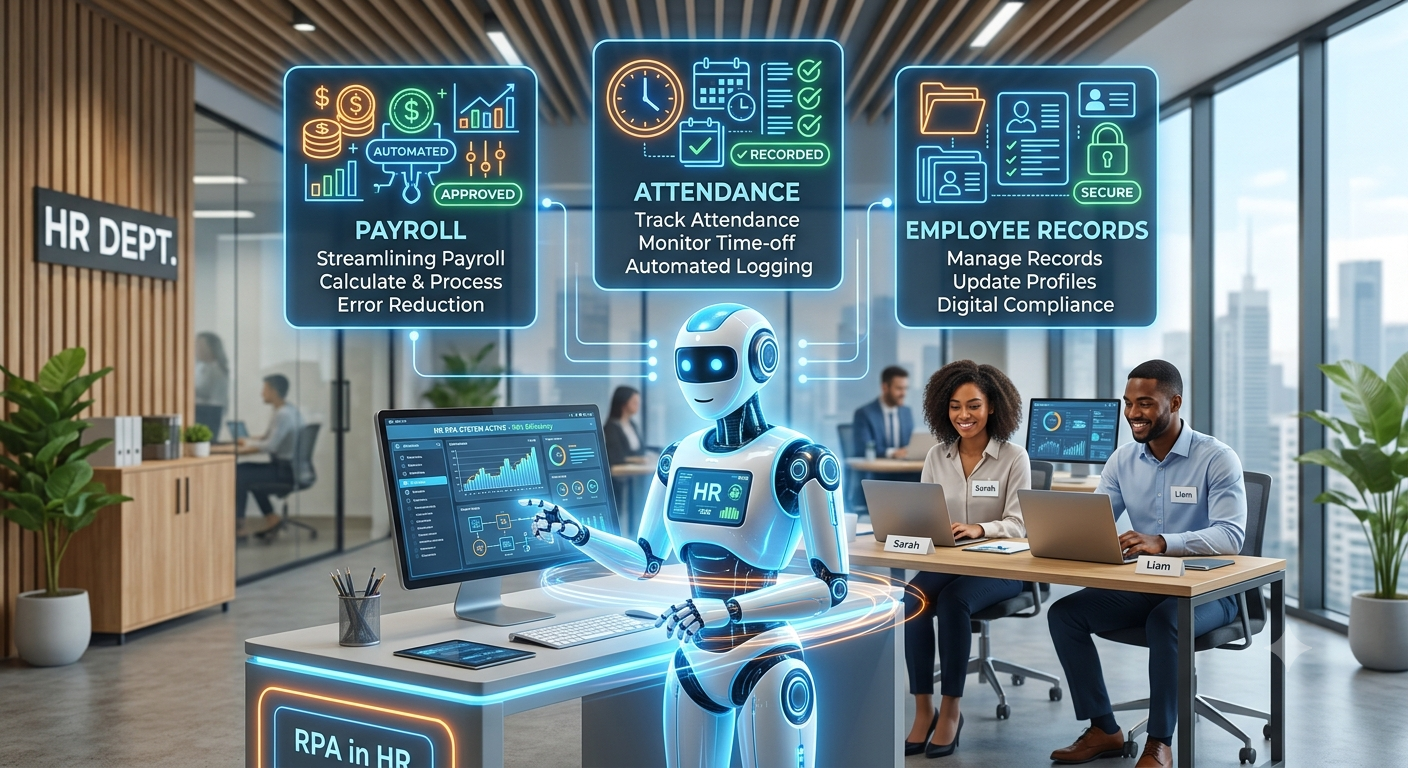

Introduction: Why HR Departments Are Turning to Robotic Process Automation
Human Resources departments are responsible for managing some of an organization’s most important operational processes. From employee onboarding and payroll processing to attendance tracking, benefits administration, and maintaining employee records, HR teams handle a continuous flow of information across multiple systems.
Despite the growing adoption of HR technology, many organizations still depend on manual activities to complete routine administrative work. HR professionals may need to download attendance reports, verify employee details, update spreadsheets, transfer information between payroll platforms, check leave balances, and prepare compliance reports. These activities consume valuable time and introduce opportunities for human error.
This is where Robotic Process Automation (RPA) in HR becomes valuable.
RPA uses software bots to automate repetitive, rule-based tasks by interacting with digital applications in ways similar to human users. Bots can retrieve information, enter data, validate records, generate reports, and trigger predefined workflows across different systems.
For example, an RPA bot can collect employee attendance data from a time-tracking application, identify missing entries, transfer approved working hours to a payroll system, and generate an exception report for HR review.
The objective is not to replace HR professionals. It is to reduce administrative workloads, improve operational consistency, and create more time for activities that require human judgment.
As organizations modernize their HR technology environments, RPA is becoming an important component of workforce operations. It can also complement Human Resource Information Systems (HRIS), Human Capital Management (HCM) platforms, payroll applications, and employee self-service portals.
1. Understanding Robotic Process Automation in HR –
Robotic Process Automation is a technology that uses software bots to execute predefined digital tasks. These bots follow configured instructions and interact with applications through user interfaces, APIs, or other supported integration methods.
Unlike traditional system integration, which generally connects applications through dedicated interfaces, RPA can automate processes that involve multiple systems even when those systems do not offer convenient integration options.
In an HR environment, RPA can automate activities such as:
- Entering employee information into HR databases.
- Transferring attendance records into payroll applications.
- Validating employee details across different systems.
- Processing routine leave and attendance updates.
- Generating payroll and workforce reports.
- Sending reminders for pending employee documentation.
- Updating employee records after approved changes.
- Preparing structured compliance reports.
Consider an organization that uses separate applications for attendance, payroll, and employee management. HR employees may manually download data from one application, check it against another, and enter the verified information into a third.
An RPA bot can automate much of this sequence. It retrieves the relevant information, performs predefined checks, updates the appropriate application, and flags records that require human attention.
This reduces repetitive work while maintaining a consistent process.
How RPA Works in an HR Environment –
A typical HR automation workflow follows a sequence:
- Trigger: A scheduled event or predefined business condition starts the automation.
- Data retrieval: The bot collects information from the relevant HR application.
- Validation: It checks records against predefined rules.
- Processing: The bot updates systems or performs approved calculations and actions.
- Exception handling: Unusual, incomplete, or conflicting records are flagged.
- Reporting: The bot records completed activities and generates an execution report.
The process can operate across multiple applications, depending on the automation platform and available access permissions.
2. Automating Payroll Processing With RPA –

Payroll processing is one of the most important and sensitive HR responsibilities. Employees expect accurate and timely salary payments, while organizations must maintain reliable records of earnings, deductions, taxes, benefits, and other payroll components.
Manual payroll processing can become particularly challenging when employee information is distributed across attendance systems, HR databases, leave management applications, and payroll platforms.
RPA can streamline several stages of payroll administration.
Automated Payroll Data Collection –
Before payroll can be processed, HR teams need accurate information about employee working hours, approved leave, overtime, salary changes, bonuses, and deductions.
An RPA bot can retrieve approved information from relevant systems and consolidate it for payroll processing.
For example, the bot may:
- Retrieve employee attendance summaries.
- Collect approved overtime information.
- Identify unpaid leave records.
- Verify employee identifiers and payroll status.
- Transfer approved inputs into the payroll application.
- Generate a report of missing or inconsistent information.
This reduces manual data transfer and helps payroll teams work with more consistent information.
Payroll Validation and Error Detection –
Payroll errors can result from incorrect employee records, missing attendance information, outdated salary details, or duplicate entries.
RPA bots can perform predefined validation checks before payroll is finalized.
Examples include checking whether:
- Employee identifiers match across systems.
- Required payroll fields are complete.
- Salary changes have the necessary approval.
- Attendance and leave information are available.
- Duplicate or unexpected transactions exist.
- Payroll inputs fall outside configured validation rules.
However, payroll calculations, statutory deductions, and tax treatment must follow applicable laws and organizational policies. Automation should not be treated as a substitute for payroll expertise or legal compliance review.
Automated Payroll Reporting –
RPA can also generate routine payroll reports, organize records, and distribute authorized summaries to relevant stakeholders.
For example, an automated workflow may prepare monthly payroll summaries, highlight exceptions, and notify payroll administrators when a review is required.
Sensitive payroll information must be protected through role-based access, encryption, secure storage, and appropriate audit controls.
3. Streamlining Attendance and Leave Management –
Attendance management is another area where manual administration can create operational challenges.

Organizations may collect attendance information through biometric devices, access-control systems, mobile applications, spreadsheets, or cloud-based workforce management platforms. When these systems are not properly connected, HR teams may need to reconcile information manually.
RPA can automate repetitive attendance-related activities and help maintain consistent workforce records.
Automated Attendance Data Synchronization –
An RPA bot can retrieve attendance information from a time-tracking application and transfer it to the HR or payroll system.
The process can include:
- Collecting daily attendance records.
- Identifying missing clock-in or clock-out entries.
- Comparing attendance against approved work schedules.
- Flagging unusual attendance patterns.
- Updating relevant HR records after validation.
- Preparing attendance summaries for managers.
For example, if an employee has a missing clock-out entry, the bot can flag the record and notify the appropriate manager instead of allowing incomplete information to move directly into payroll.
Leave Request Processing –
Leave management often involves checking employee balances, verifying approval status, updating calendars, and communicating decisions.
RPA can automate rule-based parts of this process.
A bot may retrieve approved leave requests, update leave balances, synchronize information with attendance systems, and send confirmation notifications.
More complex decisions, such as exceptions to leave policies or disputes about eligibility, should remain with authorized HR personnel.
Benefits of Attendance Automation –
Automating attendance processes can help organizations:
- Reduce repetitive spreadsheet management.
- Improve consistency between attendance and payroll systems.
- Identify missing records earlier.
- Reduce delays in leave balance updates.
- Improve visibility into attendance exceptions.
- Support more timely workforce reporting.
Organizations should also establish appropriate controls around employee monitoring and personal data. Attendance automation should follow applicable privacy requirements and clearly defined internal policies.
4. Automating Employee Records and HR Data Management –
Employee records are essential to almost every HR activity. They contain information about employee identity, job roles, departments, compensation, employment status, benefits, training, and organizational history.
Maintaining these records across multiple applications can be challenging, particularly in organizations with distributed teams, frequent employee movements, and complex technology environments.
RPA can automate routine record-management activities while helping maintain consistency across systems.
Employee Information Updates –
When an employee changes departments, receives a promotion, moves to another location, or updates personal information, multiple HR applications may need to be updated.
An RPA bot can retrieve approved changes and update designated systems according to predefined rules.
For example, after an approved department transfer, automation could update the employee’s department in the HRIS, notify the relevant payroll administrator, and synchronize the information with an organizational directory.
Sensitive changes should be subject to appropriate verification and approval before automation executes them.
Document Collection and Verification –
HR departments regularly collect employment documents, identity information, tax forms, signed policies, and other required records.
RPA can support document workflows by:
- Sending reminders for missing documents.
- Checking whether required files have been submitted.
- Updating document status fields.
- Organizing approved files in designated repositories.
- Flagging incomplete submissions for HR review.
If organizations use optical character recognition (OCR), document-processing tools, or AI-based extraction, they can also automate certain data-entry steps. Extracted information should be validated before being used for payroll, employment, or compliance decisions.
Maintaining Consistent Employee Information –
When employee information is stored in multiple systems, discrepancies can develop.
For example, an employee’s department may be updated in the HRIS but remain unchanged in a payroll application or internal directory.
RPA can compare selected fields across systems and flag inconsistencies for correction.
This capability becomes particularly useful when organizations have legacy applications that cannot easily exchange information through APIs.
5. RPA Use Cases Across the Employee Lifecycle –
Although payroll, attendance, and employee records are major automation opportunities, RPA can support many other HR activities.
| HR function | Manual activity | RPA automation opportunity |
|---|---|---|
| Recruitment | Entering candidate information | Transfer approved candidate details between systems |
| Onboarding | Sending forms and reminders | Trigger document requests and status notifications |
| Payroll | Collecting payroll inputs | Consolidate and validate approved payroll data |
| Attendance | Reconciling time records | Identify missing or inconsistent attendance entries |
| Leave management | Updating leave records | Synchronize approved leave information |
| Employee records | Updating multiple applications | Apply approved employee information changes |
| Benefits administration | Updating enrollment records | Transfer validated benefit selections |
| Offboarding | Coordinating administrative tasks | Trigger approved checklists and access-removal requests |
| HR reporting | Preparing recurring reports | Collect data and generate scheduled reports |
The suitability of each use case depends on process stability, data quality, system access, exception frequency, and the level of judgment required.
Tasks that follow consistent rules and have clearly defined inputs and outputs are generally stronger candidates for RPA.
6. RPA vs. Traditional HR Automation: Understanding the Difference –
RPA and traditional HR automation are related, but they are not identical.
Traditional HR automation often uses built-in workflows, APIs, and application-specific capabilities. RPA can complement these capabilities by automating repetitive interactions across applications, especially when direct integration is unavailable or difficult.
| Dimension | Traditional HR automation | Robotic Process Automation |
|---|---|---|
| Primary approach | Application workflows and integrations | Software bots executing predefined tasks |
| System connectivity | Often depends on APIs or native connectors | Can interact through user interfaces or APIs |
| Legacy application support | May require custom integration | Can automate supported legacy interfaces |
| Process flexibility | Depends on application configuration | Depends on bot logic and process design |
| Best suited for | Structured workflows within connected platforms | Repetitive tasks across multiple applications |
| Maintenance | Application and integration updates | Bot updates when interfaces or workflows change |
| Human involvement | Approval and exception handling | Supervision, validation, and exception handling |
RPA should not automatically replace well-designed system integrations. When a stable API or native workflow is available, it may provide a more reliable and maintainable solution.
The strongest HR automation strategies often combine RPA, application integrations, workflow engines, and employee self-service capabilities.
7. Business Benefits of Implementing RPA in HR –
RPA can create operational value beyond reducing the time required to complete administrative tasks.
- Improved Operational Efficiency –
Software bots can execute repetitive tasks according to predefined schedules and rules. This reduces the time HR professionals spend transferring information, preparing routine reports, and checking records manually.
- Better Data Accuracy –
Automated validation rules can identify missing fields, duplicate entries, inconsistent identifiers, and unexpected values.
Although bots can still make mistakes when rules are incorrectly configured or source data is inaccurate, properly designed automation can reduce common manual-entry errors.
- Faster HR Service Delivery –
Automating routine updates and notifications can reduce delays in processes such as onboarding, attendance reconciliation, leave updates, and employee record maintenance.
- Improved Auditability –
RPA platforms can maintain execution logs showing which tasks were performed, when they were executed, and whether they succeeded or encountered exceptions.
These records can support internal audits and operational reviews, provided the organization maintains appropriate logging and retention policies.
- Better Employee Experience –
Employees benefit when routine HR activities are handled consistently and promptly. Faster document processing, more timely attendance updates, and clearer payroll workflows can improve confidence in HR services.
- More Time for Strategic HR Activities –
By reducing repetitive administrative work, HR professionals can spend more time on employee engagement, workforce planning, talent development, organizational culture, and people analytics.
8. How to Implement RPA Successfully in HR –
A successful RPA initiative begins with process selection rather than technology procurement.
Organizations should identify activities that consume significant administrative time, follow predictable rules, and involve structured data.
Step 1: Identify Repetitive HR Processes
Review existing HR workflows and identify activities that involve frequent data entry, system navigation, document processing, or report generation.
Payroll data consolidation, attendance reconciliation, and employee record updates are common starting points.
Step 2: Evaluate Process Suitability
Not every HR process is suitable for RPA.
Assess each process based on:
- Transaction volume.
- Frequency of execution.
- Rule stability.
- Data availability and quality.
- Number of applications involved.
- Exception rates.
- Business impact if an error occurs.
Processes with stable rules and predictable outcomes are usually better automation candidates.
Step 3: Document Existing Workflows
Before developing bots, document how the process currently works.
Identify the systems involved, data sources, approvals, business rules, exception scenarios, and expected outcomes.
This helps prevent organizations from automating inefficient or poorly controlled processes.
Step 4: Select the Right RPA Platform
Evaluate platforms based on application compatibility, integration capabilities, security controls, monitoring, scalability, support, and licensing requirements.
Popular enterprise RPA platforms include Microsoft Power Automate, UiPath, and Automation Anywhere. Their suitability depends on the organization’s existing technology environment and business requirements.
Step 5: Develop and Test Automation
Start with a limited use case, such as attendance data synchronization or employee record validation.
Test the bot using representative data and include scenarios involving missing information, duplicate records, system downtime, invalid approvals, and unexpected application behavior.
Payroll-related automation should receive particularly rigorous testing before production deployment.
Step 6: Establish Governance and Monitoring
Define who owns each bot, who can modify automation rules, how exceptions are handled, and how execution logs are reviewed.
Organizations should also establish a process for updating bots when applications, policies, or interfaces change.
Step 7: Measure Business Outcomes
Compare performance before and after implementation.
Track processing time, error rates, exception volumes, manual intervention, automation success rates, and the cost of maintaining the solution.
These measurements help determine whether the automation is delivering sustainable value.
9. Security, Privacy, and Compliance Considerations –

HR automation involves sensitive employee information. Payroll records, personal identifiers, compensation details, attendance information, and employment documents must be handled carefully.
RPA can introduce security risks if bots are given excessive access or if credentials are stored insecurely.
Organizations should implement the following safeguards:
Role-based access control: Give bots access only to the applications, records, and actions required for their assigned processes.
Secure credential management: Store bot credentials in approved vaults or secrets-management systems rather than hardcoding passwords into scripts.
Data encryption: Protect sensitive employee information during transmission and storage.
Audit logging: Maintain records of bot activity, data changes, failures, and administrative actions.
Human approval controls: Require authorized approval for sensitive activities such as compensation changes, employee termination, and exceptional payroll adjustments.
Data retention policies: Ensure that employee records and automation logs are retained and deleted according to applicable legal and organizational requirements.
Change management: Review automation whenever HR policies, payroll rules, or application interfaces change.
For organizations operating in India, HR automation involving personal data should be designed with applicable requirements in mind, including the Digital Personal Data Protection Act, 2023, and relevant rules and notifications as they become applicable. Multinational organizations may also need to consider requirements such as the EU General Data Protection Regulation (GDPR).
The NIST Cybersecurity Framework provides a useful reference for structuring cybersecurity risk management practices.
10. Challenges Organizations May Face With HR RPA
Despite its benefits, RPA implementation can create challenges if organizations approach it without sufficient planning.
- Changing Application Interfaces –
Bots that rely on screen-based interactions may stop working when an application’s layout, navigation, or login process changes.
Organizations should monitor bot performance and establish maintenance procedures.
- Poor Source Data Quality –
Automation cannot automatically correct every underlying data problem. Inconsistent employee identifiers, missing fields, duplicate records, and outdated information can lead to incorrect processing.
A data quality strategy should therefore accompany RPA implementation.
- Complex Business Rules –
Payroll and employee administration often involve exceptions, policy variations, and regulatory requirements. If the process contains too many judgment-based decisions, full automation may be inappropriate.
- Employee and HR Team Adoption –
Employees may be concerned about automation changing their responsibilities. HR professionals may also need training to supervise bots and manage exceptions.
Clear communication, training, and involvement in process design can improve adoption.
- Unclear Return on Investment –
Organizations sometimes automate processes without measuring their actual administrative cost or expected benefits.
A business case should account for software licensing, development, infrastructure, monitoring, maintenance, exception handling, and governance—not just the time saved by individual tasks.
11. Measuring the Success of HR RPA –
HR leaders should evaluate automation using operational and employee-service metrics rather than counting the number of bots deployed.
| KPI | What it measures |
|---|---|
| Payroll processing time | Time required to prepare and complete payroll activities |
| Payroll error rate | Frequency of incorrect payroll inputs or processing outcomes |
| Attendance reconciliation time | Time spent resolving attendance discrepancies |
| Employee record accuracy | Consistency and correctness of employee information |
| Automation success rate | Percentage of bot executions completed successfully |
| Exception rate | Percentage of transactions requiring human intervention |
| HR administrative hours saved | Reduction in time spent on repetitive tasks |
| Cost per transaction | Average operational cost of completing an HR activity |
| Employee service turnaround time | Time required to complete routine employee requests |
Organizations should establish baseline measurements before deployment and compare them with post-implementation results.
It is also important to distinguish between tasks completed automatically and tasks completed correctly. A bot may report a successful execution while still processing inaccurate source information. Quality checks and reconciliation controls are therefore essential.
12. The Future of HR Automation: RPA, AI, and Intelligent Workflows –
The next stage of HR automation will increasingly combine RPA with artificial intelligence, machine learning, document processing, and conversational interfaces.
Traditional RPA is particularly effective for structured, rule-based activities. AI can extend automation to tasks that involve interpreting documents, classifying requests, extracting information, or understanding natural-language questions.
For example, an intelligent HR workflow could receive an employee’s document submission, use document-processing technology to extract relevant fields, validate the information against HR records, and use RPA to update an approved application.
Similarly, an AI-powered HR assistant could answer routine policy questions, while RPA performs permitted administrative updates in connected systems.
However, these technologies should be applied carefully. AI-generated information can be inaccurate, and employment-related decisions can have significant consequences for individuals. Organizations should retain human oversight for decisions involving compensation, hiring, performance, employee discipline, and other sensitive matters.
The future is not simply about deploying more bots. It is about creating connected HR operations in which automation, AI, business rules, and human expertise work together.
Conclusion: Building More Efficient and Employee-Centric HR Operations –
Robotic Process Automation in HR offers organizations a practical way to streamline payroll, attendance management, employee records, and other repetitive administrative activities.
By automating structured tasks across existing applications, businesses can reduce manual effort, improve data consistency, accelerate routine workflows, and strengthen operational visibility.
However, successful implementation requires more than deploying software bots. Organizations must evaluate process suitability, maintain accurate source data, establish security controls, manage exceptions, and measure business outcomes.
HR teams should begin with high-volume, predictable processes where automation can deliver measurable improvements. As experience grows, they can expand into more connected workflows involving HRIS, payroll, attendance, recruitment, and employee service applications.
Ultimately, RPA should give HR professionals more time to focus on people rather than repetitive administration.
The real value of HR automation is not simply completing administrative tasks faster. It is creating more reliable HR operations so people professionals can spend more time improving the employee experience and building a stronger workforce.
Frequently Asked Questions (FAQs) –
Robotic Process Automation in HR uses software bots to perform repetitive, rule-based administrative activities such as payroll data processing, attendance reconciliation, employee record updates, document management, and report generation.
RPA can collect approved payroll inputs, retrieve attendance information, validate employee records, identify missing data, transfer information between applications, and generate payroll reports. Sensitive payroll calculations and final approvals should remain subject to appropriate controls and review.
Yes. RPA can synchronize attendance records, identify missing clock-in or clock-out entries, process approved leave updates, update leave balances, and generate attendance reports.
Key benefits include reduced manual work, improved data consistency, faster processing, better auditability, more efficient HR service delivery, and additional time for strategic HR activities.
Yes. Smaller organizations can automate selected high-volume processes such as employee data updates, attendance reconciliation, document reminders, and recurring reports. They should evaluate implementation and maintenance costs before selecting a platform.