

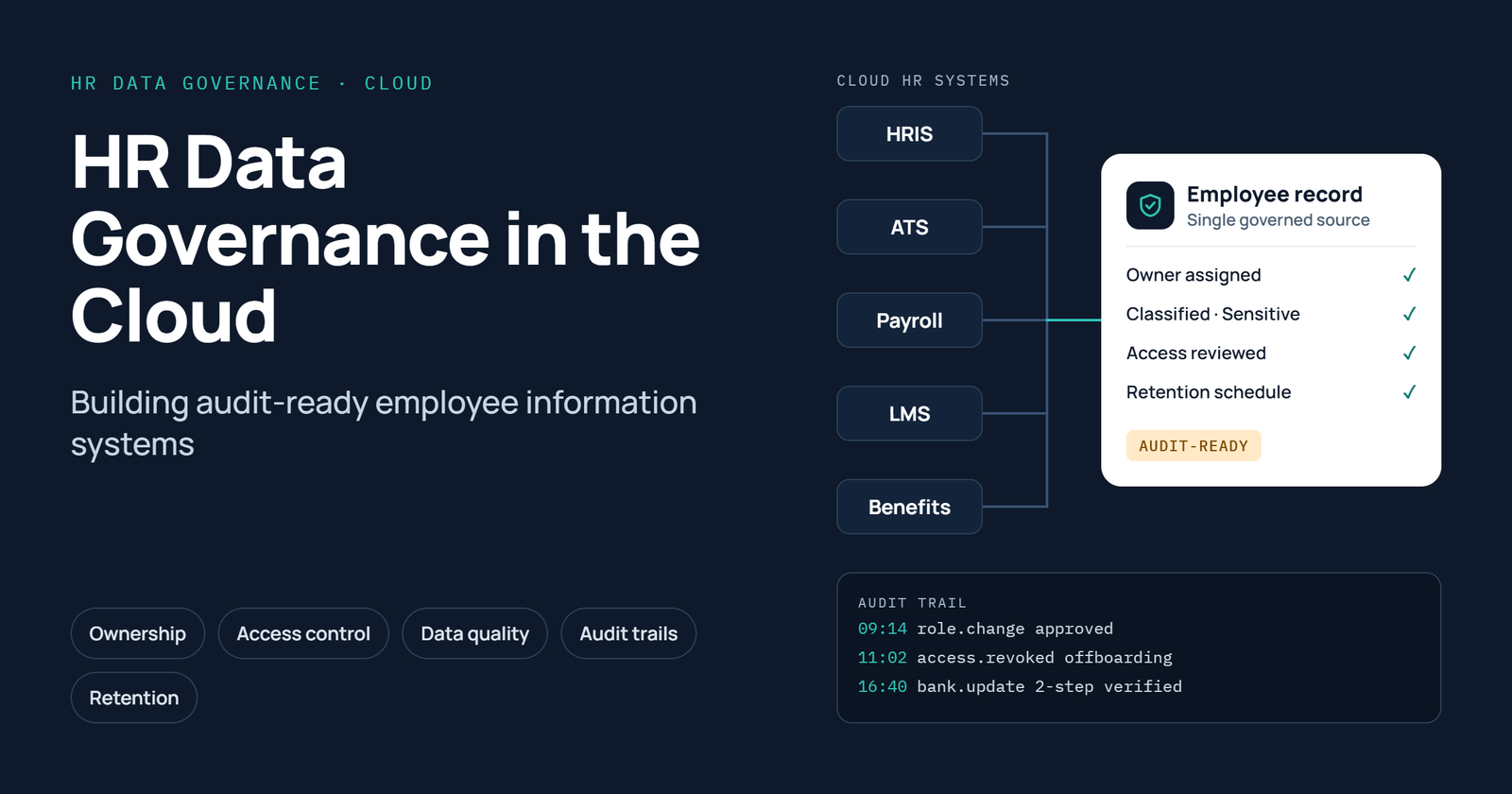


As organizations move human resources operations to cloud-based platforms, employee information is becoming more accessible, interconnected, and valuable. HR teams now rely on cloud-based Human Resource Information Systems (HRIS), applicant tracking systems (ATS), payroll applications, learning management systems (LMS), benefits platforms, and workforce analytics tools to manage the employee lifecycle. While these technologies improve efficiency, they also introduce a critical challenge: maintaining accurate, secure, consistent, and auditable employee data across multiple systems.
HR data governance in the cloud provides the policies, processes, responsibilities, and technical controls required to manage employee information throughout its lifecycle. It helps organizations establish clear ownership of HR data, control access to sensitive records, maintain reliable audit trails, and demonstrate that information is handled according to applicable legal, regulatory, and internal requirements.
The challenge is not simply storing employee records securely. Organizations must also know where information resides, who can access it, how it changes, how long it should be retained, and whether its use can be justified. Without these capabilities, even a modern cloud HR platform can become a source of compliance gaps, inconsistent reporting, and operational risk.
Building an audit-ready employee information system requires a coordinated approach that combines data governance, cloud security, privacy management, process standardization, and continuous monitoring. For HR leaders, IT teams, compliance officers, and security professionals, this is increasingly a foundational requirement for responsible workforce management.
What Is HR Data Governance in the Cloud?
HR data governance in the cloud is the framework used to manage employee information stored, processed, or exchanged through cloud-based applications and services. It defines how HR data is collected, classified, accessed, maintained, shared, retained, and eventually deleted.
Unlike data management, which focuses on operational activities such as storing, processing, and integrating information, data governance establishes the rules and accountability that guide those activities. Data management implements the controls; governance defines what those controls must achieve, who is responsible, and how compliance is verified.
For example, a company may maintain employee information in an HRIS, compensation details in a payroll platform, recruitment records in an ATS, and training history in an LMS. If each application uses different employee identifiers, job classifications, access permissions, and retention policies, the organization may struggle to produce a consistent employee record during an audit.
A governance framework establishes common data definitions, ownership responsibilities, access policies, integration standards, and evidence requirements across these platforms. The objective is to create a reliable and controlled information environment without requiring every system to be replaced by a single application.
Effective cloud HR data governance should cover the entire employee information lifecycle, from candidate application and onboarding to role changes, leave management, payroll processing, offboarding, and post-employment retention.
Why Cloud-Based HR Systems Need Stronger Governance –
Cloud HR platforms can improve accessibility, scalability, integration, and administrative efficiency. However, these advantages also increase the importance of governance because employee information may move between applications, service providers, geographic regions, and business functions.
1. Employee Data Is Distributed Across Multiple Systems –
A typical organization does not maintain every employee record in one application. Recruitment teams manage candidate information, HR teams maintain employment records, payroll teams process salary data, and learning teams track employee development.
These systems may synchronize data automatically through APIs, scheduled imports, or integration platforms. Without consistent governance, incorrect or outdated information can spread across applications. A department transfer, for instance, might update the HRIS but fail to update a payroll authorization workflow or a downstream reporting system.
Governance establishes authoritative data sources, defines how changes propagate, and creates procedures for identifying and resolving inconsistencies.
2. Employee Information Is Highly Sensitive –
HR systems contain personal identifiers, contact details, compensation information, performance records, bank details, and other sensitive information. Depending on the organization, they may also process health-related benefits information, disability accommodations, background-check records, or other specially protected data.
A compromised account or excessive permission can expose information far beyond what an employee needs to perform their role. Cloud environments therefore require carefully defined access controls, strong authentication, encryption, monitoring, and appropriate separation of responsibilities.
Governance provides the policy framework for deciding which information different users can access and under what circumstances.
3. Compliance Requirements Are Evolving –
Organizations may need to comply with privacy laws, employment regulations, financial reporting requirements, contractual commitments, and internal policies. The relevant obligations depend on employee location, business activities, the types of data processed, and the organization’s legal circumstances.
For example, India’s Digital Personal Data Protection Act, 2023, and its associated rules and commencement arrangements may be relevant to organizations processing digital personal data in India. Other organizations may have obligations under the European Union’s General Data Protection Regulation (GDPR), the California Consumer Privacy Act as amended by the California Privacy Rights Act, or applicable employment and financial regulations.
Moving HR systems to the cloud does not transfer every compliance responsibility to the service provider. Organizations must understand their own obligations, the provider’s responsibilities, contractual commitments, and the controls needed to demonstrate compliance.
4. Audits Require Evidence, Not Just Policies –
An organization may have a written policy stating that only authorized personnel can access compensation records. However, an auditor may ask for evidence showing who had access during a particular period, who approved that access, whether permissions were reviewed, and whether access was removed after a role change.
A policy without supporting evidence is insufficient to demonstrate that a control operates effectively. Audit-ready governance connects documented requirements with actual system configurations, access records, approval histories, exception logs, and remediation evidence.
Core Components of an Audit-Ready HR Data Governance Framework –
An effective framework should establish a small number of clear, measurable governance capabilities that can be applied consistently across HR platforms.
1. Data Ownership and Accountability –
Every important category of employee information should have a designated business owner responsible for its definition, quality, permitted use, and governance requirements. Data stewards can support owners by maintaining standards, resolving quality issues, and coordinating changes across systems.
For example, HR may own employee identity and employment-status definitions, payroll may own salary-processing rules, and IT may manage technical integration controls. Privacy, legal, security, and compliance teams provide specialist oversight where required.
The organization should document these responsibilities through a responsibility matrix or similar governance structure. This prevents situations where multiple teams assume another department is responsible for a data issue, access approval, or audit request.
2. Data Classification and Inventory –
Organizations need a current inventory of the employee information they collect and process. This inventory should identify the data category, business purpose, authoritative source, storage location, receiving systems, responsible owner, retention requirement, and applicable access restrictions.
Data should also be classified according to sensitivity. Basic organizational information may require standard business controls, while compensation details, government identifiers, banking information, and sensitive personal records require stronger restrictions.
Classification must be practical enough to guide real decisions. If every field is marked as equally sensitive, users may struggle to apply appropriate controls. Conversely, vague categories can leave important information insufficiently protected.
A well-maintained inventory also helps organizations identify duplicate records, undocumented integrations, unnecessary data collection, and third-party systems that may contain employee information outside the primary HR platform.
3. Identity and Access Management –
Access management is one of the most important controls in cloud HR governance. Employees should receive only the permissions necessary to perform their assigned responsibilities, with additional restrictions for highly sensitive information.
Role-based access control can assign permissions according to job functions, while attribute-based controls can consider factors such as organizational unit, location, employment relationship, or data sensitivity. Multi-factor authentication, single sign-on, privileged-access management, and periodic access reviews provide additional protection.
Access should also reflect changes in employment status and responsibilities. When an HR professional moves to another department, their previous permissions should be reviewed rather than simply adding new permissions on top of existing ones. When an employee leaves, relevant accounts and entitlements should be revoked promptly according to documented procedures.
High-risk activities, such as changing bank details, modifying payroll instructions, or approving compensation adjustments, may require additional verification and separation of duties.
4. Data Quality and Integrity –
Reliable HR decisions depend on consistent and accurate employee information. Incorrect job titles, outdated reporting relationships, duplicate employee records, and mismatched payroll identifiers can affect workforce analytics, access permissions, compliance reporting, and salary processing.
Organizations should define measurable quality rules for critical fields. These might include mandatory employee identifiers, valid employment-status values, approved job-code formats, and reconciliation rules between HR and payroll systems.
Data quality monitoring should identify exceptions automatically where possible. However, automated detection is only one part of the process. Each exception also needs an assigned owner, a resolution deadline, and a documented outcome.
Maintaining data lineage—the ability to understand where a data element originated, how it changed, and where it was used—can further improve trust in reports and support investigations into incorrect records.
5. Audit Trails and Change History –
An audit-ready HR environment should record significant activities affecting employee information. Depending on the system and risk level, these activities may include record creation, updates to sensitive fields, permission changes, approval actions, exports, administrative operations, and relevant data transfers.
Audit records should capture enough context to support investigations, such as the actor, action, timestamp, affected resource, and outcome. Where appropriate, records should also identify the approval or workflow associated with the action.
Logs must be protected from unauthorized alteration and retained for an appropriate period. Organizations should test whether logging is enabled for important events and whether records can be retrieved when needed. Logging a change without preserving sufficient context may not provide the evidence required to explain what happened.
Not every read operation or low-risk event needs identical monitoring. The level of detail and retention should be proportionate to risk, technical capabilities, and applicable requirements.
6. Retention, Archiving, and Secure Deletion –
Employee information should not remain in cloud systems indefinitely simply because storage is inexpensive. Organizations need retention schedules that account for legal obligations, employment requirements, legitimate business purposes, litigation holds, and other applicable restrictions.
Different record types may require different retention periods. Payroll records, recruitment data, performance documentation, and benefits records should not automatically follow one universal rule.
When information reaches the end of its approved retention period, the organization should follow a documented process for deletion, anonymization, or archival where appropriate. This process must consider replicated data, integration destinations, exports, backups, and third-party processors.
Deletion from an application does not always mean that every copy disappears immediately. Organizations should understand provider backup cycles, deletion mechanisms, and contractual commitments so that their retention policy reflects actual system behavior.
Cloud HR Governance Controls and Their Audit Evidence –
The following table connects common governance controls with the evidence organizations should be prepared to produce.
| Governance Area | Recommended Control | Example Audit Evidence |
|---|---|---|
| Data ownership | Assign accountable data owners and stewards | Ownership register, responsibility matrix |
| Data classification | Classify employee records by sensitivity | Data inventory, classification standards |
| Access management | Apply least privilege and periodic reviews | Access reports, approval records, review logs |
| Data quality | Validate critical fields and reconcile systems | Quality reports, exception logs, remediation records |
| Change management | Record and approve high-risk changes | Change history, workflow approvals, timestamps |
| Privacy management | Document purposes and applicable privacy controls | Processing records, privacy assessments, notices |
| Retention and deletion | Apply approved retention schedules | Retention policies, deletion logs, exception approvals |
| Vendor governance | Assess providers and define responsibilities | Contracts, security assessments, assurance reports |
| Incident response | Investigate and document relevant incidents | Incident records, investigation reports, corrective actions |
| Business continuity | Test recovery and access to critical records | Backup records, restoration tests, continuity plans |
These controls should be supported by evidence generated through normal business operations wherever possible. Reconstructing approvals, access histories, and policy exceptions only when an audit begins creates additional work and increases the risk of incomplete documentation.
How to Build Audit-Ready Employee Information Systems –
Implementing HR data governance is a cross-functional initiative rather than a configuration exercise limited to the HR department. Organizations should approach it in phases so that foundational risks are addressed before advanced automation is introduced.
Step 1: Assess the Existing HR Data Environment –
Begin by mapping HR applications, databases, integrations, file repositories, and third-party services that store or process employee information. Identify the authoritative system for each major data category and document how information moves between systems.
Review current access permissions, retention practices, audit logging, data quality controls, and vendor arrangements. The assessment should identify high-risk gaps, such as shared administrative accounts, untracked spreadsheet exports, redundant employee records, and integrations without clear ownership.
Prioritize findings according to their potential impact on employee privacy, payroll accuracy, operational continuity, and regulatory obligations.
Step 2: Establish Governance Policies and Ownership –
Develop a governance charter that defines the objectives, scope, decision-making authority, and responsibilities of the HR data governance program. Assign data owners and stewards, and establish escalation procedures for unresolved issues.
Create practical standards for data classification, naming conventions, employee identifiers, access approvals, retention, and information sharing. Policies should be understandable to the people who must follow them and specific enough to translate into technical controls.
Governance should also establish how policy exceptions are requested, reviewed, approved, and periodically reassessed. Exceptions without owners or expiry dates can gradually undermine the entire framework.
Step 3: Standardize Identity and Data Access –
Review access across the HRIS, payroll platform, ATS, LMS, and connected applications. Remove unnecessary permissions, strengthen authentication, and introduce role-based access controls where appropriate.
Connect employee lifecycle workflows to identity management so that onboarding, internal transfers, and offboarding trigger relevant access changes. Where supported, automate provisioning and deprovisioning while maintaining approval checkpoints for sensitive permissions.
Test high-risk scenarios rather than relying solely on configuration reviews. For example, confirm that a recruiter cannot access payroll records without authorization and that a former employee’s access is revoked according to policy.
Step 4: Implement Monitoring and Audit Evidence Collection –
Configure logging for sensitive record changes, administrative actions, permission modifications, exports, and other important events. Ensure that logs are protected, searchable, and retained according to the organization’s approved requirements.
Create repeatable evidence packages for common audit requests. These may include current access listings, access-review approvals, change histories, vendor assessments, retention exceptions, and incident records.
Evidence collection can be automated where the applications support reliable exports or integrations. However, automated reports should be validated to ensure that they are complete, correctly scoped, and consistent with the control being tested.
Step 5: Strengthen Data Quality and Reconciliation –
Define validation rules for employee identifiers, employment status, organizational hierarchy, compensation fields, and other business-critical information. Establish reconciliation routines between systems that depend on the same data.
For example, compare employee status in the HRIS with payroll eligibility and identity-management records. Investigate discrepancies rather than automatically overwriting one system with another, since the correct action depends on the authoritative source and business context.
Track recurring errors and identify their root causes. Persistent mismatches may indicate poor integration design, unclear ownership, inconsistent definitions, or inadequate change management.
Step 6: Test Audit Readiness Before an Actual Audit –
Conduct internal reviews that simulate likely auditor questions. Can the organization demonstrate who accessed sensitive employee information? Can it show that permissions were approved and reviewed? Can it trace a compensation change from request to approval and implementation? Can it demonstrate that an expired record was handled according to the retention policy?
Record gaps, assign remediation owners, set deadlines, and retest the relevant controls after corrective action. The objective is not merely to assemble documentation but to demonstrate that controls operate consistently over time.
The Role of Automation and AI in HR Data Governance –
Automation can reduce the manual effort required to maintain governance across large HR environments. Identity-management workflows can provision and revoke access, data-quality tools can identify inconsistent records, and policy engines can flag activities that violate established rules.
Analytics can also help identify unusual access patterns, unexpected bulk exports, repeated permission exceptions, or discrepancies between connected systems. These capabilities allow teams to investigate potential issues earlier instead of relying entirely on periodic manual reviews.
AI may further assist with classifying documents, identifying sensitive information, summarizing audit evidence, and detecting patterns across large volumes of logs. However, AI-generated findings should be validated before they are used to make consequential decisions. False positives can overwhelm reviewers, while false negatives may create a misleading impression of safety.
Organizations should avoid sending employee information to unapproved AI services or allowing automated systems to make high-impact employment decisions without appropriate safeguards. Access controls, data minimization, human oversight, testing, and clear accountability remain necessary even when governance tasks are automated.
The best approach is to automate repeatable, rules-based controls first and use AI to support human review where it provides measurable value.
Measuring the Effectiveness of HR Data Governance –
Governance programs should be evaluated using operational indicators rather than relying exclusively on policy completion or training attendance. Useful metrics include the percentage of critical data elements with assigned owners, the proportion of sensitive systems covered by access reviews, the number of unresolved data-quality exceptions, and the time required to retrieve audit evidence.
Organizations can also monitor the time taken to revoke access after employee departures, the percentage of high-risk changes with complete approval histories, the number of overdue retention exceptions, and the frequency of recurring audit findings.
Metrics should be interpreted in context. A rise in detected incidents may indicate that monitoring has improved rather than that the environment has become less secure. Similarly, a high percentage of completed access reviews does not prove that reviewers examined permissions carefully.
Establish baseline measurements, define realistic targets, and review trends with HR, IT, security, privacy, and compliance stakeholders. The goal is to demonstrate measurable improvements in control effectiveness, data reliability, and audit preparation.
Common Challenges and How Organizations Can Overcome Them –
One common challenge is fragmented ownership. HR, IT, payroll, and security teams may have different priorities and may disagree about who should resolve a data issue. A formal ownership model, documented escalation path, and shared governance metrics can help resolve these gaps.
Another challenge is legacy integration. Older systems may provide limited logging, weak access controls, or inconsistent identifiers. Organizations should assess these limitations explicitly and use compensating controls where appropriate while developing a longer-term modernization plan.
Excessive manual documentation is also a risk. If evidence depends on spreadsheets and one-time exports, it can become outdated quickly. Standardized workflows, automated evidence collection, and periodic validation can reduce this burden.
Finally, governance initiatives can fail when policies are too complicated to follow. Controls should be risk-based, clearly explained, and integrated into everyday workflows. A well-designed process should make the compliant action easier than the noncompliant alternative.
Conclusion: Building Trust Through Audit-Ready HR Data Governance –
Cloud-based HR systems create opportunities to improve workforce management, streamline operations, and support better organizational decisions. However, these benefits depend on the organization’s ability to maintain trustworthy, secure, and well-governed employee information.
HR data governance in the cloud provides the structure needed to establish accountability, standardize data definitions, control access, monitor changes, manage retention, and demonstrate compliance. By connecting policies to technical controls and verifiable evidence, organizations can move from reactive audit preparation to continuous audit readiness.
Success requires collaboration among HR, IT, security, privacy, legal, and compliance teams. It also requires clear ownership, reliable integrations, practical policies, and regular testing. Automation can make governance more efficient, but it cannot replace accountability or sound decision-making.
“Audit readiness is not a collection of documents assembled before an inspection; it is the evidence of controls working correctly every day.”
Organizations that treat HR data governance as an ongoing operational discipline will be better positioned to protect employee information, respond to audits, reduce avoidable risk, and build confidence in the systems that support their workforce.
Frequently Asked Questions (FAQs) –
HR data governance in the cloud is the framework of policies, roles, processes, and technical controls used to manage employee information across cloud-based HR systems. It addresses data ownership, privacy, security, accuracy, access, retention, and auditability.
It helps organizations demonstrate that employee information is managed according to approved policies and applicable requirements. Clear ownership, access logs, approval records, change histories, and retention evidence make it easier to verify that controls operate as intended.
An audit-ready employee information system maintains accurate records, enforces appropriate access permissions, records important changes, applies retention rules, and makes relevant evidence available for review. It supports repeatable verification rather than relying on last-minute document collection.
Organizations should implement least-privilege access, multi-factor authentication, encryption, data classification, secure integrations, continuous monitoring, and documented incident-response procedures. They should also review vendor security arrangements and regularly test access and recovery controls.