


Introduction: Why Traditional ITSM Is No Longer Enough –
For decades, IT Service Management (ITSM) has been built around a reactive operating model. When an employee experiences a system failure, application error, network disruption, or access issue, they raise a service ticket. The IT support team investigates the problem, identifies a solution, restores service, and closes the ticket.
This approach has helped organizations maintain operational stability. However, as enterprise technology environments become more distributed and interconnected, resolving individual tickets is no longer enough.
A single infrastructure issue can affect multiple applications, departments, and business processes. A recurring database performance problem may generate dozens of support tickets. A network configuration error may disrupt access to several enterprise applications. An outdated software component may create repeated security and availability incidents.
In these situations, resolving each ticket individually treats the symptoms rather than addressing the underlying problem.
This is where Intelligent ITSM changes the approach.
Intelligent ITSM uses AI, automation, analytics, and integrated operational data to help IT teams identify patterns, understand the causes of recurring incidents, predict potential disruptions, and take preventive action.
Instead of asking only, “How quickly can we resolve this ticket?”, organizations can begin asking more strategic questions:
- Why does this issue keep happening?
- Which systems are most likely to experience disruption?
- Can the problem be identified before users report it?
- Can repetitive incidents be resolved automatically?
- What changes will prevent the issue from returning?
The evolution from ticket resolution to problem prevention represents a fundamental shift in IT service management. It moves IT teams from reactive support toward proactive, predictive, and increasingly autonomous service operations.
1. Understanding the Evolution of IT Service Management –
Traditional ITSM was designed to organize and standardize IT support activities. It introduced structured processes for incident management, problem management, change management, service requests, and configuration management.
These processes remain important, but the operating environment has changed.
Modern enterprises rely on cloud infrastructure, SaaS applications, distributed networks, hybrid environments, APIs, microservices, remote work platforms, and interconnected business systems. A disruption in one component can create cascading effects across several services.
Traditional ticket-based processes often struggle to provide a complete picture of these dependencies.
The evolution of ITSM can be understood through four broad stages.
Stage 1: Reactive IT Support –
In the traditional model, users report issues through service desks, email, phone calls, or ticketing portals. Support teams investigate and resolve each reported incident.
The primary objectives are restoring service, meeting service-level agreements (SLAs), and maintaining user satisfaction.
This model works for straightforward support requests, but it can create operational pressure when incident volumes increase.
Stage 2: Process-Driven ITSM –
Organizations began standardizing IT service workflows through structured frameworks and platforms.
Incident management, problem management, change management, and service request management became more clearly defined. ITSM platforms provided centralized ticket tracking, approval workflows, escalation rules, and service reporting.
This improved visibility and accountability, although many processes still depended heavily on manual investigation and human intervention.
Stage 3: Automated ITSM –
The next stage introduced workflow automation, self-service portals, automated ticket routing, predefined remediation scripts, and integrated monitoring.
Routine requests could be processed automatically, while support teams could focus on more complex issues.
For example, an automated workflow might reset an account password, provision approved software, or route an incident to the correct technical team based on predefined rules.
Stage 4: Intelligent and Predictive ITSM –
Intelligent ITSM combines automation with AI-driven analysis, operational telemetry, knowledge systems, and predictive capabilities.
It can identify unusual patterns, correlate related incidents, recommend probable causes, support automated remediation, and help prevent recurring disruptions.
The focus shifts from managing individual tickets to understanding the health and reliability of the services behind them.
2. What Is Intelligent ITSM?
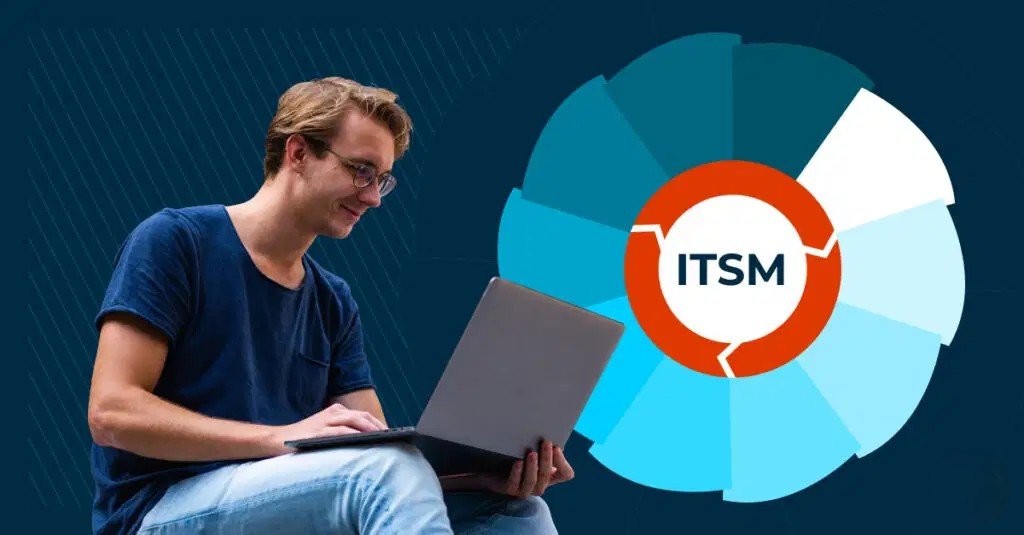
Intelligent ITSM is an advanced approach to IT service management that uses AI, machine learning, automation, analytics, and connected operational data to improve how IT services are delivered and maintained.
It extends traditional ITSM capabilities by making service management more context-aware, data-driven, and proactive.
Rather than relying only on manually submitted tickets, intelligent platforms can use information from monitoring tools, application logs, infrastructure systems, configuration databases, and previous incidents to understand what is happening across the technology environment.
For example, consider an enterprise application that becomes increasingly slow during peak business hours.
In a traditional environment, employees may submit separate tickets reporting slow login times, delayed page loading, and failed transactions.
An intelligent ITSM platform can correlate these reports with application performance metrics, database utilization, and infrastructure alerts. It may identify that all the symptoms are connected to a database resource bottleneck.
Instead of treating each ticket as an unrelated incident, the platform can help IT teams investigate the common underlying problem.
Core Technologies Behind Intelligent ITSM –
Artificial Intelligence and Machine Learning: AI can analyze historical incidents, classify tickets, identify recurring patterns, and recommend potential resolutions.
Intelligent Automation: Automation tools execute repetitive service workflows, perform approved remediation actions, and reduce manual intervention.
Predictive Analytics: Historical and real-time operational data can help identify conditions associated with future incidents.
Natural Language Processing: NLP helps interpret employee requests, categorize support tickets, summarize incident descriptions, and improve conversational self-service.
Knowledge Management: Centralized knowledge repositories provide support teams and AI assistants with approved troubleshooting information and documented resolutions.
AIOps Integration: AIOps tools analyze infrastructure and application telemetry to identify anomalies, correlate events, and support faster root-cause investigations.
These technologies work best when integrated into a clearly governed service management strategy.
3. From Incident Management to Problem Prevention –
One of the most important changes in intelligent ITSM is the growing connection between incident management and problem management.
Incident management focuses on restoring normal service as quickly as possible. Problem management focuses on identifying and addressing the underlying causes of incidents.
Both are necessary.
For example, restarting an application server may resolve an immediate service disruption. However, if the server repeatedly fails because of a memory leak, restarting it every few days does not eliminate the problem.
A preventive approach investigates the underlying condition and implements a permanent corrective action.
How Intelligent ITSM Improves Problem Management –
Intelligent ITSM can support problem prevention through several capabilities:
- Identifying recurring incident patterns.
- Grouping tickets that describe similar symptoms.
- Correlating service desk information with infrastructure alerts.
- Highlighting components associated with repeated failures.
- Recommending relevant knowledge articles and previous fixes.
- Identifying potential service risks.
- Tracking whether corrective actions reduce incident recurrence.
For example, an organization may notice a growing number of incidents related to application timeouts. An intelligent platform can analyze ticket descriptions, timestamps, affected services, and monitoring data to identify common patterns.
The problem management team can then investigate whether the issue is related to database performance, network latency, application configuration, or another dependency.
Once the underlying cause is identified, the organization can implement a permanent fix and monitor whether similar incidents decline.
The goal is not simply to close tickets faster. It is to reduce the number of tickets that need to be raised in the first place.
4. How AI Is Transforming ITSM Workflows –
AI is becoming an important part of modern service management because it can help IT teams process large volumes of operational information and identify relationships that may be difficult to recognize manually.
Its value becomes particularly clear when applied across the ITSM lifecycle.
Intelligent Ticket Classification and Routing –
Traditional ticket classification often depends on users selecting categories or support agents manually reviewing descriptions.
AI-powered systems can analyze ticket language, identify likely issue categories, detect urgency indicators, and recommend the appropriate assignment group.
For example, a request mentioning repeated VPN disconnections may be classified as a network connectivity issue and routed to the relevant team.
This can reduce manual triage and improve assignment consistency.
However, AI recommendations should be monitored to identify misclassifications, especially when tickets contain ambiguous descriptions or unfamiliar technical terminology.
AI-Powered Incident Summarization –
Major incidents can generate large volumes of comments, alerts, investigation notes, and technical updates.
AI can summarize this information into a more concise view of:
- What happened.
- Which services are affected.
- What troubleshooting steps have been attempted.
- What actions remain pending.
- Which teams are involved.
- What the current business impact is.
This can help incident managers coordinate response activities more efficiently.
Intelligent Knowledge Recommendations –
AI can compare a new incident with historical tickets and approved knowledge articles to recommend relevant troubleshooting steps.
For example, if a user reports an application authentication failure, the system may suggest previously documented checks related to identity providers, expired certificates, or access permissions.
Recommendations should come from verified knowledge sources. AI-generated troubleshooting instructions should not be executed automatically unless they have been validated and approved.
Conversational IT Support –
AI-powered virtual agents can help employees find information, submit service requests, check ticket status, and resolve common issues through natural-language conversations.
An employee might ask, “How do I request access to the finance application?” The assistant can explain the process, provide the appropriate request link, or initiate an approved workflow.
For more complex issues, the assistant can collect relevant information and escalate the request to a human support representative.
5. Predictive ITSM: Identifying Problems Before Users Notice Them –
The biggest opportunity in intelligent ITSM is moving beyond responding to reported issues and identifying conditions that may lead to service disruption.
Predictive ITSM uses historical records, monitoring data, operational patterns, and analytical models to detect early warning signals.
For example, a server experiencing gradually increasing memory consumption may not generate an immediate incident. However, if the pattern continues, it could eventually affect application availability.
A predictive monitoring system may detect the unusual trend and alert the operations team before the server becomes unavailable.
Common Predictive ITSM Use Cases –
Infrastructure capacity forecasting: Analyze resource utilization trends to identify systems that may approach capacity limits.
Application performance monitoring: Detect unusual response times, error rates, and latency patterns.
Storage capacity management: Identify storage growth that could create future service disruptions.
Network performance analysis: Detect unusual traffic patterns, packet loss, and connectivity degradation.
Recurring incident prediction: Identify services or components associated with repeated failures.
Certificate and configuration monitoring: Track expiry dates, configuration drift, and other conditions that may cause avoidable incidents.
Predictive capabilities depend on data quality, monitoring coverage, model accuracy, and the ability to connect analytical findings with operational workflows.
A prediction should therefore be treated as an actionable risk signal rather than a guarantee that an incident will occur.
6. The Role of AIOps in Intelligent ITSM –
AIOps, or Artificial Intelligence for IT Operations, uses AI and machine learning to analyze operational data and support IT operations management.
While ITSM focuses on managing IT services and service workflows, AIOps focuses more directly on understanding operational behavior across infrastructure and applications.
The two approaches complement each other.
AIOps can identify anomalies, correlate events, and detect relationships between infrastructure conditions. Intelligent ITSM can use those findings to create incidents, initiate workflows, assign ownership, and track corrective actions.
Consider an enterprise environment where several application alerts occur within a short period.
An AIOps platform may correlate these alerts and identify a shared infrastructure dependency. It can then send a consolidated event to the ITSM platform rather than allowing every alert to generate an independent ticket.
The ITSM workflow can create a major incident, notify the relevant teams, and attach available diagnostic information.
This integration reduces alert noise and helps support teams focus on the underlying service issue.
Intelligent ITSM vs. AIOps –
| Dimension | Intelligent ITSM | AIOps |
|---|---|---|
| Primary focus | Service delivery and management | IT operations intelligence |
| Main data sources | Tickets, service requests, knowledge, CMDB, workflows | Logs, metrics, traces, events, infrastructure telemetry |
| Core capabilities | Intelligent routing, workflow automation, service management | Anomaly detection, event correlation, operational analysis |
| Primary users | Service desk, ITSM teams, service owners | IT operations, SRE, infrastructure teams |
| Business outcome | Better service experience and operational efficiency | Improved visibility, reliability, and incident detection |
| Relationship | Converts operational insights into service workflows | Provides insights that can improve ITSM decisions |
When integrated effectively, AIOps and ITSM create a more connected approach to incident detection, investigation, response, and prevention.
7. Intelligent Automation and Self-Healing IT Services –

Automation has always been part of ITSM, but intelligent automation introduces more context-aware decision-making.
Traditional automation usually follows predefined conditions. Intelligent automation can use operational signals, historical patterns, and approved decision logic to determine which action is appropriate.
This creates opportunities for self-healing IT services.
A self-healing workflow detects a known problem, determines whether predefined remediation conditions are satisfied, executes an approved action, and verifies whether the service has recovered.
Examples of Self-Healing ITSM –
Automated service restart: Detect a known application failure pattern and restart the affected service according to an approved runbook.
Disk space remediation: Identify temporary files or approved cleanup opportunities when storage usage crosses a defined threshold.
Access request fulfillment: Provision approved application access based on verified authorization and predefined policies.
Account recovery: Trigger an approved password reset or account recovery workflow.
Certificate renewal: Initiate renewal workflows before certificates expire, with appropriate validation and approval.
Incident communication: Automatically notify affected users when a known service disruption is detected and provide updates as recovery progresses.
Self-healing does not mean allowing AI systems to make unrestricted changes to production infrastructure.
Organizations should define approval requirements, execution boundaries, rollback procedures, monitoring controls, and escalation paths. High-impact actions should require stronger authorization and human oversight.
8. The Importance of CMDB and Service Dependency Mapping –
Intelligent ITSM depends on understanding how different technology components relate to one another.
A Configuration Management Database (CMDB) stores information about configuration items such as servers, applications, databases, networks, and their relationships.
A well-maintained CMDB can help IT teams understand which business services depend on a particular infrastructure component.
For example, if a database becomes unavailable, the impact may extend to multiple applications and business functions.
Without dependency information, support teams may investigate incidents independently and overlook the shared source of disruption.
With accurate service mapping, intelligent ITSM can provide greater context about affected services, dependencies, and potential business impact.
However, a CMDB is only useful when its information is accurate, current, and maintained through appropriate governance.
Organizations should regularly reconcile configuration data, identify stale records, and integrate discovery tools where appropriate.
9. Implementing Intelligent ITSM: A Practical Roadmap –
Organizations do not need to replace their entire ITSM environment to become more intelligent and proactive. A phased implementation allows teams to improve existing processes while building the data and governance foundations needed for advanced capabilities.
Step 1: Assess the Existing ITSM Environment –
Review current service management processes, incident volumes, recurring problems, SLA performance, service desk workloads, and existing automation.
Identify processes that generate high volumes of repetitive tickets or require significant manual investigation.
Step 2: Improve Data Quality and Knowledge Management –
Intelligent systems depend on reliable data.
Standardize ticket categories, improve incident descriptions, maintain accurate service records, and organize verified knowledge articles.
Ensure that incident histories contain useful information about causes, resolutions, affected services, and corrective actions.
Step 3: Automate High-Volume, Low-Risk Activities –
Start with workflows that have predictable outcomes, such as password resets, access requests, ticket routing, status notifications, and routine service requests.
This helps teams establish automation governance and demonstrate measurable value.
Step 4: Integrate ITSM With Monitoring and AIOps Tools –
Connect service management platforms with relevant infrastructure, application, and security monitoring systems.
Use these integrations to correlate operational alerts with business services and existing incidents.
Step 5: Introduce AI-Assisted Service Management –
Implement AI capabilities for ticket classification, incident summarization, knowledge recommendations, and conversational self-service.
Evaluate recommendation quality and establish human review processes for important decisions.
Step 6: Develop Predictive and Preventive Capabilities –
Use historical incident records and operational telemetry to identify recurring patterns and potential failure conditions.
Work with service owners and problem management teams to convert insights into corrective actions.
Step 7: Expand Toward Controlled Self-Healing –
Automate approved remediation workflows for known, well-understood issues.
Begin with low-risk actions, verify recovery automatically, and maintain rollback and escalation procedures.
Step 8: Continuously Measure and Improve –
Review automation performance, incident recurrence, service availability, employee satisfaction, and operational costs.
Use these measurements to refine workflows and identify the next opportunities for prevention.
10. Measuring the Success of Intelligent ITSM –
Traditional ITSM performance measurement often emphasizes ticket volumes, SLA compliance, and average resolution time.
These indicators remain important, but they do not fully demonstrate whether an organization is becoming more proactive.
Intelligent ITSM requires a broader measurement framework.
| KPI | What it measures | Why it matters |
|---|---|---|
| Mean Time to Resolve (MTTR) | Average time required to resolve incidents | Measures recovery efficiency |
| Mean Time to Detect (MTTD) | Time required to identify an issue | Measures detection effectiveness |
| Incident recurrence rate | Frequency of repeated incidents | Indicates whether root causes are being addressed |
| First Contact Resolution (FCR) | Issues resolved during the initial support interaction | Measures support effectiveness |
| Change failure rate | Percentage of changes resulting in service disruption or requiring remediation | Measures change reliability |
| Automated resolution rate | Percentage of eligible issues resolved through automation | Measures automation effectiveness |
| Problem elimination rate | Reduction in incidents after corrective actions | Measures prevention outcomes |
| Service availability | Percentage of time a service remains operational | Measures service reliability |
| Employee satisfaction | User perception of IT support quality | Measures service experience |
Organizations should also consider business impact.
For example, preventing an application outage during a critical business period may be more valuable than reducing the average resolution time of several low-impact tickets.
A balanced measurement strategy connects ITSM performance with service reliability, employee productivity, and business continuity.
11. Challenges in Adopting Intelligent ITSM –
Although intelligent ITSM offers significant opportunities, implementation requires careful planning.
Fragmented Operational Data –
IT organizations often use separate platforms for monitoring, service management, infrastructure management, security, and application performance.
When these systems do not share consistent information, AI models may struggle to identify relationships between incidents and operational events.
Data integration and standardization should be addressed early.
Inaccurate Historical Tickets –
AI systems trained on poorly documented incident histories may produce unreliable classifications and recommendations.
Organizations should improve ticket quality and maintain verified knowledge sources before expanding AI-assisted workflows.
Automation Risks –
Automated remediation can create additional problems when actions are executed without sufficient context.
A restart may temporarily resolve an issue while hiding a deeper infrastructure problem. An incorrect configuration change may affect several dependent services.
Automation should therefore include authorization controls, testing, verification, and rollback capabilities.
Resistance to Change –
IT support teams may be concerned that automation will reduce their responsibilities or make their work more complex.
Organizations should explain how intelligent ITSM changes operational roles and provide training in problem management, automation governance, data analysis, and service reliability.
Unclear Business Value –
Deploying AI features without defining measurable outcomes can result in expensive technology initiatives with limited operational impact.
Businesses should connect implementation goals to improvements in service availability, incident recurrence, employee experience, and operational costs.
12. The Future of Intelligent ITSM: From Proactive to Autonomous Service Management –
The future of ITSM will likely involve deeper integration between AI agents, AIOps, automation platforms, observability tools, and enterprise service management systems.
AI agents may increasingly support multi-step activities such as investigating incidents, retrieving relevant knowledge, comparing operational signals, recommending remediation, and coordinating approved workflows.
For example, an intelligent service management environment could detect a recurring application error, correlate it with infrastructure telemetry, identify a likely configuration issue, retrieve a verified remediation procedure, and prepare a change request for approval.
Once authorized, automation could execute the corrective action and monitor whether the service has recovered.
This model represents a shift from isolated automation scripts toward coordinated, context-aware operational workflows.
However, greater autonomy also increases the importance of governance. Organizations must define which actions can be performed independently, which require approval, and how automated decisions are recorded and reviewed.
Frameworks such as the ITIL framework and the NIST Cybersecurity Framework can help organizations structure service management and risk management practices. For observability and operational telemetry, OpenTelemetry provides open standards and tools for collecting traces, metrics, and logs.
The long-term direction is clear: ITSM will increasingly be measured not only by how effectively it responds to service disruptions, but also by how successfully it prevents them.
Conclusion: The Future of ITSM Is About Preventing Problems, Not Just Closing Tickets –
The evolution from ticket resolution to problem prevention represents a major change in enterprise IT service management.
Traditional ITSM established the processes needed to manage incidents, service requests, and changes. Intelligent ITSM builds on that foundation by introducing AI, predictive analytics, automation, and connected operational intelligence.
These capabilities help organizations identify recurring problems, understand service dependencies, automate routine activities, and detect potential disruptions earlier.
However, intelligent ITSM is not simply about introducing AI into a service desk. It requires reliable operational data, effective knowledge management, accurate service mapping, clear governance, and collaboration between IT support, infrastructure, security, and business teams.
Organizations that approach this transformation strategically can move beyond measuring success by the number of tickets closed. They can focus on reducing recurring incidents, improving service reliability, and preventing disruptions that affect business productivity.
The next generation of ITSM will not be defined by how quickly IT teams close tickets. It will be defined by how effectively they identify the causes of disruption, prevent problems from recurring, and keep business services running before users even notice something is wrong.
Frequently Asked Questions (FAQs) –
Intelligent ITSM is an advanced approach to IT service management that combines AI, machine learning, automation, analytics, and operational data to improve service delivery, incident management, and problem prevention.
Traditional ITSM primarily manages incidents, service requests, changes, and support workflows. Intelligent ITSM extends these capabilities with AI-driven insights, predictive analysis, intelligent automation, and proactive problem detection.
AI supports ticket classification, incident summarization, knowledge recommendations, anomaly analysis, pattern recognition, and conversational support. It helps IT teams process information faster and make better-informed operational decisions.
Incident management focuses on restoring normal service after a disruption. Problem management investigates the underlying causes of incidents and works to prevent them from recurring.
AIOps analyzes operational data such as logs, metrics, traces, and events to detect anomalies and correlate related issues. Intelligent ITSM uses these insights to create incidents, initiate workflows, coordinate response activities, and track corrective actions.