



AI Search Visibility is becoming an increasingly important marketing metric as customers change how they discover companies, products, services, and information. For years, marketing teams have optimized primarily for traditional search engines, tracking rankings, organic traffic, impressions, click-through rates, conversions, and branded search volume. Those metrics remain valuable, but the emergence of AI-powered search experiences is changing the path between a customer’s question and a company’s website.
Instead of entering a query into a conventional search engine and selecting a link from a list of results, users can increasingly ask an AI system a question and receive a synthesized response. The answer may include recommendations, comparisons, explanations, product information, or a shortlist of companies without requiring the user to visit every source directly. This creates a new visibility challenge for marketers: Is your brand appearing in the answers generated by AI systems when potential customers ask questions related to your market?
That question is different from traditional SEO. A company can rank well for a keyword and still have limited visibility inside AI-generated answers. Conversely, a brand may be cited or discussed by AI systems for important category-level questions even when the marketing team is not tracking that visibility through conventional search metrics.
This is why AI Search Visibility is emerging as a potential new KPI for modern marketing organizations. It does not replace SEO, content marketing, or brand measurement. Instead, it adds another layer that measures whether a company’s expertise, products, brand, and evidence are being discovered and represented within AI-driven search experiences.
What Is AI Search Visibility?

AI Search Visibility refers to the extent to which a brand, product, organization, or subject appears in AI-generated search responses for relevant user questions.
The concept includes more than simple brand mentions. Marketing teams may want to understand whether an AI system identifies their company when users ask category questions, whether the brand is cited as a source, how frequently it appears, what competitors appear alongside it, and whether the information presented about the company is accurate.
For example, a traditional SEO report might show that a software company ranks highly for the phrase “enterprise data security platform.” An AI search visibility analysis would ask a different set of questions. When a potential buyer asks an AI system to recommend enterprise data security platforms, does the company appear? Is it included in the explanation? Is its website or documentation cited? Is the product described accurately? Which competing vendors are mentioned?
This creates a broader definition of search presence. Visibility is no longer limited to the position of a webpage on a results page. It increasingly includes the presence and representation of a brand inside an answer.
Why Traditional SEO Metrics Are No Longer Enough –
Traditional SEO has been built around a relatively straightforward relationship between queries, search results, clicks, and website visits. Marketing teams can measure keyword rankings, organic impressions, traffic, landing-page engagement, and conversions. These metrics provide a useful view of how effectively content captures conventional search demand.
AI-generated search experiences can interrupt that traditional journey. A user may ask a detailed question and receive a synthesized response that addresses the question directly. The user may not click through to every source used to construct that response.
This creates a measurement challenge. A brand could influence a customer’s understanding of a category without receiving a corresponding organic click. The traditional analytics platform may therefore show little evidence of the interaction even though the brand appeared during the customer’s research process.
This does not mean clicks are becoming irrelevant. Website traffic and conversions remain critical business outcomes. The change is that marketers may need additional indicators for measuring visibility before the click, particularly when AI systems become part of the research journey.
AI Search Visibility vs. Traditional SEO Visibility –
The two concepts overlap, but they measure different parts of the modern discovery experience.
| Area | Traditional SEO Visibility | AI Search Visibility |
|---|---|---|
| Primary environment | Search-engine results pages | AI-generated answers and search experiences |
| Main objective | Earn rankings and organic clicks | Be discovered, mentioned, represented, or cited in AI answers |
| Core measurement | Rankings, impressions, CTR, organic traffic | Mentions, citations, inclusion, answer presence, representation |
| Content emphasis | Keyword relevance and search intent | Clear answers, expertise, evidence, context, and authority |
| User journey | Query → results → click | Question → AI answer → possible action |
| Competitor analysis | Ranking position and SERP competition | Brand inclusion and representation within AI responses |
| Attribution | Often linked to organic sessions | Can be harder to observe directly |
| Optimization | SEO and content optimization | Content, entity clarity, authority, structured information, and answerability |
The distinction is important because marketers should not treat AI search visibility as simply another keyword-ranking report. It requires a different measurement framework.
Why AI Answers Change Brand Discovery –
AI systems can synthesize information from multiple sources. Instead of showing users ten separate pages, an AI-powered interface may summarize information across sources and present an answer that attempts to address the user’s specific question.
This changes the competitive environment. In conventional search, marketers compete for visibility within a list of results. In an AI answer, fewer brands may be explicitly mentioned because the system is synthesizing the available information.
That means the competition may shift from ranking for a query to being considered relevant to an answer.
For example, a user might ask:
“What should a 1,000-employee company consider when selecting an HR platform? Compare cloud HR systems, implementation complexity, analytics, integrations, and AI capabilities.”
The resulting answer may mention several vendors, explain selection criteria, discuss implementation risks, and reference third-party sources. A marketing team that only tracks rankings for “HR software” may miss this entire discovery interaction.
AI Search Visibility therefore encourages marketers to think about the questions customers ask rather than only the keywords they type.
The Rise of Question-Based Search –
One of the biggest changes associated with AI search is the increasing importance of conversational and question-based discovery.
Traditional SEO strategies often organize content around keywords and search intent. AI-oriented visibility expands this concept toward complete questions and multi-step information needs.
Customers may ask:
- Which cybersecurity architecture is appropriate for a distributed enterprise?
- What should a CIO evaluate before moving HR systems to the cloud?
- How does SASE compare with traditional network security?
- What are the risks of using AI agents in HR?
- Which technologies can reduce cloud infrastructure costs?
- How should a company prepare its data for AI?
These questions can be significantly more specific than traditional high-volume keywords. They also reveal more about the decision-making process.
Marketing teams therefore need to map content to customer questions, decision stages, objections, comparisons, and information gaps, rather than focusing exclusively on keyword volume.
What Makes Content Visible to AI Systems?
There is no single guaranteed formula for appearing in AI-generated answers. AI systems can use different retrieval, ranking, indexing, and generation mechanisms, and their behavior can change over time.
However, several characteristics can make content more useful and discoverable in AI-assisted information environments.
First, content should provide clear answers. If a page spends hundreds of words establishing context before addressing the question, it may be less useful than a page that clearly explains the issue and then provides supporting depth.
Second, claims should be supported by evidence. Original research, technical documentation, credible statistics, expert commentary, customer examples, and transparent methodology can make content more authoritative.
Third, organizations should maintain consistent information about their brand, products, services, people, and areas of expertise. Contradictory information across websites and third-party sources can create ambiguity.
Fourth, content should demonstrate genuine expertise rather than simply repeating generic information found elsewhere. AI search makes differentiated knowledge increasingly valuable because generic content is abundant.
The Importance of Entity-Level Brand Clarity –
Traditional SEO often focuses heavily on pages and keywords. AI search adds another important concept: entities.
An entity can be a company, product, technology, person, organization, location, concept, or other identifiable subject. AI systems need to understand relationships between entities in order to produce useful answers.
For a B2B company, this means marketers should make it clear:
- What the company does.
- Which problems its products solve.
- Which industries it serves.
- Which technologies it supports.
- Which products belong to the company.
- How its products differ from alternatives.
- Which experts represent the organization.
- What evidence supports its claims.
If this information is fragmented or inconsistent, it can become harder for automated systems to construct a reliable representation of the organization.
AI Search Visibility is therefore partly a content problem and partly an information-architecture problem.
From Keyword Rankings to Answer Presence –
Marketing teams have historically asked, “Where do we rank?”
AI search requires a broader question: “Where do we appear in the answers our customers are receiving?”
This could be measured through a structured set of test questions. A company could identify hundreds of commercially relevant prompts across different stages of the buyer journey and periodically evaluate AI-generated responses.
For each question, the team could record whether the company appears, whether competitors appear, whether the company’s information is accurate, whether the brand is associated with the correct category, and whether authoritative sources are cited.
Over time, this can create an AI visibility dashboard.
Possible metrics include:
- Brand mention rate.
- Citation frequency.
- Category inclusion rate.
- Competitive inclusion rate.
- Product mention rate.
- Accuracy of brand information.
- Share of relevant questions where the company appears.
- Visibility across different buyer stages.
- Visibility across different product categories.
- Change in AI visibility over time.
These measurements should be treated as directional indicators rather than perfectly standardized market metrics because AI systems can produce different responses depending on the query, model, context, location, and time.
AI Search Visibility Across the B2B Buyer Journey –
AI visibility can matter at multiple stages of the B2B buying journey.
At the awareness stage, customers may ask broad educational questions. A cybersecurity company, for example, may want to appear when buyers ask about modern security architectures rather than only when they search for the company’s product category.
During consideration, users may ask comparative questions. They may want to understand the differences between competing technologies, vendors, or approaches. Being represented accurately in these comparisons can influence how a company enters the buyer’s consideration set.
During evaluation, questions become more specific. Buyers may ask about implementation, pricing considerations, integrations, security controls, deployment models, or use cases. Content that directly addresses these questions can support deeper visibility.
Even during vendor selection, customers may use AI systems to summarize reviews, compare capabilities, investigate risks, or identify implementation requirements.
This means AI Search Visibility should not be treated as a top-of-funnel-only metric. It can potentially influence multiple stages of information discovery.
The New Role of Brand Authority –
AI search increases the importance of authority because AI-generated answers often need reliable information to construct useful responses.
A brand that publishes original research, maintains detailed technical documentation, contributes expert perspectives, and earns credible third-party references creates a broader information footprint.
This is particularly important in B2B markets where purchasing decisions involve complex technical and commercial questions. A product page alone may not provide enough information for an AI system to understand the company’s expertise.
A stronger authority strategy could include research reports, technical guides, implementation documentation, expert articles, case studies, original datasets, industry analysis, FAQs, and other evidence-rich resources.
The objective is not simply to produce more content. It is to build a credible information ecosystem around the organization’s expertise.
Why Third-Party Sources Matter –
A company’s own website is only one part of its digital information environment. AI systems may encounter information through publications, industry organizations, analyst content, reviews, technical communities, documentation, interviews, and other third-party sources.
This creates an important implication for marketers: AI Search Visibility is partly an off-site reputation and information-distribution challenge.
If a company describes itself as an enterprise AI platform but independent sources consistently describe it differently, an AI-generated answer may reflect that broader information environment.
Marketing teams therefore need to understand how their organization is represented across the wider web. This is not simply about obtaining backlinks. It is about ensuring that credible sources contain accurate, current, and contextually useful information.
Building an AI Search Visibility Strategy –
Organizations can begin by identifying the questions that matter most to their customers. Instead of starting with a list of keywords, marketing teams can build a question library across industries, personas, products, use cases, problems, competitors, and buying stages.
The next step is to establish a baseline. Teams can test representative questions across relevant AI search environments and record how often the brand appears and how it is represented.
Content gaps can then be mapped against those questions. If customers repeatedly ask questions that the company’s website does not answer clearly, those gaps become opportunities for content development.
The strategy should include several layers:
- Question mapping: Identify customer questions across the buyer journey.
- Content coverage: Create authoritative resources that answer important questions.
- Entity clarity: Clearly explain the relationships among the company, products, technologies, and use cases.
- Evidence development: Publish original research, data, case studies, and expert insights.
- Technical accessibility: Ensure important information can be discovered and understood by search and retrieval systems.
- Third-party visibility: Monitor how credible external sources describe the organization.
- AI monitoring: Track brand presence and representation across relevant AI search experiences.
- Human validation: Review AI-generated representations for accuracy and context.
This creates a continuous optimization loop rather than a one-time AI SEO project.
AI Search Visibility Requires Better Content, Not More Content –
One of the easiest mistakes marketers can make is assuming that AI search requires publishing huge volumes of content. More pages do not necessarily create greater authority.
In fact, an organization can create substantial content volume while still failing to answer the questions buyers actually care about.
The more valuable approach is to improve information quality. Content should address specific customer problems, explain complex subjects clearly, provide evidence, acknowledge limitations, and demonstrate subject-matter expertise.
For B2B companies, this often means moving beyond generic blog posts toward deeper assets such as original research, technical explainers, implementation guides, benchmark reports, comparison frameworks, customer evidence, and expert analysis.
The goal is to become a useful source of information, not simply another publisher producing pages for search engines.
The Relationship Between AI Search and SEO –
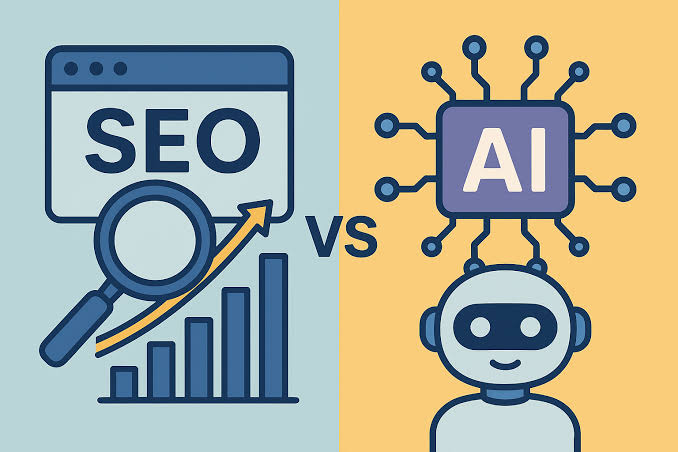
AI Search Visibility does not mean traditional SEO is disappearing. In many cases, the two disciplines reinforce each other.
Technical SEO, crawlability, structured content, strong information architecture, authoritative pages, and high-quality external references remain relevant to digital discovery.
The difference is that marketers increasingly need to optimize not only for rankings but also for retrievability, comprehensibility, and answer usefulness.
A strong SEO strategy can therefore become the foundation for AI search visibility, while AI-oriented measurement adds a new layer to understand how content is represented within answer-driven experiences.
The most effective marketing teams may ultimately operate with two complementary dashboards: one measuring conventional search performance and another measuring AI-driven visibility.
Measuring the New KPI –
AI Search Visibility should be designed as a measurable marketing KPI rather than a vague concept.
A practical framework can combine several dimensions:
Visibility = Mention + Relevance + Accuracy + Citation + Competitive Presence
Mention measures whether the brand appears at all. Relevance measures whether it appears for questions that actually matter to the business. Accuracy measures whether the information is correct. Citation measures whether authoritative content from the company or credible third parties is referenced. Competitive presence measures how the company’s visibility compares with the broader competitive set.
These metrics should be segmented by topic and buyer stage. A company might have strong visibility for educational questions but weak visibility for commercial comparisons. Another organization may be frequently mentioned but poorly represented because AI-generated descriptions contain outdated information.
That level of detail makes the metric actionable.
What Marketing Teams Should Do Now –
Marketing leaders do not need to completely rebuild their SEO programs to prepare for AI search. Instead, they can extend existing search and content processes.
Start by identifying the top questions that influence customer decisions. Then test how AI systems respond to those questions. Document which brands appear, which sources are cited, and how the organization is represented.
Next, audit the organization’s content against those questions. Look for missing answers, unclear product relationships, outdated information, unsupported claims, and weak evidence.
Finally, build a recurring measurement process. AI search behavior will continue to change, so a single audit will quickly become outdated. Monitoring should become part of the broader search, content, and brand intelligence program.
The Future of Marketing Measurement –
Marketing measurement has traditionally focused heavily on traffic and conversion. AI search introduces an additional layer: answer influence.
A customer may never click a brand’s website during an AI-assisted research session, yet the company’s expertise may still influence the answer the customer receives. Measuring that interaction is difficult, but ignoring it could leave marketing teams with an incomplete picture of how their brands are discovered.
The future may therefore involve a broader marketing measurement model that combines traditional search rankings, organic traffic, brand demand, content engagement, AI visibility, citations, and downstream business outcomes.
AI Search Visibility is not a replacement for revenue metrics. It is a leading indicator that can help marketing teams understand whether their brand is present in the information environments where customers are increasingly asking questions.
“Search visibility used to mean being found. In the AI era, it increasingly means being understood well enough to become part of the answer.”
Conclusion –
AI Search Visibility is becoming an important new consideration for marketing teams because the definition of search itself is changing. Customers are increasingly using conversational interfaces and AI-powered experiences to research products, understand categories, compare alternatives, and answer complex questions.
This creates a new challenge for brands. It is no longer enough to ask whether a webpage ranks for a keyword. Marketing teams increasingly need to understand whether their expertise, products, evidence, and brand are represented when customers ask relevant questions through AI-powered search experiences.
The organizations that adapt will not abandon SEO. They will expand it. They will build content around customer questions, strengthen brand and entity clarity, publish credible evidence, monitor third-party representation, and measure how frequently their organization appears in relevant AI-generated answers.
AI Search Visibility is therefore becoming less about winning a position on a results page and more about earning a place in the customer’s information journey.
Frequently Asked Questions –
AI Search Visibility measures how frequently and accurately a company, product, or brand appears in AI-generated answers for questions relevant to its market, products, and customers.
No. SEO primarily focuses on visibility within traditional search environments, while AI Search Visibility focuses on how brands and information are represented within AI-generated answers. The two disciplines overlap and can complement each other.
Customers increasingly use AI-powered interfaces to research products, compare vendors, and answer complex questions. Brands that are not represented in these answers may have less visibility during important research moments, even if they perform well in traditional search.
Companies can improve their potential visibility by creating authoritative, useful content; answering customer questions clearly; maintaining consistent information about products and entities; publishing original research and evidence; strengthening technical discoverability; and monitoring how AI systems represent the brand.
Potential metrics include brand mention rate, citation frequency, category inclusion, product mentions, information accuracy, visibility across customer questions, competitive presence, and visibility across different stages of the buyer journey.