


Introduction –
Search has always been the backbone of how people discover information online. For decades, Search Engine Optimization (SEO) has shaped how websites are built, how content is written, and how businesses attract traffic. The entire model was based on keywords—what users type into a search bar and how closely a webpage matches those terms.
But this model is rapidly changing.
With the rise of artificial intelligence, search is no longer limited to keywords. Instead, it is becoming conversational, contextual, and intent-driven. Users are no longer just typing “best CRM software” or “data pipeline tools.” They are asking complete questions, following up with clarifications, and expecting personalized answers.
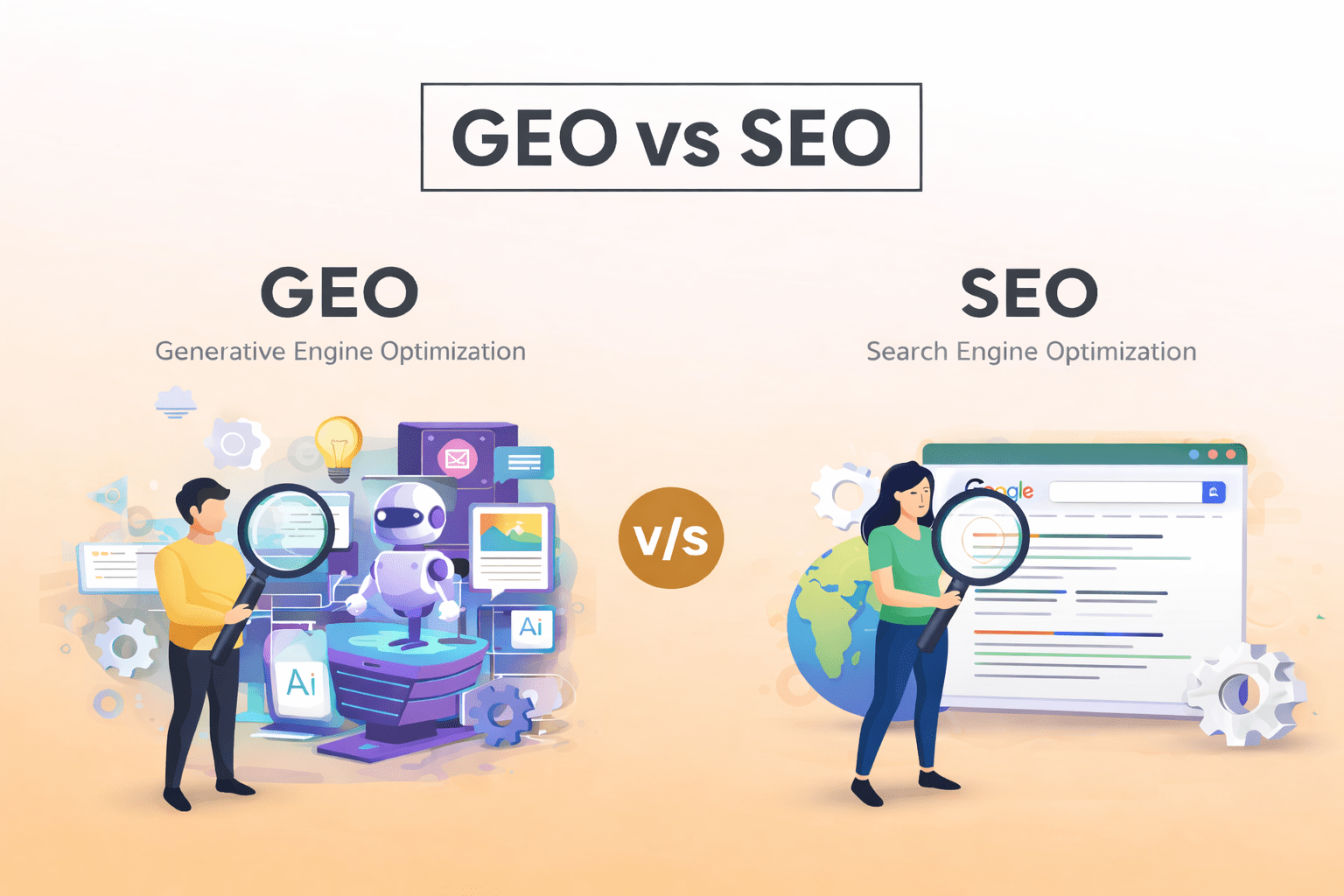
This shift has given rise to a new paradigm called AI Search, often discussed in contrast with traditional SEO. Alongside it, a new concept is emerging: GEO (Generative Engine Optimization), which focuses on optimizing content for AI-driven search engines and generative systems rather than traditional search engines.
We are moving from keywords to conversations—and this change is reshaping how content is created, ranked, and consumed.
The Era of Traditional SEO: Built on Keywords –
Search Engine Optimization was designed for a simple interaction model: users enter keywords, and search engines return the most relevant pages. Ranking depended heavily on keyword density, backlinks, metadata, and technical optimization.
In this system, success meant understanding what people searched for and matching those exact terms within content. Businesses optimized titles, headings, and body text to align with search engine algorithms.
For years, this approach worked effectively. It allowed websites to attract organic traffic and compete for visibility on search engine results pages.
However, SEO had one major limitation—it focused more on matching keywords than understanding intent. A page could rank well even if it did not fully answer the user’s question, as long as it matched the right signals.
As user behavior evolved, this gap between keywords and intent became more visible.
The Shift Toward AI Search –
AI-powered search systems are changing how information is retrieved and delivered. Instead of showing a list of links based on keyword matches, AI search engines interpret user intent and generate direct, conversational answers.
This means users no longer need to browse multiple websites to find information. Instead, they receive synthesized responses that combine insights from multiple sources.
For example, instead of searching for “benefits of cloud computing,” a user might ask:
“Why are companies moving to cloud platforms, and what are the main advantages for cost and scalability?”
An AI search system will not just return links. It will explain, summarize, and contextualize the answer.
This shift fundamentally changes how content is discovered. It is no longer about ranking for a keyword—it is about being included in AI-generated responses.
What is GEO (Generative Engine Optimization)?
Generative Engine Optimization, or GEO, is an emerging approach to content optimization designed for AI-driven search systems. Unlike SEO, which focuses on ranking in search engine results, GEO focuses on making content useful, structured, and context-rich enough to be used by AI models in generated responses.
In simple terms, GEO is about optimizing content so that AI systems choose it as a trusted source when generating answers.
This requires a different mindset. Instead of writing content purely for search engine crawlers, content must be written for understanding, clarity, and semantic depth.
GEO prioritizes:
- Context over keywords
- Meaning over repetition
- Structure over stuffing
- Clarity over optimization tricks
As AI search becomes more dominant, GEO is becoming just as important as SEO once was.
SEO vs GEO: A Fundamental Shift –
The difference between SEO and GEO is not just technical—it is philosophical. SEO is about visibility in search rankings, while GEO is about relevance in AI-generated responses.
| Aspect | SEO (Search Engine Optimization) | GEO (Generative Engine Optimization) |
|---|---|---|
| Primary Goal | Rank on search engines | Appear in AI-generated answers |
| Focus | Keywords and backlinks | Context and semantic meaning |
| Content Style | Structured for crawlers | Structured for understanding |
| User Interaction | Click-based browsing | Conversational answers |
| Optimization Target | Search engine algorithms | AI language models |
| Success Metric | Page ranking & traffic | Inclusion in AI responses |
This shift shows that content strategy is no longer just about attracting clicks—it is about becoming part of the conversation AI systems have with users.
Why AI Search is Changing User Behavior –
One of the biggest drivers of this transformation is user expectation. People now want faster, more direct answers instead of browsing multiple websites.
AI search removes friction by summarizing information instantly. It understands natural language queries, follows context across multiple questions, and delivers more personalized responses.
For example, instead of searching multiple pages about “ETL vs ELT pipelines,” users can now ask follow-up questions like:
“How do they compare in cloud data platforms?”
“Which one is better for real-time analytics?”
AI systems maintain context and provide continuous explanations, making search feel more like a conversation than a query.
This conversational experience is fundamentally changing how users interact with information online.
How GEO Changes Content Strategy –
With GEO, content is no longer created just to rank—it is created to be understood and reused by AI systems.
This means content must be written in a way that clearly explains concepts, answers related questions, and provides structured reasoning. AI systems prefer content that is logically organized, semantically rich, and contextually complete.
Instead of focusing only on short keywords, content creators must now think in terms of topics, questions, and conversational flows.
For example, rather than targeting a single keyword like “CDP benefits,” content should cover related concepts such as data unification, personalization, customer segmentation, and real-time analytics in a connected way.
This approach increases the chances of content being used in AI-generated responses.
The Role of Structured and Semantic Content –
AI systems rely heavily on understanding meaning rather than just matching words. This makes semantic structure extremely important in GEO.
Well-structured content helps AI models identify key ideas, relationships, and explanations within text. Clear headings, logical flow, and contextual depth make content more valuable for generative systems.
Unlike traditional SEO practices that sometimes encourage keyword repetition, GEO prioritizes clarity and natural language.
Content that answers questions directly, explains concepts thoroughly, and maintains contextual consistency is more likely to be selected by AI systems.
Challenges in the AI Search Era –
While AI search creates new opportunities, it also introduces challenges for businesses and content creators.
One major challenge is reduced visibility of traditional website traffic. If AI systems generate direct answers, users may not always click through to source websites.
Another challenge is content attribution. AI systems may summarize information without clearly directing users to original sources, making it harder for brands to measure visibility.
Additionally, competition increases because content must now compete not just for rankings, but for inclusion in AI-generated responses.
This requires a shift in mindset from SEO optimization to knowledge contribution.
How Businesses Can Adapt to GEO –
To succeed in the AI search era, businesses need to rethink their content strategies. Instead of focusing only on keyword targeting, they must focus on building authoritative, context-rich content ecosystems.
Content should answer real user questions in depth and cover topics comprehensively. Businesses should also focus on building trust through expertise, clarity, and consistency.
Another important strategy is improving content structure. Well-organized content with clear explanations helps AI systems interpret and reuse information more effectively.
Additionally, brands should focus on creating content that reflects real-world expertise rather than shallow keyword optimization.
As AI systems evolve, content quality will matter more than ever.
The Future of Search: Beyond Keywords –
The future of search is moving toward fully conversational experiences powered by artificial intelligence. Instead of typing short queries, users will engage in continuous dialogue with AI systems that understand context, intent, and personalization.
Search engines will evolve into answer engines, capable of reasoning, summarizing, and generating insights across multiple sources.
In this future, GEO will become a core part of digital strategy, just as SEO was in the past.
Businesses that adapt early will have a significant advantage in visibility, authority, and digital presence.
Conclusion –
The shift from keywords to conversations marks one of the most important transformations in the history of search. Traditional SEO helped businesses rank in search engines, but AI search is redefining how information is discovered and consumed.
Generative Engine Optimization (GEO) represents the next step in this evolution, focusing on making content understandable, contextual, and valuable for AI systems.
As users increasingly rely on conversational AI for information, businesses must adapt their content strategies to align with this new reality.
The future of search is not about matching keywords—it is about understanding meaning, context, and intent. Those who embrace this shift will remain visible and relevant in the era of AI-driven search.