


Introduction –
The digital world has always relied on a simple assumption: seeing is believing. Photographs, videos, and audio recordings have long been considered reliable forms of evidence, helping people verify events, identify individuals, and build trust online. However, advances in Artificial Intelligence are rapidly challenging this assumption.
Deepfakes, which use AI-powered algorithms to create realistic but fabricated audio, video, and images, are becoming increasingly sophisticated. What once required extensive technical expertise can now be created with accessible software and powerful generative AI tools. As a result, distinguishing between authentic and manipulated content is becoming more difficult than ever.
The rise of deepfake technology is not only a technical issue but also a societal one. It is reshaping how people perceive information, trust digital content, and verify reality in an increasingly connected world.
Understanding Deepfakes –
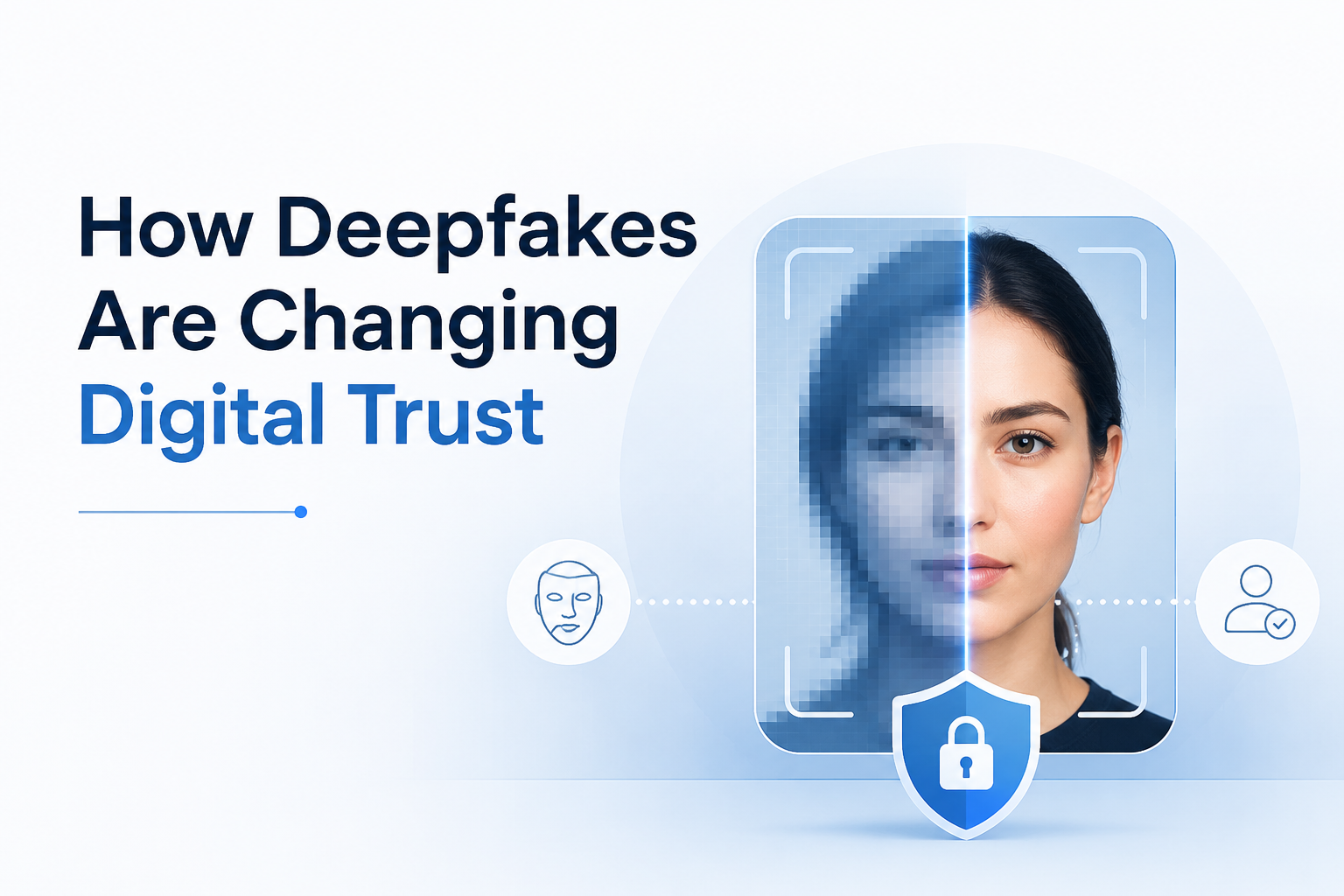
Deepfakes are synthetic media created using artificial intelligence techniques, particularly deep learning and neural networks. These systems analyze large amounts of visual and audio data to replicate a person’s appearance, voice, expressions, and mannerisms with remarkable accuracy.
By training AI models on existing content, creators can generate videos that appear to show individuals saying or doing things they never actually said or did. Similarly, audio deepfakes can mimic a person’s voice so convincingly that even close acquaintances may struggle to detect the manipulation.
What makes deepfakes particularly concerning is their realism. Modern AI systems can produce content that appears authentic to the average viewer, making misinformation more persuasive and difficult to challenge.
The Erosion of Digital Trust –

Trust is a fundamental component of digital communication. People rely on online content to make decisions, consume news, engage with brands, and communicate with others. As deepfakes become more widespread, confidence in digital media is beginning to weaken.
When realistic fake content can be created easily, individuals may start questioning the authenticity of legitimate photos, videos, and recordings. This phenomenon creates uncertainty not only around manipulated content but also around genuine evidence.
The challenge extends beyond individual skepticism. Organizations, governments, and media institutions must now operate in an environment where visual proof is no longer automatically trusted.
As a result, digital trust is evolving from an assumption to a process of verification.
Deepfakes and the Misinformation Challenge –
One of the most significant concerns surrounding deepfakes is their role in spreading misinformation. False videos and fabricated audio clips can be distributed rapidly across social media platforms, reaching millions of people before verification processes can catch up.
Deepfakes can be used to create misleading political statements, fake interviews, fabricated news events, or manipulated public appearances. Because people naturally trust visual evidence, these materials often have a strong emotional impact.
Even when deepfakes are eventually exposed, the damage may already be done. False information can influence public opinion, shape narratives, and create confusion long before corrections receive similar attention.
This ability to distort reality makes deepfakes a powerful tool for misinformation campaigns.
Impact on Businesses and Brands –
The rise of deepfakes is creating new challenges for organizations and brands. Corporate leaders, executives, and public-facing employees can become targets of sophisticated impersonation attacks.
For example, a deepfake video showing a CEO making controversial statements could damage a company’s reputation, affect investor confidence, and create public relations crises. Similarly, fraudulent audio recordings can be used in social engineering attacks to manipulate employees or customers.
Brands also face the challenge of protecting customer trust. As consumers become more aware of manipulated media, organizations must demonstrate greater transparency and authenticity in their communications.
Maintaining credibility in an era of synthetic media is becoming a critical business priority.
Cybersecurity Risks Associated with Deepfakes –
Deepfakes are increasingly being used as a cybersecurity threat. Criminals are leveraging AI-generated voices and videos to impersonate executives, employees, and trusted contacts.
These attacks often target financial transactions, sensitive information, or access credentials. Because the impersonations appear highly convincing, traditional security awareness measures may not always be sufficient.
Voice-cloning attacks have already demonstrated how synthetic audio can be used to authorize fraudulent payments or manipulate employees into revealing confidential information.
As deepfake technology improves, organizations must strengthen identity verification processes and adopt more sophisticated security controls.
How Social Media Amplifies the Problem –
Social media platforms play a significant role in the spread of deepfake content. Their algorithms are designed to promote engaging material, and sensational or controversial content often attracts significant attention.
Deepfakes can exploit this dynamic by generating strong emotional reactions that encourage sharing and discussion. Once content begins spreading, it becomes increasingly difficult to control its reach.
The speed at which information travels online often exceeds the speed of fact-checking and verification. As a result, even short-lived deepfakes can have long-lasting effects on public perception.
This amplification effect makes social media both a distribution channel and a challenge in combating synthetic media.
The Rise of Verification Technologies –
As deepfakes become more advanced, technology companies and researchers are developing new methods to verify digital authenticity. AI-based detection systems are being designed to identify subtle inconsistencies in manipulated media that may not be visible to the human eye.
Digital watermarking, content provenance systems, and cryptographic verification methods are also gaining attention. These technologies aim to establish clear records of how digital content was created and modified over time.
The goal is to create mechanisms that allow users to verify authenticity rather than relying solely on visual appearance.
While detection technologies continue to improve, the race between deepfake creators and detection systems remains ongoing.
The Human Factor in Digital Trust –
Technology alone cannot solve the deepfake challenge. Human behavior plays a significant role in how misinformation spreads and how digital trust is maintained.
Critical thinking, media literacy, and verification habits are becoming increasingly important skills. Individuals must learn to evaluate sources, question unusual content, and seek confirmation from multiple channels before accepting information as true.
Organizations are also investing in employee education programs to help staff recognize synthetic media and understand emerging cyber threats.
Building resilience against deepfakes requires a combination of technological safeguards and informed human judgment.
Deepfakes and the Future of Online Identity –
The rise of deepfakes is prompting broader discussions about digital identity. Traditional methods of verification based on voice, video, or visual appearance may become less reliable as synthetic media continues to advance.
Future identity systems may rely more heavily on biometric authentication, cryptographic credentials, and multi-factor verification methods. Trust will increasingly be based on verified digital identities rather than appearances alone.
This shift could fundamentally change how people interact online, conduct business, and establish credibility in digital environments.
As synthetic media becomes more common, proving authenticity may become just as important as creating content itself.
Balancing Innovation and Responsibility –
It is important to recognize that deepfake technology is not inherently harmful. Similar AI techniques are being used for positive purposes in entertainment, education, accessibility, and content creation.
For example, synthetic voices can help individuals with speech impairments, while visual effects technologies can enhance filmmaking and digital experiences.
The challenge lies in ensuring that innovation is accompanied by ethical standards, transparency, and responsible use. Governments, technology companies, researchers, and organizations all have a role to play in establishing safeguards against misuse.
Finding this balance will be critical as AI-generated media becomes more widespread.
Conclusion –
Deepfakes represent one of the most significant challenges to digital trust in the modern era. By enabling highly realistic synthetic media, they are changing how people evaluate information, verify authenticity, and interact online.
The implications extend far beyond technology. Deepfakes affect journalism, business, cybersecurity, politics, and everyday communication. As the line between real and artificial content becomes increasingly blurred, trust can no longer depend solely on what people see or hear.
The future of digital trust will depend on stronger verification technologies, improved media literacy, responsible AI development, and greater awareness of synthetic media risks.
In a world where almost anything can be convincingly fabricated, trust will increasingly be built through verification rather than assumption.