


For decades, the manufacturing industry has been built around a simple business model: manufacturers design and produce products, customers purchase them, and the commercial relationship often ends once the transaction is complete. Revenue growth has traditionally depended on selling more units, expanding into new markets, and encouraging repeat purchases whenever equipment reaches the end of its lifecycle. While this approach has powered industrial growth for generations, today’s digital economy is reshaping customer expectations and forcing manufacturers to rethink how they create long-term value.
Modern enterprises no longer evaluate suppliers solely on product quality or purchase price. Instead, they increasingly prioritize reliability, operational efficiency, continuous support, and measurable business outcomes. At the same time, emerging technologies such as Artificial Intelligence (AI), the Internet of Things (IoT), cloud computing, predictive analytics, and digital twins are enabling manufacturers to stay connected with their products long after deployment. These technologies allow businesses to monitor equipment performance remotely, predict maintenance requirements, optimize productivity, and continuously improve customer experiences.
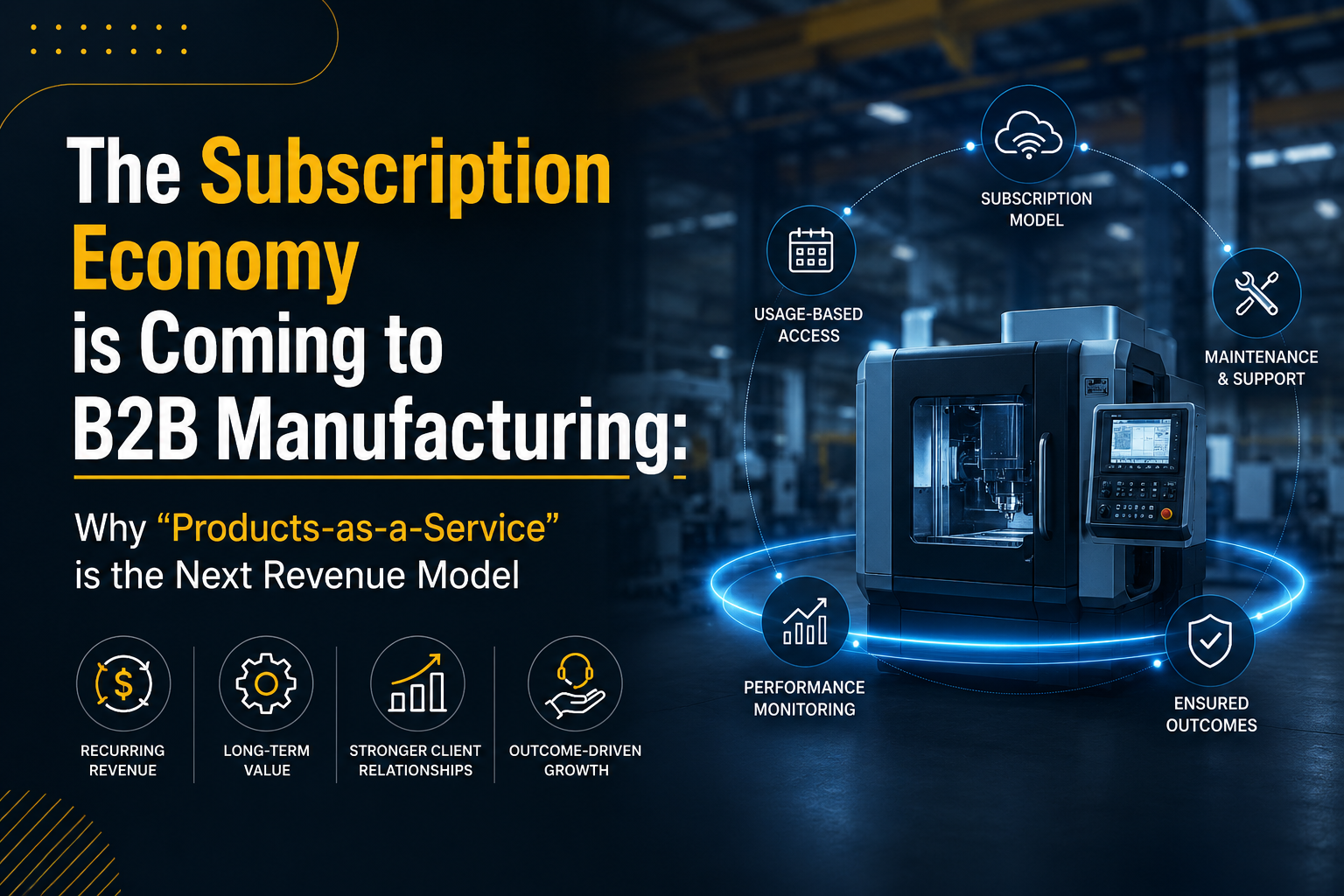
This technological evolution has given rise to Product-as-a-Service (PaaS)—a subscription-driven business model that is redefining B2B manufacturing. Instead of generating revenue from one-time product sales, manufacturers are building long-term partnerships by offering equipment alongside ongoing services such as predictive maintenance, remote monitoring, software upgrades, technical support, and performance optimization. The result is a shift from transactional selling to continuous value creation, where both manufacturers and customers benefit from stronger collaboration, predictable revenue, and improved operational performance.
What is Product-as-a-Service (PaaS)?
Product-as-a-Service represents one of the most significant business model transformations taking place within modern manufacturing. Unlike the traditional approach where ownership transfers immediately after purchase, the PaaS model allows customers to access industrial equipment through recurring subscription or usage-based pricing. Instead of paying significant upfront capital costs, businesses subscribe to equipment while manufacturers remain responsible for ensuring that products continue operating efficiently throughout their lifecycle.
These subscription agreements typically include a wide range of value-added services, including preventive maintenance, software updates, real-time monitoring, remote diagnostics, technical support, equipment optimization, and performance reporting. Rather than acting solely as equipment suppliers, manufacturers become long-term strategic partners whose success is directly linked to the operational performance of their customers.
This shift fundamentally changes the relationship between manufacturers and buyers. Instead of focusing exclusively on closing sales, organizations now focus on maximizing customer success over many years, creating recurring revenue while delivering continuous improvements throughout the customer journey.
“The future of manufacturing won’t be defined by who sells the most products—but by who delivers the greatest long-term value.”
Why Traditional Manufacturing Models Are Changing –
Several market forces are accelerating the transition toward subscription-based manufacturing. Customer expectations have evolved dramatically over the past decade as organizations increasingly adopt subscription services across nearly every aspect of business operations. From enterprise software and cloud computing to cybersecurity and business applications, companies have become comfortable paying for ongoing access instead of outright ownership. Manufacturing is now following the same path.
Businesses today operate in an environment where flexibility is becoming more valuable than ownership. Purchasing advanced industrial equipment often requires significant capital investment, making technology upgrades expensive and slowing digital transformation initiatives. Subscription-based models eliminate many of these barriers by converting large capital expenditures into manageable operational expenses. This enables organizations to adopt the latest manufacturing technologies while preserving financial flexibility.
At the same time, manufacturers benefit from greater financial stability. Traditional equipment sales often produce unpredictable revenue patterns influenced by seasonal demand, procurement cycles, and economic conditions. Subscription pricing creates recurring revenue streams that improve forecasting accuracy, strengthen investor confidence, and provide organizations with greater resources to invest in research, innovation, and customer support.
The Technologies Driving Product-as-a-Service –
The success of Product-as-a-Service would not be possible without rapid advancements in digital technologies. Connected industrial equipment now generates enormous volumes of operational data that manufacturers can analyze in real time to improve both equipment performance and customer experience.
The Internet of Things has transformed traditional machinery into intelligent connected assets. Sensors embedded within equipment continuously monitor variables such as temperature, vibration, pressure, energy consumption, production output, and component wear. This data is transmitted securely through cloud platforms, providing manufacturers with continuous visibility into equipment health regardless of geographical location.
Artificial Intelligence complements IoT by transforming raw operational data into meaningful business intelligence. AI algorithms analyze historical performance, identify hidden patterns, predict future failures, recommend maintenance schedules, and optimize overall equipment efficiency. Rather than waiting for machines to fail unexpectedly, manufacturers can proactively intervene before operational disruptions occur.
Cloud computing further enhances these capabilities by creating centralized environments where manufacturers can monitor thousands of deployed machines simultaneously while providing customers with secure dashboards, performance analytics, maintenance recommendations, and operational insights from anywhere in the world.
Together, AI, IoT, predictive analytics, and cloud infrastructure create a digital ecosystem that enables manufacturers to deliver continuous services instead of one-time products.
Benefits of Product-as-a-Service for Manufacturers and Customers –
Perhaps the most significant advantage of Product-as-a-Service is its ability to create sustainable long-term value for both manufacturers and customers.
For manufacturers, recurring subscription revenue creates greater financial predictability compared to traditional sales cycles. Instead of depending entirely on acquiring new customers, organizations generate continuous income throughout the duration of customer relationships. This recurring revenue supports strategic planning, accelerates innovation, improves cash flow, and strengthens long-term business resilience.
Customers also gain substantial advantages. Rather than making large upfront investments in expensive industrial equipment, organizations can adopt advanced technologies through flexible subscription pricing. Maintenance, repairs, software upgrades, and technical support are often included within the service agreement, reducing operational risk while improving budgeting accuracy.
More importantly, continuous engagement transforms manufacturers into trusted advisors rather than occasional suppliers. Regular performance reviews, optimization recommendations, predictive maintenance, and ongoing collaboration strengthen customer loyalty while creating opportunities for cross-selling and long-term partnership growth.
From Product Ownership to Business Outcomes –
One of the most important shifts driving Product-as-a-Service is the movement away from ownership toward measurable business outcomes.
Modern organizations increasingly care less about owning machinery and more about achieving specific operational objectives. Manufacturers are therefore moving beyond selling equipment and instead guaranteeing uptime, production efficiency, energy savings, quality improvements, and operational reliability.
Outcome-based contracts align manufacturer success directly with customer success. Because manufacturers continue earning revenue throughout the subscription lifecycle, they are incentivized to maximize equipment performance, continuously improve technology, and proactively resolve issues before they impact operations.
This alignment creates a collaborative business relationship where both parties benefit from long-term operational excellence rather than isolated product transactions.
AI and Predictive Maintenance Are Transforming Manufacturing –
Artificial Intelligence is becoming one of the most valuable components of Product-as-a-Service strategies because it enables manufacturers to shift from reactive maintenance toward predictive service delivery.
Instead of responding after equipment failures occur, AI continuously analyzes operational patterns to predict when components are likely to require maintenance or replacement. Predictive maintenance reduces unexpected downtime, extends equipment lifespan, lowers repair costs, and improves overall productivity.
Digital Twin technology further enhances this capability by creating virtual replicas of physical equipment. Manufacturers can simulate operating conditions, evaluate maintenance scenarios, optimize configurations, and identify performance improvements without interrupting production.
As AI models continue learning from operational data, they become increasingly effective at helping customers maximize productivity while reducing operational costs.
Subscription Manufacturing Supports Sustainability –
Beyond financial and operational advantages, Product-as-a-Service also contributes to more sustainable manufacturing practices.
Because manufacturers remain responsible for equipment performance throughout its lifecycle, they are encouraged to design products that last longer, consume fewer resources, require fewer replacements, and support refurbishment or recycling initiatives.
This approach naturally aligns with circular economy principles by reducing waste and maximizing equipment utilization. Customers also benefit from higher asset efficiency while manufacturers reduce environmental impact through improved lifecycle management.
As governments continue introducing stricter environmental regulations and ESG initiatives become board-level priorities, subscription manufacturing provides organizations with a practical framework for achieving both commercial and sustainability objectives.