


For nearly two decades, Decision Intelligence has been preceded by another technology that dominated enterprise leadership—Business Intelligence dashboards. From finance and sales to marketing, HR, operations, and IT, organizations have relied on dashboards to measure KPIs, monitor performance, and guide strategic planning. Executive meetings have traditionally revolved around charts, graphs, and reports designed to answer one fundamental question: What is happening inside the business?
While dashboards have significantly improved organizational visibility, today’s business landscape has become far more complex than traditional reporting systems were designed to support. Enterprises now generate millions of data points every day through CRM platforms, ERP systems, marketing automation, IoT devices, collaboration tools, customer support applications, and cloud-based services. The challenge is no longer collecting information—it is understanding what that information means and determining the best course of action before opportunities disappear or risks escalate.
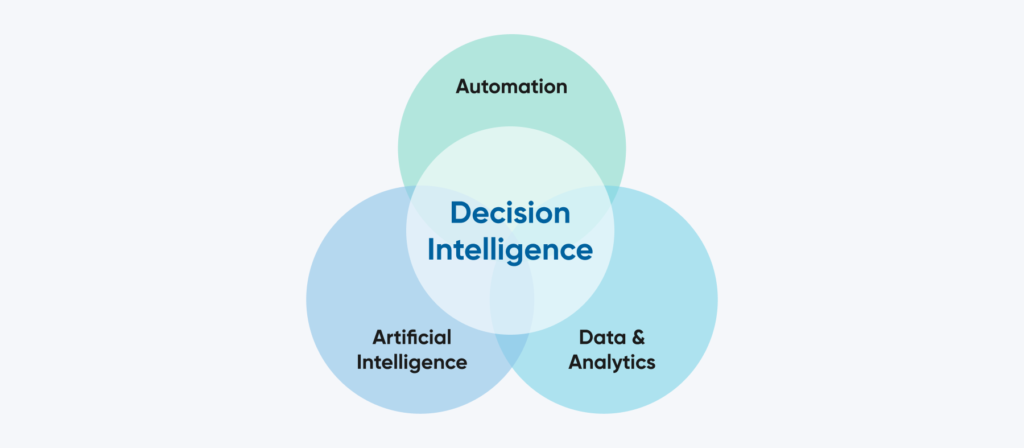
This is where Decision Intelligence is reshaping enterprise leadership. Rather than simply displaying historical or real-time metrics, Decision Intelligence combines artificial intelligence, predictive analytics, machine learning, knowledge graphs, and business rules to recommend optimal decisions. Instead of asking leaders to interpret dashboards manually, it provides context, predicts outcomes, evaluates alternatives, and recommends actions.
“The future belongs to organizations that don’t just measure performance—they continuously improve it through intelligent decision-making.”
As organizations compete in increasingly volatile markets, dashboards alone are no longer enough. The next competitive advantage lies in transforming enterprise data into intelligent recommendations that empower leaders to act faster, smarter, and with greater confidence.
Why Traditional Dashboards Are Reaching Their Limits –
Business Intelligence platforms revolutionized enterprise reporting by consolidating information into interactive dashboards. Executives gained unprecedented visibility into revenue performance, operational efficiency, workforce productivity, customer acquisition, inventory levels, and financial health. However, dashboards were designed primarily to visualize information—not interpret it.
Today’s enterprises generate massive amounts of structured and unstructured data across dozens of disconnected systems. Customer interactions, financial transactions, employee activities, operational processes, supply chain movements, and digital engagement all contribute to an ever-expanding information ecosystem.
Although dashboards successfully organize these metrics, they still depend heavily on human interpretation. Leaders must manually identify patterns, investigate anomalies, evaluate risks, compare multiple reports, and determine appropriate actions. This creates delays in environments where market conditions can change overnight.
Key Insight –
Traditional dashboards answer “What happened?” Decision Intelligence answers “Why did it happen, what will happen next, and what should we do about it?”
What Is Decision Intelligence?
Decision Intelligence (DI) represents the next evolution of enterprise analytics.
Rather than functioning solely as a reporting platform, Decision Intelligence combines:
- Artificial Intelligence
- Machine Learning
- Predictive Analytics
- Knowledge Graphs
- Behavioral Science
- Simulation Models
- Business Rules Engines
Together, these technologies transform enterprise data into intelligent recommendations.
Imagine a dashboard reporting that quarterly revenue has declined by six percent. While informative, it still requires analysts to investigate the underlying causes.
A Decision Intelligence platform automatically examines:
- Customer purchasing behavior
- Sales pipeline health
- Competitor activity
- Marketing effectiveness
- Pricing strategies
- Supply chain performance
- Economic indicators
Instead of simply highlighting the problem, it identifies the most likely causes and recommends corrective actions.
Business Intelligence vs. Decision Intelligence –
| Business Intelligence | Decision Intelligence |
|---|---|
| Reports historical performance | Predicts future outcomes |
| Displays KPIs | Recommends business actions |
| Requires manual interpretation | Provides AI-driven recommendations |
| Focuses on reporting | Focuses on decision support |
| Identifies trends | Explains why trends occur |
| Reactive | Predictive and proactive |
| Answers “What happened?” | Answers “What should happen next?” |
How Decision Intelligence Is Transforming Enterprise Functions –
- Sales –
Traditional CRM dashboards help sales managers monitor opportunities, conversion rates, pipeline value, and forecasting. While these insights are valuable, they still require managers to determine which deals deserve immediate attention.
Decision Intelligence continuously evaluates customer engagement, buying signals, pricing behavior, historical win rates, competitor activity, and sales interactions to recommend the next best action. Sales leaders can prioritize high-value opportunities, detect deal risks early, improve forecast accuracy, and personalize customer engagement more effectively.
- Marketing –
Marketing dashboards typically focus on impressions, website traffic, campaign performance, click-through rates, and lead generation.
Decision Intelligence goes beyond performance reporting by connecting campaign results with customer lifetime value, sales outcomes, competitive trends, product demand, and market conditions. Instead of simply reporting yesterday’s performance, it recommends where marketing investments should be allocated to maximize future ROI.
- Human Resources –
HR dashboards provide visibility into recruitment progress, employee engagement, workforce diversity, and turnover rates.
Decision Intelligence enables HR teams to forecast employee attrition, identify burnout risks, anticipate future skill shortages, improve succession planning, and align workforce strategies with long-term business objectives.
Rather than reacting to workforce challenges, HR leaders gain the ability to prevent them.
- Operations and Supply Chain –
Operational dashboards monitor production volumes, inventory levels, logistics, supplier performance, and manufacturing efficiency.
Decision Intelligence continuously analyzes supplier reliability, transportation disruptions, commodity prices, customer demand forecasts, weather conditions, and geopolitical events to recommend inventory adjustments, alternative suppliers, production changes, and procurement strategies before disruptions impact operations.
- Finance –
Financial dashboards summarize historical business performance through budgets, profit and loss statements, cash flow reports, and expense tracking.
Decision Intelligence enhances financial planning by simulating future scenarios based on operational, commercial, workforce, and market data. Finance leaders gain greater confidence in forecasting, budgeting, investment planning, and profitability analysis.
The Technologies Powering Decision Intelligence –
Decision Intelligence combines multiple advanced technologies into a unified enterprise decision framework.
| Technology | Business Value |
|---|---|
| Artificial Intelligence | Intelligent recommendations |
| Machine Learning | Continuous improvement |
| Predictive Analytics | Forecast future outcomes |
| Knowledge Graphs | Connect enterprise data |
| Business Rules | Ensure governance |
| Simulation Models | Evaluate multiple scenarios |
| Explainable AI | Build trust and transparency |
Why Knowledge Graphs Matter –
One of the defining capabilities of Decision Intelligence is the use of knowledge graphs.
Rather than analyzing isolated datasets, knowledge graphs connect relationships across customers, employees, suppliers, products, contracts, invoices, projects, marketing campaigns, operational activities, and financial transactions.
This contextual understanding enables AI to reason across the enterprise instead of evaluating individual metrics independently.
The result is more accurate recommendations supported by organizational context rather than isolated data points.
Scenario Simulation: Planning Before Acting –
Traditional dashboards explain historical performance.
Decision Intelligence enables organizations to simulate future business scenarios before making strategic commitments.
Enterprise leaders can evaluate questions such as:
- What happens if raw material costs increase by 20%?
- How will subscription pricing affect profitability?
- Which supply chain strategy minimizes geopolitical risk?
- How will hiring decisions influence future operational capacity?
Instead of relying solely on experience or spreadsheets, executives can evaluate multiple outcomes using continuously updated AI models.
Why Human Judgment Still Matters –
Decision Intelligence is not designed to replace executive leadership.
Instead, it reduces cognitive overload by processing enormous amounts of enterprise data while allowing leaders to focus on areas where human judgment remains irreplaceable.
These include:
- Strategic thinking
- Ethical decision-making
- Innovation
- Relationship building
- Organizational culture
- Long-term business vision
AI accelerates analytical reasoning, but final decisions continue to depend on human expertise.
Benefits of Decision Intelligence –
Organizations adopting Decision Intelligence are already experiencing measurable improvements across multiple business functions.
| Benefit | Business Impact |
|---|---|
| Faster decision-making | Reduced response time |
| Improved forecasting | Higher planning accuracy |
| Better resource allocation | Increased operational efficiency |
| Early risk detection | Lower business disruption |
| Smarter pricing strategies | Improved profitability |
| Enhanced customer retention | Higher lifetime value |
| Predictive business planning | Sustainable growth |
Conclusion –
Enterprise leadership is entering a new era where visibility alone is no longer a competitive advantage. Dashboards remain valuable for monitoring business performance, but they cannot independently explain why trends emerge, predict what will happen next, or recommend the best strategic response.
Decision Intelligence bridges this gap by transforming enterprise data into actionable business reasoning. Through artificial intelligence, predictive analytics, knowledge graphs, and simulation models, organizations can move beyond static reporting toward intelligent decision support.
As markets become increasingly dynamic, leaders who embrace Decision Intelligence will be better positioned to anticipate change, reduce uncertainty, allocate resources effectively, and respond to opportunities with confidence. The future will not belong to the organizations with the most dashboards—it will belong to those with the smartest decision systems.
Frequently Asked Questions –
Decision Intelligence is an advanced approach that combines AI, predictive analytics, machine learning, and business rules to help organizations make faster and more informed business decisions.
Business Intelligence focuses on reporting historical and current performance, while Decision Intelligence analyzes data, predicts future outcomes, and recommends optimal business actions.
Almost every industry—including healthcare, finance, manufacturing, retail, logistics, technology, and professional services—can leverage Decision Intelligence to improve operational efficiency and strategic planning.
No. Decision Intelligence enhances executive decision-making by providing intelligent recommendations while leaving strategic judgment and final decisions to human leaders.
Dashboards provide visibility into business performance but still require manual interpretation. Decision Intelligence adds context, predicts future scenarios, explains underlying causes, and recommends the best course of action.