


Introduction –
AI agents vs. traditional marketing automation is becoming an important discussion for modern marketing teams. Businesses have used marketing automation for years to send emails, segment audiences, schedule campaigns, score leads, and trigger predefined customer journeys. These systems have helped marketers reduce repetitive work and create more consistent processes. However, the emergence of AI agents is changing what automation can do.
Traditional marketing automation generally follows rules created by humans. Marketers define the conditions, actions, workflows, and outcomes in advance. AI agents can operate more dynamically by interpreting information, deciding what action may be appropriate, using available tools, and adapting their behavior based on changing conditions. This creates a significant difference between simply automating a workflow and delegating parts of a marketing process to an intelligent system.
The distinction does not mean traditional automation is becoming irrelevant. Instead, businesses are beginning to use both approaches together. Traditional automation remains valuable for predictable, repeatable processes, while AI agents can support activities that require interpretation, reasoning, personalization, and adaptation.
What Is Traditional Marketing Automation?
Traditional marketing automation is built around predefined rules and workflows. A marketer determines what should happen when a customer performs a particular action.
For example, if someone downloads an ebook, the automation platform might add that person to a particular segment, send a follow-up email after two days, assign a lead score, and notify a salesperson when the score reaches a specific threshold.
The system performs these actions consistently because marketers have already defined the workflow.
This approach is powerful because it is predictable. Businesses know what the system will do when a specific condition occurs. It is also relatively easy to measure because the workflow has clearly defined inputs and outputs.
However, traditional automation can become difficult to manage when customer journeys become complicated. As marketers create more rules, branches, exceptions, and triggers, workflows can become increasingly complex.
What Is an AI Agent?
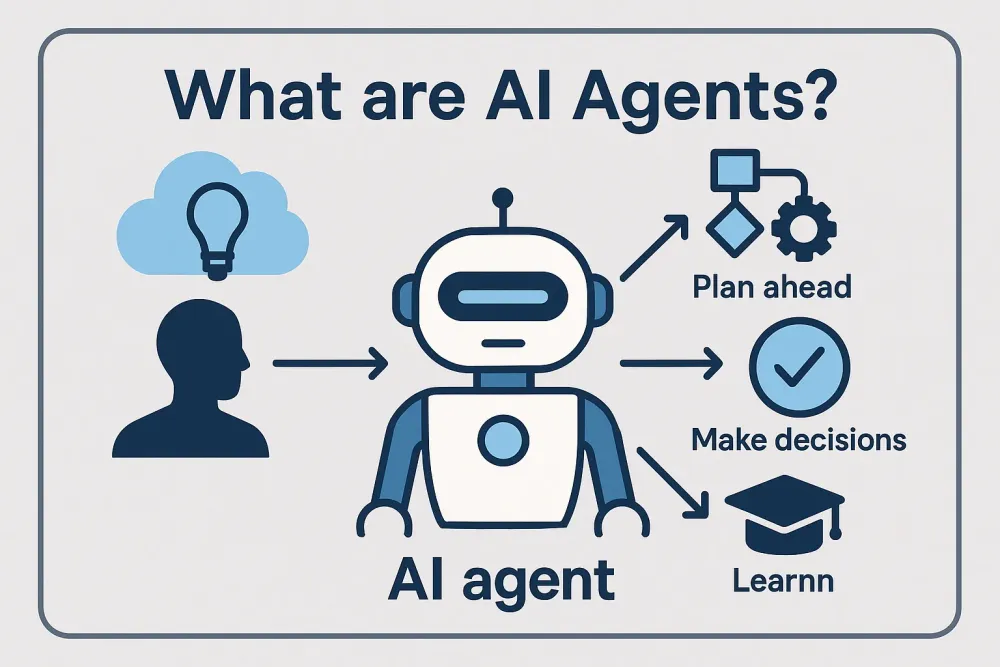
An AI agent is designed to perform tasks by interpreting information, reasoning about possible actions, using tools, and working toward a defined objective.
Instead of simply following one fixed sequence, an AI agent may determine which action is appropriate based on the context it receives.
For example, an AI marketing agent could analyze a lead’s company information, website activity, previous interactions, content consumption, and CRM data. It could then determine whether the lead appears ready for sales engagement, identify relevant content, draft a personalized message, and recommend a next action.
The key difference is that the marketer defines more of the objective, while the agent can determine some of the steps required to achieve it.
This creates a more flexible model of automation.
The Core Difference Between AI Agents and Automation –
The simplest way to understand the difference is to think about rules versus goals.
Traditional automation generally says:
“When X happens, do Y.”
AI agents can operate closer to:
“Achieve X using the information and tools available to you.”
For example, a traditional workflow might send an email when a prospect downloads a whitepaper. An AI agent could examine the prospect’s behavior, identify the topic they appear most interested in, evaluate their company profile, determine the appropriate communication approach, and recommend or execute a relevant follow-up.
The second approach requires more interpretation.
That is where AI agents can potentially create value.
AI Agents vs. Traditional Marketing Automation –
| Traditional Marketing Automation | AI Agents |
|---|---|
| Rule-driven | Goal-driven |
| Follows predefined workflows | Can determine next steps |
| Highly predictable | More adaptive |
| Requires explicit rules | Can interpret context |
| Best for repetitive tasks | Best for dynamic tasks |
| Limited decision-making | Can support decision-making |
| Fixed workflow paths | Potentially flexible workflows |
| Human defines most actions | Human defines objectives and boundaries |
| Easier to control | Requires stronger governance |
| Best for consistency | Best for adaptability |
Why Marketing Teams Are Exploring AI Agents –
Marketing teams are under pressure to deliver more personalized experiences while managing increasing amounts of data and content. Customers expect businesses to understand their interests, preferences, behavior, and stage in the buying journey.
Traditional automation can support personalization, but marketers often need to create extensive rules to account for different scenarios.
AI agents offer the possibility of reducing some of this manual configuration. Instead of creating a separate workflow for every possible customer situation, marketers can give an agent access to relevant data and tools and define the objective it should accomplish.
This could allow marketing teams to move from managing hundreds of individual workflows toward managing higher-level objectives and guardrails.
AI Agents Can Interpret Context –
One of the most important differences is contextual understanding.
Traditional automation may recognize that a customer opened an email, visited a webpage, or downloaded a document. It can then trigger a predefined action.
An AI agent can potentially combine several signals and interpret them together.
For example, a prospect might visit a pricing page several times, read an article about enterprise security, attend a webinar, and then return to the website from a company IP address.
A traditional system might assign points to each action.
An AI agent could potentially interpret the combination of behaviors and determine that the prospect appears to have a strong interest in enterprise-level evaluation.
This does not mean the agent will always make the correct decision. It means the system can work with a richer context rather than relying entirely on isolated rules.
Traditional Automation Is Still Extremely Valuable –
The rise of AI agents does not mean marketers should abandon traditional automation.
In many cases, traditional automation is actually preferable.
Consider tasks such as sending an invoice notification, updating a CRM field, adding a customer to a compliance-required list, or sending a predefined confirmation email.
These activities are predictable and often require precise execution.
Using an AI agent for every simple workflow could introduce unnecessary complexity and risk.
Traditional automation is particularly useful when businesses need consistency, predictability, auditability, and strict control.
The question is therefore not which technology will replace the other.
The better question is:
Which type of automation is appropriate for each marketing task?
AI Agents Are Better Suited to Dynamic Tasks –
AI agents can be particularly useful when a task involves changing information, multiple possible paths, or interpretation.
Examples include analyzing customer feedback, researching prospects, summarizing sales conversations, generating personalized campaign ideas, identifying potential buying signals, or recommending next actions.
These tasks are difficult to fully define using simple rules because the correct action may depend on context.
AI agents can potentially handle these situations more flexibly.
However, flexibility also introduces risk. The more freedom an agent has to make decisions or take actions, the more important governance becomes.
Lead Qualification Is a Good Example –
Lead qualification demonstrates the difference clearly.
A traditional marketing automation platform might assign points based on actions. A prospect receives points for downloading content, visiting a pricing page, attending a webinar, or opening an email. When the score reaches a specific threshold, the system sends the lead to sales.
An AI agent could potentially evaluate a broader set of information. It might consider company size, industry, job role, website behavior, recent interactions, content interests, and CRM history before recommending whether the lead deserves sales attention.
The agent may also explain why it believes the lead is worth prioritizing.
This can create a more flexible qualification process.
But organizations should still establish clear rules around what the agent can decide and what requires human review.
Personalization Becomes More Dynamic –
Traditional personalization often relies on predefined segments.
For example:
- Enterprise customers receive one email.
- Small businesses receive another.
- Existing customers receive a different campaign.
- New leads enter a separate workflow.
This works well when customer categories are clear.
AI agents can potentially move personalization toward a more dynamic model. Instead of assigning customers to a fixed segment, an agent could interpret their current behavior and determine which message, offer, content asset, or action is most relevant.
This could make customer experiences more responsive.
However, excessive personalization can also feel intrusive. Businesses need to balance relevance with privacy and customer expectations.
AI Agents and Content Marketing –
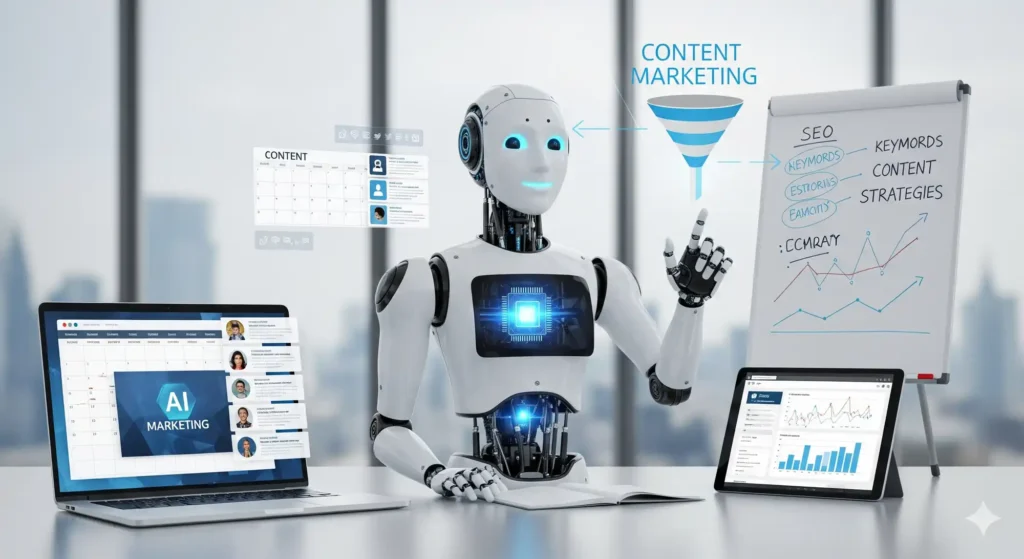
Content production is another area where AI agents can change marketing workflows.
Traditional automation can schedule content distribution, publish social posts, send newsletters, and trigger campaigns based on predefined conditions.
An AI agent could potentially monitor customer interests, identify emerging topics, analyze existing content performance, suggest new topics, draft content, create variations, and recommend distribution channels.
The important difference is that the agent can participate in multiple connected steps rather than simply triggering one predefined action.
Human review remains important, particularly for brand messaging, factual accuracy, regulated industries, and sensitive topics.
AI Agents and Campaign Optimization –
Traditional marketing automation can execute A/B tests and predefined optimization rules.
For example, marketers might configure a system to send version A to half the audience and version B to the other half, then identify the better-performing version.
An AI agent could potentially monitor campaign performance continuously and recommend adjustments based on changing results.
It might identify that one audience segment is responding differently, suggest a new message, recommend reallocating budget, or identify a potential performance issue.
The more autonomous the system becomes, however, the more carefully marketers need to define boundaries around spending, messaging, targeting, and brand safety.
The Importance of Human Oversight –
AI agents introduce a new question for marketing teams:
How much autonomy should an AI system have?
There is a major difference between an agent that recommends an action and an agent that automatically executes it.
For low-risk activities, organizations may allow greater autonomy. For example, an agent could organize research or summarize campaign performance.
For higher-risk activities, human approval may be required. Examples include changing advertising budgets, communicating sensitive information, modifying customer records, or making decisions that could significantly affect customers.
A useful framework is to establish different levels of autonomy based on risk.
AI Agents Can Reduce Workflow Complexity –
Traditional automation can create workflow sprawl.
As marketing teams add more campaigns, audiences, triggers, and exceptions, the number of workflows can grow rapidly. Eventually, marketers may spend significant time maintaining automation rather than improving strategy.
AI agents may reduce some of this complexity by allowing marketers to define broader objectives instead of building every possible decision path manually.
However, organizations should not assume that AI automatically eliminates complexity. Agentic systems introduce their own operational requirements, including monitoring, permissions, testing, logging, evaluation, and governance.
The complexity does not disappear.
It changes form.
Governance Becomes More Important –
Traditional automation is generally predictable because the workflow is predefined. AI agents can make decisions based on context, which means organizations need additional controls.
Marketing leaders should consider questions such as:
- What data can the agent access?
- What systems can it modify?
- Which actions require human approval?
- How are decisions recorded?
- How is performance evaluated?
- What happens when the agent is uncertain?
- How can an incorrect action be reversed?
These questions become particularly important when agents have access to CRM systems, advertising platforms, customer databases, or communication tools.
AI Agents and Marketing Operations –
Marketing operations teams may experience some of the biggest changes from agentic AI.
Instead of manually maintaining every workflow, operations teams may increasingly focus on designing the environment in which AI agents operate.
This includes defining objectives, permissions, data sources, tools, quality standards, approval processes, and performance metrics.
In other words, marketing operations may evolve from workflow administration to automation orchestration.
That is a significant change in the role of the marketing operations professional.
The Best Approach Is Likely Hybrid –
The future of marketing automation is unlikely to be purely agent-based.
Instead, organizations will probably use a hybrid model.
Traditional automation will handle predictable processes where consistency is more important than flexibility. AI agents will handle tasks that require interpretation, research, reasoning, and adaptation. Humans will remain responsible for strategic decisions, high-risk actions, brand direction, and governance.
This creates a three-layer model:
Traditional automation → AI agents → Human decision-making
Each layer performs the work it is best suited to handle.
How Businesses Can Start Using AI Agents –
Organizations should not begin by giving an AI agent unlimited access to their marketing systems. A better approach is to start with a narrow, measurable use case.
For example, a company could deploy an AI agent to research inbound leads and create summaries for sales representatives. Another organization might use an agent to analyze customer feedback and identify recurring themes.
Once the organization understands how the system behaves, it can gradually expand the agent’s responsibilities.
The key is to establish clear objectives and measurable outcomes from the beginning.
Measuring AI Agent Performance –
AI agent performance should not be measured only by how many tasks it completes.
Marketing teams should also measure the quality and business impact of those actions.
Relevant metrics may include lead qualification accuracy, campaign engagement, conversion rates, response time, content performance, productivity improvements, cost savings, and human override rates.
Organizations should also track errors.
If an AI agent performs thousands of actions but requires frequent correction, automation volume alone does not represent success.
The objective should be useful autonomy, not maximum autonomy.
Conclusion –
The difference between AI agents and traditional marketing automation comes down largely to how decisions are made. Traditional automation executes predefined rules and workflows, making it highly predictable and valuable for repetitive processes. AI agents can interpret context, pursue goals, use tools, and adapt their actions, making them better suited to more dynamic marketing activities.
Neither approach needs to replace the other. Traditional automation remains essential for predictable, high-volume workflows, while AI agents can add intelligence to tasks that previously required significant human judgment and manual effort.
For marketing teams, the future will likely be about combining both technologies with human oversight. Businesses that clearly define which tasks should be automated, which should be agent-driven, and which should remain human-controlled can build marketing operations that are faster, more personalized, and more adaptable.
The real opportunity is not simply replacing marketing automation with AI agents. It is creating a smarter automation ecosystem where rules handle predictable work, AI handles complexity, and humans remain responsible for strategy and judgment.
“Traditional automation follows the path you design. AI agents can help determine which path makes sense.”
Frequently Asked Questions –
Traditional marketing automation follows predefined rules and workflows, while AI agents can interpret context, pursue objectives, use tools, and potentially determine the next best action.
Not completely. Traditional automation remains highly effective for predictable and repetitive processes. AI agents are more useful for dynamic tasks that require interpretation and adaptation.
Neither is universally better. The right approach depends on the task. Predictable processes are often better suited to traditional automation, while complex and dynamic activities may benefit from AI agents.
Yes. AI agents can potentially analyze customer behavior, preferences, and context to recommend or create more personalized marketing experiences. Human oversight is still important for brand consistency and responsible data use.
Usually not. Organizations should establish permissions and approval requirements based on the risk of each action. High-impact activities should generally include human oversight.