


Introduction –
Data Loss Prevention (DLP) has become a critical component of enterprise cybersecurity as organizations increasingly depend on digital information to operate, communicate, and make business decisions. Customer records, financial reports, employee information, intellectual property, business strategies, and confidential documents are constantly moving across networks, cloud applications, endpoints, and external platforms. While this connectivity improves productivity, it also creates opportunities for sensitive information to be exposed, stolen, or shared without authorization.
A single employee accidentally sending a confidential spreadsheet to the wrong recipient, uploading customer information to an unapproved cloud application, or copying business data onto a personal USB drive can create significant security and compliance risks. More sophisticated threats, such as ransomware, compromised accounts, malicious insiders, and unauthorized data transfers, make the problem even more challenging.
Data Loss Prevention (DLP) addresses these risks by identifying sensitive information, monitoring how it is accessed and shared, and applying security controls to prevent unauthorized disclosure. Rather than relying exclusively on perimeter security, DLP helps organizations protect information wherever it is stored, accessed, or transmitted.
For modern enterprises, DLP is not simply a technology investment. It is a combination of data governance, security policies, employee awareness, monitoring, and automated enforcement designed to keep valuable business information under control.
What Is Data Loss Prevention (DLP)?
Data Loss Prevention (DLP) refers to a set of cybersecurity technologies, policies, and processes designed to identify, monitor, and protect sensitive information from unauthorized access, use, transfer, or disclosure.
DLP solutions examine data across different environments and determine whether an activity violates an organization’s information security policies. Depending on the risk, the system can generate alerts, notify security teams, restrict access, encrypt information, or block an attempted transfer.
For example, if an employee attempts to send a spreadsheet containing customer credit card information to a personal email address, a DLP solution can recognize the sensitive data and prevent the email from being sent.
DLP typically protects three categories of data:
- Data at rest: Information stored in databases, file servers, cloud storage platforms, laptops, and document management systems.
- Data in motion: Information being transmitted through email, web applications, messaging platforms, file transfers, and network connections.
- Data in use: Information actively accessed, copied, printed, downloaded, modified, or shared by users and applications.
Protecting all three categories is important because sensitive information can be exposed at different stages of its lifecycle.
Why Is Data Loss Prevention Important for Enterprises?
Organizations generate and process enormous amounts of information every day. As business operations become more distributed, employees access corporate data from offices, home networks, mobile devices, and cloud applications. Traditional security controls may not provide sufficient visibility into how that information is being used.
DLP helps organizations address several important security and operational challenges.
1. Preventing Accidental Data Leakage –
Not every data breach is caused by a cybercriminal. Employees can unintentionally expose confidential information by sending documents to incorrect recipients, sharing files with public links, or uploading sensitive records to unauthorized platforms.
DLP policies can identify these activities and prevent risky actions before information leaves the organization’s control.
2. Reducing Insider Threats –
Insider threats can originate from employees, contractors, temporary workers, or individuals with legitimate access to company systems. Some may intentionally steal information, while others may expose it through careless behavior.
DLP monitors activities such as unusual file downloads, mass data transfers, copying sensitive information to removable storage, and attempts to share confidential documents externally.
3. Supporting Regulatory Compliance –
Organizations handling personal, financial, healthcare, or other regulated information must follow applicable data protection and security requirements.
Depending on the organization’s industry and geographic footprint, relevant frameworks and regulations may include GDPR, India’s Digital Personal Data Protection Act, HIPAA, PCI DSS, and other sector-specific requirements.
DLP can support compliance by identifying sensitive information, enforcing handling policies, monitoring access, and maintaining records of security incidents. However, deploying DLP alone does not guarantee regulatory compliance.
4. Protecting Intellectual Property –
Business plans, source code, product designs, research documents, pricing strategies, and proprietary algorithms can represent significant competitive advantages.
Unauthorized disclosure of this information can affect revenue, market positioning, customer relationships, and long-term business value. DLP helps organizations control how such information is accessed and transferred.
5. Strengthening Cloud and Remote Work Security –
Cloud adoption and remote working have expanded the number of locations from which employees can access corporate information.
DLP policies can extend protection across cloud applications, endpoints, collaboration platforms, and email systems, helping security teams maintain consistent data protection controls beyond traditional office networks.
How Does a DLP Solution Work?
A DLP solution generally follows a structured process involving data discovery, classification, policy enforcement, monitoring, and incident response.
Although implementation differs between vendors, most enterprise DLP platforms follow a similar operating model.
Step 1: Discover Sensitive Information
The first step is identifying where sensitive information exists across the organization’s environment.
DLP tools can scan databases, file servers, endpoints, cloud storage, collaboration platforms, and other repositories to locate information that requires additional protection.
Common examples include:
- Personally identifiable information (PII)
- Payment card information
- Financial and banking records
- Employee and payroll information
- Customer databases
- Confidential business documents
- Intellectual property and source code
- Authentication credentials and access information
Without accurate data discovery, organizations may struggle to protect information they do not know exists.
Step 2: Classify Data Based on Sensitivity
Once information is identified, organizations classify it according to business value, confidentiality, regulatory requirements, and potential exposure risk.
A typical classification model may include:
| Data classification | Description | Example |
|---|---|---|
| Public | Approved for unrestricted distribution | Published product brochures |
| Internal | Intended for employees and authorized partners | Internal operational reports |
| Confidential | Restricted to specific teams or individuals | Customer records and financial reports |
| Highly confidential | Requires strict access and handling controls | Trade secrets, credentials, and sensitive financial information |
Classification allows organizations to apply different protection policies depending on the sensitivity of the information.
Step 3: Monitor Data Activities
DLP systems monitor how users and applications interact with sensitive information.
Activities may include opening documents, copying files, printing records, uploading attachments, sharing cloud links, transferring data to external devices, and sending emails.
Monitoring helps identify unusual or unauthorized behavior. For example, a user who normally downloads a few documents per day but suddenly attempts to download thousands of confidential files may trigger a security alert.
Step 4: Enforce Security Policies
After identifying a potentially risky activity, the DLP system evaluates it against predefined organizational policies.
Depending on the policy and risk level, the system may:
- Allow the activity when it meets security requirements.
- Warn the user before completing the action.
- Require additional authorization or justification.
- Encrypt the information before transfer.
- Block unauthorized file sharing or transmission.
- Generate an alert for the security operations team.
Effective enforcement balances information protection with legitimate business requirements. Excessively restrictive policies can interrupt daily operations, while overly permissive controls can leave sensitive information exposed.
Step 5: Investigate and Respond to Incidents
When a policy violation occurs, DLP tools can record relevant information, such as the user, device, file, destination, activity, and policy involved.
Security teams can use these records to investigate incidents, determine whether information was actually exposed, identify recurring risky behavior, and improve existing controls.
Integration with Security Information and Event Management (SIEM) and Security Orchestration, Automation, and Response (SOAR) platforms can further improve incident investigation and response.
Types of Data Loss Prevention Solutions
DLP is not a single technology. Organizations can deploy different types of solutions depending on where sensitive information is stored, how employees access it, and which risks they need to control.
1. Network DLP
Network DLP monitors information moving through an organization’s network infrastructure.
It can inspect outbound traffic, email communications, web uploads, and other data transfers to identify sensitive information being sent to unauthorized destinations.
For example, a network DLP solution may detect an employee attempting to upload a customer database to an unapproved file-sharing website and block the transfer.
Network DLP is useful for organizations that need visibility into data movement across corporate networks and supported communication channels.
2. Endpoint DLP
Endpoint DLP protects information accessed or handled on devices such as desktops, laptops, and workstations.
It can monitor activities such as copying files to USB drives, printing confidential documents, taking certain forms of screenshots, or transferring information through supported applications.
Endpoint DLP is particularly valuable in hybrid and remote working environments where employees frequently access sensitive information outside traditional corporate networks.
3. Cloud DLP
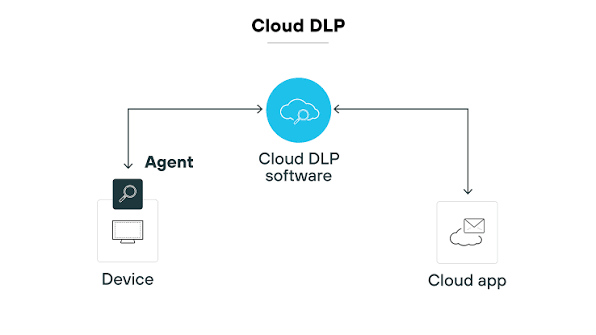
Cloud DLP protects sensitive information stored, processed, or shared through cloud applications and services.
It can identify exposed documents, detect inappropriate sharing permissions, monitor data transfers, and apply policies across supported cloud environments.
As organizations increasingly use SaaS platforms and cloud storage, cloud DLP has become an important part of enterprise data security.
4. Email DLP
Email DLP examines outgoing messages and attachments to identify sensitive information before it reaches external recipients.
For example, if an employee attempts to send a file containing payroll information to an unauthorized external email address, the system can block the message or require additional approval.
Email DLP is especially important because email remains a common channel for business communication and accidental information disclosure.
5. Data-Centric and Application-Aware DLP
Some modern DLP capabilities focus on protecting information based on its classification, context, and permitted usage rather than relying exclusively on its storage location or transmission channel.
These controls can work alongside information rights management, encryption, access management, and cloud security tools to maintain protection throughout the data lifecycle.
DLP vs. Traditional Data Security: Understanding the Difference
Traditional security technologies and DLP serve related but different purposes. Firewalls, antivirus software, identity management, and endpoint protection help defend systems and users against threats. DLP focuses specifically on preventing sensitive information from being exposed or transferred in ways that violate organizational policies.
| Security capability | Primary purpose | Typical protection |
|---|---|---|
| Firewall | Controls network traffic | Blocks unauthorized network connections |
| Antivirus / EDR | Detects and responds to malicious activity | Identifies malware and endpoint threats |
| Identity and Access Management (IAM) | Controls user identities and permissions | Restricts access to authorized users |
| Encryption | Makes information unreadable without appropriate keys | Protects data confidentiality |
| Data Loss Prevention (DLP) | Monitors and controls sensitive data usage and movement | Prevents unauthorized disclosure and transfer |
These technologies are complementary. For example, IAM can determine whether a user is authorized to access a document, encryption can protect the document’s contents, and DLP can prevent that document from being shared through an unauthorized channel.
Key Features to Look for in an Enterprise DLP Solution –
Selecting the right DLP platform requires more than comparing product features. Organizations should evaluate whether a solution can protect their actual data environments without creating unnecessary operational complexity.
Important capabilities include:
1. Automated data discovery: The platform should identify sensitive information across supported endpoints, databases, cloud repositories, and business applications.
2. Advanced data classification: It should support predefined sensitive data patterns, custom classification rules, labels, and contextual detection methods.
3. Real-time monitoring: Security teams should be able to monitor relevant data movement and policy violations as they occur.
4. Policy-based enforcement: The solution should support flexible policies that can warn, block, encrypt, quarantine, or require approval depending on the risk.
5. Insider risk visibility: It should help identify unusual user activities, suspicious data access patterns, and potentially unauthorized transfers.
6. Integration with existing security tools: Integration with IAM, SIEM, SOAR, endpoint security, cloud security, and identity governance platforms can improve visibility and incident response.
7. Reporting and audit capabilities: Detailed incident records, policy reports, and audit trails help security teams investigate incidents and demonstrate control effectiveness.
8. Scalability: The solution should support growing data volumes, additional business applications, distributed teams, and changing infrastructure requirements.
How to Implement a DLP Strategy Successfully –
A successful DLP program requires a structured approach. Organizations that deploy monitoring and blocking technologies without first understanding their data landscape often experience false positives, operational disruptions, and employee resistance.
The following steps provide a practical implementation framework.
1. Identify Critical Business Data –
Begin by identifying the information that would create the greatest business, financial, legal, or reputational impact if exposed.
Work with departments such as IT, finance, HR, legal, sales, and operations to understand where sensitive information is created, stored, and shared.
For example, HR teams may handle employee records and payroll information, while finance teams manage banking details, financial statements, and payment records.
2. Establish Data Classification Policies –
Create a consistent classification framework that defines which information is public, internal, confidential, or highly confidential.
The framework should explain how each category can be stored, accessed, shared, transferred, and retained.
Employees should understand which information requires encryption, restricted access, management approval, or additional security controls.
3. Map Data Flows –
Identify how information moves between employees, applications, devices, cloud services, customers, vendors, and external partners.
This step is essential because sensitive information may pass through several systems before reaching its final destination.
Understanding these data flows helps security teams identify weak points and apply controls where they are most effective.
4. Define Risk-Based DLP Policies –
Create policies that reflect the organization’s actual business requirements.
For example:
- Prevent confidential customer records from being uploaded to unauthorized cloud applications.
- Restrict employee payroll files from being shared with external recipients.
- Block sensitive documents from being copied to unapproved removable storage.
- Require encryption before transmitting regulated information.
- Alert security teams when unusually large volumes of confidential data are downloaded.
Start with a limited number of high-priority policies rather than attempting to monitor every possible activity immediately.
5. Deploy DLP in Monitoring Mode –
Before enabling strict blocking rules, consider operating the solution in monitoring or audit mode.
This allows security teams to understand normal business behavior, identify false positives, and adjust policies without immediately interrupting employees.
For example, a sales team may legitimately share certain customer documents with approved external partners. Monitoring helps distinguish these activities from unauthorized transfers.
6. Gradually Introduce Enforcement –
Once policies have been tested, introduce enforcement controls based on risk.
Low-risk violations may generate warnings, while high-risk activities involving highly confidential information may be blocked automatically.
A phased rollout gives employees time to understand the new policies and helps IT teams resolve operational issues.
7. Train Employees and Review Policies –
Employees play an important role in preventing data leakage. Organizations should provide regular training on data classification, secure file sharing, phishing, removable storage, cloud application usage, and reporting suspicious activities.
DLP policies should also be reviewed periodically as business applications, data requirements, regulations, and security threats evolve.
The Role of AI and Automation in Modern DLP –

Artificial intelligence and automation are changing how organizations identify and respond to data security risks.
Traditional DLP systems often depend on predefined rules, keywords, regular expressions, and known sensitive data patterns. These methods remain useful, but they may struggle to understand complex business documents or identify unusual activities that do not match established rules.
AI-assisted DLP capabilities can help improve detection by analyzing contextual information, identifying behavioral anomalies, and prioritizing potentially risky activities.
For example, behavioral analytics may identify an employee accessing an unusual number of confidential documents shortly before attempting to transfer files to an unfamiliar destination. This activity can be flagged for investigation even when the individual files do not match a simple predefined rule.
Natural language processing and machine learning can also help classify certain types of unstructured information, such as business documents and communications, depending on the platform’s capabilities.
However, AI introduces additional considerations. Models may generate false positives, misunderstand document context, or produce inconsistent classifications. Organizations should therefore maintain human oversight for sensitive enforcement decisions and regularly evaluate detection accuracy.
DLP is also becoming increasingly important as employees use generative AI tools. Uploading confidential customer information, proprietary source code, financial reports, or internal strategy documents into unapproved AI applications can expose business information to unintended destinations.
Organizations should define clear AI usage policies and apply appropriate DLP controls to supported AI applications and data transfer channels.
Common DLP Challenges and How to Overcome Them –
Although DLP provides valuable protection, implementation can introduce technical and operational challenges.
| Challenge | Business impact | Recommended approach |
|---|---|---|
| False positives | Legitimate business activities may be blocked | Tune policies using monitoring data and contextual rules |
| Poor data classification | Sensitive information may remain unprotected | Establish consistent classification standards |
| Complex IT environments | Incomplete visibility across systems | Prioritize integrations and use centralized policy management |
| Employee resistance | Users may avoid or work around security controls | Provide clear communication and practical training |
| Excessive alerts | Security teams may struggle to identify critical incidents | Prioritize alerts based on risk and business impact |
| Cloud application sprawl | Sensitive information may move through unmanaged services | Discover cloud usage and apply appropriate access controls |
| Changing business requirements | Existing policies may become outdated | Review and update policies regularly |
One of the most common mistakes is treating DLP as a tool that can simply be installed and left running. Its effectiveness depends on continuous policy refinement, accurate classification, employee awareness, and cooperation between security and business teams.
Measuring the Effectiveness of a DLP Program –
Organizations should establish measurable indicators to understand whether their DLP investment is reducing information exposure and improving security operations.
Useful metrics include:
- Sensitive data discovery coverage: Percentage of identified repositories and endpoints covered by discovery and monitoring controls.
- Policy violation frequency: Number of detected policy violations over a defined period.
- Confirmed data leakage incidents: Number of incidents where sensitive information was actually exposed or transferred without authorization.
- False positive rate: Percentage of alerts that are determined to be legitimate business activities.
- Incident response time: Average time required to investigate and resolve DLP incidents.
- Policy enforcement effectiveness: Percentage of prohibited activities successfully blocked or otherwise controlled.
- Employee policy compliance: Level of adherence to organizational data handling requirements.
These metrics should be interpreted together. A high number of alerts does not necessarily indicate better security, and a low number of incidents may reflect limited visibility rather than effective protection.
The objective is to reduce meaningful data exposure while maintaining business productivity.
The Future of Data Loss Prevention –
The future of DLP will be shaped by cloud adoption, AI-driven business processes, distributed workforces, and increasingly complex data environments.
Organizations are moving beyond traditional perimeter-based security toward data-centric protection models. Instead of protecting only the systems where information is stored, enterprises are increasingly focusing on protecting the information itself, regardless of where it moves.
Several developments are likely to influence the next generation of DLP:
AI-aware data protection: Organizations will need controls that identify sensitive information being submitted to generative AI applications and other AI-powered services.
Unified cloud and endpoint protection: DLP platforms will increasingly aim to provide consistent visibility and policy enforcement across endpoints, SaaS applications, and cloud environments.
Context-aware monitoring: Security systems will combine user identity, device health, data sensitivity, location, and activity patterns to evaluate risk more accurately.
Automated incident response: Integration with SOAR and other security platforms will help automate routine actions, such as restricting access, quarantining files, and escalating suspicious activity.
Continuous data discovery: As organizations create and store information across more applications, automated discovery and classification will become increasingly important.
Ultimately, the direction of DLP is clear: organizations need to understand not only where their information exists, but also who can access it, how it is being used, and whether its movement is appropriate.
Conclusion –
Data Loss Prevention is an essential part of a modern enterprise cybersecurity strategy. As organizations adopt cloud applications, support remote work, and process increasing volumes of sensitive information, the risk of unauthorized access and data leakage continues to grow.
A well-designed DLP program helps organizations discover sensitive information, classify it appropriately, monitor data activities, enforce security policies, and respond to potential incidents. However, technology alone cannot prevent every data exposure. Effective protection requires collaboration between IT, cybersecurity, legal, compliance, and business teams.
Organizations should begin by understanding their most valuable information, mapping how it moves across business environments, and implementing risk-based protection policies. They should then continuously improve their controls through monitoring, employee education, and regular policy reviews.
Data security is not just about protecting where information is stored. It is about controlling how information is accessed, used, shared, and transferred throughout its lifecycle.
As cybersecurity threats and digital business environments continue to evolve, DLP will remain a fundamental capability for protecting enterprise information, maintaining customer trust, and supporting responsible data management.
Frequently Asked Questions (FAQs) –
Data Loss Prevention (DLP) is a cybersecurity approach that uses technologies and policies to identify, monitor, and protect sensitive information from unauthorized access, sharing, transfer, or disclosure. It helps organizations reduce accidental data leakage, insider threats, and information theft.
DLP protects three main data states: data at rest, which is stored in databases and files; data in motion, which is transmitted across networks and applications; and data in use, which is actively accessed or handled by users and systems.
DLP identifies sensitive information, evaluates user activities against predefined security policies, and applies appropriate controls. These controls may include blocking unauthorized transfers, restricting file sharing, encrypting information, generating alerts, or requiring additional approval.
Encryption protects information by making it unreadable without the appropriate decryption key. DLP monitors and controls how sensitive information is accessed, used, and transferred. The two technologies complement each other: DLP can enforce policies that require sensitive information to be encrypted before it is shared.
Yes. Cloud-based organizations often store and share sensitive information across SaaS platforms, cloud storage, and remote devices. Cloud DLP helps identify exposed information, monitor sharing activities, and enforce data protection policies across supported services.