

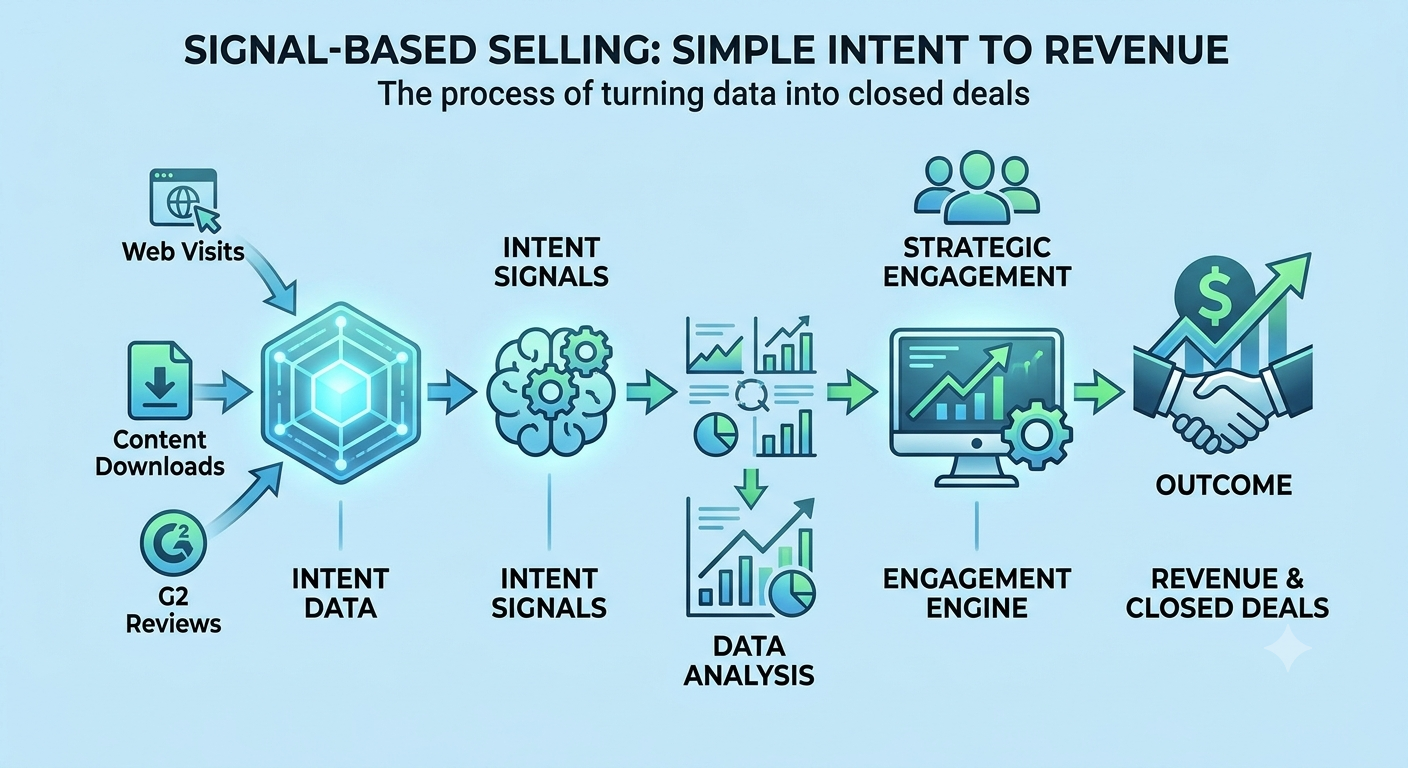

Introduction: Why Sales Teams Need to Move Beyond Traditional Lead Generation –
Traditional B2B sales strategies often rely on predefined target lists, demographic information, job titles, company size, and industry classifications. Sales representatives use these details to identify prospects, launch outreach campaigns, and generate conversations.
Although these methods remain useful, they do not always reveal whether a company is actively considering a purchase.
A technology company may match an ideal customer profile, but that does not necessarily mean it is evaluating new software. Another organization may not have responded to a sales email, yet its employees could be researching competitors, attending relevant webinars, exploring pricing pages, and discussing solutions internally.
The difference lies in buyer intent.
Modern digital interactions generate signals that can indicate when a company or individual is experiencing a business challenge, researching a solution, evaluating vendors, or preparing to make a purchasing decision.
Signal-Based Selling uses these signals to help sales teams identify, prioritize, and engage potential buyers based on their observable behavior and changing business needs.
Instead of asking only, “Who should we contact?”, sales teams can ask:
- Which accounts are showing signs of active buying interest?
- What business challenges are potential buyers researching?
- Which decision-makers are engaging with relevant content?
- Are multiple stakeholders from the same organization showing similar behavior?
- Which accounts are moving closer to a purchasing decision?
- What is the most relevant action to take based on the available signals?
This approach transforms selling from a largely activity-driven process into a more context-aware revenue strategy.
1. Understanding Signal-Based Selling –
Signal-Based Selling is a sales methodology that uses relevant buyer activities, behavioral indicators, and business events to identify potential opportunities and guide sales engagement.
A signal is an observable activity or change that may indicate a prospect’s interest, need, or readiness to evaluate a solution.
Signals can originate from multiple sources, such as:
- Website visits and product-page interactions.
- Content downloads and webinar registrations.
- Search and third-party intent data.
- Social media engagement.
- Email responses and meeting requests.
- Job postings and leadership changes.
- Technology adoption or replacement activity.
- Funding announcements and business expansion.
- Changes in organizational priorities.
For example, consider a company that has repeatedly visited a cloud security provider’s website, downloaded a security assessment, attended a webinar about identity management, and recently published job openings for cloud security specialists.
Individually, these activities may not confirm an immediate purchasing requirement. However, together they could suggest that the organization is evaluating its security capabilities.
A sales team can use this context to prioritize the account and initiate a relevant conversation.
The key distinction is that Signal-Based Selling does not treat every interaction as a buying signal. It evaluates the relevance, timing, strength, and combination of available indicators.
2. The Different Types of Buyer Intent Signals
Not all signals provide the same level of information. Some indicate general awareness, while others suggest active evaluation or a more immediate purchasing requirement.
Understanding these differences helps sales teams avoid treating low-intent interactions as qualified opportunities.
First-Party Intent Signals –
First-party signals are generated through a company’s own digital properties and customer interactions.
Examples include:
- Repeated visits to product or pricing pages.
- Downloading technical documents or case studies.
- Registering for product demonstrations.
- Attending webinars.
- Submitting contact forms.
- Requesting consultations.
- Engaging with product-related emails.
These signals are particularly useful because the business has direct visibility into the interaction.
For example, a prospect who repeatedly visits an enterprise pricing page and requests a product comparison may demonstrate stronger commercial interest than someone who simply reads a general industry blog.
However, website activity should be interpreted carefully. Multiple visits may come from the same person, different employees, automated traffic, or research activity that does not lead to a purchase.
Third-Party Intent Signals –
Third-party intent data comes from external publishers, research platforms, data providers, and other sources that observe or aggregate relevant content-consumption activity.
These signals can help organizations identify companies researching topics related to their products or services, even when those companies have not directly interacted with the seller.
For example, a company may be researching topics such as:
- Enterprise resource planning modernization.
- Cloud infrastructure migration.
- Customer data platforms.
- Cybersecurity compliance.
- Sales automation.
- HR technology implementation.
This information can help sales teams identify accounts that may be experiencing a relevant business challenge.
Third-party intent data is often account-level or aggregated. It should not automatically be interpreted as proof that a specific named employee has demonstrated buying intent.
Engagement Signals –
Engagement signals indicate how prospects interact with a company’s marketing and sales activities.
Examples include:
- Replying to sales emails.
- Commenting on LinkedIn posts.
- Sharing relevant content.
- Attending live demonstrations.
- Asking product-related questions.
- Participating in industry events.
These signals help sales teams understand whether prospects are actively engaging with the company’s expertise and offerings.
Trigger-Based Signals –
Trigger signals are business events that may create new requirements or purchasing opportunities.
Examples include:
- New executive appointments.
- Mergers and acquisitions.
- Funding announcements.
- Geographic expansion.
- New product launches.
- Regulatory changes.
- Technology leadership hiring.
- Organizational restructuring.
For example, a company expanding into multiple countries may need additional cybersecurity controls, cloud infrastructure, compliance support, or HR systems.
A relevant business trigger gives sales representatives a reason to initiate a timely conversation.
3. How Buyer Intent Data Creates Revenue Opportunities –
Buyer intent data becomes valuable when it helps sales teams make better decisions about account selection, timing, messaging, and follow-up.
The objective is not simply to collect more information. It is to convert meaningful signals into actionable sales intelligence.
Identifying Accounts Before They Enter the Sales Funnel –
Traditional lead generation often begins when prospects submit a form or respond to an outbound campaign.
Signal-Based Selling can identify potential demand earlier.
For example, a software company may discover that several organizations are researching topics related to data governance. These companies may not have requested product demonstrations, but their research behavior could indicate emerging interest.
Sales and marketing teams can prioritize these accounts, develop relevant educational content, and initiate appropriate engagement.
Prioritizing High-Intent Accounts –
Sales representatives often manage hundreds of accounts and cannot give equal attention to every prospect.
Intent data helps prioritize accounts based on relevant activity.
An account demonstrating repeated engagement with product-specific content, combined with a relevant business trigger, may deserve more immediate attention than an account that only matches demographic targeting criteria.
This helps sales teams allocate time more effectively.
Improving Sales Conversations –

Signals can also provide context for more relevant outreach.
Instead of sending a generic message such as “We help businesses improve operational efficiency,” a salesperson can reference a relevant business challenge.
For example:
A company hiring multiple data governance specialists may be investing in its data management capabilities. A vendor offering enterprise data governance solutions could initiate a conversation about common challenges associated with scaling data quality and ownership.
The goal is not to reveal private browsing behavior or make assumptions about an individual’s activities. It is to use credible business context to make outreach more useful.
Expanding Opportunities Within Existing Accounts –
Signal-Based Selling is not limited to acquiring new customers.
Existing accounts may demonstrate interest in additional products, integrations, services, or capabilities.
For example, a customer using an organization’s CRM platform may begin exploring marketing automation resources. This could indicate an opportunity to discuss a complementary solution, provided the account’s needs and permissions are understood.
4. Building a Signal-Based Selling Framework –
An effective Signal-Based Selling strategy requires a structured process that converts raw activities into sales actions.
A practical framework can be organized into six stages.
Stage 1: Define the Ideal Customer Profile
Start by identifying the types of organizations most likely to benefit from the product or service.
Consider factors such as:
- Industry and business model.
- Employee count and revenue range.
- Geographic presence.
- Technology environment.
- Business challenges.
- Existing solutions.
- Buying complexity.
- Potential contract value.
The ideal customer profile provides the foundation for evaluating whether a signal is commercially relevant.
A strong intent signal from an organization outside the target market may not represent a valuable opportunity.
Stage 2: Identify Relevant Buying Signals
Select signals that indicate a meaningful business need.
For an enterprise cybersecurity provider, relevant signals might include security leadership hiring, compliance-related research, repeated engagement with security assessment content, and requests for technical information.
For a sales technology company, relevant signals could include CRM modernization projects, sales operations hiring, engagement with sales automation content, and product demonstration requests.
Signals should be selected according to the specific buying journey rather than collected without a clear purpose.
Stage 3: Aggregate and Enrich Signal Data
Signals are often distributed across multiple systems.
A business may collect first-party website interactions through analytics tools, email engagement through marketing automation, account information through CRM, and external research activity through intent-data providers.
These sources need to be connected or consolidated to provide a more complete account view.
Data enrichment can add relevant information such as company size, industry, location, technology usage, and organizational structure.
However, organizations should maintain appropriate data permissions, transparency, and retention controls.
Stage 4: Score and Prioritize Signals
Not all signals deserve equal attention.
Sales teams can use a scoring model that considers signal strength, frequency, recency, relevance, and account fit.
For example:
| Signal | Indicative strength | Suggested sales response |
|---|---|---|
| General industry article visit | Low | Continue relevant nurture |
| Webinar registration | Medium | Share related educational resources |
| Repeated product-page visits | Medium to high | Review account engagement and qualify |
| Pricing-page interaction | High | Assess account context and consider timely outreach |
| Product demonstration request | Very high | Route promptly to sales |
| Relevant business expansion event | Context-dependent | Investigate potential business requirements |
These are illustrative categories, not universal intent scores. Actual scoring should reflect the organization’s sales cycle and historical conversion data.
Stage 5: Activate Signals Through Sales Engagement
Once accounts are prioritized, sales teams need a defined response strategy.
Possible actions include:
- Sending relevant educational content.
- Initiating personalized email outreach.
- Engaging through professional social platforms.
- Inviting prospects to relevant webinars.
- Offering a product consultation.
- Sharing a relevant customer case study.
- Scheduling an account discovery conversation.
The action should match the signal and the prospect’s likely stage in the buying journey.
Stage 6: Measure and Refine
Finally, track whether signal-based engagement creates meaningful commercial outcomes.
Review conversion rates, meeting acceptance, opportunity creation, pipeline contribution, sales cycle duration, and revenue.
Use the results to improve signal selection, scoring, and activation rules.
5. Signal Scoring: Separating Real Buying Intent From Digital Noise
One of the biggest challenges in Signal-Based Selling is distinguishing genuine buying interest from ordinary digital activity.
A prospect reading one article about cloud migration does not necessarily intend to purchase cloud infrastructure services. Similarly, repeated website visits may indicate internal research, competitor analysis, or non-commercial activity.
A signal-scoring model helps sales teams interpret activities in context.
A practical model can evaluate five dimensions:
1. Relevance: Does the signal relate directly to the product or business problem?
2. Recency: How recently did the activity occur?
3. Frequency: Is the activity repeated or isolated?
4. Account fit: Does the organization match the ideal customer profile?
5. Buying stage: Does the activity suggest awareness, consideration, evaluation, or purchase readiness?
Example of an Illustrative Intent Scoring Model
| Scoring factor | Example points |
|---|---|
| Strong ICP fit | 20 |
| Relevant business trigger | 15 |
| Repeated product-related engagement | 15 |
| Technical or solution-focused content engagement | 10 |
| Pricing or comparison activity | 20 |
| Direct demo or consultation request | 20 |
| Maximum illustrative score | 100 |
A business might define internal account-priority bands, such as:
- 0–30: Early interest or insufficient evidence.
- 31–60: Developing engagement.
- 61–80: Stronger evaluation signals.
- 81–100: High-priority engagement requiring qualification.
These thresholds should be calibrated using actual conversion and pipeline data. A high score should trigger further qualification, not automatically create a sales opportunity.
The scoring model should also prevent double-counting related signals. For example, multiple page views during a single session should not necessarily be treated as independent indicators of intent.
6. Using AI and Predictive Analytics to Improve Signal-Based Selling
As organizations collect more buyer interaction data, manual signal analysis becomes increasingly difficult.
AI and machine learning can help sales teams identify patterns, predict account engagement, and recommend appropriate actions.
Predictive Lead and Account Scoring
Machine learning models can analyze historical customer and opportunity data to identify characteristics associated with successful conversions.
These models may evaluate:
- Previous engagement patterns.
- Company characteristics.
- Sales cycle history.
- Product interest.
- Buying committee participation.
- Business triggers.
- Opportunity outcomes.
The resulting predictions can help sales teams prioritize accounts with stronger similarities to previously successful opportunities.
However, predictive scores are only as reliable as the data and assumptions behind them. Models should be evaluated regularly for accuracy, bias, and changing market conditions.
AI-Powered Signal Summarization
AI can consolidate information from CRM records, marketing engagement, customer interactions, and approved external sources into an account summary.
A sales representative might receive a summary containing:
- Recent account activity.
- Relevant business developments.
- Previously discussed challenges.
- Products of interest.
- Known stakeholders.
- Suggested discovery questions.
This reduces the time required to prepare for account conversations.
Next-Best-Action Recommendations
AI-powered sales platforms can recommend actions based on the prospect’s engagement history and buying context.
For example, an account that has attended a technical webinar but has not requested a demonstration may be better suited to receiving a technical case study rather than an immediate sales call.
A prospect who has requested pricing information may need a more direct commercial conversation.
These recommendations can help make outreach more relevant, although sales representatives should retain judgment over important customer interactions.
AI Agents and Sales Workflow Automation
AI agents can increasingly support multi-step sales workflows, such as gathering approved account information, summarizing intent signals, updating CRM fields, preparing outreach drafts, and notifying account owners.
Sensitive actions—such as contacting prospects, modifying commercial terms, or making customer-facing commitments—should remain subject to appropriate permissions and review.
7. Integrating Signal-Based Selling With CRM and Sales Technology
Signal-Based Selling becomes more effective when intent data is connected to the systems sales teams already use.
Without integration, valuable signals may remain scattered across marketing platforms, analytics tools, spreadsheets, and external data providers.
A connected sales technology environment helps transform these signals into actionable workflows.
Key Technology Components
- Customer Relationship Management (CRM): Stores account information, contacts, opportunities, interactions, and sales activity.
- Marketing Automation Platforms: Track content engagement, campaign interactions, email responses, and lead nurturing activities.
- Intent Data Platforms: Provide information about account-level research activity and relevant buying topics.
- Sales Engagement Platforms: Help sales teams execute coordinated email, calling, and social outreach.
- Data Enrichment Tools: Add firmographic, technographic, and organizational information to account records.
- Analytics and Business Intelligence: Measure signal performance, account engagement, pipeline development, and revenue contribution.
Example of an Integrated Workflow
Imagine an enterprise software provider targeting organizations that are modernizing their data infrastructure.
An account begins researching data governance topics through external content platforms. It later visits the provider’s website, downloads a data management guide, and registers for a technical webinar.
The signal-based workflow could operate as follows:
- External intent data identifies relevant account-level research activity.
- Marketing automation records the organization’s first-party engagement.
- CRM matches the activity to an existing account record.
- An account scoring model evaluates relevance and engagement.
- The system alerts the assigned sales representative.
- The representative reviews account context and selects an appropriate outreach action.
- Sales interactions and outcomes are recorded in CRM.
- Analytics evaluates whether the signals contributed to pipeline creation.
This process helps marketing and sales teams work from a more consistent understanding of account activity.
8. Account-Based Marketing and Signal-Based Selling: A Powerful Combination
Account-Based Marketing (ABM) focuses marketing and sales resources on selected high-value organizations.
Signal-Based Selling strengthens ABM by identifying when those accounts demonstrate relevant activity or experience business changes that may create new opportunities.
Traditional ABM programs may prioritize accounts based on company size, industry, revenue, and strategic importance.
Signal-based ABM adds another dimension: timing.
For example, a technology company may maintain a target list of 200 enterprise accounts. However, only a portion of those organizations may currently be researching solutions related to the company’s offering.
By combining account fit with relevant intent signals, teams can prioritize accounts that are both strategically valuable and showing signs of active interest.
Benefits of Combining ABM With Intent Data
- Better account prioritization.
- More relevant content personalization.
- Improved sales and marketing coordination.
- Earlier identification of potential opportunities.
- More efficient use of sales development resources.
- Better visibility into buying committee engagement.
The combination is particularly useful for enterprise sales, where purchasing decisions involve multiple stakeholders and longer evaluation cycles.
9. Understanding Buying Committee Signals
In complex B2B transactions, purchasing decisions rarely involve only one individual.
A technology purchase may involve IT leadership, finance, procurement, security, legal, and business operations.
This means signal-based strategies should evaluate account-level engagement rather than relying exclusively on one lead’s behavior.
For example:
- An IT director may engage with technical architecture content.
- A security leader may research compliance and risk management.
- A finance executive may explore cost and ROI information.
- A procurement representative may review vendor comparison resources.
When multiple stakeholders from the same account demonstrate related activity, the combined pattern may provide stronger evidence of organizational interest.
However, organizations should not assume that every stakeholder is part of the same buying process. Sales teams should validate roles, priorities, and decision-making relationships through appropriate conversations.
This is where CRM account mapping, stakeholder intelligence, and multi-threaded sales engagement become important.
10. Measuring the Business Impact of Signal-Based Selling
Signal-Based Selling should be measured by its contribution to revenue outcomes rather than the number of signals collected.
A useful measurement framework connects signal quality, sales activity, opportunity development, and commercial performance.
| KPI | What it measures | Business value |
|---|---|---|
| Signal-to-engagement rate | Percentage of actionable signals followed by meaningful sales engagement | Measures activation effectiveness |
| Engagement-to-meeting rate | Percentage of engaged accounts that accept meetings | Measures outreach relevance |
| Signal-to-opportunity conversion | Percentage of signal-qualified accounts that create opportunities | Measures qualification quality |
| Pipeline influenced by intent | Opportunity value associated with relevant intent activity | Measures pipeline contribution |
| Opportunity conversion rate | Percentage of opportunities converted into customers | Measures sales effectiveness |
| Sales cycle duration | Time taken to move from opportunity creation to closure | Measures sales velocity |
| Cost per qualified opportunity | Cost of generating a sales-ready opportunity | Measures acquisition efficiency |
| Revenue contribution | Closed revenue associated with signal-based programs | Measures commercial impact |
Attribution deserves special attention.
A buyer may interact with an advertisement, attend a webinar, read a customer case study, and speak with a salesperson before purchasing. It can be misleading to attribute the entire transaction to a single intent signal.
Organizations should combine CRM tracking, campaign attribution, account-level analysis, and where practical, incrementality testing to understand the actual contribution of signal-based programs.
11. Common Challenges in Signal-Based Selling
Although intent data can improve sales prioritization, organizations must address several challenges before relying on it extensively.
Data Quality and Identity Resolution
Signals may come from different systems with inconsistent account names, duplicate records, anonymous visitors, or incomplete information.
Organizations need reliable identity resolution and data governance processes to connect activities to the correct accounts without making unsupported assumptions about individuals.
Too Many Signals and Too Little Context
A large volume of data can create more noise rather than better decisions.
Sales teams should prioritize signals based on relevance, recency, frequency, and business context instead of reacting to every interaction.
Inaccurate Intent Interpretation
Research activity does not always indicate purchase readiness. An organization may be exploring a topic for educational purposes, evaluating competitors, or conducting general market research.
Intent data should therefore support qualification rather than replace it.
Poor Sales and Marketing Alignment
Marketing may identify promising accounts, but sales teams may not receive the context needed to act.
Both teams should agree on signal definitions, account-priority rules, response expectations, and feedback processes.
Privacy and Data Governance
Buyer intent data must be collected and used responsibly.
Organizations should evaluate data sources, consent requirements, platform policies, applicable privacy laws, and data retention practices. They should avoid treating aggregated or anonymous account-level activity as proof of an individual’s personal behavior.
Transparent, relevant outreach is also important. Sales representatives should use signals to understand business context rather than make prospects feel that their online activity is being monitored.
12. Building a Signal-Based Selling Strategy: A Practical Roadmap
Organizations can introduce Signal-Based Selling through a phased approach.
Step 1: Define revenue objectives. Determine whether the strategy aims to improve new account acquisition, accelerate existing opportunities, identify expansion opportunities, or increase pipeline quality.
Step 2: Select the right signals. Identify first-party, third-party, engagement, and business-trigger signals that align with the product and target market.
Step 3: Establish an account prioritization model. Combine ideal customer profile fit with signal relevance, recency, frequency, and buying-stage indicators.
Step 4: Connect sales and marketing systems. Integrate CRM, marketing automation, intent data, enrichment, and sales engagement tools where appropriate.
Step 5: Define signal-based playbooks. Create clear response strategies for different signal types. A pricing inquiry should trigger a different action from a general content download.
Step 6: Train sales teams. Help representatives interpret signals, validate account context, personalize conversations, and avoid unsupported assumptions.
Step 7: Measure and optimize. Monitor conversion rates, pipeline contribution, sales velocity, and revenue. Remove signals that generate noise and improve those that consistently identify qualified opportunities.
Starting with a focused set of high-value signals is often more effective than trying to automate every possible buyer interaction at once.
13. The Future of Signal-Based Selling: From Intent Detection to Revenue Intelligence
The future of Signal-Based Selling will be shaped by the convergence of AI, predictive analytics, account intelligence, and automated sales workflows.
Instead of simply identifying that a prospect has visited a pricing page, future sales systems will increasingly combine multiple indicators to provide a broader view of account readiness.
AI may help identify emerging business needs, summarize stakeholder engagement, recommend relevant conversations, and highlight potential opportunities within existing accounts.
AI agents may also support account research, signal monitoring, CRM updates, and sales preparation. This could reduce the administrative work associated with identifying and acting on opportunities.
However, the value of these capabilities will depend on data accuracy, responsible use, and the quality of human decision-making.
Technology can help identify where an opportunity may exist. Sales professionals still need to understand the customer’s business, validate the problem, establish credibility, and demonstrate how a solution creates value.
The most successful organizations will combine intelligent systems with meaningful human engagement.
Conclusion: Turning Buyer Signals Into Meaningful Revenue Opportunities
Signal-Based Selling represents an important evolution in modern B2B sales.
Instead of depending entirely on static lead lists and broad outbound campaigns, organizations can use buyer intent data, digital engagement, business triggers, and account intelligence to identify potential opportunities more effectively.
The real advantage comes from connecting these signals to practical sales actions.
When teams understand which accounts are showing relevant activity, why that activity matters, and how to respond appropriately, they can improve prioritization, create more meaningful conversations, and use sales resources more efficiently.
However, signals should never be treated as guaranteed evidence of purchase intent. They are indicators that help sales teams ask better questions, identify relevant business challenges, and determine whether a genuine opportunity exists.
As AI and sales intelligence platforms continue to evolve, Signal-Based Selling will become increasingly important for organizations seeking to connect customer behavior with revenue outcomes.
The future of B2B selling will not belong to the teams that contact the most prospects. It will belong to the teams that recognize the right signals, understand the business context behind them, and turn that intelligence into meaningful customer conversations.
Frequently Asked Questions (FAQs) –
Signal-Based Selling is a sales approach that uses buyer intent data, engagement activities, and business events to identify potential opportunities and guide sales outreach. It helps sales teams prioritize accounts based on relevant buying indicators rather than relying only on static lead lists.
Buyer intent signals are observable activities or business events that may indicate interest in a product, service, or business solution. Examples include pricing-page visits, webinar participation, product research, relevant content downloads, technology hiring, and direct product inquiries.
First-party intent data comes from a company’s own digital channels and interactions, such as website visits, content downloads, and email engagement. Third-party intent data comes from external sources that aggregate research activity across publishers and platforms.
It helps sales teams identify relevant accounts, prioritize outreach, understand potential business needs, personalize conversations, and allocate resources more effectively. It can also support earlier opportunity identification and better coordination between marketing and sales.
AI can analyze engagement patterns, summarize account activity, support predictive scoring, recommend next-best actions, identify potential opportunities, and automate parts of sales preparation and workflow management.