


Introduction –
Data Mesh vs. Data Fabric has become an important architectural discussion for enterprises dealing with rapidly growing volumes of data. Modern organizations collect information from cloud applications, SaaS platforms, databases, customer systems, IoT devices, business applications, analytics platforms, and AI workloads. As these environments become more distributed, traditional centralized data architectures can struggle to provide timely access, consistent governance, and reliable data for business teams. Organizations are therefore looking for approaches that can make enterprise data easier to discover, manage, govern, and use.
Data Mesh and Data Fabric offer two different ways of addressing these challenges. Data Mesh focuses heavily on decentralized ownership, domain-oriented architecture, and treating data as a product, while Data Fabric focuses more on connecting distributed data through metadata, integration, automation, governance, and intelligent data discovery. Although these approaches are often compared as competing architectures, they can also complement one another. The right choice depends on an organization’s technology environment, business structure, data maturity, governance requirements, and long-term goals.
For CIOs, CTOs, Chief Data Officers, enterprise architects, and data leaders, understanding the difference between Data Mesh and Data Fabric is important because the architecture selected today can influence how effectively an organization supports analytics, automation, machine learning, and enterprise AI in the future.
What Is Data Mesh?
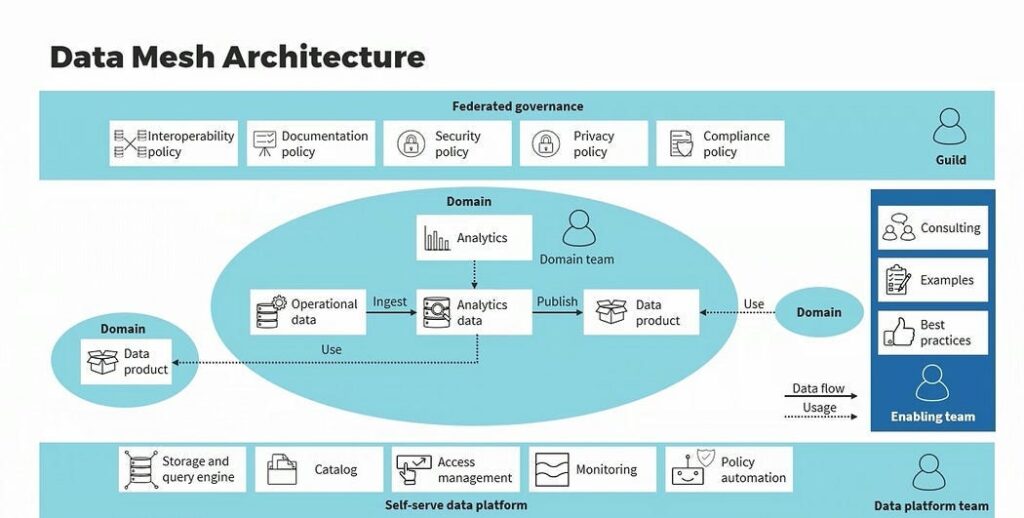
Data Mesh is a decentralized approach to data architecture and data management that distributes responsibility for data across business domains. Instead of expecting a central data team to collect, clean, manage, and deliver every dataset across the enterprise, Data Mesh gives individual business domains greater responsibility for the data they generate and understand. For example, sales, finance, marketing, supply chain, and customer service teams may each become responsible for managing their respective data domains.
One of the most important principles of Data Mesh is the concept of data as a product. Under this model, data is treated as something that should have clear ownership, documentation, quality standards, discoverability, and defined users. A finance team, for example, would not simply store financial data for its own use. It would be responsible for making that data reliable and accessible to other authorized teams that need it for reporting, forecasting, analytics, or AI applications.
The objective is to move data responsibility closer to the teams that understand its business meaning. Instead of asking a centralized data team to interpret every dataset, domain teams can provide data products with the necessary business context. This can improve accountability and reduce bottlenecks, but it also requires strong governance and organizational maturity.
What Is Data Fabric?
Data Fabric is an architectural approach designed to connect and manage data across different environments. Enterprises often have information distributed across cloud platforms, on-premises systems, SaaS applications, databases, data warehouses, data lakes, APIs, and other technology platforms. Data Fabric aims to provide a connected layer that helps organizations discover, integrate, govern, and access this distributed information.
Metadata plays an important role in Data Fabric. Metadata can provide information about where data comes from, who owns it, how it is being used, what it means, how frequently it changes, and what policies apply to it. By using metadata, automation, integration technologies, and intelligent discovery mechanisms, a Data Fabric can help users and applications understand and access data without requiring every dataset to be physically moved into one centralized location.
This approach can be particularly valuable for large organizations operating complex hybrid and multi-cloud environments. Instead of forcing every business unit to adopt a single physical data repository, Data Fabric focuses on making data across different systems more connected, discoverable, and governable.
Data Mesh vs. Data Fabric: The Core Difference –
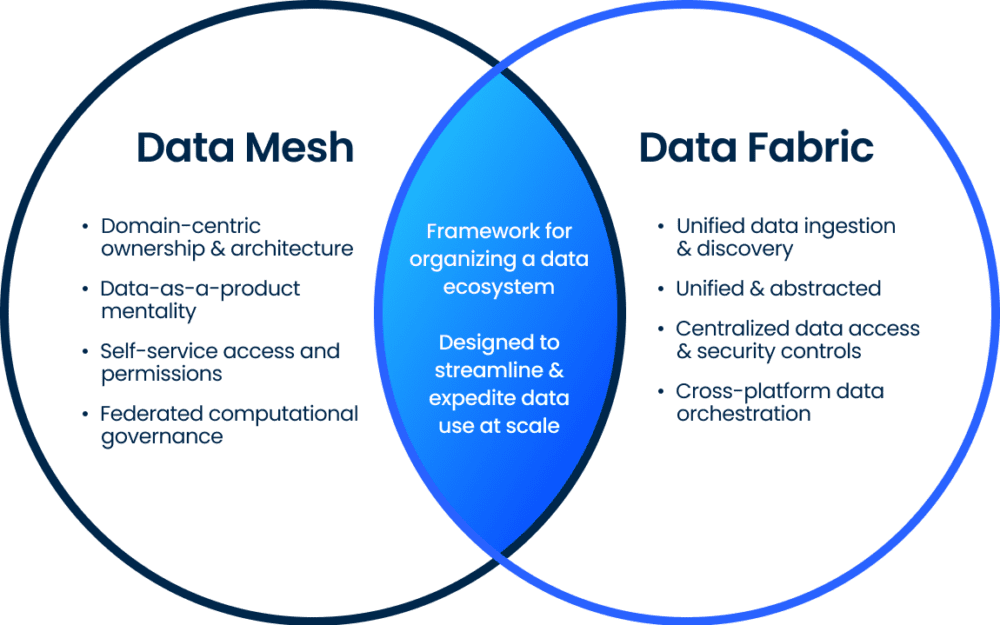
The biggest difference between Data Mesh and Data Fabric is the problem each approach is primarily designed to solve. Data Mesh focuses on the organizational ownership and management of data, while Data Fabric focuses on the technical connectivity and accessibility of data. In other words, Data Mesh asks how an organization should structure responsibility for data, while Data Fabric asks how technology can connect and make distributed data easier to find and use.
Data Mesh is based on the idea that business domains should own their data and provide it as a product to other users. Data Fabric, on the other hand, can connect information across many systems regardless of where that information is physically stored or which team owns it. Data Mesh therefore represents a significant operating-model change, while Data Fabric is more focused on creating an intelligent and connected data environment.
This distinction is important because enterprises do not necessarily have to choose only one. An organization could use Data Mesh principles to establish domain ownership and data products while using Data Fabric technologies to provide enterprise-wide discovery, integration, metadata management, and governance.
Data Mesh vs. Data Fabric –
| Area | Data Mesh | Data Fabric |
|---|---|---|
| Primary focus | Decentralized data ownership | Data connectivity and integration |
| Core concept | Data as a product | Connected and intelligent data environment |
| Ownership | Business-domain oriented | Can be centralized or distributed |
| Governance | Federated governance | Technology-enabled governance |
| Architecture | Domain-oriented | Integration and metadata-oriented |
| Main challenge addressed | Data ownership and organizational silos | Technical data fragmentation |
| Metadata | Important | Central component |
| Business involvement | Very high | Moderate to high |
| Technology dependency | Moderate | High |
| Best suited for | Mature domain-driven enterprises | Complex distributed data environments |
Why Traditional Data Architectures Are Under Pressure –
Many enterprises historically relied on centralized data warehouses and centralized data teams. Business systems generated data, and the central data organization collected and transformed that information for reporting and analytics. This model can work effectively when the number of systems and business requirements is manageable, but it can become difficult to scale as an enterprise grows.
As organizations adopt more cloud applications, SaaS platforms, data sources, and AI workloads, centralized teams can become bottlenecks. Business teams may need to wait weeks or months for new datasets, integrations, transformations, or reports. At the same time, central data teams may not have enough business context to understand every dataset they are responsible for managing.
The increasing demand for real-time analytics and AI makes this challenge even more significant. AI applications require reliable, accessible, well-governed data, while business teams increasingly expect self-service access to information. Data Mesh and Data Fabric are both attempts to address different parts of this growing complexity.
Data Mesh Decentralizes Data Ownership –
One of the strongest benefits of Data Mesh is its focus on accountability. When business domains become responsible for the data they generate, they are also responsible for its quality, documentation, accessibility, and usefulness. This can create stronger incentives to treat data as an important business asset rather than simply a technical byproduct.
For example, a customer service organization may understand customer interaction data much better than a centralized data team. Under a Data Mesh model, the customer service domain could manage a customer-interaction data product that contains standardized definitions, documentation, quality expectations, and access mechanisms. Marketing, sales, analytics, and other authorized teams could then use that data without repeatedly asking a central team to interpret it.
This model can improve responsiveness because the people closest to the business problem are also responsible for the relevant data. However, decentralization does not mean that every domain should create its own independent standards. Strong federated governance is necessary to ensure that different domains use compatible definitions, security practices, quality standards, and access policies.
Data Mesh Requires Organizational Maturity –
Data Mesh is not simply a technology implementation. Organizations cannot become a Data Mesh environment by purchasing a new data platform alone. The approach requires changes in ownership, responsibilities, processes, governance, skills, and organizational culture.
Business domains need people who understand both their data and the technology required to manage it effectively. They also need incentives to maintain high-quality data products. If domains are given ownership without sufficient skills or governance, the organization could end up replacing one centralized data silo with many decentralized silos.
This is why Data Mesh is often more appropriate for organizations with relatively mature data teams, clearly defined business domains, strong leadership support, and a culture that is comfortable with shared responsibility.
Data Fabric Connects Disconnected Data –
Data Fabric approaches the same problem from a different direction. Instead of primarily changing who owns the data, it focuses on connecting information that already exists across different systems and environments. This can be especially useful for organizations that have accumulated multiple databases, applications, cloud environments, legacy platforms, and data repositories over time.
Through metadata, integration, lineage, APIs, automation, catalogs, and other technologies, a Data Fabric can create a more unified view of distributed data. Users do not necessarily need to know where every dataset physically resides. Instead, they can use discovery and governance capabilities to identify relevant information and understand how it can be accessed.
This can help enterprises reduce the friction caused by fragmented technology environments. It can also provide a foundation for analytics and AI applications that need access to information from multiple sources.
Data Fabric Can Help With Hybrid Environments –
Many large enterprises operate hybrid technology environments. They may have some applications running in public clouds, others in private infrastructure, and additional systems managed through SaaS providers. Legacy systems may continue to support critical business processes even as newer cloud platforms are introduced.
Replacing all of these systems with one centralized architecture is often unrealistic. Data Fabric can therefore provide a more flexible approach by focusing on connectivity across existing environments.
For example, a company could have customer data in a CRM platform, transaction data in a cloud warehouse, employee information in an HR system, and operational information in a legacy database. A Data Fabric approach can help provide the metadata, integration, governance, and discovery mechanisms needed to work with these different sources as part of a broader enterprise data environment.
Governance: Centralized vs. Federated –
Governance is one of the most important areas where Data Mesh and Data Fabric differ. Data Mesh generally promotes federated governance, where individual domains maintain responsibility for their data while following common enterprise standards. This approach attempts to balance local decision-making with organization-wide consistency.
Data Fabric can support governance through centralized technological capabilities such as metadata management, data catalogs, lineage, access controls, policy enforcement, and automated monitoring. Rather than relying entirely on individual teams to implement governance manually, technology can help apply and monitor policies across distributed systems.
In practice, modern enterprises can combine these approaches. Data Mesh can define who owns and maintains specific data products, while Data Fabric technologies can provide the enterprise-wide capabilities needed to discover, integrate, monitor, and govern those data products.
Which Approach Is Better for AI?

AI has made the Data Mesh vs. Data Fabric discussion even more important. AI applications require more than large quantities of information. They need reliable, relevant, well-governed, and understandable data. They also require information about where data came from, what it means, whether it can be trusted, and what permissions apply to it.
Data Mesh can contribute by making business domains accountable for producing high-quality data products. Data Fabric can contribute by connecting information across distributed environments and making it easier for AI applications to discover and access relevant data.
This means enterprises preparing for AI may benefit from combining the two approaches. Data Mesh can provide ownership and accountability, while Data Fabric can provide connectivity and discoverability. Together, they can create a stronger foundation for AI, analytics, and automation.
Data Products Are Central to Data Mesh –
The idea of a data product is at the heart of Data Mesh. A data product is more than a database table or dataset. It should have a clear owner, defined users, quality expectations, documentation, security controls, and a reliable method of access.
For example, a retail company’s customer domain could create a customer-profile data product that provides standardized information about customers. Marketing could use it for personalization, sales could use it for account planning, customer service could use it for support, and analytics teams could use it for business intelligence.
The benefit is that data becomes easier to consume because its meaning, ownership, and quality expectations are clearly defined. However, creating useful data products requires ongoing investment and responsibility from domain teams.
Metadata Is Central to Data Fabric –
Metadata is one of the most important components of Data Fabric because it provides context about enterprise information. Without metadata, organizations can have enormous quantities of data without knowing what it means, where it came from, whether it is accurate, or who should be allowed to use it.
A strong metadata environment can help answer questions such as where a dataset originated, who owns it, how often it is updated, what systems consume it, which transformations have been applied, and what regulatory or security policies affect it.
This becomes particularly important for AI because AI systems need context to determine whether information is relevant and trustworthy. Metadata and lineage can therefore become important building blocks for enterprise AI governance.
Implementation Complexity –
Both Data Mesh and Data Fabric introduce complexity, but the nature of that complexity is different. Data Mesh can be challenging because it requires organizational transformation. Business domains need to accept responsibility for data, establish data products, develop technical capabilities, and participate in federated governance.
Data Fabric can be technically demanding because organizations need to integrate diverse systems, implement metadata management, establish governance mechanisms, and create reliable data connectivity across potentially complicated environments.
Enterprises should therefore evaluate their existing strengths before choosing an approach. An organization with strong domain teams but fragmented technology may approach the problem differently from an organization with sophisticated technology infrastructure but weak domain-level data ownership.
Cost Considerations –
Cost should also be evaluated carefully. A Data Mesh transformation may require investment in domain teams, data engineering capabilities, governance frameworks, data product development, training, and organizational change. The costs are therefore not limited to software or infrastructure.
Data Fabric may require investment in integration platforms, metadata systems, catalogs, governance tools, automation capabilities, and supporting infrastructure. The technical implementation can become significant if the enterprise has many legacy systems and data sources.
The most important question is not which architecture costs less initially. Instead, enterprises should evaluate which approach can reduce long-term data friction, improve productivity, support AI initiatives, and deliver measurable business value.
Can Enterprises Use Both?
Yes. In fact, combining Data Mesh and Data Fabric principles may be the most practical approach for many large enterprises. Data Mesh can establish domain-level ownership, accountability, and data products, while Data Fabric can provide the technological layer needed to connect, discover, govern, and integrate those products across the organization.
This combination recognizes that data architecture has both an organizational and a technical dimension. Data Mesh answers questions about ownership and responsibility, while Data Fabric addresses questions about connectivity and access. Together, they can provide a more complete approach to enterprise data management.
The Role of the CIO and Chief Data Officer –
The decision between Data Mesh and Data Fabric should involve more than the data engineering team. CIOs, CTOs, Chief Data Officers, enterprise architects, security leaders, business-domain leaders, analytics teams, and AI leaders can all contribute important perspectives.
The CIO may focus on architecture, technology strategy, scalability, integration, and cost. The Chief Data Officer may focus on data governance, quality, ownership, and data strategy. Business leaders can help determine which data products and capabilities have the greatest commercial value.
This cross-functional decision-making process is important because enterprise data architecture ultimately exists to support business objectives. A technically sophisticated architecture that does not improve decision-making, productivity, customer experience, or AI capabilities may not provide sufficient value.
A Practical Decision Framework –
Before choosing between Data Mesh and Data Fabric, organizations should first identify their most significant data problems. They should examine where data resides, who owns it, how it moves between systems, where quality issues occur, how difficult it is to discover information, and which teams depend on it.
The organization should then assess its level of maturity. If business domains have strong technical capabilities and are prepared to take ownership of their data, Data Mesh may be appropriate. If the biggest challenge is fragmented systems and complex integration, Data Fabric may provide a stronger starting point.
Enterprises should also consider their AI strategy, governance requirements, hybrid-cloud environment, regulatory obligations, data quality challenges, and expected growth. The architecture should support not only today’s requirements but also the organization’s future data and AI ambitions.
The Future of Enterprise Data Architecture –
The Data Mesh vs. Data Fabric discussion is likely to become less about selecting one architecture and more about combining complementary principles. Enterprises need data ownership, quality, governance, interoperability, discoverability, security, and accessibility. No single architecture completely solves every one of these challenges.
Data Mesh provides an operating model for making business domains accountable for their data. Data Fabric provides technologies and architectural patterns for connecting distributed information and making it easier to discover and use.
As AI becomes more deeply embedded in enterprise operations, the need for both trusted data ownership and technical connectivity will increase. Organizations will need data that is not only available but also understandable, governed, secure, and connected to the right business context.
“Data Mesh makes organizations accountable for their data. Data Fabric makes distributed data easier to connect and use. Modern enterprises may need both.”
Conclusion –
Data Mesh vs. Data Fabric is not simply a choice between two competing technologies. The two approaches address different dimensions of the enterprise data problem. Data Mesh focuses on decentralized ownership, domain accountability, data products, and federated governance, while Data Fabric focuses on integration, metadata, connectivity, discovery, automation, and technical governance.
For organizations with mature business domains and strong decentralized teams, Data Mesh can provide a powerful operating model. For enterprises dealing with fragmented applications, hybrid infrastructure, legacy systems, and distributed data, Data Fabric can provide a more practical technical foundation.
For many modern enterprises, however, the strongest strategy may involve using both. Data Mesh can establish who owns the data and how it should be managed, while Data Fabric can establish how that data can be connected, discovered, governed, and consumed across the enterprise.
Frequently Asked Questions –
The main difference is that Data Mesh is primarily an organizational and operating model, while Data Fabric is primarily a technology and architectural approach. Data Mesh focuses on domain ownership and treating data as a product, whereas Data Fabric focuses on connecting, integrating, discovering, and governing distributed data.
No. Data Mesh is not a single technology platform or product. It is a set of architectural and organizational principles that can be implemented using different data technologies. Its success depends heavily on domain ownership, data products, governance, and organizational maturity.
No. Data Fabric is an architectural approach that can involve multiple technologies, including metadata management, data integration, catalogs, APIs, governance tools, automation, and data lineage capabilities. Different vendors may offer platforms that support Data Fabric principles, but Data Fabric itself is broader than one product.
There is no universal answer. Data Mesh can be more appropriate when an organization needs stronger domain-level ownership and accountability, while Data Fabric can be more appropriate when the primary challenge is connecting fragmented data across multiple systems and environments. Many enterprises can benefit from combining both approaches.
Yes. An enterprise can use Data Mesh to establish domain ownership and data products while using Data Fabric technologies to provide metadata management, integration, discovery, governance, and connectivity across those data products.