


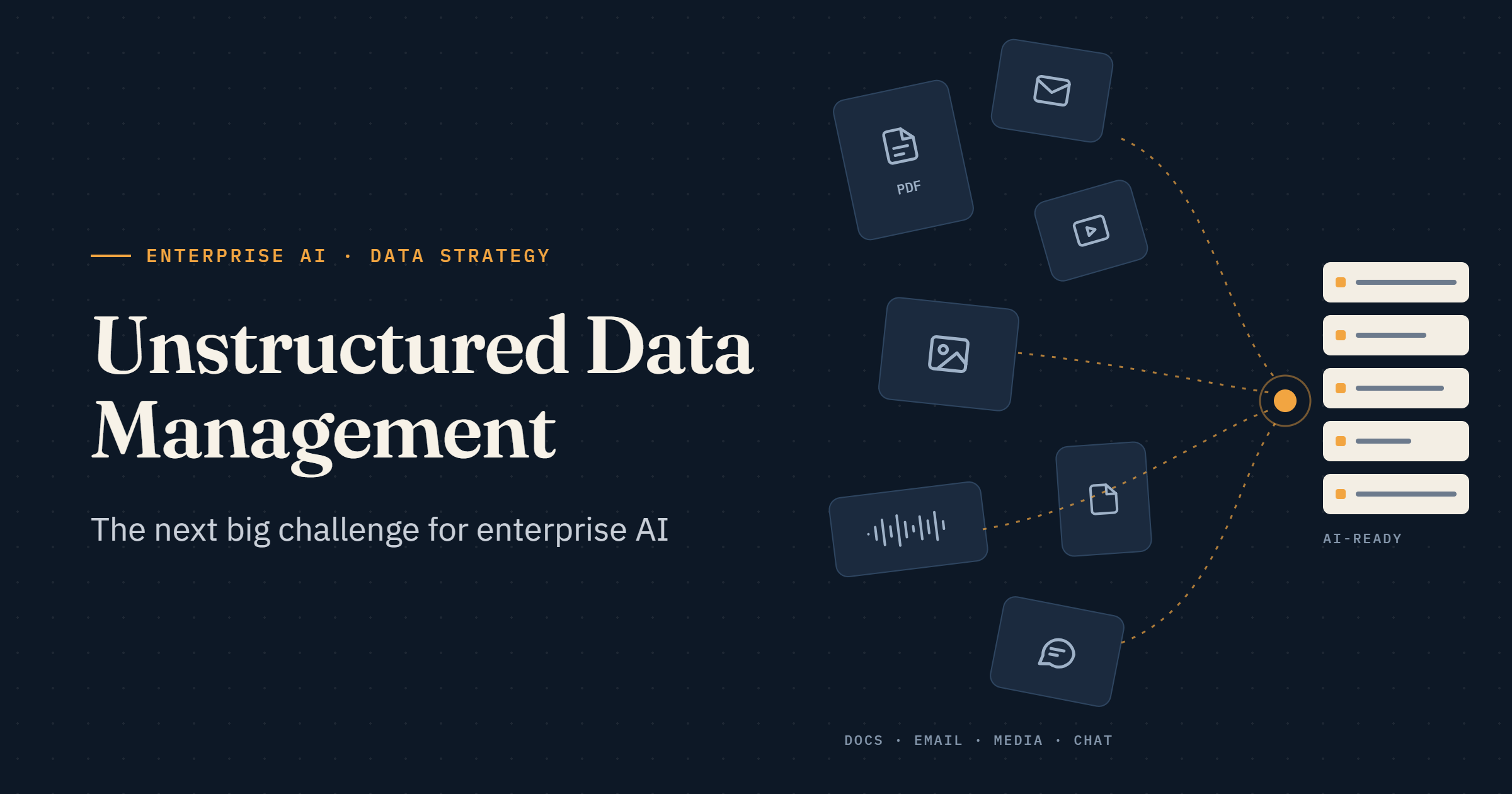
Unstructured data management is becoming one of the most important challenges for enterprises adopting artificial intelligence. Organizations have invested heavily in cloud platforms, data warehouses, analytics tools, and machine learning infrastructure, yet much of their most valuable information remains trapped in documents, emails, PDFs, customer conversations, images, videos, audio recordings, and other formats that traditional data systems were not designed to manage efficiently.
As enterprises move from experimental AI projects to production-scale applications, this data problem is becoming harder to ignore. Generative AI, retrieval-augmented generation (RAG), multimodal models, and AI agents can unlock insights from information that previously required manual searching and interpretation. However, their effectiveness depends on whether the underlying data is accessible, accurate, relevant, secure, and properly governed.
Simply connecting an AI model to a collection of enterprise files does not create an intelligent enterprise. Poorly organized documents, outdated information, duplicate records, inconsistent permissions, and missing business context can all undermine AI outputs. The result may be inaccurate answers, unreliable recommendations, security exposure, and reduced employee trust.
Unstructured data management is therefore evolving from a storage and information-retrieval concern into a strategic requirement for enterprise AI. Organizations that can organize, contextualize, secure, and continuously maintain their unstructured information will be better positioned to build reliable AI applications and turn existing knowledge into measurable business value.
3 Biggest Unstructured Data Challenges for Enterprise AI –

Fragmented Enterprise Information –
Business knowledge is scattered across documents, emails, cloud storage, and collaboration platforms. Without a unified approach to discovery and organization, AI systems can struggle to retrieve complete and relevant information.
Poor Data Quality and Context –
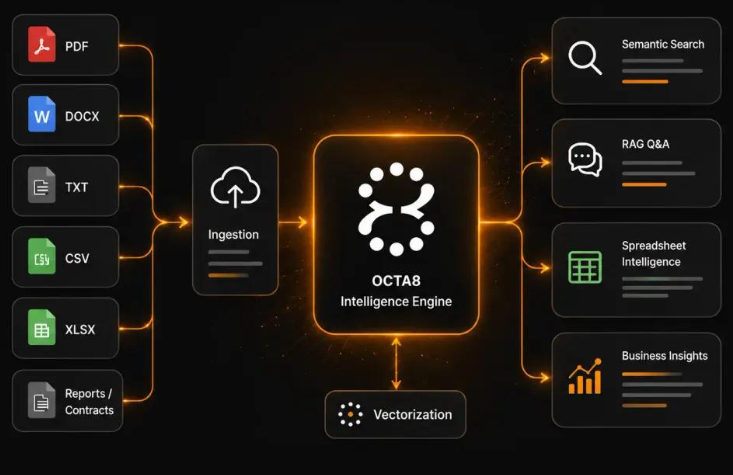
Outdated files, duplicate documents, extraction errors, and missing metadata can undermine AI accuracy. Enterprises need reliable processing and contextual information to help AI systems retrieve trustworthy evidence.

Security and Data Governance –
Enterprise data often contains confidential business and employee information. Strong access controls, data classification, audit trails, and lifecycle policies are essential to prevent sensitive information from being exposed through AI applications.
What Is Unstructured Data Management?
Unstructured data management refers to the processes, technologies, and governance practices used to collect, organize, classify, store, secure, retrieve, and maintain information that does not follow a rigid tabular structure. Unlike relational database records with predefined columns and data types, unstructured information may contain text, images, audio, video, layouts, or a combination of several content types.
Enterprise examples include contracts stored in document repositories, support conversations in customer service platforms, product manuals in PDF format, engineering diagrams, meeting recordings, scanned invoices, and employee policy documents. Although these assets may not fit neatly into rows and columns, they contain valuable operational knowledge, customer insights, institutional expertise, and business evidence.
Managing this information involves more than selecting a storage platform. Enterprises need to understand what each asset contains, where it originated, who owns it, who can access it, how current it is, and how it should be used. Depending on the use case, the process may involve metadata extraction, optical character recognition (OCR), document parsing, classification, entity recognition, indexing, semantic search, and lifecycle management.
For enterprise AI, the objective is to make relevant information usable by applications without losing its meaning, provenance, security restrictions, or relationship to the original source. A contract clause, for example, should not be treated as an isolated text fragment if its interpretation depends on the contract version, jurisdiction, parties, or surrounding clauses.
Effective unstructured data management connects information engineering with business context. It creates a foundation on which AI systems can retrieve relevant evidence, generate better-grounded responses, and support decisions with greater consistency.
Why Unstructured Data Is Becoming the Next Enterprise AI Bottleneck –
Enterprise AI initiatives frequently begin with a model, a promising use case, and a prototype. Teams connect a chatbot to selected documents, test a few questions, and demonstrate that employees can retrieve information more quickly. The challenge emerges when the same application must operate across thousands or millions of assets, multiple repositories, different business units, and constantly changing information.
The problem is not simply the volume of data. It is the uneven quality and organization of that data. One department may maintain the latest policy in a document management platform, another may circulate an older version through email, and a third may store related guidance in a shared folder with unclear ownership. An AI system retrieving information from all three locations may produce a response that appears convincing but combines conflicting instructions.
Access complexity creates another obstacle. Enterprise information is distributed across SaaS applications, cloud object stores, collaboration platforms, content management systems, local file shares, and industry-specific tools. Each system may have different metadata, permission models, retention rules, and search capabilities. Connecting them without a consistent governance strategy can create fragmented AI experiences or expose information to users who should not see it.
There is also a growing gap between AI experimentation and operational readiness. A small proof of concept may work well with a curated set of documents, but production deployment requires reliable ingestion, incremental updates, monitoring, access enforcement, and recovery when a source system changes. These are ongoing engineering responsibilities rather than one-time data preparation tasks.
As a result, enterprise AI performance increasingly depends on the quality of the information layer beneath the model. Better models can improve reasoning and generation, but they cannot reliably compensate for missing evidence, outdated sources, broken document extraction, or poorly enforced access controls.
The Different Types of Unstructured Data Enterprises Need to Manage –
Unstructured enterprise information spans several formats, each with its own processing and governance requirements.
- Documents, PDFs, and Business Records –
Contracts, reports, presentations, invoices, technical manuals, and policy documents often contain a mixture of paragraphs, tables, footnotes, headings, and embedded images. Extracting plain text without preserving document structure can remove relationships that are essential to interpretation. Tables may lose their row and column associations, while a clause separated from its heading may become difficult to interpret correctly.
Enterprises must therefore preserve meaningful structure and metadata during ingestion. Document type, author, creation date, version, department, and sensitivity classification can help determine how an asset should be indexed and retrieved. Where accuracy is critical, extraction quality should be validated rather than assumed.
- Emails, Chats, and Collaboration Data –
Email threads, internal messaging platforms, meeting transcripts, and collaboration spaces contain substantial institutional knowledge. They also contain informal language, duplicate messages, quoted conversations, outdated decisions, and context that may depend on who participated in a discussion.
Before this information is used by AI, organizations need rules for identifying authoritative content, handling conversation history, respecting retention policies, and controlling access. A message that was appropriate for a private team discussion should not automatically become discoverable through an enterprise-wide AI assistant.
- Images, Audio, and Video –
Multimodal AI expands the range of information that enterprises can analyze. Images may contain product defects, equipment conditions, medical or industrial imagery, diagrams, or handwritten notes. Audio and video may capture customer calls, training sessions, inspections, and operational procedures.
Making these assets useful can require OCR, speech recognition, transcription, image classification, visual extraction, and timestamp-aware indexing. A video transcript alone may not capture an important visual event, while an image label may omit details needed for a technical decision. The processing pipeline must reflect the intended use case and the level of accuracy required.
- Logs, Technical Files, and Domain-Specific Content –
System logs, source-code repositories, engineering diagrams, geospatial files, and scientific records can be difficult to process using generic text extraction. Their meaning depends on specialized structures, schemas, naming conventions, and relationships between components.
Enterprises should select parsing and indexing techniques that preserve these relationships instead of forcing every data type into the same processing pipeline. A universal approach may simplify architecture on paper but create poor retrieval quality in practice.
The Biggest Challenges in Unstructured Data Management –
1. Data Discovery and Fragmented Repositories –
Many enterprises cannot easily answer a basic question: what unstructured information do we have, and where is it stored? Data may exist in multiple repositories with overlapping content, unclear ownership, and inconsistent naming conventions. Employees may rely on personal knowledge or direct messages to locate important documents because enterprise search does not provide dependable results.
This fragmentation makes AI deployment more difficult. Before creating an AI knowledge assistant, teams need to discover the relevant sources, identify authoritative repositories, and understand how information flows between systems. A data inventory should capture ownership, format, sensitivity, retention requirements, and intended business use.
Discovery should be treated as a continuous capability rather than a one-time cleanup project. New applications, acquisitions, employee turnover, and changing business processes constantly create new information sources. Without ongoing visibility, the AI data layer gradually becomes incomplete or inconsistent.
2. Poor Data Quality and Missing Context –
Unstructured data is not automatically useful simply because it is accessible. Documents may contain outdated instructions, duplicate content, inconsistent terminology, missing metadata, or conflicting statements. Scanned documents can also introduce OCR errors that change names, numbers, dates, or critical contractual language.
Context is equally important. A policy document may apply only to a specific country, business unit, employee category, or time period. If these attributes are not captured, an AI system may retrieve technically relevant text that is inappropriate for the user’s situation.
Enterprises need quality checks that evaluate extraction accuracy, document completeness, freshness, duplication, and source reliability. They should also distinguish between an authoritative source and a secondary reference. These controls help AI applications retrieve evidence that is not only semantically similar to a question but also appropriate for the decision being made.
3. Making Data Searchable by Meaning –
Traditional keyword search works well when users know the exact terminology used in a document. However, enterprise users often describe problems differently from the language used in policies, technical manuals, or customer records. A support engineer may search for a symptom, while the relevant manual describes a component failure using specialized terminology.
Semantic search helps address this mismatch by retrieving content based on meaning rather than exact word matches. Vector embeddings can represent text or other supported content as numerical representations that enable similarity-based retrieval. Hybrid search combines semantic retrieval with keyword matching, which can be particularly valuable for exact identifiers, product codes, contract numbers, and technical terminology.
Nevertheless, semantic search is not a complete solution. Similarity does not guarantee correctness, authority, or freshness. Effective retrieval often requires metadata filters, reranking, source prioritization, and evaluation using representative business questions. The objective is not merely to retrieve something related to the query; it is to retrieve the right evidence for the user’s actual task.
4. Security, Privacy, and Access Control –

Unstructured repositories frequently contain sensitive information such as employee records, customer contracts, financial reports, internal communications, and intellectual property. When this information becomes available to AI applications, existing permissions must remain effective throughout ingestion, indexing, retrieval, and generation.
A major risk arises when organizations create a centralized AI index without preserving source-level access restrictions. A document that was visible only to a small project team could become discoverable to a broader group if the indexing pipeline ignores the original permissions. Even when the model itself is secure, weaknesses in retrieval and authorization can expose confidential information.
Security must therefore be designed into the data pipeline. Enterprises should enforce identity-aware retrieval, least-privilege access, appropriate encryption, data minimization, audit logging, and retention policies. They should also test whether access revocations and permission changes are reflected promptly in downstream indexes and caches.
AI-specific threat scenarios require additional attention. Malicious instructions embedded in documents may attempt to manipulate an AI system, while sensitive information may be exposed through poorly designed prompts or tool integrations. Organizations need defenses at the ingestion, retrieval, application, and monitoring layers rather than relying solely on model-level safeguards.
5. Keeping AI Knowledge Fresh –
Enterprise knowledge changes constantly. Pricing documents are revised, product manuals receive updates, policies change, and employees replace old procedures with new ones. An AI application that relies on a static index may continue retrieving information that is no longer valid.
Maintaining freshness requires reliable change detection and incremental processing. When a source document is updated or deleted, the corresponding index entries and derived representations should be updated or removed. Version identifiers, timestamps, ownership information, and source references help the system distinguish current information from historical records.
Not every source requires the same refresh frequency. A frequently updated operational knowledge base may need near-real-time synchronization, while an archival research collection may be refreshed less often. Enterprises should define freshness service-level objectives based on business risk and operational requirements, then monitor whether the data pipeline meets them.
6. Cost and Infrastructure Complexity –
Processing unstructured data at enterprise scale can require significant compute, storage, and engineering resources. OCR, transcription, multimodal extraction, embedding generation, reprocessing, indexing, and retrieval all contribute to the overall cost. Repeatedly processing unchanged assets can waste resources, while aggressive indexing can increase storage and operational overhead.
Organizations need to understand the full lifecycle cost rather than focusing exclusively on storage prices or model usage. Relevant expenses include connectors, data transformation, compute, indexing, observability, security controls, and human review of extraction errors. The right architecture should balance retrieval quality, response latency, freshness, and total cost of ownership.
Practical cost controls include incremental ingestion, deduplication, caching where appropriate, selective processing, tiered storage, and model selection based on task complexity. Expensive multimodal processing should be applied where it improves business outcomes rather than indiscriminately across every asset.
How Unstructured Data Management Powers Enterprise AI –
A well-managed unstructured data foundation supports multiple AI capabilities, but the value depends on matching the processing approach to the business requirement.
Retrieval-Augmented Generation (RAG) –
RAG combines information retrieval with language-model generation. Instead of relying only on information learned during model training, an application retrieves relevant enterprise content at query time and supplies that content as context for the response.
The quality of a RAG application depends heavily on its retrieval pipeline. Documents must be parsed accurately, divided into useful chunks, enriched with metadata, indexed appropriately, and filtered according to the user’s permissions. Retrieved passages should preserve enough context to support correct interpretation, and generated answers should provide source references where practical.
Poor unstructured data management can cause RAG systems to retrieve incomplete passages, outdated policies, or irrelevant documents. This means organizations should evaluate the full retrieval-and-generation process rather than treating model selection as the main determinant of performance.
Enterprise Knowledge Assistants –
Knowledge assistants can help employees locate procedures, understand technical documentation, retrieve project information, and navigate internal policies. Their value increases when they can search across approved sources while respecting the distinctions between current guidance, historical records, and informal discussions.
For example, an IT support assistant might retrieve troubleshooting steps from a technical manual, identify a relevant incident report, and link the employee to the source material. The assistant can be more useful when each source has clear ownership and freshness metadata, allowing the system to prioritize current and authoritative information.
Organizations should measure success through answer accuracy, retrieval relevance, source coverage, resolution time, and employee satisfaction. A high number of chatbot interactions does not necessarily indicate that the assistant is solving problems effectively.
AI Agents and Workflow Automation –
AI agents can use enterprise information to plan tasks, select tools, and coordinate actions across business systems. However, an agent’s ability to act safely depends on the reliability of the information it retrieves. If an agent relies on outdated procedures or misinterpreted contract terms, it may initiate the wrong workflow or recommend an inappropriate action.
A well-governed data layer helps agents identify relevant sources, check the status of information, and respect access boundaries. When actions have significant consequences, organizations should also require verification, approval, and audit trails. Better data management does not remove the need for agent safeguards; it makes those safeguards more effective.
Multimodal AI Applications –
Multimodal systems can process combinations of text, images, audio, and video. This opens opportunities in manufacturing, healthcare, financial services, retail, logistics, and customer experience. For example, a maintenance application might combine a technician’s written description, a photograph of damaged equipment, and relevant passages from a repair manual.
These applications require more than converting every asset into text. Images may need visual embeddings, videos may require timestamped segments, and audio may need transcripts linked to speakers or events. The system should preserve relationships between the original asset, extracted information, and generated representations so users can verify important findings.
Building an Enterprise Unstructured Data Management Architecture –
A scalable architecture should support the entire information lifecycle rather than concentrating exclusively on the search index or AI model.
1. Data ingestion and source connectors: Connect approved repositories, document management systems, collaboration platforms, object storage, and business applications. Capture source identifiers, ownership, permissions, timestamps, and version information during ingestion.
2. Parsing and content extraction: Use appropriate tools to extract text, tables, layouts, metadata, images, and other relevant content. Apply OCR or speech recognition when required, and record extraction failures so that problematic assets do not silently disappear from the knowledge base.
3. Classification and enrichment: Apply document classification, entity extraction, metadata enrichment, sensitivity labels, and business-specific taxonomy. Preserve relationships between documents and their associated customers, products, projects, departments, or policies.
4. Quality validation and governance: Check for duplicate content, missing metadata, extraction errors, outdated records, and inconsistent source information. Apply data retention, access-control, privacy, and lifecycle policies before making information available to AI applications.
5. Indexing and retrieval: Select suitable indexing strategies, including keyword indexes, vector indexes, structured metadata, or hybrid retrieval. Choose chunking and retrieval methods according to the content type and intended use case, and preserve links to the original sources.
6. AI application and access enforcement: Integrate the managed data layer with RAG applications, knowledge assistants, and agents. Enforce user permissions at retrieval time, provide source attribution where appropriate, and limit the information supplied to each application to what it needs.
7. Monitoring and continuous improvement: Track ingestion failures, synchronization delays, retrieval quality, access-control errors, processing costs, and user feedback. Use evaluation datasets and recurring tests to identify regressions when source systems, parsing methods, indexes, or models change.
The architecture should be modular enough to accommodate new AI use cases without requiring every source to be redesigned. At the same time, standardization is important: common metadata conventions, consistent permission handling, shared quality checks, and reusable connectors reduce duplication across teams.
Data Lakes, Knowledge Graphs, and Vector Databases: Choosing the Right Foundation –
Different technologies solve different parts of the unstructured data problem. Enterprises should avoid treating any single storage or indexing technology as a complete data management strategy.
| Technology | Primary role | Strengths | Limitations |
|---|---|---|---|
| Data lake or object storage | Stores original files and large volumes of raw or processed content | Flexible storage, scalable capacity, and support for diverse formats | Does not automatically provide semantic search, context, or governance |
| Content management or enterprise search platform | Organizes documents and supports search and access management | Document lifecycle features, permissions, metadata, and established search workflows | AI retrieval quality and multimodal support vary by platform |
| Vector database or vector index | Supports similarity search over embeddings | Semantic retrieval and efficient nearest-neighbor search at scale | Similarity alone does not establish correctness, freshness, or authority |
| Knowledge graph | Represents entities and relationships | Useful for connecting people, products, processes, and business concepts | Requires modeling, maintenance, and suitable source relationships |
| Lakehouse or unified data platform | Integrates data storage, processing, governance, and analytics capabilities | Can standardize pipelines and controls across data types | May require additional components for advanced document parsing and AI-specific retrieval |
These technologies are often complementary. An enterprise might retain original documents in object storage, manage business records through a content platform, create embeddings for semantic retrieval, and use a knowledge graph to represent relationships among products, customers, and policies. The architecture should reflect the actual information needs and operational constraints rather than follow a technology trend.
A Practical Roadmap for Enterprise Adoption –
Organizations do not need to catalog and process every unstructured asset before launching any AI initiative. A phased approach can generate useful outcomes while building reusable capabilities.
Phase 1: Identify a high-value use case. Start with a clearly defined problem, such as helping support engineers find approved troubleshooting guidance or helping employees locate current HR policies. Identify the relevant sources, users, expected outcomes, and risks.
Phase 2: Inventory and assess the data. Determine which repositories contain the required information, who owns them, how frequently the content changes, and what access restrictions apply. Evaluate content quality, duplication, document formats, and availability of authoritative sources.
Phase 3: Establish a minimum viable data pipeline. Implement ingestion, parsing, metadata extraction, permissions, indexing, and monitoring for the selected use case. Keep the original source available for verification and ensure that updated or deleted documents are reflected in the AI application.
Phase 4: Evaluate using real business questions. Build a representative evaluation set containing common questions, ambiguous requests, outdated-source scenarios, and questions for which the system should abstain. Measure retrieval relevance, answer correctness, source attribution, unauthorized-access prevention, and response latency.
Phase 5: Deploy with operational controls. Define owners, service-level expectations, incident procedures, refresh requirements, and escalation paths. Train users on the application’s limitations and establish a process for reporting incorrect or outdated results.
Phase 6: Expand through reusable capabilities. Reuse validated connectors, metadata standards, security controls, and evaluation methods for additional departments and use cases. Expand only when the architecture can maintain acceptable performance, governance, and cost at the larger scale.
This approach prevents organizations from treating unstructured data management as an endless preliminary cleanup exercise. It links data investment to concrete business outcomes while ensuring that the foundation improves with each deployment.
Measuring the Success of Unstructured Data Management –
A data initiative should be evaluated through operational and business metrics, not simply the volume of files ingested or embeddings generated. Those measures may indicate pipeline activity, but they do not establish whether enterprise AI has become more reliable or useful.
Useful metrics include document-processing success rates, extraction accuracy, duplicate-content rates, source freshness, ingestion lag, retrieval precision, and the percentage of responses supported by appropriate evidence. Security measures should track access-control failures, permission synchronization, sensitive-data exposure incidents, and compliance with retention requirements.
Business metrics depend on the use case. A knowledge assistant may be assessed by time to find information, support resolution time, employee satisfaction, and the proportion of queries successfully resolved without escalation. A contract-analysis application may focus on extraction accuracy, reviewer effort, coverage of relevant clauses, and the rate of material errors identified during validation.
Cost metrics are equally important. Enterprises should track processing cost per document, indexing cost, storage growth, cost per successful AI task, and ongoing maintenance effort. Comparing these measures against an established baseline helps determine whether a data architecture is improving outcomes or merely introducing additional infrastructure.
Measurement should also be continuous. As source systems evolve and users ask new kinds of questions, retrieval quality may decline even when the underlying model remains unchanged. Regular evaluations help teams detect problems early and determine whether they originate in the source data, extraction pipeline, indexing strategy, permissions, or application logic.
Common Mistakes Enterprises Should Avoid –
One frequent mistake is assuming that a vector database automatically solves unstructured data management. Vector indexes are useful for semantic retrieval, but they do not replace source discovery, data quality, metadata management, access controls, document lifecycle policies, or provenance. Treating embeddings as the entire data foundation can create a technically functional search system that is difficult to govern.
Another mistake is applying the same processing strategy to every format. Contracts, scanned invoices, video recordings, engineering drawings, and chat conversations have different structural and contextual requirements. Generic text extraction may work for simple documents but fail to preserve the information needed for more specialized tasks.
Organizations also risk over-indexing data before defining access and retention rules. A broad ingestion project may duplicate sensitive information across indexes, caches, and derived stores, making it harder to enforce permissions or respond to deletion requests. Data minimization and security reviews should occur before expanding the scope.
Finally, teams sometimes measure success by how impressive an AI demonstration appears. A fluent answer can still be inaccurate, unsupported, or based on an outdated source. Production readiness requires systematic evaluation, representative testing, monitoring, and a way for users to verify the evidence behind important answers.
The Future of Unstructured Data Management in the Enterprise AI Era –
As AI systems become more capable, enterprise data architectures will increasingly need to support multiple forms of retrieval and reasoning. Text search will remain important, but organizations will also need to connect documents to structured records, images to product information, audio to events, and business entities to their relationships across systems.
Data governance will also move closer to the AI application layer. Enterprises will need to know not only where information is stored but also which AI applications can retrieve it, how derived representations inherit access restrictions, when source information was last updated, and whether a generated response can be traced back to supporting evidence.
Another likely direction is more automated data preparation. AI-assisted classification, metadata extraction, duplicate detection, and document understanding can reduce manual work. However, automation introduces its own quality risks. Organizations will need confidence thresholds, human review for sensitive cases, and validation processes that detect systematic errors.
The long-term opportunity is to make enterprise knowledge more accessible without making it less secure or reliable. When managed effectively, unstructured information can support faster decisions, better customer service, more effective knowledge sharing, and AI applications grounded in the organization’s own expertise.
“Enterprise AI will not be limited only by the intelligence of its models, but by the quality, context, and trustworthiness of the information those models can access.”
Frequently Asked Questions (FAQs) –
Unstructured data management is the process of organizing, processing, securing, and maintaining information such as documents, emails, images, audio, and video so it can be used reliably by enterprise applications. For AI, this includes preserving context, metadata, source information, and access permissions so that systems can retrieve relevant evidence.
Much of an organization’s business knowledge exists outside structured databases. Generative AI can use this information to answer questions, summarize documents, support research, and assist employees. However, the results depend on the quality, relevance, freshness, and accessibility of the underlying data.
It improves the quality of the information retrieved for a language model. Accurate parsing, appropriate chunking, useful metadata, hybrid search, permission-aware retrieval, and source freshness help RAG applications provide more relevant and better-grounded answers.
A vector database stores and searches numerical representations of content, often called embeddings, to support similarity-based retrieval. Unstructured data management is a broader discipline that includes source discovery, parsing, metadata, quality, security, retention, governance, and retrieval. A vector database can be one component of a complete solution.
Organizations should preserve source permissions, enforce least-privilege access, classify sensitive information, encrypt data appropriately, maintain audit logs, apply retention rules, and validate authorization at retrieval time. They should also test whether permission changes and data deletions propagate correctly to derived indexes and caches.
Conclusion –
Unstructured data management is becoming a foundational capability for enterprise AI because the value of AI depends on more than model intelligence. It depends on whether organizations can provide relevant, trustworthy, current, and properly authorized information when applications need it.
Enterprises that treat this challenge as a complete information lifecycle problem will be better positioned to scale RAG, knowledge assistants, multimodal AI, and AI agents. That requires combining reliable ingestion and extraction with metadata, semantic retrieval, governance, access control, monitoring, and continuous evaluation.
The most effective strategy is to start with a meaningful business problem, establish a secure and measurable data pipeline, and expand through reusable capabilities. Rather than indexing everything and hoping AI will make sense of it, organizations should build an information foundation that helps AI systems find the right evidence, understand its context, and use it responsibly.
As enterprise AI adoption grows, the ability to manage unstructured information effectively will become an increasingly important differentiator between organizations that can demonstrate AI and those that can operationalize it.