


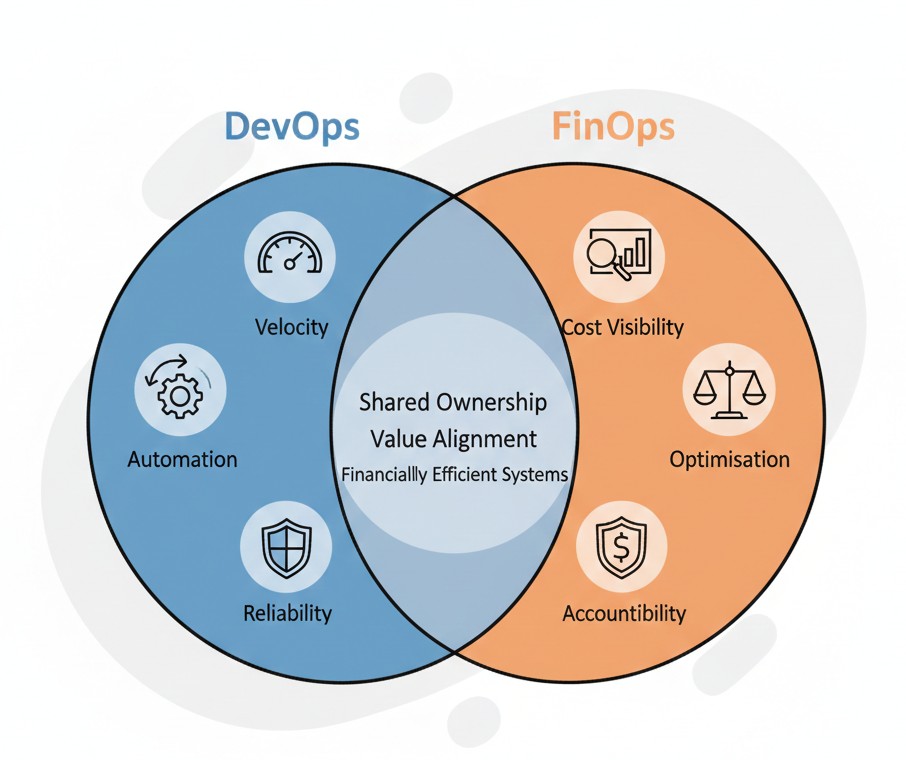
FinOps + DevOps is becoming an important operating model for organizations that want to control cloud spending without slowing down engineering innovation. DevOps transformed software delivery by bringing development and operations closer together, encouraging automation, continuous delivery, infrastructure as code, and faster release cycles. FinOps adds financial visibility to this model by helping teams understand how engineering decisions affect cloud consumption and business costs. Together, FinOps and DevOps create a culture where engineers can consider cost alongside performance, reliability, scalability, security, and customer experience.
The need for this approach is growing as enterprise infrastructure becomes increasingly dynamic. Cloud environments can automatically scale, create resources on demand, run distributed workloads, and support applications across multiple regions and services. These capabilities provide enormous flexibility, but they also make cloud costs harder to predict. A seemingly small engineering decision—such as increasing container resources, retaining logs longer, moving data between regions, or deploying additional database capacity—can have a meaningful financial impact at scale. FinOps + DevOps helps organizations bring that financial awareness closer to the teams making those decisions.
The objective is not to turn developers into finance professionals or encourage engineering teams to choose the cheapest infrastructure available. Instead, the goal is to help technical teams understand the economic consequences of their choices and make informed trade-offs. A cost-aware engineering organization asks not only whether an application works, but whether it is delivering the required performance and reliability at an appropriate cost.
What Is FinOps?
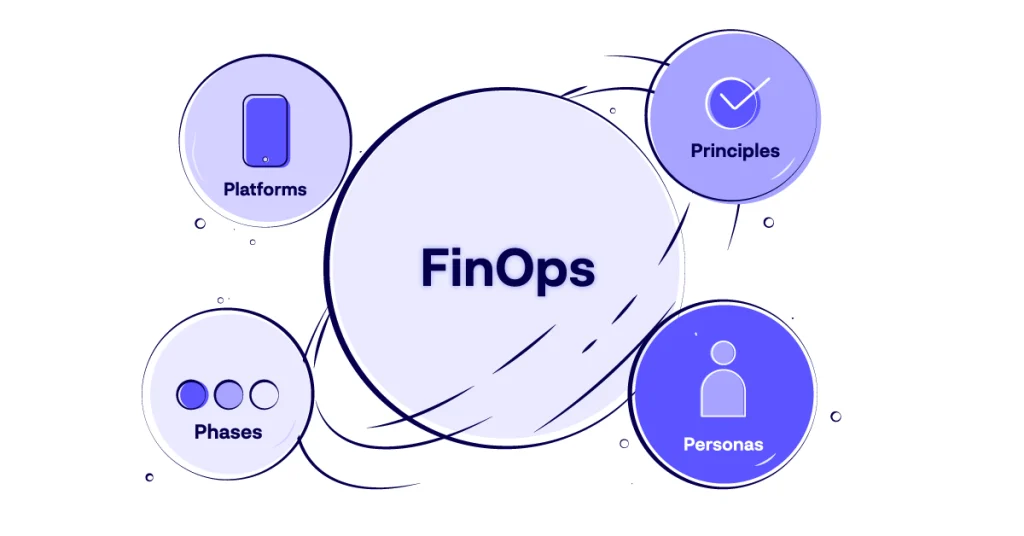
FinOps is a discipline that brings financial accountability into cloud operations by connecting engineering, finance, operations, and business teams. Traditional IT environments often relied on relatively predictable infrastructure investments, where organizations purchased servers,
storage, networking equipment, and software licenses and planned those expenses over longer periods. Cloud computing changed that model by allowing organizations to consume infrastructure dynamically and pay according to usage.
This flexibility makes cloud infrastructure powerful, but it also creates a new financial management challenge. An application can suddenly require more compute resources because of increased traffic, a development team can create additional environments for testing, or a data pipeline can process significantly more information than expected. Without appropriate visibility and ownership, these changes can appear only after they have already increased the organization’s bill.
FinOps helps organizations understand where cloud money is being spent, who is responsible for that spending, what business value it supports, and where optimization opportunities exist. It therefore creates a shared language between financial planning and technical operations.
Why DevOps Teams Need Cost Awareness –
DevOps teams directly influence many of the decisions that determine cloud consumption. Engineers choose application architectures, configure infrastructure, define resource requirements, implement autoscaling, select databases, determine storage policies, configure monitoring, and manage deployment environments. These technical choices are necessary for building reliable applications, but they also create financial consequences.
For example, an engineering team might increase the CPU and memory allocated to a container because an application is experiencing performance problems. That may be the right technical decision, but the team should also understand whether the additional capacity is being used efficiently. Similarly, a company may retain large quantities of application logs because they are useful for troubleshooting, but keeping that information indefinitely can create substantial storage and observability costs.
This is why cloud cost should not be viewed as a problem that appears only on a finance team’s monthly report. It is an operational characteristic of the application itself. When engineers have access to relevant cost information, they can identify inefficiencies earlier and understand the financial implications of architectural decisions while there is still an opportunity to change them.
FinOps + DevOps Creates Shared Accountability –
One of the biggest advantages of FinOps + DevOps is that it brings different perspectives into the same conversation. Finance teams typically understand budgets, forecasting, cost allocation, and business economics. Engineering teams understand infrastructure, workloads, architecture, application behavior, and technical trade-offs. Neither perspective provides the complete picture on its own.
A cloud bill may show that spending increased by 25%, but it does not necessarily explain whether the increase was wasteful or justified. Engineering teams may know that traffic increased significantly, but they may not understand how that growth affects the company’s overall infrastructure economics. When these perspectives are connected, organizations can determine whether increased spending represents waste, growth, investment, or a combination of all three.
This creates a healthier approach to accountability. Instead of telling engineers to reduce spending by an arbitrary percentage, organizations can provide them with the information necessary to identify genuine optimization opportunities. Teams can then make decisions based on evidence and business priorities rather than simple cost-cutting targets.
From Cloud Cost Reporting to Cost Engineering –
Traditional cloud cost management often begins with reporting. Teams receive dashboards showing monthly spending, service-level costs, or budget variance and then investigate unexpected increases. While this information is useful, it is reactive. By the time a significant cost problem appears on a monthly report, the underlying technical decisions may already be deeply embedded in production systems.
Cost engineering moves the discussion earlier in the development lifecycle. Instead of waiting to discover what an architecture costs after deployment, teams can consider potential financial consequences while designing the system. A new service, database architecture, storage strategy, or data-processing pipeline can be evaluated not only for technical feasibility but also for expected operating economics.
This makes cost similar to other engineering considerations. Security is considered during architecture. Performance is tested before production. Reliability is designed into systems. Cost can be treated in the same way. The goal is to identify expensive design patterns early, before they become difficult or expensive to change.
The Four Dimensions of Cloud Optimization –
Cost optimization should never happen independently of the other characteristics of a production system. Engineering teams typically need to balance cost, performance, reliability, and business value. Optimizing one dimension too aggressively can negatively affect another.
A cheaper database tier might reduce infrastructure spending but introduce slower queries. Removing redundant infrastructure might reduce costs while increasing the impact of an outage. Reducing observability data might save money but make production incidents harder to diagnose. Similarly, retaining additional capacity may increase costs but provide the performance required during traffic spikes.
The purpose of FinOps + DevOps is therefore not simply to minimize spending. It is to help teams understand these trade-offs and choose an architecture that provides an appropriate balance for the business requirement. The right question is rarely “What is the cheapest option?” It is usually “What level of cost is justified by the value and requirements of this workload?”
How FinOps + DevOps Changes the Engineering Workflow –
When financial awareness becomes part of DevOps, it can be incorporated into existing engineering processes instead of becoming a separate administrative activity. During planning, teams can estimate the infrastructure implications of new features. During architecture reviews, they can evaluate expected resource consumption. During development, engineers can identify inefficient queries, unnecessary processing, or oversized resources before workloads reach production.
The same principle can continue through CI/CD and operations. Infrastructure changes can be automatically checked for policy violations, while production monitoring can combine application performance with infrastructure cost information. Teams can then see whether a deployment improved performance at a reasonable cost or created unnecessary consumption.
A mature workflow might therefore look like this:
Plan → Estimate → Build → Test → Deploy → Monitor → Optimize
Cost becomes part of the continuous feedback loop rather than a separate activity performed after the engineering work is complete.
Making Cloud Costs Visible to Engineers –

Cost awareness cannot develop when engineers have no visibility into the resources their applications consume. A centralized cloud bill may be useful to finance, but it is often too abstract for a developer trying to understand why a particular workload became expensive.
Organizations should provide cost information at levels that are meaningful to engineering teams. Depending on the environment, this could include application-level costs, service-level spending, environment costs, team ownership, database consumption, Kubernetes workloads, storage usage, and data-transfer costs. The objective is to connect financial information with the technical components that engineers actually control.
This visibility also makes optimization more collaborative. Instead of finance identifying a cost increase and asking engineering to investigate it, engineers can discover unusual spending themselves. When cost metrics sit alongside CPU utilization, latency, error rates, throughput, and availability, financial efficiency becomes another operational signal.
Unit Economics Makes Cloud Cost More Meaningful –
Raw cloud spending can sometimes create the wrong impression. An application that costs $100,000 per month may appear expensive, but the number becomes more meaningful when it is connected to business activity. If the application supports millions of transactions and generates significant business value, its economics may be very different from a smaller workload consuming the same amount of infrastructure.
This is where unit economics becomes useful. Organizations can measure infrastructure costs against business activities such as customers served, transactions processed, API requests completed, orders fulfilled, documents processed, or data analyzed. These metrics help engineering teams understand whether infrastructure efficiency is improving as the business grows.
For example, if application costs increase by 15% while transaction volume increases by 50%, the organization may actually be improving its infrastructure efficiency. Conversely, if infrastructure spending increases rapidly while business activity remains relatively flat, the organization may have an efficiency problem that deserves investigation.
Kubernetes Makes Cost Awareness More Important –
Kubernetes environments are particularly relevant to FinOps because infrastructure consumption can become difficult to associate with individual applications and teams. Multiple workloads may share clusters, nodes, storage systems, and networking infrastructure. Resource requests can also differ significantly from actual utilization, creating situations where capacity is reserved but not fully used.
Cost-aware Kubernetes management requires teams to examine how resources are requested, scheduled, consumed, and scaled. Engineers may need to review CPU and memory requests, autoscaling policies, idle workloads, persistent storage, cluster capacity, and workload placement. The objective is not simply to make clusters smaller, but to ensure that infrastructure capacity reflects real application requirements.
This is another area where DevOps and FinOps naturally intersect. Kubernetes configuration is fundamentally an engineering responsibility, while the economic impact of that configuration belongs to the broader organization. Bringing both perspectives together allows teams to optimize infrastructure without compromising the reliability or performance that applications require.
Infrastructure as Code Brings FinOps Into the Pipeline –
Infrastructure as Code provides an effective mechanism for integrating cost awareness into DevOps workflows. When infrastructure is defined through version-controlled configuration, organizations can evaluate proposed changes before they are deployed. This creates an opportunity to introduce automated policies around infrastructure consumption.
For example, a CI/CD pipeline can flag resources that exceed predefined sizing guidelines, lack appropriate ownership metadata, use unapproved regions, or create unusually expensive configurations. Teams can also use automated checks to identify missing tags, excessive storage retention, or other patterns that make cost allocation and optimization difficult.
This approach is powerful because it moves governance closer to the point where infrastructure is created. Instead of discovering expensive configurations after deployment, organizations can identify them during development and review. Cost becomes part of the engineering quality process rather than a separate financial control.
Cost Optimization Should Not Become a Developer Tax –
There is an important cultural distinction between cost awareness and cost pressure. If FinOps is introduced simply as a way to reduce engineering budgets, developers may see it as another constraint imposed by finance. That can encourage teams to optimize for short-term savings without considering performance, reliability, security, or business requirements.
A more effective approach is to give engineers the information needed to understand trade-offs. Rather than saying, “Reduce this workload’s cost by 20%,” leaders can explain which resources are generating the expense, how consumption changed, what optimization options exist, and what impact each option could have.
This creates a more constructive engineering culture. Developers are not being asked to make arbitrary financial decisions. They are being asked to understand the economics of the systems they build and operate. That distinction is critical for creating long-term cost ownership.
Building a Cost-Aware Engineering Culture –
Technology alone cannot create a cost-aware organization. Teams also need processes and cultural expectations that make cost part of normal engineering conversations. Architecture reviews can include a cost dimension, engineering dashboards can expose relevant spending information, and teams can periodically review whether workloads are operating efficiently.
Cost awareness should also be connected to ownership. If nobody knows which team owns a workload, it becomes difficult to determine who should investigate unexpected spending or identify optimization opportunities. Clear ownership allows organizations to establish meaningful accountability without turning cost management into centralized policing.
Over time, cost can become part of the definition of engineering quality. A well-designed application should not only be secure, scalable, and reliable. Where appropriate, it should also use infrastructure efficiently and have an understandable economic model.
FinOps + DevOps Requires Collaboration With Finance –
The combination of FinOps and DevOps works best when finance and engineering teams develop a shared operating model. Finance can provide information about budgets, forecasts, business priorities, and financial targets. Engineering can explain resource consumption, architectural decisions, workload behavior, and the technical trade-offs associated with optimization.
FinOps acts as a bridge between these perspectives. It helps translate technical consumption into financial information and financial requirements into actionable engineering practices. This allows teams to have more productive conversations about cloud spending because both sides can work from the same information.
The result is not simply better reporting. It is better decision-making. Finance gains greater insight into the technical drivers behind cloud costs, while engineering gains a clearer understanding of the business consequences of infrastructure decisions.
The Role of AI in Cost-Aware Engineering –
Artificial intelligence is creating another opportunity for FinOps and DevOps teams. AI-based systems can analyze large amounts of infrastructure telemetry, identify unusual consumption patterns, compare workloads, detect potential waste, and recommend optimization opportunities. These capabilities can help engineers investigate cost changes much faster than manual analysis.
For example, an AI system could detect that a workload consistently uses a small percentage of its allocated resources and recommend reviewing its configuration. It might also identify that a deployment coincided with a sudden increase in compute consumption or that a particular storage workload has accumulated unused data.
However, AI recommendations should not automatically become production changes. A recommendation to reduce resources may appear financially attractive but could create performance or reliability problems. Human review remains essential for changes involving critical workloads, complex architectures, or significant business consequences.
A Practical FinOps + DevOps Operating Model –
Organizations can introduce cost-aware engineering gradually rather than attempting to transform their entire cloud environment at once. The first step is to establish clear ownership for major workloads and improve cost allocation so teams can understand what they are responsible for. Without ownership and visibility, optimization becomes difficult because teams cannot easily connect spending to their technical decisions.
The next step is to bring cost information into engineering workflows. Dashboards can combine infrastructure consumption with performance metrics, while CI/CD pipelines can introduce automated policy checks. Organizations can then begin measuring unit economics and identifying workloads where cost efficiency is becoming a business concern.
A practical progression is:
- Establish ownership — Identify teams responsible for major applications and infrastructure.
- Improve visibility — Connect cloud spending to applications, teams, environments, and services.
- Define policies — Establish sensible standards for resource sizing, tagging, storage, and infrastructure provisioning.
- Automate detection — Identify unusual or potentially inefficient configurations through engineering pipelines.
- Measure unit economics — Connect infrastructure costs to business activity.
- Optimize continuously — Treat cloud efficiency as an ongoing engineering practice rather than a one-time cleanup exercise.
What Cost-Aware Engineering Teams Look Like –
A cost-aware engineering team is not a team that always chooses the least expensive technology. Instead, it is a team that understands why it is making a particular infrastructure decision and can explain the associated trade-offs.
Such a team might deliberately choose a more expensive architecture because it provides the reliability required by a critical application. At the same time, the team will investigate idle resources, inefficient workloads, unnecessary storage, poor resource utilization, and other forms of waste.
The defining characteristic is intentionality. Cost is visible, understood, and discussed alongside other engineering requirements. Teams can therefore spend more when additional infrastructure creates genuine business value and reduce spending when resources are providing little benefit.
The Future of FinOps + DevOps –
The relationship between financial management and software engineering will become increasingly important as cloud environments become more programmable and distributed. Infrastructure is no longer something that organizations purchase and leave relatively unchanged for years. Engineers can create resources through code, scale them automatically, deploy them across regions, and modify them continuously.
That means financial outcomes are increasingly influenced by engineering workflows. A developer writing infrastructure configuration may effectively make a financial decision without directly interacting with the finance department. FinOps + DevOps provides a framework for connecting those decisions to organizational priorities.
This will become especially important as organizations adopt AI workloads, Kubernetes, serverless architectures, data-intensive applications, and multi-cloud environments. These systems can create complex and rapidly changing consumption patterns that traditional budgeting models struggle to capture.
The goal of cost-aware engineering is not to make engineers spend less. It is to help engineers understand what they are spending, why they are spending it, and whether the business is receiving enough value in return.
FAQ: FinOps + DevOps –
FinOps + DevOps combines cloud financial management practices with DevOps engineering processes. It brings cost visibility and accountability into software development, infrastructure management, deployment, and operations so teams can make more informed technical decisions.
DevOps teams influence many factors that determine cloud spending, including compute resources, databases, storage, networking, Kubernetes configuration, monitoring, and application architecture. Understanding these costs helps teams identify inefficiencies and make better technical trade-offs.
No. FinOps is broader than cost reduction. Its purpose is to create financial accountability and help organizations understand whether cloud spending is delivering appropriate business value. In some cases, spending more may be justified when it improves performance, reliability, scalability, or customer experience.
Engineers can become more cost-aware when organizations provide application-level cost visibility, clear resource ownership, unit-economics metrics, automated infrastructure policies, and regular optimization reviews. Cost information becomes particularly useful when it appears alongside operational metrics such as performance and utilization.
Cloud unit economics measures infrastructure spending in relation to a business activity. Examples include cost per transaction, cost per customer, cost per API request, cost per order, or cost per processed document. These measurements help organizations understand infrastructure efficiency in a business context.
Conclusion –
FinOps + DevOps is ultimately about making cloud economics part of modern engineering practice. As organizations adopt increasingly dynamic infrastructure, technical teams have more influence over financial outcomes than ever before. Cloud resources can be created, scaled, modified, and removed through software, meaning engineering decisions can directly influence infrastructure spending.
The answer is not to introduce financial bureaucracy into every development decision. Instead, organizations should give engineers appropriate visibility, clear ownership, useful automation, and enough business context to understand the consequences of their choices.
When cost becomes visible alongside performance, reliability, security, and scalability, engineering teams can make more balanced decisions. They can identify waste without blindly cutting resources, invest in infrastructure when the business requires it, and continuously improve the efficiency of the systems they operate.
The future of cloud engineering will therefore require more than technical excellence. It will require economic awareness. Teams that understand both how their systems work and how those systems create costs will be better equipped to build sustainable, scalable, and business-aligned technology environments.