


Edge AI is changing where enterprise intelligence happens. For years, organizations have relied heavily on centralized cloud platforms and data centers to collect, process, and analyze information. That model remains important, but the rapid growth of connected devices, real-time applications, industrial systems, cameras, sensors, and intelligent machines is creating a new requirement: intelligence needs to move closer to where enterprise data is actually generated.
Instead of sending every piece of data to a centralized cloud environment, Edge AI allows organizations to process and analyze information closer to the source. This can reduce latency, lower bandwidth requirements, improve responsiveness, and support applications that cannot always depend on a continuous connection to a remote data center.
The shift is not simply about moving artificial intelligence from the cloud to the edge. It represents a broader architectural change in how enterprises think about data, computing, security, and decision-making. As organizations deploy AI across factories, retail locations, healthcare environments, vehicles, offices, telecommunications networks, and field operations, the edge is becoming an increasingly important part of the enterprise AI infrastructure.
What Is Edge AI?
Edge AI refers to the deployment of artificial intelligence and machine learning capabilities on or near the devices and systems where data is generated. Instead of transmitting all raw information to a centralized cloud or data center for processing, an edge-enabled system can analyze some or all of that information locally.
Consider an industrial manufacturing facility filled with cameras and sensors. These systems may generate enormous amounts of information every second. Sending every video frame and sensor reading to the cloud could introduce latency, increase network costs, and create unnecessary data movement.
With Edge AI, processing can happen on an industrial gateway, specialized server, camera, machine controller, or another nearby computing device. The system can identify relevant events locally and send only important information to centralized systems.
This creates a distributed intelligence model in which cloud infrastructure and edge infrastructure work together rather than competing with each other.
Why Intelligence Is Moving Closer to Enterprise Data –
The fundamental reason for the growth of Edge AI is simple: enterprise data is increasingly being generated outside traditional data centers.
Modern organizations operate thousands or even millions of endpoints. These include sensors, cameras, connected equipment, mobile devices, vehicles, point-of-sale systems, medical equipment, robotics platforms, and industrial controllers.
The traditional approach was to move this data toward centralized infrastructure. However, several factors are making that approach less efficient for certain workloads.
- Real-Time Decisions Require Low Latency –
Some enterprise applications cannot afford to wait for data to travel to a remote cloud environment, be processed, and return with a response.
For example, an autonomous machine operating on a factory floor may need to react to an object within milliseconds. A security camera may need to identify an unusual event immediately. A retail system may need to detect inventory conditions while a customer is interacting with a product.
In these situations, processing data closer to the source can significantly reduce the time between observation and action.
- Data Volumes Are Increasing –
AI workloads are also generating enormous quantities of data. High-resolution video, machine telemetry, audio, location information, and sensor streams can quickly overwhelm networks if every piece of information is transmitted continuously.
Edge AI allows organizations to filter, classify, summarize, and analyze information locally.
Instead of sending everything upstream, an edge system can send:
- Relevant events
- Anomaly alerts
- Aggregated metrics
- Model predictions
- Metadata
- Selected images or video segments
- Operational summaries
This can reduce unnecessary data movement while preserving the information that matters.
- Connectivity Cannot Always Be Guaranteed –
Enterprise environments are not always connected to high-speed and highly reliable networks. Retail stores, remote facilities, transportation systems, offshore operations, mining locations, and field service environments may experience connectivity limitations.
Edge AI can allow critical intelligence to continue operating even when connectivity to centralized infrastructure is degraded or temporarily unavailable.
The edge therefore becomes more than a performance optimization. In some environments, it becomes an operational resilience layer.
Edge AI vs. Cloud AI –
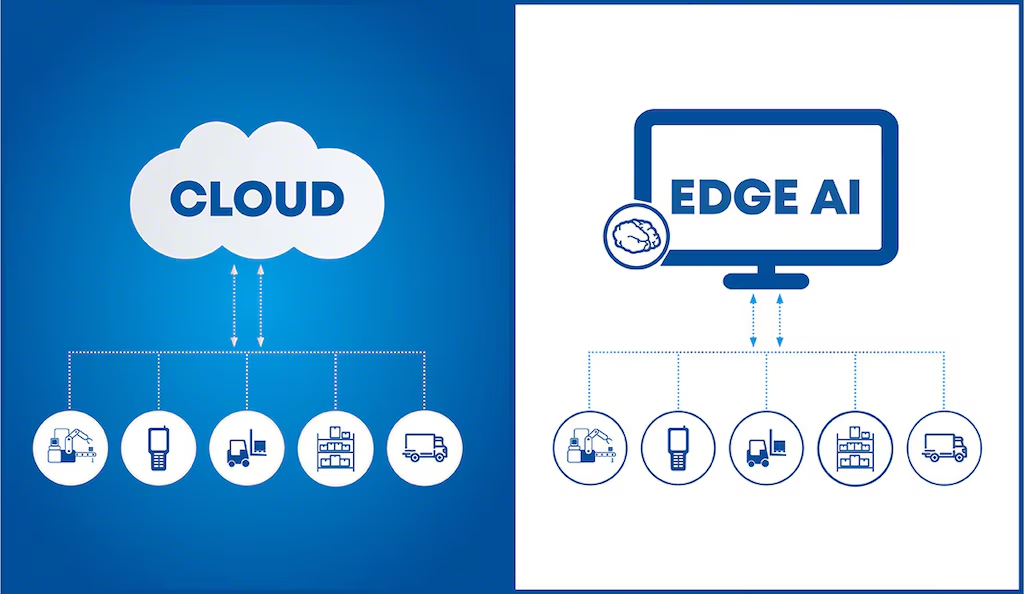
Edge AI does not mean enterprises are abandoning cloud computing. In most cases, the future will involve a combination of edge and cloud infrastructure.
| Capability | Edge AI | Cloud AI |
|---|---|---|
| Processing location | Near the data source | Centralized cloud infrastructure |
| Latency | Very low | Depends on network connection |
| Bandwidth requirement | Lower for upstream data | Potentially higher |
| Offline operation | Stronger | Usually requires connectivity |
| Compute resources | More constrained | Highly scalable |
| Data movement | Reduced | Often higher |
| Model management | Distributed | Centralized |
| Best suited for | Real-time and local decisions | Large-scale training and centralized analytics |
| Enterprise governance | Distributed | More centralized |
| Typical use cases | Industrial AI, computer vision, IoT | Model training, analytics, enterprise AI |
The most practical enterprise architecture is therefore likely to combine both approaches.
Cloud infrastructure can provide centralized model development, large-scale analytics, governance, and orchestration, while edge infrastructure can provide local inference and real-time decision-making.
The Enterprise Data Architecture Is Changing –
The rise of Edge AI is also changing enterprise data architecture.
Historically, many organizations designed architectures around a centralized flow:
Device → Network → Data Center/Cloud → Analytics → Decision
Edge computing introduces another model:
Device → Edge Processing → Local Decision → Cloud Synchronization
The difference is significant. Not every decision needs to travel through centralized infrastructure.
An edge system can make immediate decisions locally while sending selected information to enterprise platforms for long-term analysis, reporting, model improvement, and governance.
This creates a distributed data architecture in which intelligence exists at multiple levels.
Where Edge AI Is Already Becoming Important –
Edge AI is particularly valuable in environments where data is abundant and decisions need to happen quickly.
- Manufacturing –
Factories are one of the strongest use cases for Edge AI. Industrial cameras and sensors can monitor equipment, production lines, and product quality in real time.
AI models running close to production equipment can detect anomalies, identify manufacturing defects, and predict potential equipment failures.
Instead of waiting for centralized analytics to identify a problem, local systems can trigger alerts or operational responses immediately.
- Retail –
Retail environments generate significant amounts of data through cameras, point-of-sale systems, inventory systems, and connected devices.
Edge AI can support applications such as computer vision, shelf monitoring, customer-flow analysis, and localized operational intelligence.
Processing certain information locally can also reduce the need to transmit sensitive video or customer-related data to centralized environments.
- Healthcare –
Healthcare environments increasingly use connected devices, imaging systems, monitoring equipment, and intelligent diagnostic tools.
Edge AI can help process information closer to where care is delivered. This can be particularly valuable when fast analysis is important or when transferring large datasets is impractical.
However, healthcare deployments require particularly strong privacy, security, validation, and governance controls.
- Transportation and Logistics –
Vehicles and logistics operations produce continuous streams of information from cameras, GPS systems, sensors, and onboard equipment.
Edge AI can analyze this information locally to support safety, route decisions, predictive maintenance, and operational monitoring.
The ability to make decisions without relying entirely on remote connectivity is especially important for mobile systems.
- Telecommunications –
Telecommunications providers are deploying intelligence across increasingly distributed network infrastructure.
Edge AI can support network optimization, anomaly detection, traffic management, and localized services.
As 5G and distributed computing environments expand, the relationship between telecommunications networks and edge intelligence is becoming increasingly important.
Edge AI and Data Privacy –
One of the most important benefits of Edge AI is the ability to reduce unnecessary movement of sensitive information.
Data can sometimes be analyzed locally without transferring the complete raw dataset to a centralized platform.
For example, an organization could potentially process a video stream locally and transmit only an event classification rather than continuously transferring the entire video feed.
This does not automatically make an edge architecture secure or private. Edge devices can introduce new security challenges because computing resources are distributed across many physical locations.
Organizations therefore need to consider:
- Device identity
- Encryption
- Secure boot
- Firmware management
- Model protection
- Access controls
- Remote monitoring
- Software updates
- Audit logging
- Physical security
The security model must evolve from protecting centralized infrastructure to protecting a distributed computing environment.
The Challenge of Managing AI Models at the Edge –
Deploying an AI model in a cloud environment is different from deploying that model across thousands of distributed edge devices.
Organizations need mechanisms for managing the entire model lifecycle.
A typical enterprise Edge AI lifecycle may include:
- Develop the model centrally.
- Validate the model against business requirements.
- Optimize the model for edge hardware.
- Deploy the model to edge devices.
- Monitor performance.
- Detect model drift.
- Update the model when required.
- Maintain version control and auditability.
This creates an important operational requirement: enterprises need strong MLOps and device-management capabilities that can operate across distributed infrastructure.
Edge AI Requires Smaller and More Efficient Models –
Edge devices often have significantly fewer computing resources than centralized AI infrastructure.
As a result, organizations may need to optimize models through techniques such as:
- Model quantization
- Pruning
- Knowledge distillation
- Hardware acceleration
- Efficient neural network architectures
- Specialized inference chips
The objective is not necessarily to deploy the largest possible AI model. It is to deploy a model that provides sufficient intelligence while meeting the constraints of the environment.
This changes the optimization question from “How powerful can the model be?” to “How efficiently can the model deliver the required result?”
Edge AI and the Rise of Hybrid Intelligence –
The future of enterprise AI is unlikely to be entirely centralized or entirely decentralized.
Instead, organizations are moving toward hybrid intelligence architectures.
In this model, different layers perform different functions:
Edge Layer:
Real-time inference, local decision-making, sensor processing, and immediate response.
Regional Layer:
Aggregation, coordination, caching, and localized analytics.
Cloud Layer:
Large-scale model training, centralized analytics, governance, orchestration, and long-term storage.
This approach allows enterprises to place intelligence where it creates the most operational value.
A manufacturing machine does not need to send every sensor reading to the cloud before stopping a dangerous operation. At the same time, the organization may still want aggregated production information available centrally for strategic analysis.
The two environments can therefore complement each other.
What Edge AI Means for Enterprise IT Teams –
The growth of Edge AI will expand the responsibilities of enterprise IT teams.
Infrastructure teams will increasingly need to manage computing resources outside traditional data centers. Security teams will need to protect distributed devices. Data teams will need to manage information flows between edge and cloud environments. AI teams will need to monitor models running across heterogeneous hardware.
This means Edge AI cannot be treated as an isolated AI initiative.
Successful implementations will require collaboration across:
- IT infrastructure
- Data engineering
- AI and machine learning
- Cybersecurity
- Network operations
- Application development
- Compliance
- Business operations
The organizations that treat edge infrastructure as part of their broader enterprise architecture will be better positioned to scale it.
The Business Case for Edge AI –
Organizations considering Edge AI should not begin with the technology itself. They should begin with the business problem.
A strong Edge AI use case usually has one or more of the following characteristics:
- Decisions must happen quickly.
- Network connectivity is limited.
- Data volumes are extremely large.
- Sending all data to the cloud is expensive.
- Local processing improves privacy.
- Continuous cloud dependency creates operational risk.
- Physical systems need autonomous or semi-autonomous responses.
If none of these conditions exist, centralized cloud AI may remain the simpler and more economical solution.
The goal is not to move AI to the edge simply because edge computing is becoming popular. The goal is to determine where intelligence creates the greatest business value.
Challenges Enterprises Need to Address –
Despite its advantages, Edge AI introduces several challenges.
The first is operational complexity. Managing hundreds or thousands of distributed AI-enabled devices is significantly more complicated than managing a centralized AI platform.
The second is security. Edge devices may operate in locations that are physically accessible to unauthorized individuals, increasing the attack surface.
The third is model consistency. Different hardware environments may require different model versions, configurations, or optimization strategies.
The fourth is observability. Organizations need visibility into device health, model performance, connectivity, resource utilization, and AI output quality.
Finally, there is the challenge of governance. When AI makes decisions closer to the point of operation, organizations need clear policies around accountability, monitoring, human oversight, and data handling.
How Enterprises Should Prepare for Edge AI –
Organizations do not need to transform their entire infrastructure immediately. A phased approach is usually more practical.
Start With High-Value Use Cases –
Identify applications where latency, bandwidth, availability, or privacy creates a clear business requirement for local processing.
Build a Standard Edge Architecture –
Define standards for hardware, operating systems, connectivity, security, model deployment, monitoring, and lifecycle management.
Design for Centralized Governance –
Even when intelligence is distributed, governance should remain coordinated. Organizations should maintain centralized visibility into models, versions, permissions, and policies.
Treat Devices as Enterprise Assets –
Edge devices should receive the same level of lifecycle management as servers and other infrastructure.
Build Hybrid Data Pipelines –
Not all data should remain at the edge. Define what should be processed locally, what should be transmitted, and what should be stored centrally.
Establish Human Oversight –
For high-impact decisions, organizations should clearly define when AI can act autonomously and when human intervention is required.
Edge AI Is Becoming an Enterprise Architecture Decision –
The most important shift created by Edge AI is not the introduction of AI-enabled devices. It is the change in where organizations decide intelligence should exist.
For decades, enterprise computing increasingly moved toward centralized infrastructure. Now, the combination of AI, IoT, connected systems, and real-time applications is pushing some intelligence back toward the point where data is created.
That does not represent a reversal of cloud computing. Instead, it represents a more distributed architecture in which cloud and edge environments perform complementary roles.
The future of enterprise AI is not about choosing between cloud and edge. It is about deciding where intelligence creates the most value, and placing computation accordingly.
FAQ: Edge AI in Enterprise –
Edge AI is the use of artificial intelligence and machine learning capabilities on or near the devices where data is generated. It allows organizations to process information locally rather than sending all raw data to centralized cloud infrastructure.
Edge AI can reduce latency, lower data-transfer requirements, improve operational resilience, and support real-time applications. It is especially valuable when decisions need to happen close to the source of data.
No. Edge AI and cloud AI are complementary. Cloud platforms remain valuable for model training, centralized analytics, governance, and large-scale computing, while edge infrastructure can handle local inference and real-time decisions.
Manufacturing, retail, healthcare, transportation, logistics, telecommunications, energy, and industrial operations are among the environments where Edge AI can provide significant benefits.
It can reduce the amount of raw data that needs to leave the local environment, which may improve privacy in certain use cases. However, edge deployments still require strong security, encryption, access controls, and governance.