


Introduction –
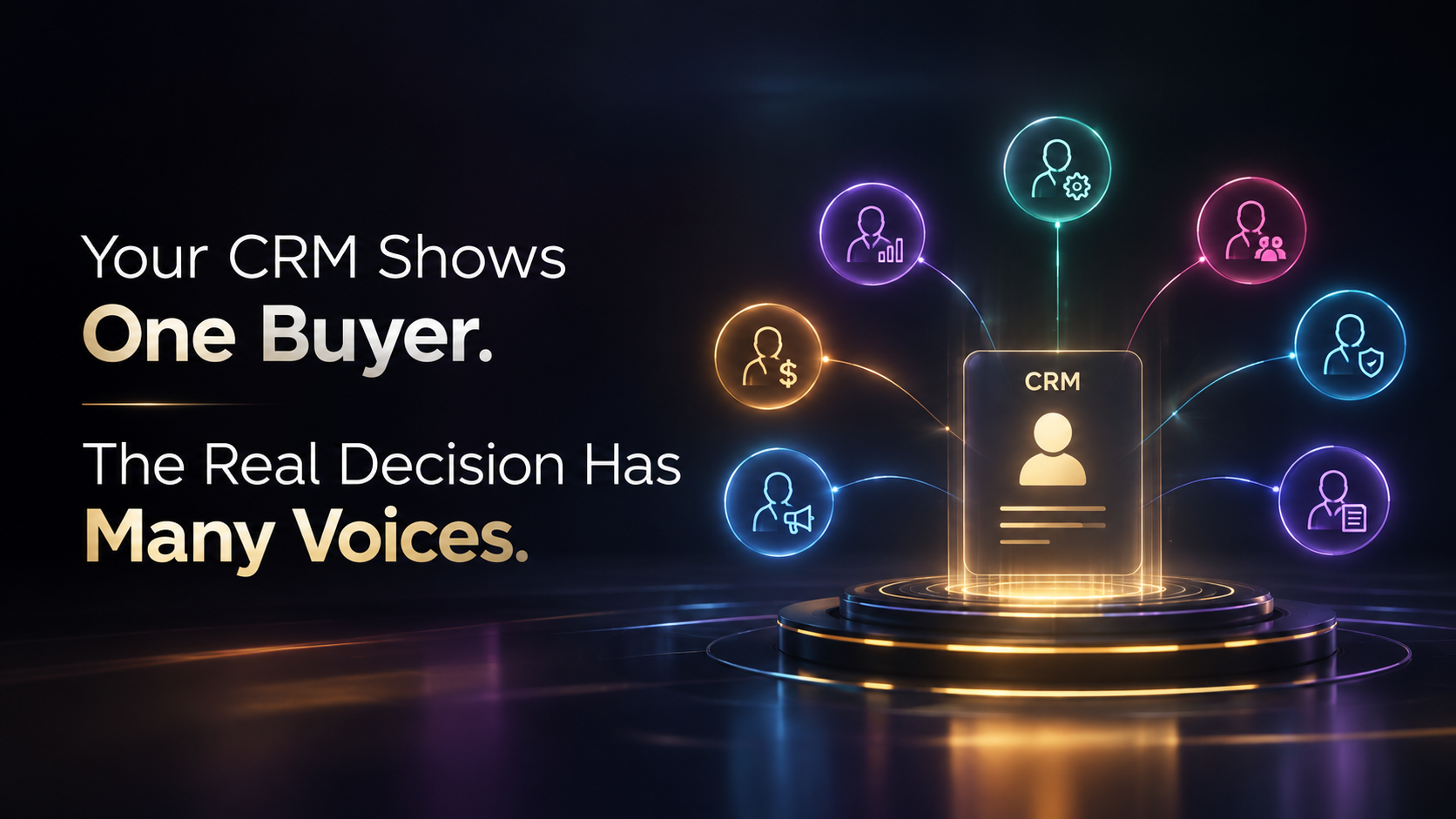
Your CRM may show one contact, one opportunity owner, and one primary decision-maker. But in modern B2B sales, the B2B buying committee is rarely represented by a single person. Behind the contact listed in your CRM can be an entire network of stakeholders influencing whether a deal moves forward, stalls, changes scope, or disappears completely.
Enterprise purchases have become increasingly cross-functional. IT may evaluate integration and architecture, finance may examine the business case, security may assess risk, procurement may negotiate pricing, legal may review contracts, and executives may determine whether the investment supports broader business priorities. Recent industry discussions continue to emphasize the importance of mapping and engaging these multiple stakeholders rather than relying on one champion.
This creates a significant visibility problem for sales teams. A CRM might show that the primary contact is highly engaged, attending meetings and responding to emails. The opportunity may therefore appear healthy in the pipeline. However, another stakeholder could be questioning the business case, security could be delaying approval, procurement could be challenging the commercial terms, or an executive could be unconvinced about the strategic value.
The problem is not necessarily that the CRM lacks information. The bigger problem is that the CRM often represents the relationship as one buyer when the actual decision is being shaped by many voices.
The Single-Contact Illusion in B2B Sales –
Traditional sales methodology often teaches salespeople to identify the decision-maker and build a relationship with that individual. This approach can work reasonably well for smaller purchases where authority is concentrated in one person. Enterprise buying, however, is rarely that straightforward.
A person may initiate the evaluation without controlling the budget. A department head may strongly support a solution without having final approval authority. An executive may approve the investment without ever attending a product demonstration. A security or procurement team may never appear during the early sales conversation but still have the ability to stop the purchase later.
This creates the single-contact illusion. The person who is most visible to the salesperson becomes the person the salesperson assumes is most important. Because that individual is responding to emails and joining meetings, the opportunity looks active.
But activity does not necessarily equal influence.
The primary contact may simply be collecting information for an internal committee. Their enthusiasm can be genuine while the broader organization remains unconvinced.
Enterprise Buying Is a Network, Not a Conversation –
Enterprise buying is increasingly a network of conversations rather than a single buyer-seller relationship. Multiple departments can participate in the evaluation, and each department may have its own definition of a successful purchase.
For example, an IT leader may care about integration, scalability, and technical architecture. A finance leader may want predictable costs and measurable ROI. Security may focus on data protection and compliance. Procurement may concentrate on pricing and contract terms, while operations may worry about implementation and disruption.
These stakeholders do not always communicate directly with the vendor. Much of the decision happens internally, between the stakeholders themselves.
That means the salesperson has two jobs: influence the people they can see and understand the people they cannot see.
This is why multi-threaded selling is becoming increasingly important in complex B2B sales. Industry guidance on enterprise selling consistently recommends mapping multiple stakeholders and building relationships across the buying committee rather than depending on one champion.
Every Buyer Has an Internal Audience –
A common mistake in B2B sales is assuming that convincing one person means convincing the organization.
In reality, your champion usually has to sell the decision internally.
Imagine a technology leader telling your sales representative:
“We really like the solution, but I need to get finance, security, procurement, and our CIO comfortable before we can move forward.”
This is not necessarily a lost deal. But it is also not a won deal.
The champion still needs evidence, documentation, financial justification, and internal credibility to convince other stakeholders. If the salesperson has not prepared the champion for those conversations, the opportunity can easily stall.
The buyer may need to answer questions such as:
- Why do we need this solution?
- Why should we choose this vendor?
- What will it cost?
- What is the expected ROI?
- How difficult will implementation be?
- What security risks exist?
- How will this integrate with our current technology?
- What happens if the project fails?
- Who will own the implementation?
- Why should we make this investment now?
A successful sales process therefore does more than persuade the primary contact. It gives that contact the tools required to build organizational consensus.
Understanding the Hidden B2B Buying Committee –
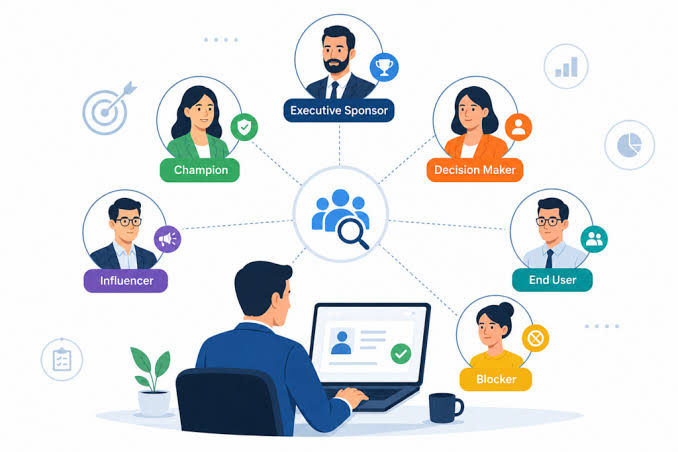
The B2B buying committee does not always appear clearly in CRM records. Some stakeholders may never join a vendor call. Others may enter the process only after the solution has already been selected internally.
A finance executive might never attend a demonstration but could determine whether funding is available. A security team may never speak with the account executive but can prevent the technology from being approved. An executive sponsor might appear near the end of the sales process but have enormous influence over the final decision.
This creates one of the most important questions for enterprise sales teams:
Who else needs to say yes?
Salespeople should ask this question early and continue asking it as the opportunity develops. The stakeholder map can change throughout the buying process, particularly when procurement, legal, security, or executive leadership enters the conversation.
Different Stakeholders Ask Different Questions –
One of the biggest challenges with a B2B buying committee is that every participant evaluates the same product from a different perspective.
A CFO does not necessarily want the same presentation as a security architect. An operations leader does not evaluate the solution in the same way as a CIO. Sending everyone the same product deck can therefore weaken the sales message rather than strengthen it.
| Stakeholder | Main Question | Typical Concern | Evidence They Need |
|---|---|---|---|
| Business Leader | Will this solve our business problem? | Business impact | Outcomes and ROI |
| IT | Will this work with our environment? | Integration and complexity | Technical documentation |
| Security | Is this safe? | Risk and compliance | Security evidence |
| Finance | Is this investment justified? | Cost and return | Business case and ROI |
| Procurement | Can we structure the purchase effectively? | Price and terms | Commercial clarity |
| Legal | What risks are we accepting? | Contractual exposure | Legal documentation |
| Operations | How will this affect our teams? | Implementation and disruption | Deployment plan |
| Executive Sponsor | Does this support our strategy? | Strategic alignment | Executive-level business impact |
The message should therefore change according to the stakeholder while remaining consistent around the overall business outcome.
Your Champion Is Valuable, But Your Champion Is Not the Entire Deal –
A strong champion can be one of the most valuable assets in enterprise sales. They can introduce the vendor internally, explain organizational politics, provide insight into the decision process, and advocate for the solution when the salesperson is not present.
However, relying completely on that champion creates risk.
The champion may not control the budget. They may not influence security approval. They may not have authority over procurement. Their priorities may change, they may move to another role, or they may leave the company.
This is why sales teams should build relationship depth, not just relationship strength.
A healthy enterprise opportunity should ideally include relationships with multiple relevant stakeholders, such as:
- A business champion who understands the problem.
- An economic buyer who controls or influences funding.
- A technical evaluator who validates the solution.
- A security or compliance stakeholder where appropriate.
- A procurement contact.
- An executive sponsor when the purchase is strategically important.
- End users or operational leaders affected by implementation.
The goal is not to contact everyone in the organization. The goal is to understand who has influence and establish meaningful engagement with the people who can materially affect the decision.
The CRM Needs to Represent Influence, Not Just Contacts –
Most CRM systems are good at storing contact records, activities, meeting history, opportunity stages, and notes. The bigger challenge is understanding how those contacts influence one another.
Knowing that an account has ten contacts does not tell the salesperson whether the deal is safe.
Sales teams should instead ask:
- Who initiated the evaluation?
- Who owns the business problem?
- Who controls the budget?
- Who can approve the purchase?
- Who can block the purchase?
- Who will use the solution?
- Who is skeptical?
- Who influences the executive decision?
- Who controls procurement?
- Who owns implementation?
- Which important stakeholder has not yet been engaged?
This moves CRM from simple contact management toward decision-network mapping.
A contact database tells you who works at the company. A decision map tells you who matters to the purchase.
The Missing Voice Problem –
One of the most overlooked warning signs in enterprise sales is not negative feedback.
It is silence.
If the business team strongly supports a solution but security has never reviewed it, there may be future risk. If procurement has not been involved, commercial obstacles may still be hidden. If finance has not validated the business case, budget approval may be uncertain. If executives have not been briefed, strategic alignment may not exist.
The absence of a stakeholder from the conversation does not mean that stakeholder is irrelevant.
It may mean that the stakeholder is influencing the decision somewhere else.
This is why sales teams should actively search for missing voices before the proposal stage. Bringing a stakeholder into the conversation earlier is often easier than discovering their objections after the buyer has already reached the final stage.
Buying Committees Are Organizational Systems –
Enterprise purchasing is not purely analytical. It is also organizational and, in many cases, political.
Different departments have different incentives. A business team may want rapid deployment while IT prefers standardization. Finance may want to reduce costs while operations wants additional capabilities. Security may prioritize risk reduction while executives prioritize growth.
The salesperson is therefore entering an internal decision system.
Understanding this system can be just as important as understanding the product requirements. If security is likely to challenge the architecture, the salesperson should prepare technical evidence early. If finance requires a quantified business case, that information should be available before the final approval stage.
The more accurately a salesperson understands the internal decision structure, the fewer unexpected objections are likely to appear late in the deal.
Multi-Threading Is More Than Adding Contacts –
Adding more contacts to a CRM record does not automatically create a multi-threaded sales opportunity.
True multi-threading means developing meaningful relationships across the buying organization. Each stakeholder should have a reason to engage with the vendor and should receive information relevant to their role.
For example, a security stakeholder may need a security architecture document. A CFO may need a financial model. An executive may need a strategic business case. An operations leader may need an implementation roadmap.
The communication should therefore be tailored without becoming inconsistent.
A useful multi-threaded strategy can include:
- Business thread: Focus on business outcomes and measurable value.
- Executive thread: Focus on strategic priorities and organizational impact.
- Technical thread: Address architecture, integrations, scalability, and implementation.
- Security thread: Provide compliance, data protection, and risk information.
- Finance thread: Demonstrate ROI, total cost, and financial justification.
- Procurement thread: Establish commercial expectations and contracting requirements.
- Operations thread: Explain adoption, workflow changes, and implementation.
This approach creates multiple paths for the deal to remain healthy.
The Salesperson Becomes a Consensus Builder –
In complex B2B sales, the salesperson’s role increasingly goes beyond presenting product features.
The salesperson becomes a consensus builder.
That can mean helping a champion prepare for an executive meeting, creating a business case for finance, providing security documentation, preparing an implementation plan, or helping different departments understand how the solution affects them.
The objective is to make it easier for the buyer to say yes internally.
This is a significant shift in sales thinking. The salesperson is not simply selling the product to one individual. The salesperson is helping the customer build enough internal confidence to make the purchase collectively.
How AI Can Help Identify the Buying Committee –
AI can potentially make stakeholder mapping much easier by analyzing information already stored in sales systems. CRM records, email activity, meeting transcripts, call notes, account information, and engagement patterns can provide signals about stakeholder roles and relationship strength.
For example, AI could identify that one stakeholder consistently discusses technical requirements while another focuses on pricing and budget. It could also flag when an executive who previously participated in the process has become inactive.
AI can help sales teams identify patterns such as:
- Potential stakeholder roles.
- Relationship gaps.
- Changes in engagement.
- Repeated objections.
- Unresolved questions.
- Procurement involvement.
- Executive participation.
- Stakeholders who appear influential but remain unengaged.
However, AI should remain a decision-support tool rather than an unquestionable source of truth. Organizational relationships are complicated, and communication patterns do not always reveal formal authority or informal influence.
The Future CRM Will Understand Relationships –
The next generation of CRM systems will likely become increasingly relationship-aware.
Instead of simply showing contact records and opportunity stages, CRM platforms can increasingly help sales teams understand the decision structure surrounding an account.
The system could show who is engaged, who is influential, where relationships are weak, which stakeholders have become inactive, and where consensus appears to be breaking down.
That would transform CRM from a database of sales activity into a map of organizational decision-making.
A database tells you who exists.
A decision map tells you who matters.
A Practical Framework for Mapping the B2B Buying Committee –
Sales teams do not need a complicated process to begin. A simple stakeholder framework can provide significant visibility.
Step 1: Identify the Problem Owner
Start with the person or team experiencing the business problem. This person often becomes the initial champion because they have a direct reason to support the purchase.
Step 2: Identify the Economic Buyer
Determine who controls the budget or has final financial authority. This person may not attend early meetings, so salespeople should actively identify them rather than assuming the primary contact is the economic buyer.
Step 3: Identify Technical and Risk Evaluators
Understand which teams will validate technology, security, compliance, architecture, data protection, or implementation requirements.
Step 4: Identify Potential Blockers
Ask the buyer which departments or individuals could prevent the project from moving forward. This question can uncover stakeholders who otherwise remain invisible.
Step 5: Build Stakeholder-Specific Evidence
Once the stakeholders are identified, provide each group with the information required to evaluate the purchase from its own perspective.
Step 6: Monitor Consensus
As the opportunity progresses, watch for changes in stakeholder engagement. A previously active stakeholder becoming silent can be an important warning sign.
The Real Competitive Advantage Is Organizational Alignment –
Sales teams often think they are competing against another vendor.
Sometimes they are.
But in complex enterprise sales, the bigger competitor can be internal uncertainty.
A buyer may prefer your product but still postpone the purchase because the organization cannot agree. Finance may not see the ROI. Security may not be comfortable with the risk. Procurement may not agree with the commercial structure. Executives may not consider the initiative urgent.
In these situations, another vendor does not necessarily win.
The deal simply stops.
This means sales teams that can help buyers create internal alignment have an advantage that goes beyond product features.
Conclusion –
Your CRM may show one buyer, but the real decision often involves an entire organization.
The modern B2B buying committee can include business leaders, technical evaluators, finance, security, procurement, legal, operations, executives, and other influencers. Each stakeholder brings different questions, priorities, concerns, and levels of authority to the decision.
A salesperson who focuses exclusively on the primary contact may build a strong relationship without building a strong opportunity.
The answer is not to collect as many contacts as possible. It is to understand the decision network behind the opportunity.
Sales teams need to identify champions, economic buyers, technical evaluators, blockers, executives, procurement teams, and missing voices. They need to create stakeholder-specific evidence and help the buyer build consensus internally.
The future of enterprise selling will therefore be less about asking, “Who is the decision-maker?”
It will be about asking:
“Who needs to believe this is the right decision?”
“A deal is not truly progressing when one buyer says yes. It is progressing when the organization has enough voices saying yes to move together.”
FAQ –
A B2B buying committee is a group of stakeholders who collectively influence, evaluate, approve, or implement a business purchase. The group can include business leaders, finance, IT, security, procurement, legal, operations, and executives.
Selling through one contact creates dependency on a single relationship. That person may support the purchase but may not control budget, security approval, procurement, or executive authorization. If another stakeholder objects, the deal can stall even when the primary contact remains enthusiastic.
The exact stakeholders depend on the product and organization, but sales teams should generally consider the problem owner, champion, economic buyer, technical evaluator, security or compliance team, procurement, legal, operations, executive sponsor, and potential blockers.
Multi-threaded selling means developing meaningful relationships with multiple stakeholders within the same buying organization. Rather than depending on one champion, sales teams create several relevant relationships that correspond to different areas of the customer’s decision process.