

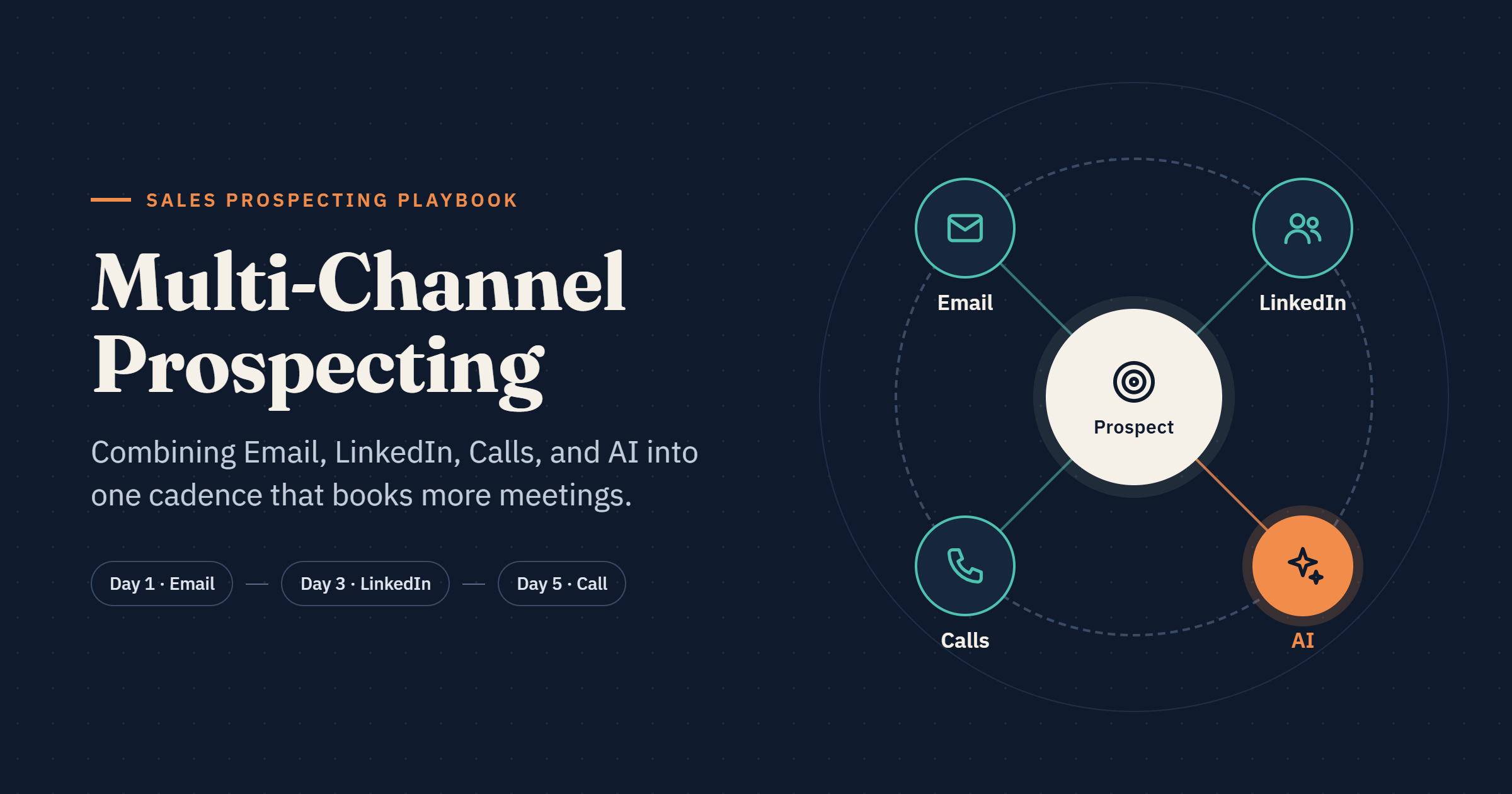

Multi-Channel Prospecting is becoming an essential strategy for B2B sales teams that need to reach buyers across multiple digital and human touchpoints. Instead of depending on a single outreach channel, modern sales teams are combining email, LinkedIn, phone calls, and artificial intelligence to create coordinated prospecting experiences. This approach allows sales representatives to connect with prospects through the channels they actually use while creating multiple opportunities for engagement throughout the buying journey.
B2B buyers rarely follow a predictable path from discovering a company to speaking with a salesperson. A prospect might read an email in the morning, view a LinkedIn post later in the day, visit a company’s website, and eventually respond to a phone call several days later. Multi-Channel Prospecting recognizes this fragmented behavior and gives sales teams a structured way to coordinate their outreach instead of treating every channel as an isolated activity.
What Is Multi-Channel Prospecting?
Multi-Channel Prospecting is the practice of using several communication channels together to identify, engage, and develop potential customers. Common channels include email, LinkedIn, phone calls, social selling, personalized content, events, and increasingly AI-powered sales tools.
The important distinction is that multi-channel prospecting is not simply sending more messages. Effective prospecting requires coordination between channels. A LinkedIn interaction should inform the next email, an email response should influence the next call, and information gathered during a call should improve subsequent messaging.
For example, a salesperson might begin by sending a personalized email to a technology leader. If the prospect does not respond, the salesperson could engage with the prospect’s LinkedIn content before sending a follow-up. A phone call might then reference the prospect’s role, company priorities, or a relevant business challenge. AI can support this process by helping research accounts, identify signals, personalize messaging, and determine appropriate follow-up actions.
The objective is to create a connected sequence rather than a collection of unrelated touches.
Why Single-Channel Prospecting Is Becoming Less Effective –
Traditional outbound sales often focused heavily on one communication method, particularly cold email or cold calling. While these approaches can still generate conversations, relying exclusively on one channel creates limitations.
A prospect may not respond to email because the message arrives at the wrong time. Another prospect may rarely answer unknown phone numbers but regularly use LinkedIn. Someone else may ignore sales messages until they recognize the salesperson’s name through multiple interactions.
A single-channel approach also provides limited behavioral information. When sales teams combine channels, they can observe more signals and adjust their strategy accordingly.
Consider the difference between these two approaches:
- Single-channel: Send five emails and stop.
- Multi-channel: Send a personalized email, engage on LinkedIn, make a relevant call, share useful information, and adjust follow-ups based on engagement.
The second approach does not necessarily mean contacting prospects more aggressively. Instead, it creates multiple pathways for legitimate business communication.
Email, LinkedIn, Calls, and AI Play Different Roles –
Each prospecting channel has different strengths. The most effective strategy is therefore not about selecting one channel as the winner but understanding what each channel contributes to the overall sales process.
| Channel | Primary Strength | Best Use | Common Challenge |
|---|---|---|---|
| Scalable personalized communication | Introductions, follow-ups, useful resources | Crowded inboxes | |
| Professional context and relationship building | Research, engagement, social selling | Low-quality automation | |
| Phone Calls | Real-time human conversation | Qualification and discovery | Low connect rates |
| AI | Research, personalization, prioritization, automation | Supporting sales workflows | Data quality and oversight |
Email provides scalability. LinkedIn provides professional context. Phone calls create direct conversations. AI connects the information across these activities and helps sales teams decide where to focus their time.
The real opportunity comes from combining these capabilities into one coordinated prospecting workflow.
How Email Fits Into a Multi-Channel Strategy –
Email remains an important component of B2B prospecting because it gives prospects an opportunity to review information on their own schedule. However, generic sequences can quickly become ineffective when prospects receive large volumes of similar messages.
In a multi-channel strategy, email should be contextual rather than repetitive. Instead of sending several variations of the same pitch, each message can serve a different purpose within the sequence.
For example, an initial email may introduce a specific business problem. A follow-up could provide a relevant insight or customer example. A later message might connect the conversation to a recent company development or role-specific priority.
Effective B2B email prospecting typically focuses on:
- A clearly defined business problem
- Relevance to the recipient’s role
- A concise value proposition
- Personalization based on legitimate research
- A clear but low-friction call to action
- Appropriate follow-up timing
The objective is not to make every email longer or more personalized. It is to make each interaction more relevant.
How LinkedIn Strengthens Prospecting –
LinkedIn can add an important layer of professional context to outbound sales. Salespeople can use it to understand a prospect’s role, responsibilities, professional interests, company changes, and publicly shared business content.
However, LinkedIn should not become another channel for repetitive automated messages. The strongest use cases involve genuine professional engagement and context.
A salesperson might notice that a prospect has posted about a technology challenge. That information can help shape an email or phone conversation. Similarly, engaging meaningfully with relevant content can create familiarity before a direct sales conversation.
LinkedIn can therefore operate as both a research channel and relationship channel.
Rather than asking, “How many LinkedIn messages can we send?” sales teams should ask, “What useful context can LinkedIn provide about this prospect?”
Why Phone Calls Still Matter –
The growth of digital communication has not eliminated the value of direct conversations. Phone calls remain particularly useful when a salesperson needs to clarify a complex issue, qualify an opportunity, or understand a buyer’s priorities.
A call can also reveal information that is difficult to obtain through digital engagement. Tone, urgency, objections, questions, and conversational details can provide valuable context for the next stage of the sales process.
The challenge is timing and relevance. Calling a prospect without understanding who they are or why the conversation matters can result in a poor experience.
Multi-channel prospecting changes the role of cold calling. Instead of treating a phone call as an isolated activity, sales teams can use information from email engagement, LinkedIn activity, account research, and other legitimate signals to make the conversation more relevant.
The Role of AI in Multi-Channel Prospecting –
AI can become the coordination layer connecting different prospecting activities. Rather than replacing salespeople, AI can reduce the amount of manual research and administrative work required before and after outreach.
AI tools can assist sales teams with activities such as:
- Account and prospect research
- Contact prioritization
- Message personalization
- Email drafting
- Call preparation
- Conversation summarization
- Follow-up recommendations
- Lead scoring
- Intent and engagement analysis
- CRM data organization
- Sales sequence optimization
- Identifying potential next actions
For example, an AI system could analyze available account information and identify which prospects have characteristics similar to previously engaged customers. A salesperson could then review those prospects, validate the information, and determine the appropriate outreach strategy.
This creates a model in which AI handles repetitive analysis while sales professionals remain responsible for judgment and relationship building.
AI Can Help Sales Teams Prioritize Instead of Just Automate –
One of the biggest opportunities for AI in prospecting is prioritization. Sales teams often have more potential prospects than they can realistically contact with the same level of attention.
AI can help identify which accounts deserve additional research or human attention based on defined signals and historical patterns. These signals might include company changes, technology adoption, hiring activity, engagement with content, previous interactions, or other relevant business information.
However, AI-generated prioritization should be treated as decision support rather than absolute truth. Models can inherit inaccurate data, incomplete information, or biased historical patterns.
Human review remains important, particularly for high-value accounts.
Building a Multi-Channel Prospecting Sequence –
A successful sequence should have a logical progression. Every touch should add something rather than simply repeat the previous message.
A sample B2B sequence could look like this:
Day 1 — Email: Introduce a specific problem and explain why it may be relevant to the prospect.
Day 2 — LinkedIn: Review the prospect’s professional context and engage appropriately with relevant public content.
Day 4 — Phone: Make a concise call that connects the conversation to the original outreach.
Day 6 — Email: Share a useful insight, resource, or relevant example.
Day 9 — LinkedIn: Continue professional engagement if there is a legitimate reason to do so.
Day 12 — Phone: Attempt another conversation based on available context.
Day 15 — Email: Send a concise closing-the-loop message rather than continuing an endless sequence.
The exact timing should depend on the audience, sales cycle, industry, and communication preferences. The important principle is that the channels should work together.
Personalization Should Be Based on Relevance –
Multi-channel prospecting creates more opportunities for personalization, but personalization should not become superficial.
Adding someone’s first name or company name to an automated message is not necessarily meaningful personalization. Stronger personalization connects the outreach to something relevant about the prospect’s responsibilities, business environment, or publicly observable professional context.
For example, a message to a CIO might focus on infrastructure complexity, security, operational efficiency, or technology modernization. A message to a CHRO could address workforce technology, employee experience, talent processes, or HR operations.
AI can make this process more scalable, but salespeople should verify AI-generated details before using them in customer communication.
Avoiding the Multi-Channel Spam Problem –
More channels do not automatically produce better prospecting. If poorly coordinated, multi-channel outreach can simply create more opportunities to annoy prospects.
A prospect who receives three emails, two LinkedIn messages, and four calls within a short period may experience the strategy as excessive rather than personalized.
Sales teams should therefore establish communication rules.
Useful safeguards include:
- Define maximum outreach frequency.
- Stop sequences when prospects respond.
- Remove contacts who request no further communication.
- Coordinate activity across sales representatives.
- Avoid repeating identical messaging across channels.
- Use legitimate and accurate prospect information.
- Give prospects meaningful reasons to engage.
- Review automated sequences regularly.
The goal should be consistent relevance, not maximum contact volume.
Measuring Multi-Channel Prospecting Performance –
Traditional sales metrics often focus heavily on activity volume. While activity data is useful, it does not tell the entire story.
A multi-channel strategy should measure performance across the full prospecting journey.
Important metrics include:
- Positive response rate
- Conversation rate
- Meeting-booking rate
- Qualified opportunity rate
- Time to first meaningful conversation
- Channel-level engagement
- Account-level engagement
- Pipeline generated
- Conversion from meeting to opportunity
- Conversion from opportunity to revenue
- Sequence completion and drop-off rates
Teams should also examine combinations of channels. For example, they may discover that prospects who engage with email and LinkedIn before a call behave differently from prospects reached through phone-first outreach.
This type of analysis can help sales organizations understand which sequences are generating meaningful engagement.
From Channel Metrics to Account-Level Intelligence –
A major shift in B2B sales is moving from individual contact activity toward account-level intelligence.
An enterprise prospect is rarely represented by one person. Multiple stakeholders may influence a purchase, including executives, technical teams, finance, procurement, operations, and end users.
Multi-channel prospecting can therefore be combined with multi-threaded selling. Different stakeholders can be approached through appropriate channels while maintaining a coherent account strategy.
For example, an enterprise technology account might involve:
- A CIO evaluating strategic value
- An IT leader evaluating technical requirements
- A security team evaluating risk
- Finance evaluating financial impact
- Procurement evaluating commercial terms
The sales team needs to understand how these perspectives connect rather than treating each contact as an independent lead.
Human Expertise Remains Central –
AI can improve research, automation, and prioritization, but B2B sales still depends heavily on human judgment.
Sales professionals need to determine whether a prospect’s problem is real, whether the timing is appropriate, whether the organization has a reason to change, and whether a solution genuinely fits the situation.
This is particularly important for enterprise sales, where buying decisions can involve complex requirements and multiple stakeholders.
The future of prospecting is therefore unlikely to be simply “AI versus salespeople.” A more practical model is AI-supported salespeople operating across multiple coordinated channels.
“The purpose of multi-channel prospecting is not to contact buyers everywhere. It is to create a more relevant conversation wherever buyers choose to engage.”
How Businesses Can Build a Multi-Channel Prospecting Strategy –
Organizations looking to implement Multi-Channel Prospecting can start with a structured framework rather than immediately adding more tools.
1. Define the Ideal Customer Profile
Identify the industries, company characteristics, roles, business problems, and buying signals that matter most.
2. Map the Buyer Journey
Understand how prospects discover problems, research solutions, evaluate vendors, build internal consensus, and make purchasing decisions.
3. Assign a Purpose to Each Channel
Determine what email, LinkedIn, phone, and AI should accomplish within the overall sequence.
4. Connect Your Sales Data
CRM, sales engagement, marketing, and conversation data should provide a consistent view of prospect interactions.
5. Introduce AI Carefully
Start with research, summarization, prioritization, and drafting before expanding into more automated workflows.
6. Create Outreach Governance
Set rules around frequency, personalization, data quality, privacy, opt-outs, and human review.
7. Measure Outcomes
Evaluate conversations, qualified opportunities, pipeline, and revenue rather than focusing exclusively on the number of activities completed.
The Future of Multi-Channel Prospecting –
The next generation of B2B prospecting will likely become increasingly coordinated. AI systems will be able to process larger volumes of account information, identify relevant signals, summarize previous interactions, and help salespeople determine what to do next.
At the same time, buyers will continue to expect relevance and control. More automation does not eliminate the need for trust. In many cases, it increases the importance of accurate information, responsible communication, and genuine business value.
The sales organizations that adapt successfully will need to balance automation with human judgment. AI can help determine where attention may be valuable, but salespeople still need to decide how to communicate and whether the conversation is worth pursuing.
Multi-channel prospecting is therefore becoming less about adding channels and more about connecting them intelligently.
Frequently Asked Questions –
Multi-Channel Prospecting is a B2B sales approach that combines multiple outreach channels, such as email, LinkedIn, phone calls, and AI-powered sales tools, into a coordinated prospecting strategy.
B2B buyers interact with companies across multiple channels. Using a coordinated approach allows sales teams to create more relevant interactions and gather more context throughout the prospecting process.
AI can assist with prospect research, personalization, lead prioritization, email drafting, call preparation, conversation analysis, CRM organization, and identifying potential next actions.
Yes. Phone calls can provide direct conversations and valuable qualification information. Their effectiveness depends on factors such as audience, timing, relevance, industry, and the quality of the sales approach.
Conclusion –
Multi-Channel Prospecting represents a broader shift in how B2B sales organizations approach outbound engagement. Email, LinkedIn, phone calls, and AI each provide different capabilities, but their value increases when they are connected through a coherent strategy.
The objective is not to contact prospects through every available channel. It is to understand the buyer, identify relevant business context, select appropriate communication methods, and create a sequence in which every interaction has a purpose.
As AI becomes more integrated into sales operations, organizations will have more opportunities to automate research and improve prioritization. However, the strongest prospecting strategies will continue to combine technology with human judgment, professional relevance, and respectful communication.
For modern B2B sales teams, the competitive advantage may come not from making more outreach attempts, but from making every channel contribute to one connected buyer conversation.