

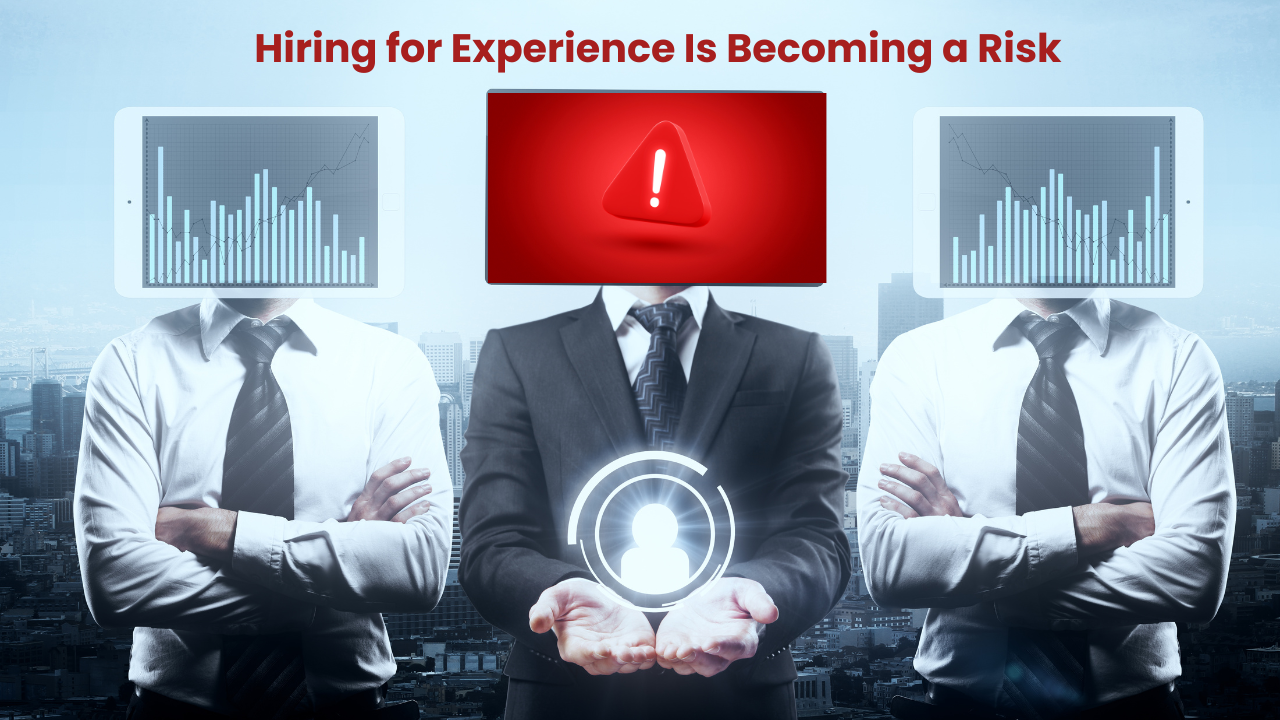

Hiring for Experience is becoming a less reliable way to evaluate candidates in a rapidly changing business environment. For decades, companies have used years of experience as a simple indicator of expertise, asking candidates to have five, eight, or even ten years of experience for different roles. While experience can provide valuable knowledge, judgment, and pattern recognition, it does not always indicate how well someone can adapt to changing technologies, processes, and business requirements.
The modern workplace is evolving faster than many traditional hiring systems were designed to handle. Artificial intelligence, automation, cloud technologies, and digital transformation are changing how employees perform their work. Skills that were highly valuable several years ago can become less relevant as new tools and processes emerge. This creates a growing challenge for organizations: hiring someone who has extensive experience with existing methods does not necessarily mean hiring someone who is prepared for the future.
Experience still matters, but it should not be treated as a substitute for capability. Two candidates can each have ten years of professional experience while possessing very different abilities. One may have spent a decade performing the same processes in a stable environment, while another may have continuously learned new technologies, changed responsibilities, solved unfamiliar problems, and adapted to different business conditions. Their résumés may appear similar, but their ability to respond to change could be dramatically different.
Why Hiring for Experience Alone Is Becoming Risky
For decades, years of experience have been one of the easiest ways for companies to evaluate candidates. A job description asks for five years of experience, another asks for eight, and senior roles often come with expectations that the candidate has spent a significant part of their career doing similar work. On the surface, this makes sense. Experience suggests that someone has already encountered difficult situations, understands professional environments, and can contribute without needing to start from zero. But the workplace is changing faster than many hiring systems were designed to handle.
Technologies are evolving, entire job functions are being redesigned, and skills that were highly valuable five years ago can become less relevant surprisingly quickly. In this environment, hiring primarily for experience can create an unexpected problem: companies may end up selecting people who are highly experienced at yesterday’s way of working while overlooking people who are better prepared for tomorrow’s.
The issue is not that experience has stopped mattering. Experience still provides valuable context, judgment, and pattern recognition. Someone who has handled complex projects for years will often understand risks that a less experienced employee has never encountered. The problem occurs when experience becomes a substitute for capability. Two candidates can have ten years of professional experience and possess completely different abilities.
One may have spent those years repeatedly performing the same processes in a stable environment, while the other may have continuously learned new technologies, changed roles, solved unfamiliar problems, and adapted to different business conditions. Their résumés may look similar from a distance, but their ability to handle change could be dramatically different. This is why the number of years someone has worked is becoming a weaker measure of how prepared they are for the future.
How Technology Is Changing the Value of Experience
Technology is accelerating this shift. AI is already changing how employees research, write, analyse, communicate, code, design, manage information, and make decisions. This does not necessarily mean that existing jobs will disappear. In many cases, the work itself will be reorganized. Tasks that once required significant manual effort may become automated, while new responsibilities will emerge around judgment, quality control, problem-solving, interpretation, and collaboration with technology.
A candidate who has extensive experience performing a manual process may not automatically have an advantage over someone who has less experience but is much better at learning new tools and redesigning workflows. Companies that fail to recognize this difference can unintentionally hire for a world that is already changing.
Why Adaptability Matters in Modern Hiring
This is where adaptability becomes one of the most valuable qualities in modern hiring. An adaptable employee does not need to know every emerging technology on day one. What matters is how quickly that person can understand something unfamiliar, ask the right questions, experiment, learn from mistakes, and apply what they have learned to a real business problem. Technology will continue to change, which means companies cannot realistically hire people who already have years of experience with every future tool.
They have to hire people who can learn the tools that do not exist yet. That is a fundamentally different hiring philosophy. Instead of asking only, “Has this person done this before?” organizations increasingly need to ask, “How does this person respond when they have never done this before?”
Experience vs. Adaptability in Digital Transformation
This distinction becomes particularly important for companies undergoing digital transformation. A transformation project rarely succeeds simply because an organization hires people with impressive résumés. It succeeds when employees can work across functions, understand new systems, challenge inefficient processes, communicate clearly, and adapt as the project evolves.
Someone may have fifteen years of experience in a particular function but struggle when asked to work with a new technology or cross-functional team. Another candidate may have fewer years of experience but demonstrate exceptional learning ability and a history of successfully entering unfamiliar areas. If the hiring process is designed primarily around years of experience, the second candidate may never make it through the first stage.
How AI Is Changing Candidate Evaluation
AI is also changing how recruiters and hiring managers can evaluate candidates. Instead of relying entirely on résumé keywords and years of experience, organizations can increasingly assess practical capabilities through structured interviews, simulations, work samples, problem-solving exercises, and scenario-based assessments. A candidate can be given an unfamiliar business problem and asked to explain how they would approach it. They can be evaluated on how they structure the problem, what questions they ask, how they use available information, and how they respond when new information changes the situation. These assessments reveal something that a résumé often cannot: how a person actually thinks.
Why Continuous Learning Matters More Than Experience
There is another important factor that companies need to consider: the speed at which skills become outdated. In a stable environment, experience compounds naturally because employees continue building on the same knowledge. In a rapidly changing environment, however, experience can sometimes create attachment to familiar methods. This is not a flaw in experienced professionals; it is a natural consequence of becoming successful at a particular way of working.
When a method has worked for years, people understandably trust it. But businesses increasingly need employees who can recognize when a previously successful approach is no longer producing the same results. The ability to unlearn can therefore become just as important as the ability to learn.
Rethinking the Definition of a Strong Candidate
For HR teams, this means the definition of a “strong candidate” may need to change. Instead of building job descriptions around long lists of tools, technologies, degrees, and years of experience, companies can start separating skills into two categories: what someone needs to know immediately and what they need to be capable of learning. The first category is important for productivity.
The second category is important for long-term value. This approach allows companies to identify candidates who may not have every requirement on paper but have the learning ability, curiosity, judgment, and problem-solving skills needed to grow into the role. It also expands the talent pool because organizations are no longer filtering people out simply because their career path does not look conventional.
This shift also creates a responsibility for existing employees. If companies begin hiring for adaptability, they must also create environments where adaptability is rewarded. It is difficult to expect employees to continuously learn if every mistake is punished, experimentation is discouraged, and people are evaluated only on whether they follow established processes. A future-ready workforce requires continuous learning to become part of the culture rather than an occasional training activity.
Employees need opportunities to experiment with new tools, share what they learn, work across departments, and develop skills that may not have been part of their original job description. Hiring can bring adaptable people into the organization, but culture determines whether that adaptability survives.
The most successful organizations will likely move toward a more balanced approach. Experience will continue to matter, but it will be evaluated alongside learning agility, technological confidence, critical thinking, communication, and the ability to operate in uncertain environments. The goal should not be to replace experienced professionals with younger or less experienced employees.
That would simply create another form of bias. The goal is to stop treating experience as the primary evidence of capability. A person with twenty years of experience can be extremely adaptable, just as someone with three years of experience can be resistant to change. The relevant question is not how long someone has been working. It is what they have learned, how they have adapted, and what they are capable of learning next.
The future of hiring will therefore become less about finding candidates who perfectly match the past and more about finding people who can grow with the future. Companies cannot predict every technology they will use five years from now, every skill their customers will demand, or every role their workforce will need. What they can do is build teams that are comfortable learning, questioning, experimenting, and adapting.
Experience remains valuable, but adaptability determines how valuable that experience remains when the environment changes. In a business world where change is no longer an occasional disruption but a constant condition, the strongest hiring decision may not be the person who has done the job the longest. It may be the person who has shown they can learn what the job becomes next.