




Introduction –
AI for Employee Lifecycle Management is becoming an important strategy for B2B companies looking to improve how they attract, onboard, develop, engage, and retain employees. Artificial intelligence is transforming traditional HR processes by automating repetitive administrative work, analyzing workforce data, identifying employee needs, and helping HR teams make faster and more informed decisions.
For B2B companies, where skilled employees directly influence customer relationships, innovation, productivity, and revenue growth, managing the employee lifecycle effectively is critical. From recruiting the right talent to providing personalized training and identifying potential retention risks, every stage of the employee journey can benefit from intelligent automation and data-driven insights.
Traditional employee lifecycle management often depends on manual processes, disconnected HR applications, spreadsheets, emails, and periodic reviews. These approaches can create data silos, increase administrative workloads, delay decision-making, and make it difficult for HR leaders to understand what employees need at different stages of their careers.
With AI for Employee Lifecycle Management, organizations can connect these processes and create a more proactive approach to workforce management. AI can help recruiters identify suitable candidates, guide new employees through onboarding, recommend personalized learning opportunities, analyze performance trends, identify engagement risks, and support long-term workforce planning.
The goal is not to replace HR professionals. Instead, AI can handle repetitive tasks and provide actionable insights so HR teams can spend more time on strategic priorities such as employee development, leadership, culture, engagement, and organizational growth.
As B2B organizations continue adopting digital HR technologies, AI for Employee Lifecycle Management is moving from an experimental capability to a practical component of modern workforce strategy.
Understanding Employee Lifecycle Management –
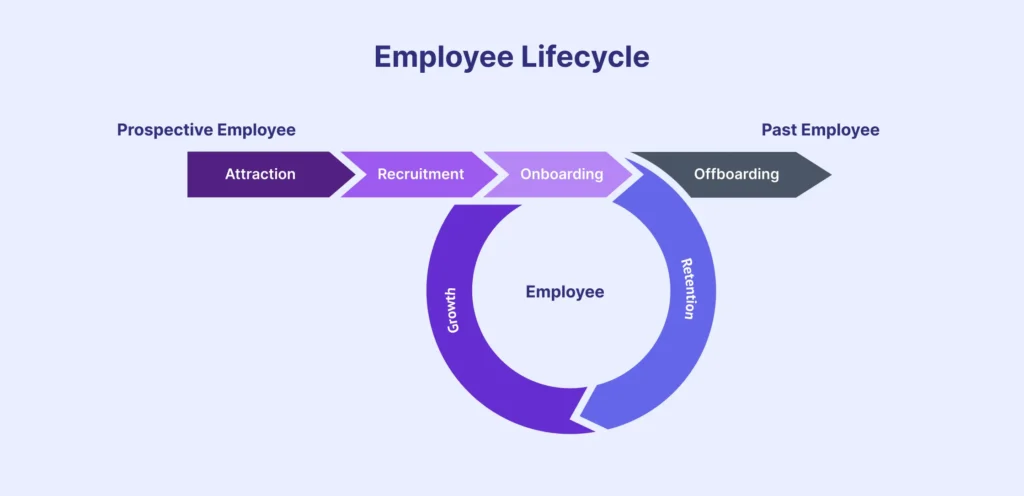
Employee Lifecycle Management refers to the complete journey of an employee within an organization. It starts before an individual is hired and continues through recruitment, onboarding, training, performance management, career development, engagement, retention, and eventually offboarding.
Each stage generates valuable information.
Recruitment systems capture candidate information. HRIS platforms maintain employee records. Learning Management Systems track training and certifications. Performance platforms collect feedback and objectives. Payroll systems manage compensation and benefits.
When these systems operate independently, HR teams often struggle to obtain a complete view of the employee journey.
AI for Employee Lifecycle Management connects data and processes across these stages, allowing organizations to move from reactive HR administration to proactive workforce management.
Employee Lifecycle Stages and AI Applications –
| Employee Lifecycle Stage | Traditional Process | AI-Powered Improvement |
|---|---|---|
| Recruitment | Manual resume screening | AI candidate matching |
| Hiring | Manual interview coordination | Automated scheduling and assessments |
| Onboarding | Paperwork and checklists | AI onboarding assistants |
| Learning & Development | Standard training | Personalized learning recommendations |
| Performance Management | Annual reviews | Continuous performance insights |
| Employee Engagement | Periodic surveys | Sentiment analysis and predictive insights |
| Retention | Reactive interventions | AI attrition prediction |
| Offboarding | Manual documentation | Automated knowledge capture |
AI Is Revolutionizing Recruitment –
Recruitment is often the first interaction candidates have with an organization, making efficiency and responsiveness essential. AI streamlines recruitment by screening resumes, matching candidate qualifications to job requirements, ranking applicants, and identifying skills that align with organizational needs.
AI-powered chatbots answer candidate questions, schedule interviews, and provide application updates, improving the candidate experience while reducing recruiter workloads.
Predictive analytics also help hiring teams identify candidates who are more likely to succeed based on skills, experience, and cultural alignment rather than relying solely on keywords or manual evaluations.
As a result, organizations reduce hiring time, improve candidate quality, and strengthen recruitment efficiency.
Smarter Onboarding Through AI –
Employee onboarding significantly influences long-term engagement and productivity. AI simplifies onboarding by guiding new employees through required documentation, policy reviews, compliance training, and organizational introductions using virtual assistants and automated workflows.
AI-powered onboarding platforms personalize learning paths based on job roles, departments, locations, and experience levels. New hires receive relevant resources, training modules, and reminders without requiring continuous manual coordination from HR teams.
This personalized experience helps employees become productive more quickly while improving consistency across the organization.
“Artificial intelligence does not replace human onboarding—it ensures every employee receives the right support at the right time.”
Personalized Learning and Career Development –
Traditional corporate training often delivers identical learning content to all employees regardless of their individual goals or existing skills. AI transforms learning by recommending personalized training programs based on employee performance, career aspirations, certifications, project assignments, and organizational priorities.
Learning Management Systems (LMS) enhanced with AI continuously recommend courses, identify emerging skill gaps, and suggest career development opportunities.
Managers also gain visibility into workforce capabilities, allowing organizations to prepare employees for future leadership positions while supporting internal mobility.
This personalized approach increases employee engagement while maximizing learning investments.
AI Enhances Performance Management –
Annual performance reviews often fail to capture ongoing employee contributions or identify issues early. AI enables continuous performance management by analyzing productivity trends, project outcomes, collaboration patterns, customer feedback, and development progress throughout the year.
Managers receive data-driven insights that support objective evaluations while reducing unconscious bias. AI also recommends coaching opportunities, identifies high-performing employees, and highlights individuals who may require additional support.
Rather than replacing managerial judgment, AI provides evidence that strengthens performance discussions.
Employees benefit from more frequent feedback, clearer expectations, and targeted development plans.
Improving Employee Engagement with Predictive Analytics –
Employee engagement directly influences productivity, innovation, customer satisfaction, and retention. AI-powered analytics help organizations monitor engagement by analyzing survey responses, collaboration patterns, communication trends, participation rates, and other workplace indicators.
Sentiment analysis identifies declining morale before it affects organizational performance. HR leaders receive early warnings about disengagement, enabling proactive interventions such as career discussions, manager coaching, workload adjustments, or additional learning opportunities.
Predictive insights help organizations address challenges before valuable employees choose to leave.
Workforce Planning Becomes Data-Driven –

Strategic workforce planning requires organizations to anticipate future hiring needs, identify emerging skill requirements, and prepare for changing business demands. AI analyzes historical workforce data alongside market trends, business forecasts, retirement projections, and internal mobility patterns to support long-term planning.
Organizations can simulate different workforce scenarios, evaluate hiring strategies, and determine where automation or reskilling initiatives may be most effective.
These predictive capabilities help businesses align talent strategies with organizational growth objectives.
AI Supports Employee Retention –
Replacing experienced employees is expensive and disruptive. AI helps organizations retain valuable talent by identifying patterns associated with employee turnover before resignations occur.
Factors such as declining engagement, limited career progression, reduced collaboration, compensation concerns, training participation, and workload trends can indicate increased attrition risk.
HR teams use these insights to create personalized retention strategies that may include leadership development, mentoring, career opportunities, compensation reviews, or flexible work arrangements.
Retention becomes proactive rather than reactive.
Ethical AI Is Essential for Modern HR –
As AI becomes more deeply integrated into HR operations, organizations must ensure fairness, transparency, and accountability in automated decision-making. HR leaders should regularly evaluate AI models for bias, validate recommendations against organizational values, and maintain human oversight for important employment decisions.
Employees should understand how AI supports HR processes and how their data is collected, analyzed, and protected.
Responsible AI governance builds trust while ensuring compliance with employment regulations and data privacy requirements.
Technology should strengthen fairness—not compromise it.
“The most successful AI strategy is one that empowers people, supports better decisions, and strengthens trust across the organization.”
Challenges of AI Adoption in HR –
Although AI offers substantial benefits, successful implementation requires careful planning. Organizations may encounter challenges such as fragmented HR systems, inconsistent employee data, integration complexity, employee resistance, and concerns about privacy or algorithmic bias.
HR teams should begin with clearly defined business objectives rather than adopting AI simply because it is available. Data quality, change management, employee training, and cross-functional collaboration between HR and IT remain essential for long-term success.
Organizations that treat AI as a strategic capability rather than a standalone technology achieve better outcomes.
Best Practices for Using AI in Employee Lifecycle Management –
- Define clear business goals before implementing AI.
- Integrate HRIS, ATS, LMS, payroll, and performance systems.
- Maintain high-quality employee data.
- Ensure transparency in AI-supported HR decisions.
- Use AI to augment—not replace—human judgment.
- Monitor AI models regularly for fairness and accuracy.
- Personalize employee learning and development.
- Leverage predictive analytics for workforce planning.
- Train HR professionals to interpret AI insights effectively.
- Continuously evaluate AI performance and employee feedback.
The Future of AI in Employee Lifecycle Management –
Artificial intelligence will continue expanding its role across every stage of the employee lifecycle. Future HR platforms will provide real-time workforce intelligence, personalized employee experiences, predictive career planning, intelligent coaching, automated compliance monitoring, and advanced talent analytics.
Generative AI assistants will support managers by creating performance summaries, recommending development plans, drafting employee communications, and answering HR-related questions instantly.
As organizations embrace hybrid work, global talent strategies, and skills-based workforce planning, AI will become the foundation for building more agile, inclusive, and resilient organizations.
Companies that invest in AI-enabled HR today will be better prepared to attract top talent, improve employee experiences, and adapt to future workforce challenges.
Conclusion –
AI is transforming employee lifecycle management from a collection of disconnected HR activities into an intelligent, connected, and proactive business function. By automating repetitive tasks, delivering predictive insights, personalizing employee experiences, and supporting better decision-making, AI enables B2B companies to build stronger, more engaged, and higher-performing workforces.
Successful implementation requires more than adopting new technology. Organizations must establish strong data governance, integrate HR systems, maintain ethical AI practices, and ensure human oversight remains central to workforce decisions.
As workforce expectations continue evolving, AI will become an essential partner in helping HR leaders attract, develop, retain, and empower employees throughout every stage of their professional journey.
Frequently Asked Questions (FAQs) –
AI-powered employee lifecycle management uses artificial intelligence to improve recruitment, onboarding, learning, performance management, employee engagement, retention, workforce planning, and offboarding through automation and data-driven insights.
AI automates resume screening, matches candidates with job requirements, schedules interviews, powers recruitment chatbots, and helps identify high-potential candidates more efficiently.
Yes. AI analyzes engagement patterns, career progression, performance data, and workplace trends to predict employee turnover risks, enabling proactive retention strategies.
Common challenges include poor data quality, system integration issues, employee privacy concerns, algorithmic bias, change management, and ensuring responsible AI governance.