




Cloud HR Platforms are changing how organizations manage employees, HR processes, workforce data, and people operations. For many years, organizations relied on legacy HR systems installed on internal servers and supported through customized applications, scheduled upgrades, and manual integrations. These systems may still support important HR processes, but changing workforce expectations, distributed workforces, artificial intelligence, employee self-service, and the growing need for real-time data are pushing organizations to reconsider how their HR technology should operate.
The modernization of HR technology is not simply about replacing an old application with a newer one. HR departments are increasingly expected to provide faster services, better employee experiences, stronger analytics, seamless integrations, and more responsive workforce management. At the same time, IT teams are under pressure to reduce infrastructure complexity and support systems that can scale with organizational needs. Cloud HR Platforms address many of these requirements by providing centrally managed, continuously updated, and increasingly connected HR capabilities.
However, modernization does not mean that every legacy HR system needs to be replaced immediately. Some organizations have deeply customized environments, complex integrations, historical data requirements, and business processes built around their existing platforms. The real question is whether the current HR technology can continue supporting the organization’s strategic requirements or whether its limitations are beginning to affect productivity, employee experience, data quality, and the ability to adopt new capabilities.
What Are Cloud HR Platforms?
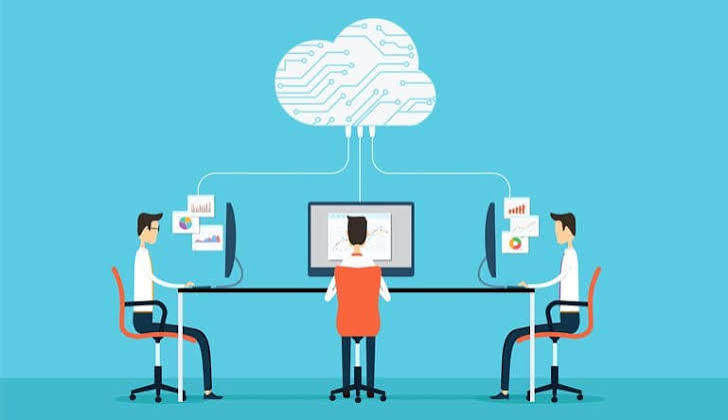
Cloud HR Platforms are human resources systems delivered through cloud infrastructure rather than being dependent primarily on servers managed within an organization’s own data center. These platforms can provide capabilities such as employee records, payroll integration, recruiting,
onboarding, performance management, workforce analytics, learning, benefits administration, and employee self-service through a connected digital environment.
One of the most important characteristics of Cloud HR Platforms is that the software provider typically manages much of the underlying infrastructure and application maintenance. Updates, security improvements, feature releases, scalability, and infrastructure management can be handled through the cloud service model. This can reduce some of the operational burden traditionally associated with maintaining HR applications internally, although organizations still need to manage configuration, governance, access controls, integrations, and data quality.
Cloud HR Platforms also make it easier to connect HR information with other enterprise systems. Modern organizations rarely operate HR in isolation. Employee information may need to interact with finance, identity management, collaboration tools, learning systems, payroll providers, recruiting platforms, benefits systems, and workforce management applications. A cloud-based architecture can provide a foundation for connecting these systems through APIs and integration platforms.
What Are Legacy HR Systems?
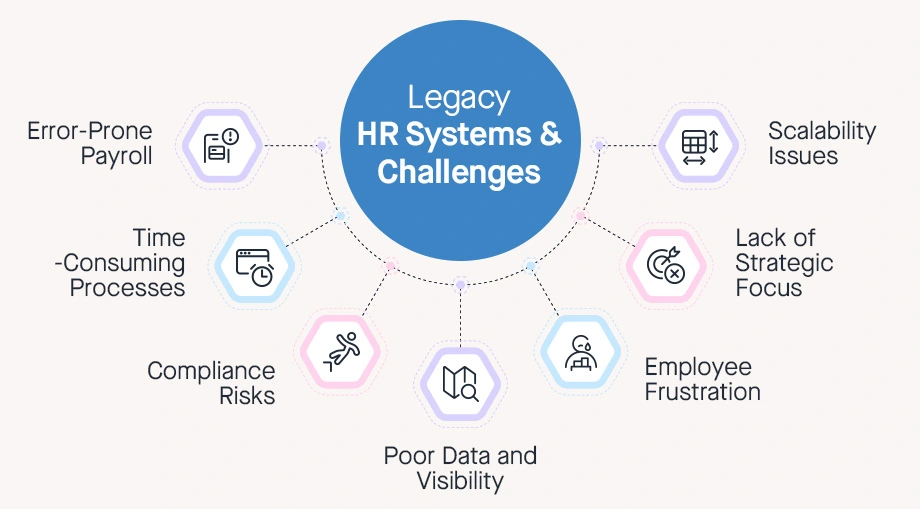
Legacy HR systems are older HR technology environments that organizations have operated for many years, often through on-premises infrastructure or heavily customized applications. These systems can be deeply integrated into business operations and may contain years of historical employee information, organizational rules, workflows, and business-specific configurations.
The word “legacy” does not necessarily mean that a system is useless or incapable. Many legacy HR systems continue to perform core functions reliably. The challenge is that systems designed for earlier technology environments may not have been built for today’s expectations around mobile access, real-time analytics, continuous software updates, AI capabilities, modern integrations, or employee self-service.
Customization can create another challenge. Organizations sometimes modify legacy systems extensively to accommodate specific processes. Over time, those customizations can make upgrades, integrations, testing, and maintenance more complicated. What was originally a useful customization can eventually become a technical dependency that makes modernization more difficult.
Why Organizations Are Moving Toward Cloud HR Platforms –
The move toward Cloud HR Platforms is being driven by several factors at the same time. HR teams increasingly need technology that can support employees across locations, provide information quickly, and integrate with a wider enterprise technology ecosystem. Employees also expect HR services to work more like the digital services they use elsewhere, with intuitive interfaces, mobile access, self-service capabilities, and faster responses.
IT departments have their own reasons for modernization. Maintaining aging infrastructure can require specialized knowledge, hardware management, patching, backup processes, and extensive testing whenever the HR system changes. Cloud platforms can shift some of these responsibilities to the software provider and allow organizations to consume HR technology as an ongoing service rather than managing the entire technology stack themselves.
Another major factor is the pace of innovation. AI, automation, analytics, conversational interfaces, and intelligent workflow capabilities are evolving rapidly. Organizations increasingly want to adopt these technologies without rebuilding their HR infrastructure every time a new capability becomes available. Cloud platforms can provide a more flexible foundation for introducing new functionality over time.
Cloud HR Platforms vs. Legacy HR Systems –
| Capability | Cloud HR Platforms | Legacy HR Systems |
|---|---|---|
| Infrastructure | Cloud-based and provider-managed | Often organization-managed |
| Updates | Frequent and centrally managed | Periodic and often complex |
| Scalability | Generally easier to scale | May require infrastructure changes |
| Employee self-service | Usually built into modern platforms | Often limited or customized |
| Mobile access | Commonly supported | May require additional solutions |
| Integrations | APIs and modern integration tools | Often dependent on custom interfaces |
| Analytics | Real-time and integrated capabilities | May require separate reporting systems |
| AI readiness | Increasingly built into platforms | Often requires additional integration |
| Customization | Configuration-focused | Often heavily customized |
| Maintenance | Shared with software provider | More internal responsibility |
| Deployment model | Subscription/service-based | Often license and infrastructure based |
| Upgrade complexity | Generally lower for infrastructure | Can be significant |
The differences are not absolute. Some legacy platforms have modernized their capabilities, while some cloud implementations can become highly complex because of extensive configuration and integrations. Organizations therefore need to evaluate their specific environment rather than assuming that cloud automatically means better outcomes.
Employee Experience Is Becoming a Technology Requirement –
One of the strongest arguments for HR modernization is the changing employee experience. Employees increasingly expect to access information and complete routine tasks without depending on HR administrators for every interaction. They may want to update personal information, access documents, submit requests, view benefits information, complete learning activities, or manage time-related processes from a browser or mobile device.
Cloud HR Platforms can support these expectations by bringing more HR services into centralized self-service experiences. When employees can complete routine tasks themselves, HR teams can spend more time on workforce planning, employee development, organizational strategy, and complex employee needs.
This does not mean automation should eliminate human interaction from HR. Employees still need access to HR professionals for sensitive, complex, or high-impact situations. The objective is to remove unnecessary administrative friction while preserving human support where judgment, empathy, and context are important.
Real-Time HR Data Is Becoming More Important –
Traditional HR reporting often involved extracting information from multiple systems and preparing reports manually. This can create delays and introduce inconsistencies, particularly when different systems contain conflicting employee information.
Cloud HR Platforms can provide more centralized access to workforce information and analytics. HR leaders can potentially examine workforce trends, organizational structures, employee movement, recruiting activity, learning participation, and other indicators with less dependence on manual reporting processes.
Real-time or near-real-time information can also improve decision-making. When organizations are restructuring teams, expanding into new markets, planning workforce requirements, or evaluating talent strategies, timely information can help leaders understand what is happening across the workforce rather than relying exclusively on historical reports.
Integration Is a Major Modernization Driver –
Modern HR technology rarely exists as a single system. Organizations may use separate platforms for recruiting, payroll, learning, benefits, identity management, performance management, workforce scheduling, and employee engagement. If these systems cannot communicate effectively, HR teams may need to enter the same information multiple times or reconcile conflicting records.
Cloud HR Platforms increasingly use APIs and integration technologies to connect HR applications with the broader enterprise technology environment. This can reduce manual data movement and create more consistent employee information across systems.
Integration also becomes important when organizations introduce AI and automation. An intelligent HR workflow is only as useful as the data and systems it can access. If employee information is fragmented across disconnected applications, automation becomes more difficult to implement reliably. Modernizing the underlying HR architecture can therefore create the foundation for future automation.
Security and Compliance Need a Modern Approach –
Employee information is among the most sensitive categories of enterprise data. HR systems may contain personal information, compensation details, employment records, benefits information, performance data, and other confidential information. Modernization therefore cannot focus only on convenience and functionality.
Cloud HR Platforms can provide sophisticated security capabilities, but organizations remain responsible for configuring access correctly, managing identities, defining permissions, monitoring activity, and establishing appropriate governance. Moving to the cloud does not automatically eliminate security risks; it changes how those risks need to be managed.
Organizations should evaluate security architecture, encryption, authentication, role-based access, audit logging, data residency requirements, retention policies, integration security, and vendor controls when evaluating modernization projects. Security should be part of the architecture from the beginning rather than something addressed after migration.
AI Is Accelerating HR Technology Modernization –
Artificial intelligence is adding another dimension to the modernization conversation. Modern HR organizations are exploring AI for tasks such as employee support, recruiting assistance, workforce analytics, learning recommendations, document processing, HR knowledge management, and administrative automation.
Cloud HR Platforms can provide a foundation for these capabilities because they typically maintain centralized data and provide integration mechanisms through which AI services can access authorized information. AI can then help employees and HR professionals find information, summarize documents, identify patterns, or automate structured workflows.
However, organizations should be careful about treating AI as a reason to migrate without a clear strategy. Poor-quality data, inconsistent processes, excessive customization, and weak governance can undermine AI initiatives. A modern HR platform can provide technical capabilities, but organizations still need clean data, standardized processes, clear policies, and appropriate human oversight.
The Cost Question: Is Cloud Always Cheaper?
Cost is often part of the modernization discussion, but comparing cloud and legacy HR systems purely by license or subscription price can be misleading. Legacy environments may have infrastructure costs, specialized support requirements, upgrade expenses, integration maintenance, backup requirements, and internal administrative overhead. Cloud platforms may have recurring subscription costs, implementation expenses, integration costs, and potential charges for additional functionality.
Organizations should therefore evaluate the total cost of ownership rather than comparing a single line item. The analysis should consider infrastructure, software, support, maintenance, upgrades, internal staffing, integrations, security, downtime, and the operational cost of maintaining older technology.
Business value should also be included. If a modern HR platform reduces administrative work, improves employee self-service, accelerates reporting, simplifies integrations, or enables new workforce capabilities, those benefits can influence the overall economics of the investment.
Modernization Does Not Mean Migrating Everything at Once –
One of the most common mistakes organizations can make is treating HR modernization as a single massive technology replacement project. Large HR environments often contain years of accumulated processes, integrations, data, and customizations. Attempting to replace everything simultaneously can increase implementation risk and make it difficult to identify the source of problems.
A phased modernization strategy can be more manageable. Organizations can begin by assessing existing processes and identifying the areas where legacy technology creates the greatest business or operational limitations. They can then prioritize high-value processes, establish data standards, simplify workflows, and gradually migrate capabilities.
A practical modernization sequence might include:
- Assess existing HR applications and integrations.
- Identify critical business processes and dependencies.
- Remove unnecessary customization where possible.
- Improve employee and organizational data quality.
- Define integration and security requirements.
- Prioritize high-value modernization opportunities.
- Pilot new cloud capabilities with controlled user groups.
- Establish governance and change-management processes.
- Gradually expand the modernized environment.
This approach allows organizations to learn from early implementations before expanding the transformation across the entire HR technology landscape.
Data Migration Is More Than Moving Records –
Data migration is one of the most complicated parts of HR modernization because historical HR information can have significant business and compliance value. Organizations may have years of employee records spread across multiple databases, applications, spreadsheets, and customized systems.
Simply transferring all historical data into a new platform can recreate old problems in a new environment. Modernization creates an opportunity to determine which information is still required, which data needs cleansing, how records should be standardized, and which historical information should be archived.
Data quality should therefore be treated as a modernization workstream rather than a technical afterthought. Incorrect employee records, inconsistent organizational structures, duplicate information, and incomplete historical data can affect reporting, integrations, automation, and employee experiences after migration.
Change Management Is Critical –
Even the most technically capable HR platform can fail to deliver value if employees and HR teams do not adopt it effectively. Modernization often changes familiar workflows, responsibilities, approval processes, and ways of accessing information.
HR professionals need to understand not only how the new system works but also why processes are changing. Employees need clear guidance about new self-service capabilities and where they should go for support. Managers may need additional training because their responsibilities within HR workflows could change significantly.
Communication, training, stakeholder involvement, and phased adoption are therefore critical components of modernization. Technology implementation should be treated as an organizational change initiative rather than simply an IT deployment.
How HR and IT Should Work Together –
Successful HR modernization requires close collaboration between HR and IT. HR understands workforce processes, employee requirements, organizational policies, and business priorities, while IT understands architecture, security, integrations, identity management, infrastructure, and technical risk.
Neither team should operate independently during modernization. HR-led projects without sufficient technical architecture can create integration and security challenges, while IT-led projects without sufficient HR involvement can produce technically efficient systems that fail to address real workforce needs.
The strongest modernization programs establish shared governance between HR, IT, security, finance, and business stakeholders. This creates a common framework for prioritizing investments, managing risks, evaluating vendors, and measuring outcomes.
What Organizations Should Evaluate Before Moving to the Cloud –
Before selecting a Cloud HR Platform, organizations should evaluate their existing environment honestly. The objective is to understand not only what the current system does, but also why particular configurations and customizations exist.
Important questions include:
- Which HR processes are most dependent on the legacy system?
- Which customizations are genuinely required?
- Which integrations are business-critical?
- How reliable and clean is employee data?
- What security and compliance requirements apply?
- What employee experience problems need to be addressed?
- Which processes should be standardized before migration?
- What AI and automation capabilities will be needed in the future?
- How will success be measured after implementation?
These questions help organizations avoid simply moving old processes into a new platform without addressing the underlying problems.
The Future of Cloud HR Platforms –
The evolution of Cloud HR Platforms is likely to continue beyond basic digitization. HR technology is moving toward more connected employee experiences, intelligent automation, predictive analytics, conversational interfaces, workflow orchestration, and increasingly personalized workforce services.
This means modernization should be designed with the future in mind. Organizations should avoid building another rigid environment that requires extensive customization every time business requirements change. Instead, they should prioritize configurable workflows, open integrations, strong data foundations, security, and the ability to adopt new capabilities without major architectural disruption.
The most important question is therefore not simply whether an organization should move HR technology to the cloud. It is whether its HR architecture can support the way the organization expects to operate over the next several years.
Modern HR technology is not simply about moving employee data to the cloud. It is about creating an HR operating environment that can adapt as employees, business models, and technology continue to change.
FAQ: Cloud HR Platforms vs. Legacy HR Systems –
Cloud HR Platforms are HR technology systems delivered through cloud infrastructure. They can provide capabilities such as employee records, recruiting, onboarding, workforce analytics, performance management, learning, payroll integration, and employee self-service.
Organizations are modernizing because legacy systems can create challenges around integrations, upgrades, customization, mobile access, employee self-service, analytics, scalability, and adoption of newer technologies such as AI and automation.
Yes. Many legacy HR systems continue to support important business processes effectively. The question is whether the system can meet current and future business requirements without creating unacceptable operational, technical, or financial limitations.
Security depends on architecture, configuration, governance, access controls, vendor practices, and organizational processes. Cloud platforms can provide sophisticated security capabilities, but organizations still need to configure and manage those capabilities properly.
Modern platforms can allow employees to access HR information and complete routine tasks through web and mobile interfaces. This can reduce administrative workload and provide employees with faster access to common HR services.
AI can support HR knowledge management, employee assistance, recruiting workflows, document processing, analytics, recommendations, and administrative automation. The value of these capabilities depends heavily on data quality, governance, process design, and human oversight.
Conclusion –
Cloud HR Platforms are becoming an important foundation for organizations that want to modernize HR operations and create more connected employee experiences. Their value extends beyond moving HR software away from internal infrastructure. Modern cloud platforms can provide better integration, more frequent innovation, stronger self-service capabilities, improved accessibility, and a foundation for analytics, automation, and AI.
However, modernization should not be treated as a simple technology replacement. Organizations need to examine their existing processes, data, integrations, customizations, security requirements, and employee expectations before deciding what should change. Moving inefficient processes from a legacy environment into a new platform does not create true transformation.
The most effective modernization strategies combine technology with process redesign and organizational change. HR and IT need to work together to create a clear architecture, establish data and security standards, prioritize meaningful use cases, and help employees adapt to new ways of working.
As HR becomes increasingly digital and AI-enabled, the organizations that modernize thoughtfully will have a stronger foundation for delivering responsive workforce services. The real opportunity is not simply replacing legacy technology. It is creating an HR environment that can continuously adapt to changing employees, business requirements, and technology.