


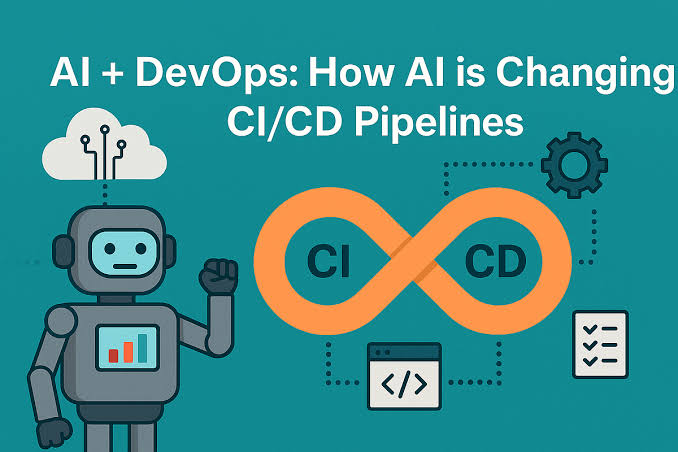
AI-assisted DevOps is changing how engineering teams build, test, deploy, and maintain software. Traditional DevOps practices have already helped organizations accelerate software delivery through continuous integration and continuous delivery (CI/CD), infrastructure as code, automated testing, and collaborative workflows. However, as applications become more distributed and release cycles become shorter, conventional automation alone is no longer enough to manage every operational challenge efficiently.
Modern CI/CD pipelines generate enormous amounts of information, from build logs and test results to deployment metrics, security findings, and production alerts. Engineering teams must interpret this information quickly while maintaining software quality, system reliability, and security. Artificial intelligence (AI) introduces a new layer of intelligence that can analyze these signals, identify patterns, recommend corrective actions, and automate selected decisions throughout the software delivery lifecycle.
Rather than replacing DevOps engineers, AI-assisted DevOps helps them make better decisions and spend less time on repetitive troubleshooting. By combining machine learning, generative AI, predictive analytics, and intelligent automation, organizations can build more adaptive delivery pipelines that respond to changing conditions. The result is a shift from rule-based automation toward software delivery processes that can learn from operational data, anticipate potential failures, and continuously improve.
What Is AI-Assisted DevOps?
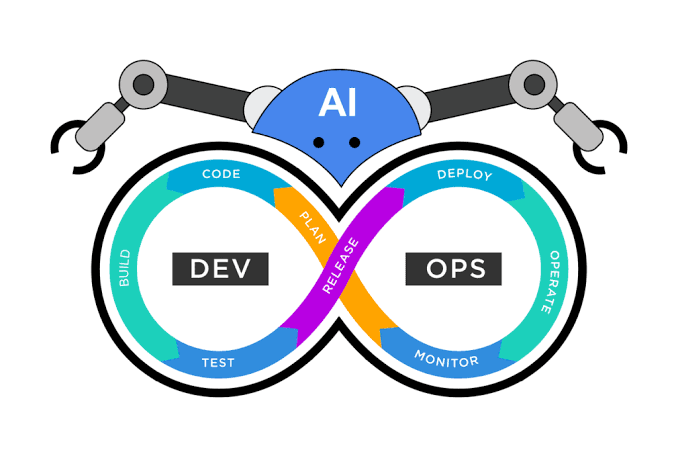
AI-assisted DevOps is the integration of artificial intelligence and machine learning into DevOps workflows to improve software development, testing, deployment, monitoring, and incident management. Traditional DevOps automation follows predefined rules, such as running unit tests after a code
commit or deploying an application when a pipeline passes. AI-assisted DevOps extends these capabilities by using historical and real-time data to identify patterns, assess risks, generate recommendations, and support more context-aware decisions.
For example, a conventional CI/CD pipeline might rerun a failed test whenever a developer submits a new commit. An AI-assisted pipeline could analyze the failure logs, compare them with previous failures, identify a likely dependency issue, and recommend a targeted fix. Similarly, instead of treating every production alert independently, an AI-enabled system can correlate application logs, infrastructure metrics, and recent deployment changes to help engineers identify the probable source of an incident.
These capabilities do not require every part of the pipeline to become autonomous. Organizations can begin with AI-generated explanations, code suggestions, and risk assessments while retaining human approval for consequential actions. Over time, teams can introduce controlled automation in areas where the recommendations are consistently accurate and the consequences of errors are manageable.
Why CI/CD Pipelines Need Intelligent Automation –
CI/CD pipelines have become essential to modern software engineering, allowing development teams to integrate code frequently, run automated tests, and release changes through repeatable processes. Yet, as development environments grow more complex, maintaining these pipelines introduces new challenges. Microservices, containerized applications, cloud infrastructure, third-party dependencies, and multiple deployment environments create more potential failure points than many traditional delivery workflows were designed to handle.
One major challenge is the volume of information generated by automated delivery systems. A single release can produce hundreds of test results, build logs, security findings, and performance measurements. Engineers may spend considerable time identifying which failures matter, determining whether a problem originates in application code or infrastructure, and deciding whether a release is safe to proceed. These activities can slow delivery even when most pipeline stages are already automated.
Another challenge is that rule-based systems typically respond to conditions that engineers have explicitly anticipated. They are effective at executing known procedures but less capable of interpreting ambiguous failures, detecting unfamiliar patterns, or evaluating multiple signals together. AI can help bridge this gap by identifying relationships across pipeline data and presenting engineers with relevant explanations and recommendations.
Intelligent automation is particularly valuable when organizations need to balance delivery speed with reliability. Faster deployments are beneficial only when teams can detect problems early, limit the impact of failures, and recover quickly. AI-assisted DevOps can support this balance by helping teams prioritize testing, assess release risk, detect anomalies, and make troubleshooting more efficient.
7 Ways AI Is Transforming CI/CD Pipelines –
1. Intelligent Code Reviews and Pull Request Analysis
AI-assisted code review can help developers identify potential defects before changes enter the main codebase. By examining source code, pull request descriptions, dependency changes, and relevant coding standards, AI tools can flag suspicious patterns, explain complex changes, and suggest improvements. They can also help reviewers understand how a modification might affect related modules or existing functionality.
This capability is useful for teams working with large repositories, multiple programming languages, and distributed development groups. An AI assistant can summarize a pull request, identify missing test coverage, highlight potentially unsafe input handling, or explain why a change might introduce a performance regression. Developers can then use these findings to focus their attention on the areas that require the most careful review.
However, AI-generated code review comments should be treated as additional evidence rather than definitive judgments. Models can miss subtle defects or flag valid code incorrectly. Human review, static analysis, security scanning, and automated tests remain important safeguards, especially for changes involving authentication, financial transactions, sensitive data, or critical infrastructure.
2. AI-Powered Test Selection and Test Generation –
Testing is one of the most time-consuming stages of many CI/CD pipelines. Large applications may have extensive test suites that take substantial time to execute, even when a code change affects only a small portion of the system. AI-assisted testing can help teams identify relevant tests based on code changes, dependency relationships, historical failures, and previous execution patterns.
For example, when a developer modifies an API authentication module, an intelligent testing system may prioritize authentication, authorization, integration, and regression tests that cover related functionality. Other tests can still run according to the organization’s required validation policy, but targeted execution can provide faster feedback during development. AI can also suggest test cases for boundary conditions, error handling, and unusual user inputs that developers may have overlooked.
Generative AI can further assist by creating test scaffolding, proposing assertions, and converting requirements into candidate test scenarios. These suggestions can improve coverage when reviewed and validated by developers. Teams should avoid allowing AI to remove mandatory tests solely because a model predicts that they are unlikely to fail. Risk-based prioritization should complement, not silently weaken, the quality gates required for production releases.
3. Predictive Build Failure Detection –
Build failures can result from code defects, dependency conflicts, configuration changes, resource constraints, or infrastructure instability. Traditional pipelines generally report a failure after it occurs, leaving developers to investigate the cause. AI-assisted DevOps can analyze historical build records, recent code changes, dependency updates, and environment metrics to identify patterns associated with unsuccessful builds.
An intelligent system might detect that a particular dependency update frequently causes integration failures or that a specific runner configuration is associated with intermittent build errors. It can alert the engineering team before the next release attempt, recommend a configuration check, or direct developers toward similar incidents in the past. This shortens the distance between detecting a problem and understanding how to address it.
Predictive failure detection is most effective when organizations maintain reliable pipeline records and distinguish application defects from infrastructure-related failures. Historical correlations can also be misleading when the underlying environment changes. Teams should evaluate whether predictions improve actual outcomes, track false positives, and periodically retrain or recalibrate models when build processes evolve.
4. Intelligent Deployment Risk Assessment –
Not every code change carries the same operational risk. A small documentation update is generally different from a database migration, a change to an authorization service, or a modification to a widely used application dependency. AI-assisted deployment systems can evaluate factors such as change size, affected components, test outcomes, service criticality, dependency relationships, and historical incidents to help estimate release risk.
Based on this assessment, the pipeline can recommend additional testing, require a second approval, select a canary deployment, or suggest a staged rollout. For example, a release that modifies a critical payment workflow and has incomplete integration-test coverage could receive additional scrutiny before production deployment. A routine change with strong test results and a proven release pattern might follow the standard delivery path.
Risk scores should not become unexplained automatic decisions. Engineering teams need to understand which factors influenced the recommendation and establish clear rules for handling uncertainty. For high-impact systems, deterministic release gates and explicit approvals should remain in place even when an AI model reports low risk. The purpose is to make release decisions better informed, not to eliminate accountability.
5. Automated Root Cause Analysis –
When a deployment fails or a service begins experiencing errors, engineers often need to investigate logs, traces, metrics, deployment records, and infrastructure events across several monitoring platforms. The volume and fragmentation of this information can make incident diagnosis difficult, especially in distributed systems where a problem in one service can affect many dependent components.
AI-assisted root cause analysis can correlate these signals, summarize relevant events, and identify plausible relationships between a recent change and an observed failure. For instance, an AI system might connect an increase in API latency with a recent configuration update, elevated database connection usage, and a rise in timeout errors. Instead of manually reviewing every event, an engineer receives a structured explanation of the most likely causes and the evidence supporting them.
This approach can reduce investigation time, but correlation does not automatically establish causation. A system may identify a recent deployment as a likely contributor when the actual issue is a traffic surge or an unrelated infrastructure fault. Teams should validate recommendations against telemetry, traces, and reproducible evidence before implementing fixes. Automated rollback can be useful when explicit health checks and deployment policies confirm that a release is causing unacceptable impact.
6. AI-Driven Infrastructure and Resource Optimization –
CI/CD performance depends on more than application code. Build runners, test environments, container registries, artifact storage, and cloud infrastructure all influence pipeline speed and operating costs. Static resource allocations can leave expensive environments underutilized while creating bottlenecks during periods of high demand.
AI-assisted infrastructure optimization uses historical workload patterns, resource utilization metrics, queue lengths, and execution times to recommend more appropriate resource allocations. A system might identify opportunities to schedule non-urgent workloads during quieter periods, right-size build runners, or detect test environments that remain active after their work is complete. These recommendations can help organizations reduce waste without compromising delivery performance.
More advanced implementations can automate selected scaling or scheduling actions within defined limits. Nevertheless, resource optimization must account for workload priorities, security isolation, service-level objectives, and the possibility of sudden demand changes. Cost reduction should not come at the expense of developer productivity or production reliability. Teams should measure both financial savings and delivery outcomes when evaluating these initiatives.
7. Continuous Security and Compliance Monitoring –
Security is an integral part of modern software delivery, but the growing number of dependencies, containers, infrastructure configurations, and deployment artifacts can make security findings difficult to prioritize. AI-assisted DevSecOps can help analyze vulnerability reports, identify related risks, summarize potential impact, and connect findings to the services or release stages they affect.
For example, an intelligent pipeline could identify a vulnerable dependency, determine which applications use it, summarize the potential exposure, and recommend an upgrade path. AI can also assist with reviewing infrastructure-as-code changes for risky configurations, explaining security scanner output, and preparing evidence for compliance reviews. These capabilities can help security teams focus on findings that are relevant to the application’s actual context.
AI should not replace established security controls. Software composition analysis, secret scanning, static application security testing, container scanning, access controls, and signed artifact verification continue to provide essential protection. AI-generated remediation must be tested because a proposed fix can introduce breaking changes or overlook a transitive dependency. Organizations should also prevent sensitive source code, credentials, and proprietary logs from being sent to unauthorized AI services.
Traditional DevOps Automation vs. AI-Assisted DevOps –
Traditional automation remains the foundation of reliable software delivery. AI-assisted DevOps builds on that foundation by introducing prediction, contextual analysis, and recommendation capabilities where fixed rules alone are insufficient.
| Capability | Traditional DevOps Automation | AI-Assisted DevOps |
|---|---|---|
| Code review | Applies predefined checks and rules | Highlights contextual risks and suggests improvements |
| Testing | Runs configured test suites | Recommends relevant tests and proposes new scenarios |
| Build monitoring | Reports failed builds | Identifies failure patterns and possible causes |
| Deployment | Follows predefined release conditions | Adds risk assessments and rollout recommendations |
| Incident response | Triggers alerts and runbooks | Correlates signals and summarizes likely root causes |
| Infrastructure management | Uses configured scaling and provisioning rules | Predicts demand and recommends resource adjustments |
| Security analysis | Detects known issues using configured tools | Helps prioritize findings and explain potential impact |
| Decision-making | Primarily rule-based | Combines established rules with data-driven insights |
The distinction is not that traditional automation is obsolete or that AI can operate reliably without constraints. Predictable operations should continue to use deterministic automation because it is easier to test, audit, and reproduce. AI adds the greatest value when a task requires interpreting large volumes of information, recognizing patterns, or helping engineers choose between multiple plausible actions.
The Role of AIOps in Modern CI/CD Pipelines –
AIOps, or artificial intelligence for IT operations, applies AI and machine learning to operational monitoring, event correlation, anomaly detection, and incident management. Although AIOps and AI-assisted DevOps are closely related, they address different parts of the software lifecycle. AI-assisted DevOps often focuses on code changes, builds, testing, and releases, while AIOps frequently focuses on production systems and ongoing service operations.
Integrating these capabilities creates a feedback loop between development and operations. Production telemetry can reveal which types of changes frequently cause performance regressions, which services are vulnerable to capacity problems, and which tests are most effective at detecting defects. These insights can inform future code reviews, test selection, deployment strategies, and release risk assessments.
For example, if production monitoring repeatedly detects memory pressure after a particular class of application updates, the delivery pipeline can incorporate additional memory-focused tests or require stronger validation for similar changes. Likewise, recurring incident patterns can help teams improve runbooks and deployment checks. This feedback loop allows engineering organizations to learn from operational outcomes instead of treating every release as an isolated event.
How to Implement AI-Assisted DevOps Successfully –
- Start With a Specific Engineering Problem –
Organizations should avoid introducing AI across the entire software delivery lifecycle without first identifying a measurable problem. Common starting points include long build times, recurring test failures, excessive time spent reviewing logs, noisy alerts, or slow incident investigations. Selecting one high-friction workflow makes it easier to evaluate whether AI produces meaningful improvements.
Establish a baseline before introducing the new capability. Measure build duration, failure rates, mean time to recovery, review turnaround time, deployment frequency, and the amount of manual effort required for troubleshooting. The relevant metrics depend on the use case, but they should reflect actual engineering outcomes rather than the number of AI suggestions generated.
- Prepare Reliable Data and Context –
AI-assisted automation depends on the quality and accessibility of its supporting information. Build logs, test reports, deployment histories, source-control records, incident tickets, observability data, and infrastructure configurations should be organized so that systems can retrieve the information relevant to a specific task. Inconsistent timestamps, missing metadata, duplicate incidents, and poorly documented failures can undermine the quality of recommendations.
Organizations should also define the context AI tools are permitted to access. A code assistant may need repository documentation and test results, while an incident assistant may require service ownership records and selected telemetry. Applying role-based access controls, data retention policies, and appropriate redaction helps prevent sensitive information from being exposed unnecessarily.
- Integrate AI Into Existing Developer Workflows –
AI capabilities are more useful when engineers can access them within familiar tools, such as source-control platforms, CI/CD systems, issue trackers, and observability dashboards. Developers should not have to switch between multiple disconnected interfaces just to understand a failed pipeline or investigate a release risk.
Integration should provide concise explanations, supporting evidence, and practical next steps. For example, a failed build notification could summarize the error, identify the relevant log segment, link to a previous similar failure, and suggest a diagnostic command. The engineer can then validate the recommendation in the same workflow. Clear integration reduces friction and helps teams develop trust in the system over time.
- Introduce Human Approval and Controlled Autonomy –
Not every AI recommendation should result in an immediate automated action. A sensible implementation begins with read-only analysis and recommendations, moves toward actions requiring human approval, and introduces limited autonomous execution only after sufficient testing and monitoring.
Organizations should define which actions are permitted at each stage. Generating a test suggestion may require minimal approval, while modifying production infrastructure, changing access policies, or deploying a high-risk application version requires stronger controls. Automated actions should have clear permissions, audit logs, timeouts, rollback mechanisms, and limits on their operational scope.
- Measure Outcomes and Continuously Improve –
AI-assisted DevOps should be evaluated using engineering and business outcomes rather than adoption metrics alone. A tool may generate useful-looking summaries without reducing troubleshooting time or improving release quality. Teams should compare results against the original baseline and account for changes in application complexity, release volume, and infrastructure conditions.
Useful measures include change failure rate, deployment lead time, mean time to recovery, pipeline duration, escaped defects, false-positive recommendations, and the percentage of AI-generated fixes accepted after review. Organizations should also gather developer feedback to identify recommendations that are confusing, repetitive, or difficult to validate. Regular evaluation helps determine which capabilities deserve broader deployment and which need further refinement.
Challenges and Risks of AI-Assisted DevOps –
Despite its potential, AI-assisted DevOps introduces challenges that organizations must address before relying on it for critical delivery decisions. One concern is recommendation accuracy. AI systems can generate incorrect explanations, overlook important dependencies, or propose fixes that appear reasonable but fail in real environments. If engineers accept suggestions without validation, intelligent automation can introduce defects rather than prevent them.
Data privacy and intellectual property protection are also significant considerations. Source code, proprietary architecture details, infrastructure configurations, and production logs may contain sensitive information. Organizations need clear policies for approved models, data processing, access permissions, and retention. Self-hosted or enterprise-controlled deployments may be appropriate for certain workloads, depending on regulatory and security requirements.
Another challenge is over-automation. When teams allow AI to change code, modify infrastructure, or deploy applications without sufficient restrictions, a single incorrect recommendation can affect multiple services. The risk increases when an AI system has broad credentials or can execute commands without independent validation. Least-privilege access, isolated execution environments, policy-based controls, and human approval for high-impact operations help reduce this exposure.
Finally, organizations should account for cost, complexity, and skills. AI services can add usage fees, latency, integration effort, and new operational dependencies. Engineering teams need to understand how to validate model output, monitor automated actions, and troubleshoot failures in the AI layer itself. A phased approach that prioritizes high-value use cases is generally more sustainable than attempting to make every pipeline stage AI-driven from the beginning.
The Future of AI-Assisted DevOps: From Automation to Adaptation –
The next stage of AI-assisted DevOps is likely to involve increasingly capable assistants and agents that can coordinate multiple steps across software delivery workflows. Depending on their permissions and integrations, these systems may investigate failed builds, gather supporting evidence, draft code changes, run tests, prepare pull requests, and summarize deployment outcomes. Such workflows could reduce the amount of manual coordination required for routine engineering tasks.
However, greater capability does not automatically mean greater reliability. An AI agent that can execute multiple actions must be constrained by clear goals, narrowly scoped permissions, verifiable completion criteria, and explicit stopping conditions. It should not be allowed to bypass mandatory quality gates simply because it believes a deployment is likely to succeed. Human engineers will continue to play an important role in architecture decisions, exception handling, security oversight, and accountability for production outcomes.
Another important direction is the integration of software delivery metrics with operational feedback. As engineering platforms become better at connecting code changes to production behavior, teams can make more informed decisions about testing priorities, rollout strategies, and reliability improvements. The most effective systems will combine AI’s ability to process complex information with deterministic controls that ensure delivery processes remain predictable and auditable.
Conclusion –
AI-assisted DevOps represents an important evolution in how organizations build, test, deploy, and operate software. By introducing intelligent analysis into CI/CD pipelines, teams can identify potential failures earlier, prioritize testing more effectively, assess deployment risk, investigate incidents faster, and improve infrastructure utilization. These capabilities are especially valuable in complex environments where conventional automation generates more information than engineers can efficiently interpret.
Successful adoption requires more than adding an AI tool to an existing pipeline. Organizations need reliable engineering data, secure integrations, measurable objectives, clear governance, and safeguards around automated actions. Traditional automation should remain responsible for predictable, mandatory controls, while AI supports the decisions that benefit from contextual reasoning and pattern recognition.
“The goal of intelligent DevOps is not to remove engineers from the delivery process. It is to remove unnecessary friction, surface better evidence, and help engineering teams deliver reliable software with greater confidence.”
Organizations that approach AI-assisted DevOps as a disciplined engineering improvement—not simply a race toward autonomous deployment—will be better positioned to increase delivery efficiency while protecting software quality, security, and system reliability.
Frequently Asked Questions (FAQs) –
AI-assisted DevOps uses artificial intelligence and machine learning to improve software development, testing, deployment, monitoring, and incident response. It helps engineering teams analyze pipeline data, identify patterns, predict potential failures, and make better-informed decisions throughout the software delivery lifecycle.
AI can improve CI/CD pipelines by supporting intelligent code reviews, test selection, build failure analysis, deployment risk assessment, anomaly detection, and incident investigation. These capabilities can reduce manual troubleshooting and help teams identify problems earlier while retaining the quality gates required for reliable releases.
AI can support or execute selected deployment tasks when integrated with suitable tools and permissions, but fully autonomous deployment is not appropriate for every application. Critical systems still need deterministic quality checks, security controls, monitoring, approval policies, and reliable rollback procedures. The appropriate level of autonomy depends on the application’s risk and the organization’s operational maturity.
AI-assisted DevOps generally focuses on improving software development and delivery activities, including code review, testing, builds, and deployments. AIOps applies AI to IT operations, including monitoring, event correlation, anomaly detection, and incident management. The two approaches complement each other when operational insights inform future development and release decisions.