

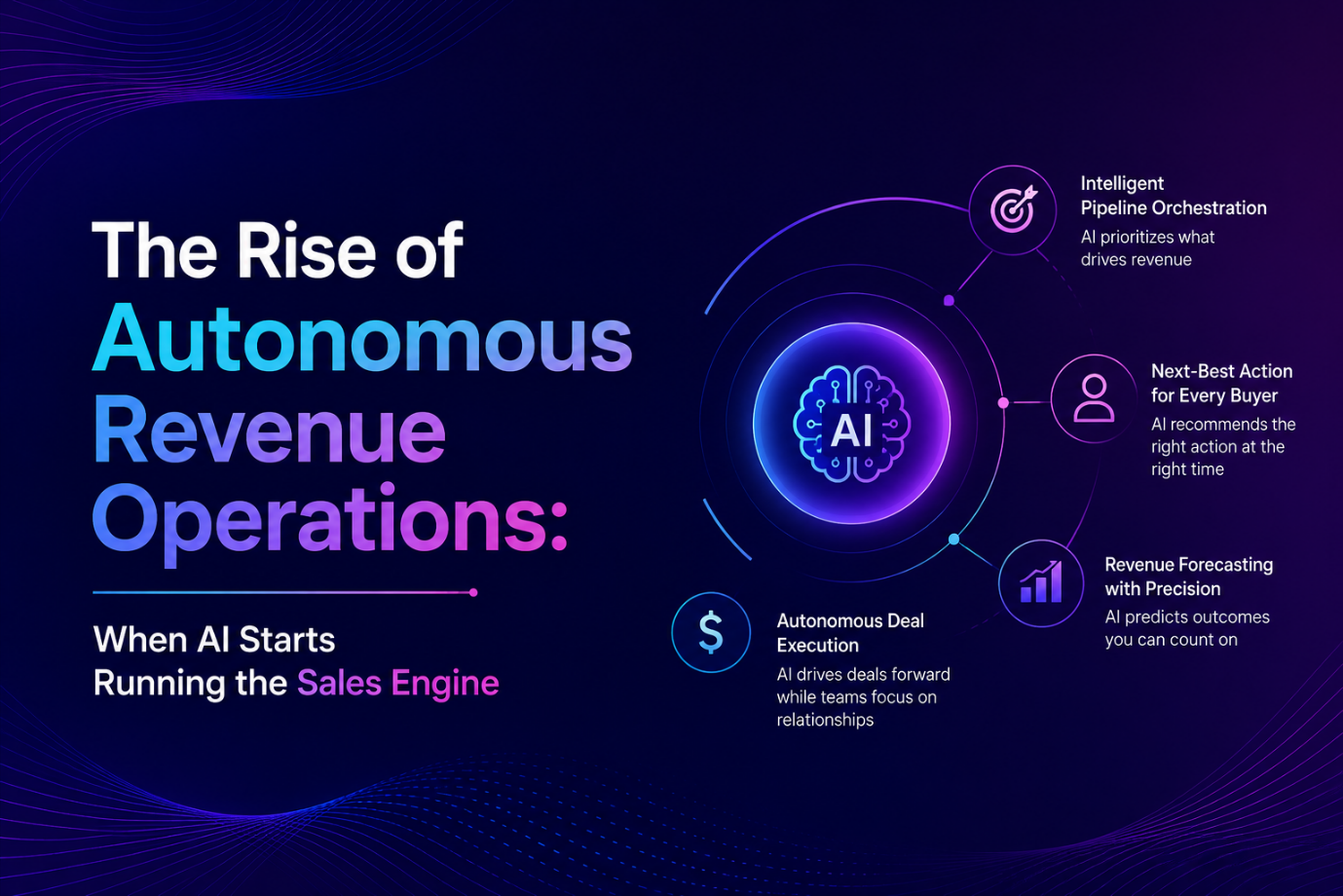

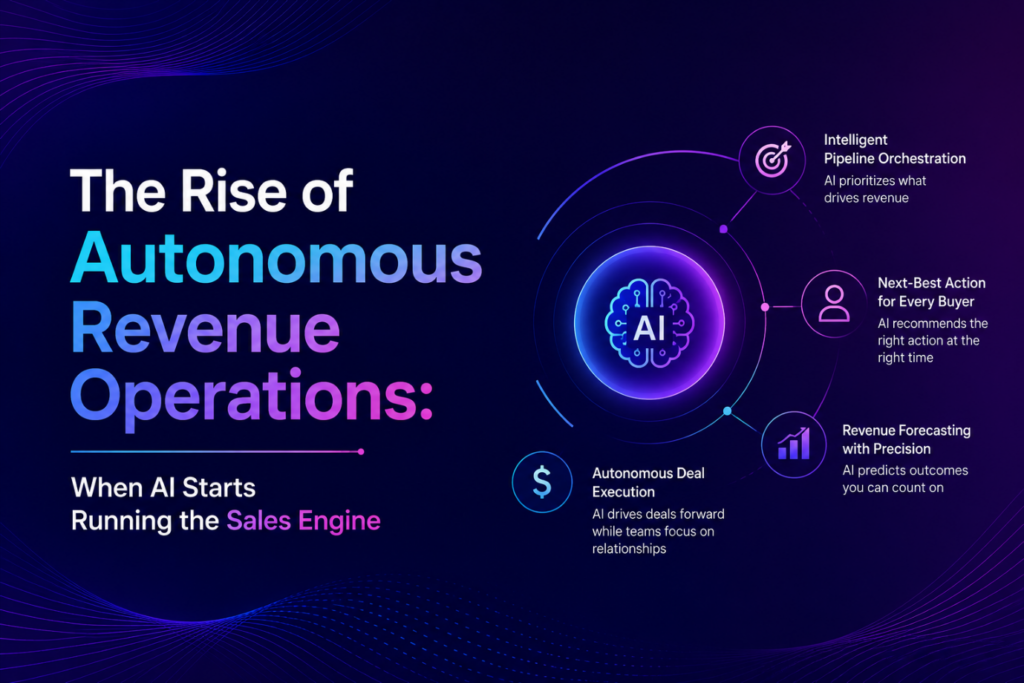
Autonomous Revenue Operations is quickly becoming one of the biggest shifts in enterprise sales strategy. For years, artificial intelligence has been viewed as a productivity tool that helps sales representatives draft emails, summarize meetings, recommend follow-up actions, and automate repetitive administrative tasks. While these capabilities continue to deliver value, enterprises are now entering a new phase where AI is no longer acting only as an assistant—it is beginning to operate significant parts of the revenue engine itself.
Modern organizations generate enormous volumes of customer, sales, and operational data every day. Yet many revenue teams still rely on manual reporting, disconnected systems, spreadsheet-driven forecasting, and time-consuming pipeline reviews. As buying journeys become increasingly complex and customer expectations continue to evolve, these traditional processes struggle to keep pace.
Autonomous Revenue Operations represents the next evolution of RevOps by combining artificial intelligence, predictive analytics, workflow automation, customer intelligence, and real-time decision-making into a unified operating model. Rather than simply supporting revenue teams, AI continuously monitors pipeline health, improves forecasting accuracy, automates CRM updates, optimizes pricing strategies, identifies growth opportunities, and recommends proactive actions before problems arise.
Organizations adopting this approach are discovering that competitive advantage no longer comes from collecting more customer data—it comes from transforming that data into intelligent, automated business decisions.
“The future of revenue growth belongs to organizations where AI doesn’t just support the sales engine—it helps run it.”
What Is Autonomous Revenue Operations?
Revenue Operations (RevOps) has traditionally focused on aligning sales, marketing, finance, and customer success to improve business performance. However, most RevOps processes still depend heavily on manual coordination, periodic reporting, and human intervention.
Autonomous Revenue Operations takes this concept several steps further.
Instead of waiting for teams to identify issues, AI continuously analyzes operational data, detects revenue risks, recommends corrective actions, and automates repetitive workflows without requiring constant human oversight.
This creates a revenue engine capable of learning, adapting, and improving as market conditions evolve.
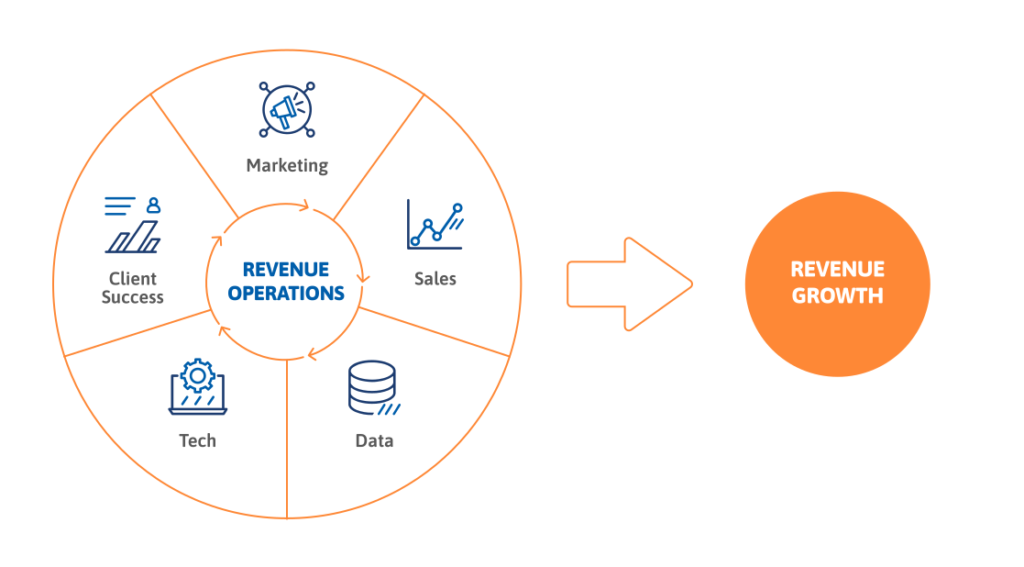
Why Traditional Revenue Operations Are Reaching Their Limits
As enterprises expand, revenue operations become increasingly difficult to manage manually. Sales teams generate opportunities, marketing creates demand, finance monitors revenue recognition, customer success drives retention, and operations teams attempt to keep every system synchronized.
Although each department contributes to revenue growth, their tools often operate independently.
This fragmentation creates several operational challenges:
- CRM records quickly become outdated.
- Pipeline reviews consume significant management time.
- Revenue forecasts rely heavily on subjective judgment.
- Sales representatives spend too much time on administrative work.
- Executive decisions are often based on historical rather than real-time data.
Despite significant investments in digital transformation, many organizations still require manual intervention to coordinate workflows that AI can now automate continuously.
Key Insight –
Autonomous Revenue Operations is not about replacing revenue teams—it is about replacing repetitive operational work so people can focus on strategy, customer relationships, and growth.
How AI Is Becoming the Revenue Engine –
The biggest difference between traditional automation and autonomous operations is intelligence.
Conventional automation executes predefined workflows.
Autonomous AI evaluates live business conditions, identifies emerging patterns, predicts future outcomes, and recommends the best course of action without waiting for manual intervention.
Rather than functioning as another software platform, AI becomes an operational decision-making layer across the entire revenue organization.
Every customer interaction, sales conversation, proposal, support request, contract update, and CRM activity contributes to continuously improving operational intelligence.
AI-Powered CRM and Data Integrity –
One of the largest operational challenges facing enterprise sales teams has always been CRM accuracy.
Sales representatives naturally prioritize customer conversations over administrative tasks, leading to incomplete opportunity records, outdated deal stages, missing notes, and inconsistent reporting.
Autonomous Revenue Operations eliminates much of this manual work.
AI automatically captures meeting transcripts, analyzes emails, updates opportunity stages, records customer commitments, identifies missing information, and synchronizes customer data across connected business systems.
Instead of becoming a database that employees constantly update, the CRM evolves into a continuously maintained source of business intelligence.
Benefits of Autonomous Revenue Operations –
| Traditional Revenue Operations | Autonomous Revenue Operations |
|---|---|
| Manual CRM updates | AI automatically updates customer records |
| Quarterly forecasting | Continuous predictive forecasting |
| Reactive pipeline reviews | Real-time pipeline monitoring |
| Spreadsheet reporting | Live operational dashboards |
| Manual pricing decisions | AI-driven pricing optimization |
| Static territory planning | Dynamic territory recommendations |
| Human commission calculations | Automated commission management |
| Limited customer insights | Predictive customer intelligence |
The Future of AI-Driven Revenue Operations –
Enterprise sales is entering a period where AI will become deeply integrated into every stage of the revenue lifecycle. CRM platforms will continue serving as systems of record, but intelligent automation will increasingly become the system of action.
Organizations that successfully combine AI with human expertise will benefit from:
- Faster revenue decisions
- More accurate forecasting
- Stronger customer experiences
- Higher operational efficiency
- Improved sales productivity
- Better cross-functional collaboration
Rather than replacing experienced revenue professionals, AI will enable them to spend more time solving complex customer problems and less time managing operational processes.
Conclusion –
Autonomous Revenue Operations represents far more than another wave of sales automation. It marks a fundamental shift in how enterprise revenue organizations operate.
Instead of relying on manual reporting, disconnected workflows, and historical dashboards, businesses are moving toward intelligent systems capable of continuously monitoring pipeline health, maintaining CRM accuracy, optimizing pricing, improving forecasting, and uncovering new growth opportunities in real time.
The future of enterprise sales will not be defined by how much customer data organizations collect—it will be defined by how effectively they transform that data into intelligent action. Companies that embrace Autonomous Revenue Operations today will build faster, smarter, and more resilient revenue engines capable of adapting to rapidly changing markets while empowering their people to focus on what matters most: creating meaningful customer relationships and driving sustainable growth.
Frequently Asked Questions –
Autonomous Revenue Operations uses AI, automation, and analytics to manage revenue processes such as forecasting, CRM updates, pipeline management, pricing, and customer intelligence with minimal manual intervention.
Traditional RevOps relies heavily on manual reporting and coordination, whereas Autonomous RevOps continuously analyzes data, predicts outcomes, and automates operational tasks in real time.
No. It enhances sales teams by automating repetitive operational work, allowing professionals to focus on customer relationships, negotiations, and strategic decision-making.
Key technologies include Artificial Intelligence (AI), Machine Learning (ML), Predictive Analytics, CRM platforms, Revenue Intelligence, Conversational Intelligence, and Workflow Automation.
Organizations adopt Autonomous RevOps to improve forecasting accuracy, maintain cleaner CRM data, optimize pricing, reduce operational costs, enhance customer experiences, and accelerate revenue growth.