



The B2B sales technology stack has become essential for organizations that want to identify prospects, manage customer relationships, automate outreach, forecast revenue, and improve sales productivity. Modern sales teams use a wide range of tools for customer relationship management (CRM), sales engagement, prospect intelligence, conversation analytics, revenue forecasting, and performance reporting. While each platform may solve a specific problem, the growing number of disconnected tools can create a new challenge: sales technology becomes more complicated to manage than the sales process itself.
Tool sprawl occurs when organizations accumulate overlapping applications without a clear strategy for ownership, integration, or business value. Data silos emerge when information remains trapped in separate systems, preventing sales representatives, managers, and revenue operations teams from developing a consistent view of prospects and customers. The consequences can include duplicate records, inconsistent reporting, inefficient workflows, rising software costs, and missed opportunities to engage buyers with relevant information.
The solution is not necessarily to reduce the number of tools at any cost. A well-designed B2B sales technology stack should provide the capabilities sales teams need while minimizing unnecessary complexity. Organizations can achieve this by defining a clear technology architecture, establishing trusted data sources, integrating essential platforms, and measuring tools against actual business outcomes. When systems work together effectively, sales teams spend less time managing technology and more time building relationships, advancing opportunities, and generating revenue.
What Is a B2B Sales Technology Stack?
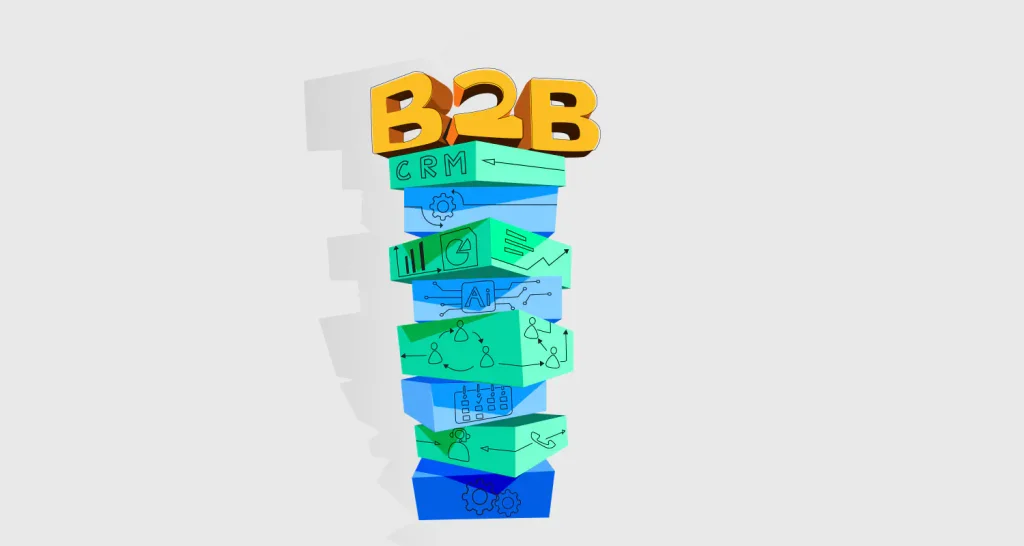
A B2B sales technology stack is the collection of software applications, data platforms, and integrations that support the sales process, from identifying potential customers to closing deals and managing customer relationships. Depending on the organization,
the stack may include CRM software, prospecting databases, sales engagement platforms, marketing automation, conversation intelligence, sales analytics, proposal management, and revenue forecasting tools.
Each application serves a particular purpose. A CRM platform typically maintains account, contact, opportunity, and activity records. Sales engagement tools coordinate emails, calls, and follow-up sequences. Sales intelligence platforms help representatives identify target accounts and understand buying signals. Conversation intelligence tools analyze sales calls, while revenue analytics platforms help leaders evaluate pipeline performance and forecast outcomes.
A connected stack allows these applications to exchange relevant information and support a consistent workflow. For example, prospect data collected by a sales intelligence platform can populate CRM records, engagement activities can update contact histories, and opportunity changes can inform forecasting dashboards. When these connections work reliably, teams can access the information they need without manually reconciling multiple systems.
However, a stack becomes difficult to manage when tools are selected independently by different departments, teams, or individual representatives. Without a common architecture, the organization may end up with multiple applications performing the same function, separate databases containing conflicting information, and integrations that are expensive to maintain. The challenge is therefore to build a sales technology ecosystem that is connected, purposeful, and aligned with the company’s revenue strategy.
Why B2B Sales Organizations Experience Tool Sprawl –
1. Technology Purchases Happen Without Centralized Planning –
Sales teams often adopt new tools to solve immediate problems. A manager may introduce a prospecting platform to improve lead generation, while another team adopts an engagement platform to increase outreach productivity. Marketing may purchase a separate enrichment tool, and revenue operations may introduce another application for reporting. Each purchase can appear reasonable in isolation, but the combined ecosystem may become unnecessarily complex.
This pattern becomes more common when departments have independent budgets and limited visibility into existing technology. Before purchasing a new application, teams may not know that another platform already provides the same capability or that the required feature is available through an existing subscription. Over time, the organization pays for overlapping functionality and creates additional integration requirements.
A centralized technology review process helps prevent this problem. Sales leadership, revenue operations, IT, security, and procurement should evaluate new tools against existing capabilities, business requirements, integration options, and measurable outcomes. This does not mean every purchase needs an elaborate approval process. It means organizations should understand how a proposed application fits into the broader sales architecture before adding it to the stack.
2. Different Teams Optimize for Different Goals –
Marketing, sales development, account executives, customer success, and revenue operations often use different tools because their responsibilities and performance metrics differ. Marketing may prioritize campaign attribution and lead engagement, sales development representatives may focus on prospecting speed, and account executives may prioritize opportunity management and deal progression.
Problems arise when each team optimizes its own workflow without considering the information required by other teams. Marketing may define a qualified lead using one set of criteria, while sales uses another. Sales development representatives may track outreach in an engagement platform, but account executives may rely on the CRM as their primary source of information. If these systems do not share consistent records and definitions, handoffs become unreliable.
A shared revenue operations strategy can align these workflows. Teams should agree on common definitions for leads, accounts, opportunities, qualification stages, and customer lifecycle events. They should also establish which system owns each data field and how information moves between applications. This creates a more consistent experience for both internal teams and buyers.
3. Point Solutions Multiply Across the Sales Lifecycle –
Specialized tools can provide valuable functionality, but their cumulative impact is easy to underestimate. An organization might use separate applications for contact discovery, email sequencing, meeting scheduling, call recording, proposal creation, forecasting, and sales coaching. Every application introduces its own interface, data model, permissions, subscription costs, and maintenance requirements.
When these tools are poorly coordinated, representatives must switch between platforms to complete routine tasks. They may copy contact details manually, update the same opportunity in several places, or search different systems to understand a prospect’s history. These activities create friction and reduce the time available for direct customer engagement.
The right response is to evaluate capabilities across the complete sales workflow rather than assessing each product independently. Some specialized applications are worth retaining because they deliver differentiated value. Others may be replaced by existing platform features, integrated more effectively, or removed when adoption and business impact are too low.
The Hidden Cost of Data Silos in B2B Sales –
Data silos are more than an inconvenience for reporting teams. They can directly affect prospecting quality, customer experience, sales productivity, and revenue predictability. When information is distributed across disconnected systems, representatives may lack the context needed to personalize conversations or determine the appropriate next step in an opportunity.
Consider a prospect who has downloaded a technical resource, attended a webinar, exchanged emails with a sales development representative, and participated in a product demonstration. If each interaction is stored in a different platform without reliable synchronization, the account executive may see only part of the buyer’s journey. The representative could repeat questions, recommend irrelevant content, or overlook a concern that was already raised during an earlier conversation.
Data silos also undermine sales analytics. If CRM opportunity values differ from forecasting records, or if engagement activities are missing from reporting dashboards, managers may struggle to understand pipeline health accurately. Sales leaders can end up debating the validity of the numbers rather than deciding how to improve performance.
There is an additional risk when organizations introduce artificial intelligence into sales workflows. AI-assisted prospecting, lead prioritization, deal analysis, and forecasting depend on relevant and reliable information. Fragmented records and inconsistent definitions can lead to misleading recommendations. Before expanding AI use cases, companies should ensure that the underlying data is sufficiently accurate, accessible, governed, and connected to the decisions the tools are expected to support.
The Core Components of a Modern B2B Sales Technology Stack –
A practical B2B sales technology stack does not need to contain every available category of software. It needs to support the organization’s sales motion, target market, team structure, and operational requirements. The following categories provide a useful starting point for evaluating the stack.
- Customer Relationship Management –
The CRM platform typically acts as the central operational record for accounts, contacts, opportunities, and sales activities. It gives representatives and managers a shared view of customer relationships, deal stages, and pipeline status. A CRM is most effective when its data model reflects the actual sales process and its records are maintained consistently.
Organizations should clarify which information belongs in the CRM and which information should remain in specialist applications. The CRM does not necessarily need to store every call transcript or every raw intent signal. It should, however, contain or link to the information required to manage relationships, progress opportunities, and report on sales performance.
- Sales Intelligence and Prospect Data –
Sales intelligence tools help teams identify potential customers, enrich account records, validate contact information, and understand buying signals. Their value depends on data relevance, coverage, accuracy, and how effectively the information enters the sales workflow.
Multiple prospecting tools can create duplication when each maintains its own contact database or enrichment rules. Organizations should evaluate whether a primary data provider can meet most requirements and define how additional sources should be used. Data provenance, consent requirements, regional privacy rules, and refresh frequency should be part of this evaluation.
- The CRM often serves as the primary system of record for accounts, contacts, opportunities, and sales activities, but it does not need to own every type of information. Other systems may remain authoritative for product usage, billing, consent, or detailed conversation records. The important requirement is to define clear ownership and reliable synchronization for each relevant data category.
Sales engagement platforms coordinate outbound and follow-up activities across channels such as email, calls, and professional networking platforms. They can help teams maintain consistent processes and understand which activities are associated with meaningful engagement.
Integration with CRM is particularly important. Contact changes, activity history, sequence enrollment, replies, and meeting outcomes should be reflected in the appropriate systems without creating duplicate or contradictory records. Teams should also ensure that automated outreach follows applicable privacy requirements, communication preferences, and internal contact policies.
- Conversation Intelligence and Sales Enablement –
Conversation intelligence platforms capture and analyze sales conversations, helping teams identify objections, coaching opportunities, recurring buyer concerns, and competitive themes. Sales enablement systems provide training materials, messaging, playbooks, and approved content for representatives.
These tools become more useful when their insights connect to relevant accounts, opportunities, and coaching workflows. However, access to recordings and transcripts should be carefully controlled because conversations may contain confidential commercial information or personal data. Organizations should establish clear retention policies and permissions rather than allowing unrestricted access across the sales team.
- Revenue Analytics and Forecasting –
Revenue analytics platforms consolidate pipeline, activity, conversion, and forecast information to support management decisions. Some organizations can meet these needs through CRM reporting and business intelligence tools, while others require specialized forecasting or revenue intelligence capabilities.
Before adopting another analytics platform, organizations should determine whether the underlying data is trustworthy and whether the desired reports can be produced through existing tools. A sophisticated dashboard cannot compensate for inconsistent opportunity definitions, missing activity records, or unreliable stage updates.
How to Eliminate Tool Sprawl Without Disrupting Sales –
Step 1: Audit Every Application in the Stack –
The first step is to create a complete inventory of sales-related technology. Include formal enterprise subscriptions, team-level applications, browser extensions, data providers, AI assistants, and tools purchased through departmental budgets. The objective is to understand what the organization actually uses, not merely what appears in the official procurement records.
For each application, document its primary purpose, owner, user groups, annual cost, contract renewal date, adoption level, data stored, integrations, security requirements, and business outcomes. Identify applications with overlapping functionality, low usage, redundant licenses, or integrations that require substantial maintenance. This inventory provides a factual basis for consolidation decisions.
It is important to involve frontline representatives in the audit. A tool with low usage may be genuinely unnecessary, but it may also solve a critical problem for a specialized team. Usage statistics should therefore be considered alongside user feedback, workflow requirements, and measurable business impact.
Step 2: Map Tools to the Sales Process –
Once the inventory is complete, map each application to the sales lifecycle. Document how teams move from account selection and prospect research to outreach, qualification, opportunity management, negotiation, and forecasting. Include the information created at each stage and the systems that receive it.
This exercise reveals where multiple applications perform the same task, where information is entered repeatedly, and where handoffs depend on manual updates. It can also expose capabilities that are missing entirely. For example, an organization may have several tools for finding contacts but no reliable process for recording data provenance or preventing duplicate account creation.
The goal is to simplify the end-to-end workflow rather than remove applications solely because their names or features appear similar. Two tools may look alike but serve different requirements, while two differently branded products may perform nearly identical functions. Decisions should be based on actual workflows and outcomes.
Step 3: Establish a Clear System of Record –
A system of record is the designated source that an organization trusts for a particular type of information. In many B2B sales environments, the CRM serves as the primary record for accounts, contacts, opportunities, and pipeline stages. Other systems may remain authoritative for specific data, such as subscription status, product usage, billing, or marketing consent.
The key is to define ownership at the data-field level where necessary. If several applications can update a contact’s job title, for example, the organization needs a rule for determining which update is accepted and how conflicts are resolved. Without these rules, integrations can continuously overwrite valid information or create records that appear correct in one application but not another.
A clear ownership model also helps teams understand where to make corrections. If a representative discovers an inaccurate account record, there should be a defined process for correcting the authoritative source and propagating the update to connected systems. This reduces duplicate effort and improves confidence in reporting.
Step 4: Integrate Essential Platforms and Standardize Data –
Integration should focus on business-critical workflows rather than connecting every application to every other application. For example, a prospecting platform may need to send verified contact information to the CRM, while a sales engagement platform needs to retrieve contact eligibility and record outreach activity. A forecasting dashboard may need opportunity values, close dates, stage history, and selected activity indicators.
Organizations can use native integrations, integration platforms, APIs, or event-driven architectures depending on the complexity of their environment. Regardless of the method, they should establish consistent field definitions, identity matching, synchronization rules, error handling, and monitoring. Integrations that fail silently can be more damaging than integrations that do not exist because teams may continue trusting incomplete data.
Standardization is equally important. Account names, job titles, opportunity stages, industry categories, and campaign identifiers should follow consistent rules. Data validation, deduplication, enrichment policies, and regular quality checks help keep information reliable as it moves across the stack.
Step 5: Consolidate Overlapping Capabilities –
With the inventory and architecture documented, organizations can evaluate which applications to retain, consolidate, replace, or retire. A capability matrix is useful for comparing functional coverage, adoption, cost, integration quality, data governance, and user experience.
Some capabilities may already be included in existing enterprise subscriptions. In other cases, consolidating several applications into one platform may reduce maintenance effort but introduce trade-offs in specialization or flexibility. The decision should consider total cost of ownership, migration complexity, data portability, contract obligations, and the effect on sales workflows.
Consolidation should happen in phases. Start with redundant or low-value applications that have clear alternatives, validate the replacement process, and confirm that required data and historical records remain accessible. Avoid removing a tool before its dependent workflows, integrations, and reporting requirements have been tested. A carefully planned retirement is more effective than a sudden reduction in the software budget that leaves sales representatives without essential capabilities.
Step 6: Create Governance and Ownership Rules –
A streamlined stack requires ongoing governance. Without clear ownership, new applications can accumulate again as teams discover new requirements or individuals adopt tools outside established processes. Governance should establish who can approve new software, who owns each application, how security reviews are conducted, and how renewal decisions are made.
A cross-functional group involving sales leadership, revenue operations, IT, security, and procurement can review proposed purchases and major changes to the stack. This group should use practical criteria rather than treating standardization as an end in itself. Specialized tools should be allowed when they solve a meaningful problem that existing platforms cannot address adequately.
Governance should also cover data access, retention, consent, and AI use. Organizations need to understand what customer information is processed by each tool, which vendors can access it, and whether the data is used to train external models. These controls become increasingly important as sales platforms incorporate generative AI and automated decision-making features.
B2B Sales Technology Stack Consolidation: Before and After –
The following comparison illustrates how a fragmented sales environment can evolve into a more connected architecture. It is a conceptual example rather than a requirement that every organization use the same set of tools.
| Sales Capability | Fragmented Stack | Streamlined Stack |
|---|---|---|
| CRM and opportunity management | Multiple overlapping contact and pipeline records | One designated CRM system of record |
| Prospect intelligence | Several providers creating duplicate contacts | Primary data source with controlled enrichment |
| Outreach and engagement | Separate activity records with inconsistent synchronization | Engagement platform integrated with CRM |
| Conversation insights | Recordings and summaries isolated from opportunity data | Relevant insights linked to accounts and deals |
| Reporting and forecasting | Conflicting spreadsheets and dashboards | Governed reporting based on agreed definitions |
| Integration management | Numerous point-to-point connections without clear ownership | Documented integrations with monitoring and support |
| Software governance | Team-level purchases with limited visibility | Shared inventory, ownership, and renewal reviews |
A streamlined stack is not necessarily the one with the fewest applications. It is the one in which each application has a clear purpose, information moves reliably, and users can complete their work without unnecessary duplication. The right architecture depends on organizational size, sales complexity, regulatory obligations, and the capabilities already available within existing platforms.
How to Measure the Success of Sales Technology Consolidation –
Tool consolidation should be treated as an operational improvement program with measurable goals. Reducing subscription costs is important, but it is only one part of the outcome. Organizations should also determine whether the new stack reduces administrative work, improves data quality, strengthens reporting, and helps sales teams move opportunities forward more effectively.
Technology cost and utilization metrics can include total sales technology spending, cost per active user, unused license percentage, number of overlapping applications, and integration maintenance costs. These indicators help establish whether the organization is paying for capabilities that deliver little value. However, low-cost tools should not automatically be considered successful if they create substantial manual work elsewhere.
Data quality and integration metrics can include duplicate record rates, required-field completeness, synchronization failure rates, time taken to resolve data errors, and the percentage of records with a clearly defined source of truth. These measures help determine whether consolidation is producing a more reliable information environment rather than simply reducing the number of subscriptions.
Sales productivity and revenue outcomes should also be tracked. Useful measures include time spent on administrative tasks, CRM adoption, time required to prepare for customer meetings, lead-to-opportunity conversion, sales cycle length, forecast accuracy, and the percentage of opportunities with complete activity histories. Because these outcomes can be affected by market conditions, staffing, pricing, and sales strategy, organizations should avoid attributing every change directly to technology consolidation.
A sensible measurement plan establishes baseline performance before changes begin, reviews progress at defined intervals, and gathers feedback from the people using the tools. This helps leadership identify which changes are working, which integrations need improvement, and where additional investment may be justified.
The Role of AI in a Unified B2B Sales Technology Stack –
Artificial intelligence can help organizations extract more value from a connected sales stack, but its effectiveness depends on the quality and accessibility of the underlying data. When CRM records, engagement activity, account intelligence, and opportunity history are aligned, AI tools can provide more relevant summaries, identify patterns across deals, and help representatives prioritize their next actions.
For example, an AI assistant may summarize recent account interactions, highlight unresolved buyer concerns, and prepare a meeting brief using approved CRM and conversation data. A sales manager may use AI-assisted analysis to identify common reasons opportunities stall or to compare forecast assumptions against historical performance. These applications can reduce manual research and help teams make decisions with greater context.
A fragmented stack creates the opposite conditions. If customer interactions are missing, opportunity stages are inconsistent, or multiple systems disagree about account ownership, AI-generated recommendations may be incomplete or misleading. Connecting systems without establishing data quality and access controls can also increase the exposure of sensitive customer information.
Organizations should therefore treat data governance and stack integration as prerequisites for dependable AI adoption. AI tools should have access only to the information required for their purpose, and their outputs should be evaluated against reliable evidence. High-impact decisions—such as account prioritization, pricing exceptions, or changes to customer engagement—should remain subject to appropriate human judgment and organizational policies.
Common Mistakes to Avoid When Simplifying the Sales Stack –
One common mistake is choosing a single vendor for every capability without assessing functional fit. An all-in-one platform may reduce integration complexity, but it may not provide the depth required for specialized workflows. A better approach is to identify the capabilities that should be centralized and those that justify a dedicated application.
Another mistake is focusing exclusively on software subscription costs. A less expensive platform may require more manual work, custom development, or ongoing administration. Organizations should compare total cost of ownership, including implementation, integration, training, maintenance, data migration, and the operational impact of switching tools.
Companies can also underestimate change management. Representatives who are familiar with existing workflows may resist consolidation if replacement tools are harder to use or if historical information becomes difficult to access. Training, clear communication, pilot testing, and frontline feedback are essential for maintaining adoption throughout the transition.
Finally, organizations should avoid assuming that integration automatically eliminates data silos. Systems can exchange information while still maintaining conflicting definitions, duplicate records, or unclear ownership. Effective integration requires data standards, synchronization rules, monitoring, and accountability for data quality.
Conclusion: Build a Connected Stack, Not a Bigger One –
The B2B sales technology stack should make selling easier, improve the quality of revenue decisions, and provide a reliable view of customer relationships. When organizations accumulate overlapping applications and allow information to become fragmented, technology can create more administrative work instead of reducing it. Tool sprawl increases complexity, while data silos undermine collaboration, reporting, and the effectiveness of AI-assisted sales workflows.
Eliminating these problems requires a deliberate approach: audit existing applications, map capabilities to the sales process, establish clear systems of record, integrate essential platforms, standardize data, and retire redundant tools in controlled phases. Ongoing governance and outcome-based measurement help ensure that the improvements last beyond the initial consolidation project.
The objective is not to eliminate every specialized application or force every team into an identical workflow. It is to create a connected ecosystem in which each tool serves a defined purpose, critical information remains trustworthy, and sales representatives can work without unnecessary friction.
“The strongest B2B sales technology stack is not the one with the most tools or the fewest tools. It is the one that connects the right capabilities, gives every team access to reliable information, and turns technology into measurable sales performance.”
As B2B sales becomes increasingly data-driven and AI-enabled, organizations with a well-governed, integrated technology stack will be better equipped to personalize buyer interactions, improve forecasting, and scale their revenue operations without allowing complexity to grow faster than the business.
Frequently Asked Questions (FAQs) –
A B2B sales technology stack is the collection of software platforms and integrations that support prospecting, customer relationship management, sales engagement, opportunity management, analytics, and forecasting. A well-designed stack connects these capabilities so that sales teams can work efficiently with consistent customer and pipeline information.
Tool sprawl occurs when an organization accumulates too many applications, often with overlapping features, unclear ownership, or limited integration. It can increase software costs, complicate workflows, reduce adoption, and make it harder to maintain consistent sales data.
Data silos prevent information from moving reliably between sales, marketing, revenue operations, and other business systems. As a result, representatives may lack important buyer context, managers may receive inconsistent reports, and organizations may struggle to understand pipeline performance or deliver coordinated customer experiences.
A company can reduce sales technology costs by auditing its applications, identifying unused licenses, comparing overlapping capabilities, consolidating redundant tools, and reviewing contract renewals. It should also evaluate integration, administration, migration, and training expenses to understand the total cost of ownership rather than focusing only on subscription prices.
The CRM often serves as the primary system of record for accounts, contacts, opportunities, and sales activities, but it does not need to own every type of information. Other systems may remain authoritative for product usage, billing, consent, or detailed conversation records. The important requirement is to define clear ownership and reliable synchronization for each relevant data category.