


Introduction –
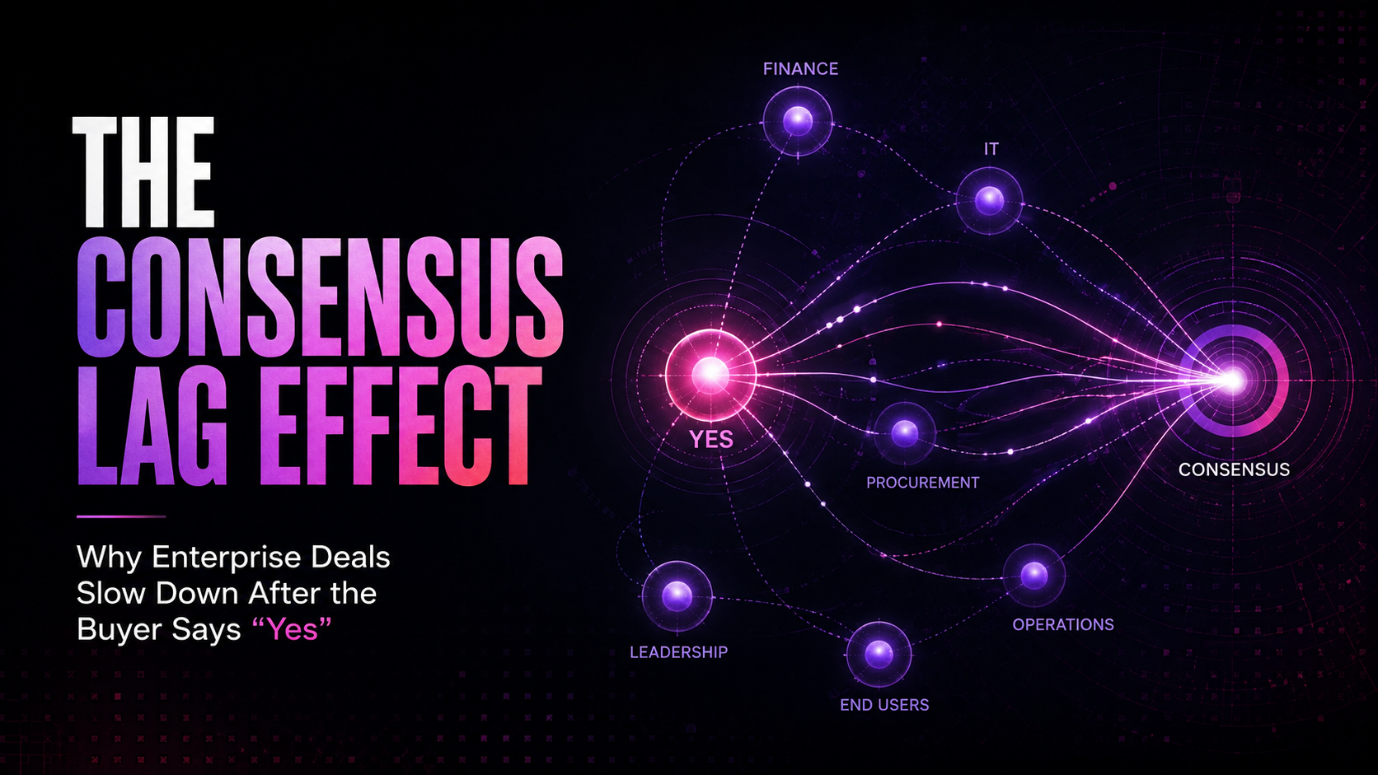
The enterprise sales process does not always become easier after a buyer says yes. In fact, this is often the point where a promising opportunity enters its most complicated stage. A business leader may agree that a solution is valuable, approve the proposed approach, and tell the sales team that the organization wants to move forward. Yet weeks can pass without a signed contract. Procurement becomes involved, security asks for additional documentation, legal requests revisions, finance reviews the budget, and new stakeholders suddenly appear in meetings. This delay is what can be described as the Consensus Lag Effect.
The Consensus Lag Effect occurs because an individual buyer’s decision is not always the same as an organization’s decision. Enterprise purchases typically involve multiple stakeholders with different responsibilities, priorities, and levels of authority. The person who recognizes the value of a solution may not control the budget, approve the contract, or have the authority to eliminate security and compliance concerns. As a result, sales teams can mistake buyer enthusiasm for organizational readiness.
Understanding this difference is increasingly important for B2B sales organizations. Winning the initial buyer is only one part of an enterprise deal. The real challenge is helping the wider buying organization reach enough agreement to act.
What Is the Consensus Lag Effect?
The Consensus Lag Effect describes the period between individual buyer approval and organizational readiness to complete a purchase. A buyer can be completely convinced that a product solves an important business problem while other departments remain uncertain about cost, risk, implementation, compliance, or contractual obligations.
For example, a head of operations may decide that a new software platform is exactly what the company needs. The business case may be strong, the expected return may be attractive, and the implementation plan may look reasonable. However, the company’s security team may still need to evaluate the vendor, IT may need to assess integration requirements, procurement may need to negotiate pricing, and legal may need to approve the contract. From the salesperson’s perspective, the buyer has already said yes. From the organization’s perspective, several decisions are still outstanding.
This creates a gap between commercial conviction and organizational consensus. The longer that gap remains unresolved, the greater the risk that the deal will lose momentum, move into another quarter, or eventually stall.
Why a Buyer’s “Yes” Is Not Always a Final Decision –
Enterprise purchasing is fundamentally different from a simple transactional purchase. In a smaller transaction, the person evaluating the product may also have the authority to purchase it. Enterprise transactions usually involve a network of people who influence, approve, evaluate, or execute the decision.
The business sponsor may care about productivity and business outcomes, while the IT team may focus on integration and support. Security may be concerned about data protection, finance may evaluate the investment, procurement may negotiate commercial terms, and legal may examine contractual risk. Each stakeholder can introduce requirements that were not part of the original sales conversation.
This means a buyer saying “yes” often means “I believe we should buy this.” It does not necessarily mean “Everyone required to approve this purchase has agreed.” Sales teams that fail to recognize this difference can forecast deals too early and underestimate the amount of work required between verbal approval and signature.
The Hidden Complexity of Enterprise Buying Committees –

Enterprise buying committees are becoming increasingly important because technology purchases often affect multiple departments. A software platform may influence data security, employee workflows, technology architecture, financial planning, compliance, and customer operations at the same time.
The challenge for sales teams is that these stakeholders may enter the process at different stages. A security team may not participate during the initial product evaluation but become heavily involved once the buyer requests a contract. Procurement may not engage until the business sponsor has selected a preferred vendor. Legal may only become involved after commercial terms have been discussed.
Late involvement creates delays because each new stakeholder needs time to understand the solution and evaluate its implications. If their concerns were never addressed earlier, the sales team may have to restart parts of the decision process.
The Role of the Internal Champion –
A strong internal champion can dramatically improve an enterprise deal, but relying too heavily on one champion can create hidden risk. A champion may genuinely support the solution and actively promote it internally, but they may not have enough authority to resolve objections from other departments.
This is particularly dangerous when the salesperson receives consistently positive updates from the champion. Statements such as “leadership loves it” or “we are just waiting for procurement” can create a false sense of security. The salesperson may assume the deal is effectively closed even though critical approval steps remain unresolved.
The solution is not to distrust the champion. Instead, sales teams should help the champion build broader internal support. A strong champion should have the evidence, business case, technical information, and stakeholder support necessary to move the decision forward.
Why Procurement, Legal, and Security Can Slow Deals –
Procurement, legal, and security are often perceived as departments that simply delay sales. In reality, they are usually performing legitimate organizational functions. Their involvement becomes a problem when those requirements are discovered too late.
Security teams may need information about data handling, access controls, encryption, compliance, integrations, and vendor risk. Legal teams may review liability, intellectual property, data protection, termination provisions, and other contractual terms. Procurement may evaluate pricing, payment terms, vendor comparisons, and purchasing policies.
These reviews can take considerable time, especially when the vendor was not prepared for them. Sales teams can reduce the Consensus Lag Effect by identifying these requirements early instead of waiting until the buyer has already selected the solution.
Multi-Threading Can Reduce Consensus Lag –
Multi-threading is one of the most effective ways to reduce late-stage enterprise deal risk. Instead of developing a relationship with only one stakeholder, sales teams should establish connections with the people who influence different parts of the decision.
The objective is not to contact as many people as possible. It is to understand the decision structure. Salespeople should know who owns the business problem, who controls the budget, who evaluates technology, who manages security, who handles procurement, and who has final approval authority.
When multiple stakeholders understand the solution and its value, the deal becomes less dependent on one individual. More importantly, objections can be addressed before they become late-stage blockers.
From Selling Value to Removing Risk –
Early in an enterprise sales cycle, the primary goal is usually to demonstrate value. Sales teams explain how the solution can reduce costs, increase productivity, improve revenue, solve operational problems, or create strategic advantages.
After the buyer says yes, the conversation changes. The organization now needs confidence that the purchase can be implemented safely and successfully.
This means sales teams need to shift from value creation to risk reduction. They need to provide security documentation, implementation plans, integration details, customer references, financial justification, legal information, and other evidence that helps internal stakeholders approve the purchase.
The strongest enterprise sellers understand this transition and prepare for it before the buyer reaches the final decision.
Consensus Lag and Revenue Forecasting –
The Consensus Lag Effect also creates a major challenge for sales forecasting. A salesperson may assign a high probability to a deal because the primary buyer has verbally approved the purchase. However, the actual close date may remain uncertain because internal approvals have not been completed.
This creates an important distinction between purchase confidence and purchase timing. A company may genuinely intend to buy a product while still being unable to complete the transaction within the forecast period.
Sales leaders should therefore examine not only whether the buyer wants the solution but also whether the organization has completed the steps required to purchase it. The closer a deal gets to signature, the more important operational readiness becomes.
Building a Consensus-Ready Sales Process –
Sales organizations can reduce consensus lag by understanding the customer’s decision process much earlier. During discovery, salespeople should ask how purchasing decisions are normally made, which departments become involved, what approvals are required, and what could prevent the purchase from moving forward.
Once the buying process is understood, the sales team can create a shared action plan. Instead of simply targeting a signature date, the plan should identify the major milestones required to reach that date. This could include business approval, technical validation, security review, procurement, legal approval, and final executive authorization.
This approach makes potential delays visible. If security has not started its review two weeks before the planned signature, the problem becomes obvious before the forecast is missed.
Buyer Approval vs Organizational Consensus –
| Buyer Approval | Organizational Consensus |
|---|---|
| One or a few stakeholders support the solution | Relevant stakeholders understand and support the decision |
| Business value is accepted | Business value, cost, and risk are accepted |
| Champion wants to proceed | Required decision-makers are aligned |
| Product evaluation is complete | Security, legal, finance, and procurement requirements are addressed |
| Purchase intent exists | Organization is operationally ready to purchase |
| Salesperson hears “yes” | Contract can realistically move to signature |
How Sales Teams Can Manage the Consensus Lag Effect –
The first step is to stop treating a verbal “yes” as the final milestone. Instead, it should trigger a new phase of the sales process focused on organizational execution. Sales teams should identify which stakeholders still need to approve the decision and what information each stakeholder requires.
The second step is to provide role-specific evidence. A CFO may need a financial justification, while a security leader needs technical documentation. A procurement manager may need commercial information, while an executive sponsor may need a concise strategic business case. Giving every stakeholder the same sales presentation is unlikely to address their individual concerns.
Finally, sales teams should maintain momentum through clear next steps. Every meeting should end with an agreed action, owner, and timeline. This prevents the deal from entering an undefined period where everyone assumes someone else is moving it forward.
The Future of Enterprise Sales –
Enterprise sales is increasingly becoming a discipline of decision orchestration rather than simple persuasion. Salespeople must understand not only why a customer wants a product but also how the customer’s organization converts that desire into an approved purchase.
As enterprise buying committees become more complex, sales teams that rely heavily on one champion or one decision-maker will face greater risk. The ability to build consensus across departments will become just as important as demonstrating product value.
The most successful enterprise sales teams will therefore measure more than pipeline and win rates. They will pay attention to stakeholder coverage, approval progress, decision velocity, unresolved risks, and the number of critical buying steps remaining.
Conclusion –
The Consensus Lag Effect explains why enterprise deals can slow down even after a buyer says “yes.” The problem is not always a lack of interest or a change in priorities. Often, the individual buyer has reached a decision before the broader organization has completed its own decision-making process.
Enterprise sales teams can reduce this gap by building relationships across the buying committee, identifying approval requirements early, preparing role-specific evidence, supporting internal champions, and creating clear mutual action plans.
Ultimately, the most important lesson is simple: a buyer’s “yes” is not necessarily the organization’s “go.” The real enterprise sales challenge is helping the entire organization move from agreement to action.
Frequently Asked Questions –
The Consensus Lag Effect is the delay between a key buyer agreeing to a purchase and the wider organization completing the approvals needed to finalize the deal.
Enterprise deals can slow down because procurement, legal, security, finance, IT, and executive stakeholders may still need to review and approve the purchase.
Sales teams can reduce consensus lag through multi-threading, early stakeholder mapping, clear decision plans, role-specific evidence, and early engagement with procurement, security, legal, and finance.
A strong champion can help significantly, but they may not have enough authority to approve every aspect of an enterprise purchase. Building support across multiple stakeholders is more reliable.
It can make sales forecasts overly optimistic because a deal may have high purchase intent but still lack the organizational readiness required to close within the expected timeframe.