


Introduction –
Reskilling for the AI Economy has become one of the most important priorities for HR leaders in 2026. Artificial intelligence is no longer limited to experimental projects or specialized technology teams. Organizations across industries are integrating AI into customer service, finance, marketing, operations, software development, human resources, sales, and decision-making. As AI adoption accelerates, the challenge for businesses is no longer simply finding people who know how to use AI. The bigger challenge is preparing existing employees to work effectively alongside increasingly capable AI systems.
For HR departments, this creates a fundamental workforce challenge. Many organizations already have employees with valuable institutional knowledge, industry expertise, customer relationships, and operational experience. Replacing those employees with entirely new talent may be expensive, disruptive, and unnecessary. Instead, businesses need to determine which existing skills remain valuable, which skills are becoming outdated, and which new capabilities employees need to develop.
Reskilling is therefore becoming more than a traditional learning and development initiative. It is becoming a strategic component of workforce planning. HR leaders need to connect business strategy, technology adoption, employee development, and organizational change into one coordinated approach. Companies that successfully reskill their workforce may be better positioned to capture the productivity benefits of AI while reducing talent shortages and employee disruption.
What Does Reskilling for the AI Economy Mean?

Reskilling for the AI economy means helping employees develop new capabilities that allow them to remain productive and valuable as artificial intelligence changes how work is performed. This does not necessarily mean turning every employee into a programmer or AI engineer. In many cases, the most important skills will involve understanding how to work with AI tools, evaluate AI-generated information, make decisions, communicate effectively, and apply human judgment to complex situations.
The nature of reskilling will also vary significantly between roles. A marketing professional may need to learn AI-assisted content creation, customer segmentation, campaign analysis, and prompt design. A finance professional may need to understand AI-driven forecasting and automated reporting. An HR professional may need to work with AI-enabled recruiting, workforce analytics, employee experience platforms, and skills intelligence systems.
The objective is not simply to teach employees how to operate another software application. The objective is to help people understand how their jobs are changing and give them the capabilities needed to perform those jobs effectively in an AI-enabled workplace.
Why Reskilling Has Become an HR Priority in 2026 –
The rapid adoption of AI is changing the relationship between technology and talent. Historically, organizations often introduced new technologies while keeping job structures relatively stable. Employees were trained to use the new systems, but the fundamental responsibilities of their roles remained recognizable.
AI is different because it can increasingly perform portions of knowledge work. It can summarize information, generate content, analyze documents, identify patterns, write software, automate repetitive tasks, support customer interactions, and assist with decision-making. This means technology can influence not only how employees work but also which tasks employees spend their time performing.
For HR leaders, this creates a workforce planning challenge. A job may not disappear, but its skill requirements can change significantly. Employees who once spent hours producing reports may increasingly be expected to interpret AI-generated reports and make decisions based on them. Employees who manually created content may spend more time reviewing, refining, and strategically directing AI-generated outputs.
This shift means organizations need to think about jobs in terms of tasks and skills, rather than relying exclusively on traditional job titles.
AI Is Changing Jobs Before It Replaces Jobs –
One of the most important concepts for HR leaders is that AI-driven workforce transformation does not necessarily mean mass job elimination. In many organizations, the more immediate change will be the transformation of existing jobs.
A customer service representative, for example, may use AI to summarize customer conversations, recommend responses, identify customer sentiment, and retrieve information. The employee still interacts with the customer, but the nature of the work changes. The employee may spend less time searching for information and more time handling complex situations that require empathy and judgment.
Similarly, an analyst may spend less time manually preparing spreadsheets and more time interpreting results, challenging assumptions, and explaining business implications.
This creates an important opportunity for HR departments. Instead of asking only “Which jobs will AI replace?”, HR leaders should ask “How will AI change the tasks within each job, and what skills will employees need as a result?”
The Skills Gap Is Becoming a Strategic Risk –
The AI economy is creating a growing gap between the skills organizations currently possess and the capabilities they will need in the future. This skills gap can become particularly challenging when companies adopt AI faster than they develop their workforce.
Organizations may invest heavily in AI platforms but discover that employees do not know how to use them effectively. Employees may have access to powerful tools but lack the knowledge to verify outputs, identify errors, protect sensitive information, or integrate AI into existing workflows.
There is also a risk of creating a two-speed workforce. Employees who receive meaningful AI training may become significantly more productive, while employees who receive little support may struggle to adapt. Over time, this can create differences in productivity, career progression, and employee engagement.
HR therefore has an important role in ensuring that AI adoption does not become purely a technology initiative. Workforce capability needs to develop alongside technology capability.
How AI Changes Workforce Skill Requirements –
| Traditional Skill Requirement | Emerging AI-Era Requirement |
|---|---|
| Manual data processing | AI-assisted data interpretation |
| Basic content production | AI-assisted content strategy |
| Information searching | AI-supported research and validation |
| Repetitive reporting | Analytical interpretation |
| Manual customer support | AI-assisted customer problem solving |
| Routine coding | AI-assisted software development |
| Static job skills | Continuous learning |
| Tool-specific knowledge | AI and digital adaptability |
| Individual productivity | Human-AI collaboration |
AI Literacy Will Become a Core Workplace Skill –
Not every employee needs to become an AI specialist, but increasingly, employees will need a baseline level of AI literacy.
AI literacy involves understanding what AI systems can do, where they can fail, how to use them responsibly, and how to evaluate their outputs. Employees should understand that AI-generated information can contain errors, incomplete reasoning, outdated information, or inappropriate recommendations.
For HR departments, AI literacy programs can therefore become part of broader employee development strategies. Employees may need training in areas such as prompt design, AI-assisted workflows, data privacy, responsible AI usage, verification, and human oversight.
The most effective programs will connect AI education to real work rather than treating AI as a theoretical subject. Employees are more likely to adopt new capabilities when they can immediately see how those capabilities improve their everyday responsibilities.
Reskilling vs. Upskilling –
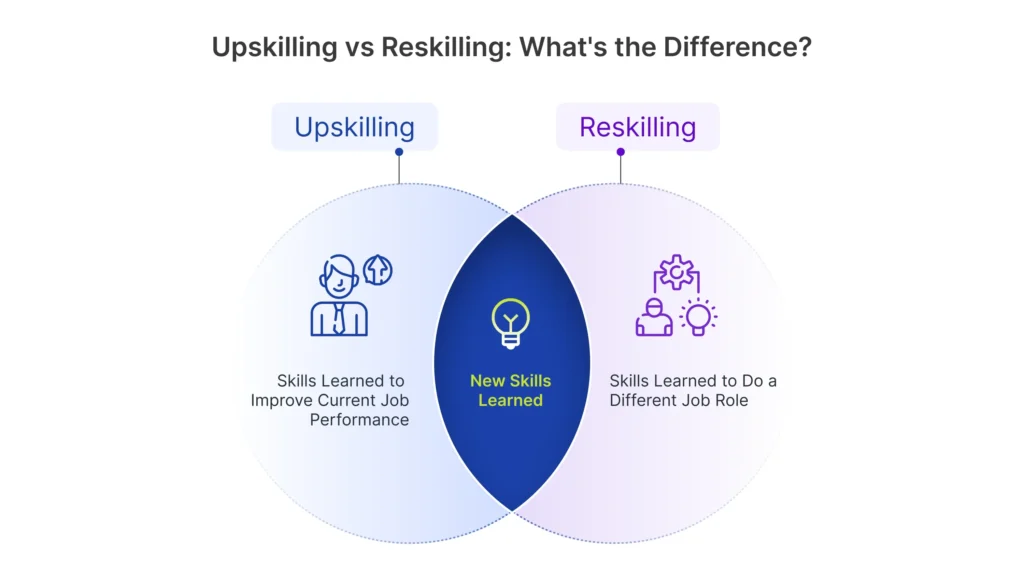
Although the terms are often used together, reskilling and upskilling serve different purposes.
Upskilling generally means improving an employee’s capabilities within their existing role. For example, an HR manager learning how to use AI-powered workforce analytics is being upskilled.
Reskilling involves developing capabilities that prepare an employee for a substantially different role or set of responsibilities. For example, an employee whose previous role involved routine administrative work may be trained for a new position focused on AI-supported operations or data analysis.
Both approaches will be important in the AI economy.
Some employees will need deeper expertise in their current roles, while others may need to transition into entirely new responsibilities as automation changes existing jobs.
The Role of HR in AI Workforce Transformation –
HR departments are uniquely positioned to coordinate reskilling because they sit at the intersection of people, organizational strategy, performance, and workforce planning.
HR leaders can begin by identifying which business functions are most affected by AI adoption. They can then assess the skills currently available within those functions and compare them with the capabilities required in the future.
This creates a skills gap analysis.
Once the gaps are identified, HR can determine whether they should be addressed through training, internal mobility, hiring, partnerships, or a combination of approaches.
This is where HR needs to move beyond traditional training calendars. Instead of asking employees to complete generic courses, organizations should create learning pathways connected directly to changing business requirements.
Skills-Based Workforce Planning –
Traditional workforce planning often focuses on headcount. Organizations determine how many employees they have and how many they expect to need.
The AI economy requires a more detailed approach.
Companies increasingly need to understand which skills they have, where those skills are located, and which capabilities are becoming more important.
A skills-based workforce model can help HR identify employees who may be suitable for new responsibilities based on their existing capabilities and learning potential.
For example, an employee with strong analytical skills, business knowledge, and communication ability may be a strong candidate for an AI-enabled analyst role even if their current job title does not suggest that career path.
This approach can help organizations make better use of internal talent while giving employees clearer opportunities for career mobility.
The Importance of Internal Mobility –
Reskilling becomes more valuable when employees have somewhere to go after developing new skills.
An organization may invest in training employees on AI, data analysis, automation, or digital operations, but if internal career opportunities do not change, employees may eventually leave to find roles where their new capabilities are valued.
HR departments should therefore connect reskilling programs with internal mobility.
Employees should be able to see how developing a particular skill can lead to new responsibilities, projects, promotions, or career paths.
This transforms learning from a compliance activity into a career development strategy.
Managers Are Critical to Successful Reskilling –
Employees do not experience workforce transformation through HR policies alone. They experience it through their managers and everyday work.
Managers determine which skills employees use, which projects they receive, how new technologies are introduced, and how performance is evaluated.
If managers treat AI as a threat to existing roles, employees may become reluctant to experiment with new tools. If managers encourage learning and provide opportunities to apply new skills, employees are more likely to adapt.
HR therefore needs to equip managers with their own AI transformation guidance. Managers should understand how roles are changing, what employees are expected to learn, and how performance expectations will evolve.
Creating a Culture of Continuous Learning –
One of the biggest challenges with AI reskilling is that the technology itself continues to change.
A training program created today may become outdated surprisingly quickly. This means organizations cannot rely entirely on one-time training programs.
Instead, businesses need to build a culture of continuous learning.
Employees should have opportunities to experiment, learn from colleagues, participate in practical projects, and continuously develop their capabilities. Learning should become part of the normal workflow rather than something employees complete once a year.
Organizations can support this through internal communities, mentoring, learning platforms, AI experimentation programs, and role-specific development plans.
Measuring Whether Reskilling Actually Works –
One of the biggest mistakes organizations can make is measuring reskilling only by course completion.
An employee completing a six-hour AI course does not necessarily mean they can use AI effectively.
HR should measure whether training changes behavior and business outcomes.
Useful metrics may include:
- AI tool adoption
- Productivity improvements
- Time saved on repetitive tasks
- Quality improvements
- Internal mobility
- Skill proficiency
- Employee confidence
- Manager assessments
- Retention rates
- Promotion rates
- Business performance
For example, if employees complete an AI productivity program, HR could measure whether they subsequently reduce the time required to complete routine tasks while maintaining or improving quality.
The goal should be to measure capability development, not simply training participation.
The Human Skills AI Cannot Easily Replace –
Reskilling for the AI economy should not focus exclusively on technical capabilities.
As AI becomes better at routine analytical and content-related tasks, uniquely human capabilities may become even more important. Communication, leadership, empathy, negotiation, creativity, critical thinking, relationship management, ethical judgment, and strategic decision-making can become differentiating capabilities.
This creates an interesting paradox. The more organizations automate routine tasks, the more important certain human capabilities may become.
Employees therefore need a combination of technical and human skills.
An effective AI-era employee may be someone who understands AI tools while also knowing when not to trust them.
A Practical AI Reskilling Framework –
- Assess – Identify how AI will affect jobs, tasks, and business functions.
- Map – Create a clear picture of current employee skills and future skill requirements.
- Prioritize – Focus first on roles where AI adoption is likely to create the greatest business impact.
- Train – Develop role-specific learning programs that combine technical and human capabilities.
- Apply – Give employees opportunities to use their new skills in real business situations.
- Measure – Track skill development, adoption, productivity, internal mobility, and business outcomes.
- Adapt – Continuously update the reskilling strategy as technology and organizational needs change.
“The organizations that win the AI economy will not simply have the best AI tools. They will have the workforce capable of using those tools effectively.”
The Future of HR in the AI Economy –
The role of HR is evolving from managing workforce processes to actively shaping workforce capability.
In the past, HR could often respond to technological change after business teams had already made major decisions. In the AI economy, that approach is increasingly risky. HR needs to participate earlier in technology planning because every major AI deployment has workforce implications.
HR leaders will increasingly need to understand AI adoption, skills intelligence, workforce analytics, organizational design, internal mobility, and continuous learning. They will also need to help leadership teams understand how technology investments translate into changes in roles and capabilities.
This makes HR a strategic partner in AI transformation rather than simply the department responsible for training employees after implementation.
Conclusion –
Reskilling for the AI Economy is becoming one of the defining HR challenges of 2026. Artificial intelligence is changing how work is performed, which tasks employees handle, and which capabilities organizations need to remain competitive.
The answer is not simply to hire more AI specialists. Organizations need to look inward and understand how their existing workforce can evolve. Employees with strong domain knowledge, business experience, and human skills can become highly valuable when those capabilities are combined with AI literacy and new technical competencies.
Successful reskilling requires more than online courses. It requires skills-based workforce planning, internal mobility, manager support, continuous learning, transparent communication, and meaningful opportunities to apply new capabilities.
Ultimately, AI transformation is a people transformation. Technology may provide the tools, but employees determine how effectively those tools are used. Organizations that invest in helping their workforce adapt will be better positioned to turn AI from a source of disruption into a source of productivity, innovation, and sustainable growth.
Frequently Asked Questions –
Reskilling for the AI economy involves helping employees develop new capabilities required to work effectively as artificial intelligence changes jobs, workflows, and business processes.
AI is changing job tasks across industries, creating new skill requirements and potential workforce gaps. HR plays a central role in identifying those gaps and developing employees for emerging responsibilities.
No. Most employees do not need advanced AI engineering skills. However, many will benefit from basic AI literacy, responsible AI usage, critical thinking, and the ability to collaborate effectively with AI tools.
Upskilling improves capabilities within an existing role, while reskilling prepares an employee for substantially different responsibilities or a new role.
HR can measure AI reskilling through skill assessments, AI adoption, productivity improvements, internal mobility, employee confidence, manager feedback, retention, and business performance.