


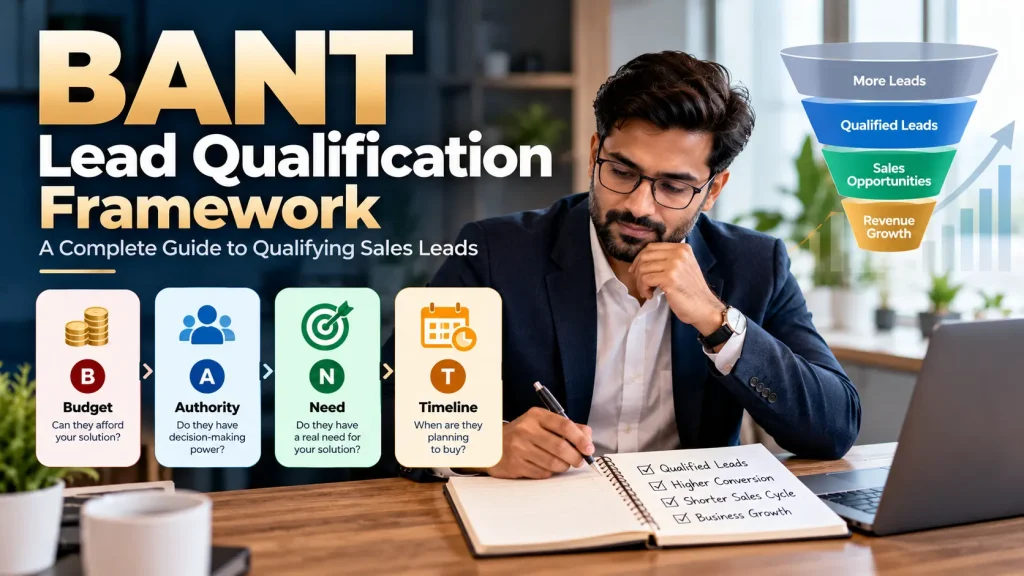
Lead qualification frameworks help sales and marketing teams identify sales-ready prospects, prioritize high-value opportunities, and allocate resources more effectively. In B2B sales, generating a large number of leads does not automatically translate into revenue. Some prospects are actively evaluating solutions, others are researching future options, and many may never become customers because they lack the budget, authority, urgency, or business need to purchase.
Without a structured qualification process, sales representatives can spend hours pursuing contacts who are unlikely to convert while overlooking prospects who are ready to engage. Marketing teams may also generate leads that appear promising based on form submissions or website activity but fail to meet sales expectations. A well-defined lead qualification framework bridges this gap by establishing consistent criteria for evaluating prospects, identifying buying intent, and determining the most appropriate next step.
As B2B buying journeys become more complex, qualification must go beyond basic demographic information or a single interaction. Sales teams need to understand the prospect’s business challenges, decision-making process, buying timeline, engagement behavior, and fit with the company’s solution. By combining established frameworks such as BANT, MEDDIC, CHAMP, and lead scoring with reliable CRM data and sales-marketing alignment, organizations can improve pipeline quality and build a more predictable revenue process.
What Is Lead Qualification?

Lead qualification is the process of evaluating whether a potential customer is a suitable fit for a company’s product or service and whether there is a realistic opportunity to convert that prospect into a customer. It helps sales teams distinguish between people who have expressed general interest and prospects who have a relevant business need, the ability to purchase, and a plausible path toward a buying decision.
Qualification typically considers two broad dimensions: fit and intent. Fit determines whether the prospect matches the organization’s ideal customer profile (ICP), based on factors such as industry, company size, geography, technology environment, and business requirements. Intent evaluates whether the prospect is showing meaningful signs of wanting to solve a problem, such as requesting a demonstration, discussing implementation requirements, or engaging with sales about a specific initiative.
For example, a technology company may receive two inquiries for its enterprise software. The first comes from a company that matches its target industry but is only downloading introductory content. The second comes from a company that has requested a product demonstration, described an operational challenge, and asked about implementation timelines. Although both leads may be relevant, the second prospect demonstrates stronger buying intent and may deserve more immediate sales attention.
Effective qualification does not mean rejecting every prospect who is not ready to buy today. It means assigning the right next step to each lead, whether that involves an immediate sales conversation, further discovery, targeted nurturing, or disqualification.
Why Lead Qualification Frameworks Matter in B2B Sales –
B2B sales cycles often involve multiple stakeholders, detailed evaluations, financial approvals, technical requirements, and procurement procedures. A prospect may show strong interest in a product without having the authority or resources to purchase it. Similarly, a company may have a genuine problem but no immediate plan to address it.
Lead qualification frameworks provide a repeatable way to assess these situations. Instead of relying entirely on a salesperson’s intuition, teams can use shared criteria to evaluate opportunities, document gaps, and make more consistent decisions.
Improving Sales Productivity –
Sales representatives have limited time and must decide which prospects deserve immediate attention. Qualification frameworks help prioritize conversations with buyers who have a relevant need, sufficient organizational fit, and a realistic path to purchase. This reduces time spent on poorly matched opportunities and gives representatives more time to investigate promising accounts.
Increasing Pipeline Quality –
A pipeline filled with unqualified leads can make revenue forecasts unreliable. By applying consistent qualification criteria before opportunities progress, sales managers can improve pipeline quality and identify risks earlier. Deals that lack a confirmed business problem, a credible buying process, or an identified decision-maker can be flagged for further discovery rather than treated as equally likely to close.
Aligning Sales and Marketing –
Marketing teams may define a successful lead based on campaign engagement, while sales teams judge success by the likelihood of creating a revenue opportunity. Qualification frameworks create a common language for evaluating leads and agreeing on when marketing should hand them to sales.
This alignment helps organizations define marketing-qualified leads (MQLs), sales-qualified leads (SQLs), and service-level agreements (SLAs) that establish expectations for follow-up, feedback, and lead recycling.
Improving the Buyer Experience –
A structured qualification process helps sales representatives understand a prospect’s challenges before recommending a solution. Rather than delivering generic pitches, representatives can focus on relevant business outcomes, technical requirements, and buying priorities. This makes early conversations more useful for both parties.
Popular Lead Qualification Frameworks –
Different qualification frameworks address different sales situations. Some are designed for quick initial screening, while others support complex enterprise opportunities involving multiple stakeholders and extended decision cycles.
1. BANT: Budget, Authority, Need, and Timeline –
BANT is one of the most widely recognized lead qualification frameworks. It evaluates four factors: whether the prospect has a budget, whether the salesperson is engaging with someone who has purchasing authority or access to decision-makers, whether a genuine need exists, and when the organization expects to make a decision.
BANT works well for relatively straightforward sales processes where buying requirements can be established early. For example, a business software provider might ask whether a prospect has allocated funding for a new platform, who will approve the purchase, what problem the platform needs to solve, and when implementation should begin.
However, rigidly applying BANT can cause sales teams to reject promising prospects too early. A buyer may have a strong business need and executive support but no approved budget until the next planning cycle. In such cases, the salesperson should understand the funding process rather than automatically disqualify the opportunity.
2. MEDDIC: Qualification for Complex Enterprise Deals –
MEDDIC is designed to help sales teams evaluate complex B2B opportunities. It focuses on Metrics, Economic Buyer, Decision Criteria, Decision Process, Identify Pain, and Champion.
Metrics identify the measurable business outcomes the customer expects, such as lower operating costs or faster processing. The Economic Buyer is the person with authority over the financial decision. Decision Criteria describe how the organization will evaluate potential solutions, while the Decision Process explains how the purchase will be approved.
Identify Pain focuses on the business problem and its consequences. Champion refers to an internal supporter who actively advocates for the solution and helps the sales team navigate the organization.
MEDDIC is particularly useful when multiple stakeholders, financial approvals, technical evaluations, and procurement requirements influence the outcome. Its detailed structure helps representatives identify weaknesses in an opportunity before the deal reaches the final stages.
3. CHAMP: Challenges, Authority, Money, and Prioritization –
CHAMP puts the prospect’s challenges at the center of the qualification process. Instead of beginning with budget, sales representatives investigate the business problem and determine why solving it matters.
Authority and Money help establish the buying structure and financial feasibility, while Prioritization evaluates how urgently the prospect needs to address the challenge relative to other business initiatives.
This framework can be useful for consultative selling, where the prospect may not yet have a clearly defined solution or approved budget. By understanding the business challenge first, representatives can help buyers assess the value of solving it and determine whether a purchasing initiative is justified.
4. GPCTBA/C&I: A Broader Discovery Framework –
GPCTBA/C&I stands for Goals, Plans, Challenges, Timeline, Budget, Authority, Consequences, and Implications. It supports a detailed discovery conversation by exploring the prospect’s objectives, current plans, obstacles, buying constraints, and the consequences of taking or delaying action.
This framework is particularly useful when sales representatives need to understand how a proposed solution fits into the customer’s broader business strategy. It encourages discovery beyond the immediate product requirement and helps establish the potential value of a successful outcome.
Because it covers several dimensions, GPCTBA/C&I may be more appropriate for consultative sales than for rapid qualification of high-volume inbound leads.
5. Lead Scoring: Prioritizing Leads at Scale
Lead scoring assigns points to leads based on attributes and behaviors associated with a higher likelihood of conversion. Fit-based criteria may include industry, company size, job role, and geographic location. Behavioral signals may include demo requests, visits to pricing pages, webinar attendance, repeat engagement with relevant content, or responses to sales outreach.
A prospect might receive a higher score for matching the target customer profile and requesting a product demonstration. Someone who repeatedly visits introductory content but does not match the target market may receive a lower score.
Lead scoring is especially useful for organizations handling large lead volumes. However, a score should be treated as a prioritization signal rather than definitive proof of purchase readiness. Behavioral data can be incomplete, and high engagement does not always indicate a genuine buying project.
Lead Qualification Frameworks Compared –
| Framework | Main Focus | Best Suited For | Key Limitation |
|---|---|---|---|
| BANT | Budget, authority, need, and timeline | Straightforward B2B sales and initial qualification | Can overlook early-stage buyers without approved budgets |
| MEDDIC | Metrics, economic buyer, decision criteria and process, pain, and champion | Complex enterprise sales with multiple stakeholders | Requires detailed discovery and disciplined CRM documentation |
| CHAMP | Customer challenges, authority, money, and prioritization | Consultative selling and problem-led discovery | May require additional criteria for complex buying processes |
| GPCTBA/C&I | Goals, plans, challenges, timeline, budget, authority, consequences, and implications | Strategic and consultative sales conversations | Can be time-consuming for high-volume lead screening |
| Lead Scoring | Fit and behavioral engagement signals | Marketing automation and large lead databases | Scores may misrepresent buying intent if poorly designed |
These frameworks are complementary rather than mutually exclusive. A business might use automated lead scoring to prioritize inbound inquiries, BANT or CHAMP for initial discovery, and MEDDIC for opportunities that enter a complex enterprise sales cycle.
How to Identify Sales-Ready Prospects –
Selecting a framework is only the beginning. Organizations must translate it into practical criteria that sales and marketing teams can apply consistently.
1. Define Your Ideal Customer Profile –
An ideal customer profile describes the types of organizations most likely to benefit from a company’s offering and become successful, valuable customers. It may include industry, company size, annual revenue range, geography, technology stack, operational complexity, and common business challenges.
For example, a cybersecurity provider specializing in large enterprise environments may prioritize organizations with complex infrastructure, formal security teams, and significant compliance requirements. A small-business software vendor may focus on companies with fewer employees, simpler buying processes, and limited internal IT resources.
A clear ICP helps teams evaluate whether a prospect is commercially and operationally suitable before investing heavily in sales discovery.
2. Identify the Prospect’s Business Need –
A prospect is more likely to become sales-ready when a specific problem exists and the proposed solution is relevant to it. Sales representatives should explore what the organization is trying to improve, what is preventing progress, and how the current situation affects performance.
Useful discovery questions include:
- What business problem are you trying to solve?
- How are you managing this process today?
- What challenges or limitations are you experiencing?
- What happens if the problem remains unresolved?
- How will you measure a successful outcome?
The goal is not to force the prospect to acknowledge a problem. It is to understand whether a meaningful need exists and whether the solution can address it.
3. Assess Buying Intent and Engagement –
Engagement can provide clues about a prospect’s readiness, but not every interaction has the same value. A request for a personalized demonstration generally provides stronger evidence of active evaluation than a single visit to a blog article.
Sales teams should consider the context, frequency, and relevance of engagement. A prospect who repeatedly reviews implementation documentation, attends a product-focused webinar, and asks detailed technical questions may be conducting a serious evaluation. A prospect who downloads a general industry report may simply be researching the topic.
Intent signals should be interpreted alongside account fit and direct discovery. They should not replace conversations with buyers.
4. Understand the Buying Committee –
Enterprise purchases rarely depend on one person’s opinion. Decision-making may involve end users, department heads, IT teams, security reviewers, finance leaders, procurement specialists, and executive sponsors.
Sales representatives should identify the stakeholders who influence the purchase, understand their priorities, and determine how decisions are made. A technical evaluator may care about integration and security, while the economic buyer may focus on financial return and operational impact.
If a prospect is enthusiastic but cannot explain how other stakeholders will evaluate or approve the solution, the opportunity may require additional discovery before it can be considered fully qualified.
5. Validate Budget and Purchase Timing –
Budget and timing help establish whether an opportunity has a realistic path forward. However, these factors should be explored in context rather than treated as simple pass-or-fail questions.
A prospect may have approved funding and an urgent deadline, indicating a near-term opportunity. Another may have a well-defined business need but require a budget request for the next fiscal year. Both may be valuable, but they need different sales approaches.
Representatives should clarify whether funding is approved, planned, or still uncertain, and whether the timeline is tied to a business event, contract renewal, regulatory deadline, or internal planning cycle.
6. Agree on a Concrete Next Step –
Sales readiness should be supported by an agreed next action. Depending on the opportunity, this may be a product demonstration, technical assessment, stakeholder meeting, business case review, or formal evaluation.
A scheduled next step does not guarantee that a deal will close, but it provides evidence that the buyer is willing to continue the process. If a prospect repeatedly avoids committing to any next action, the salesperson should investigate whether the project has lost priority, the problem is not urgent, or the wrong stakeholder is involved.
Building an Effective Lead Qualification Process –
A consistent qualification process turns individual criteria into an operational workflow.
Step 1: Establish shared qualification criteria. Sales and marketing should agree on what constitutes a qualified lead, including ICP fit, engagement signals, business need, and any minimum requirements for a sales handoff. Criteria should reflect actual conversion patterns rather than assumptions.
Step 2: Separate fit from intent. Maintain distinct indicators for whether a prospect matches the target market and whether the prospect is actively evaluating a solution. This helps prevent high engagement from compensating for poor fit or strong company fit from being mistaken for immediate buying readiness.
Step 3: Automate initial screening. CRM systems and marketing automation platforms can enrich lead records, apply scoring rules, flag missing information, and route leads based on territory, product interest, or account ownership. Automation should support sales judgment rather than make every qualification decision independently.
Step 4: Use discovery to validate assumptions. Representatives should confirm the prospect’s problem, buying process, stakeholder involvement, expected outcomes, and timeline. CRM records should distinguish confirmed information from assumptions so that sales managers can assess opportunity quality accurately.
Step 5: Create clear lead handoff and recycling rules. Define how quickly sales must follow up on qualified inbound leads, what feedback sales should provide, and when a lead should return to marketing for nurturing. Prospects who are not ready today should not automatically disappear from the pipeline if they may become relevant later.
Step 6: Review performance and refine the framework. Analyze which qualification signals are associated with successful opportunities, which lead sources generate poor-fit inquiries, and where deals frequently stall. Use these findings to improve scoring models, discovery questions, and handoff policies.
Common Lead Qualification Mistakes to Avoid –
One common mistake is prioritizing budget too early. A prospect without an approved budget may still have a significant problem, a credible internal sponsor, and a realistic future purchasing plan. Representatives should establish the full context before deciding whether to advance or nurture the lead.
Another mistake is treating engagement as equivalent to intent. Email opens, content downloads, and website visits can help identify interest, but they do not necessarily prove that a company is evaluating a purchase. Engagement should be interpreted with account fit, relevant behavior, and direct buyer conversations.
Organizations can also make qualification unnecessarily complicated. If a framework requires too many fields or detailed information before a first conversation, salespeople may avoid using it or enter inaccurate data simply to complete the CRM record. Qualification criteria should be detailed enough to improve decisions without adding unnecessary administrative work.
Finally, teams should avoid treating qualification as a one-time event. Business priorities, budgets, stakeholders, and competitive conditions can change during a sales cycle. Reassessing these factors at major milestones helps representatives detect stalled deals and update forecasts before problems become more serious.
Measuring Lead Qualification Effectiveness –
A qualification framework should be evaluated by its impact on pipeline quality and revenue outcomes, not simply by the number of leads it classifies.
Important metrics include lead-to-opportunity conversion rate, which measures how effectively qualified leads become genuine sales opportunities, and sales acceptance rate, which shows how frequently sales agrees that marketing-qualified leads deserve follow-up. Organizations should also monitor opportunity win rate, sales cycle length, lead response time, and the percentage of opportunities that are disqualified after significant sales effort.
For example, a high MQL volume combined with a low sales acceptance rate may indicate that marketing’s scoring criteria do not align with sales requirements. A strong lead-to-opportunity conversion rate but a low win rate may indicate that initial qualification is effective but deeper opportunity qualification needs improvement.
Teams should analyze results by lead source, customer segment, product line, and qualification framework where sample sizes permit. This can reveal whether the same criteria work across different markets or whether distinct sales motions require different approaches.
Metrics should also be interpreted carefully. A shorter sales cycle is not always better if it comes at the expense of deal size or customer fit, and a higher qualification threshold may reduce lead volume while improving conversion quality. The objective is to create a balanced, sustainable revenue process.
The Future of Lead Qualification: AI and Predictive Insights –
AI is expanding how organizations identify and prioritize sales-ready prospects. Predictive lead scoring models can analyze historical CRM data, account attributes, engagement patterns, and opportunity outcomes to estimate which leads are more likely to convert. Generative AI can help summarize discovery calls, extract buying requirements, identify unanswered qualification questions, and prepare account briefs for sales representatives.
For example, an AI assistant could analyze a discovery transcript and highlight that the prospect has described a business problem and a target implementation date but has not identified the economic buyer. The representative can use that insight to guide the next conversation rather than relying on memory alone.
AI-driven qualification also introduces risks. Incomplete CRM data can produce unreliable scores, historical sales patterns may encode bias, and automated summaries may misinterpret what a buyer said. Organizations should make qualification recommendations explainable, validate model performance, protect customer data, and keep humans responsible for consequential sales decisions.
The most effective approach combines automation with direct buyer engagement. AI can help teams process information faster and identify patterns at scale, but it cannot reliably replace the trust, judgment, and contextual understanding required in complex B2B sales.
Conclusion –
Lead qualification frameworks help B2B organizations distinguish between general interest and genuine sales opportunities. By assessing customer fit, business need, buying intent, budget, decision-making authority, and purchase timing, sales teams can prioritize their efforts and improve the quality of their pipelines.
Frameworks such as BANT, MEDDIC, CHAMP, and GPCTBA/C&I offer different levels of structure for different sales environments. Lead scoring adds another layer by helping teams prioritize large volumes of prospects using fit and engagement signals. The strongest qualification process combines these methods selectively, aligns sales and marketing around shared definitions, and continuously improves based on conversion data.
Ultimately, identifying sales-ready prospects is not about asking more questions or disqualifying leads faster. It is about understanding which buyers have a meaningful problem, whether the organization can help solve it, and what needs to happen next for both sides to make a well-informed decision.
“Better qualification is not about chasing more leads. It is about recognizing the right opportunities early and investing in the conversations that can create real business value.”
Frequently Asked Questions (FAQs) –
A lead qualification framework is a structured method for assessing whether a prospect is a good fit for a company’s offering and has a realistic opportunity to buy. It provides criteria for evaluating business need, buying intent, budget, authority, timing, and other relevant factors.
The best framework depends on the sales process. BANT can work well for straightforward sales, CHAMP is useful for challenge-led discovery, and MEDDIC supports complex enterprise deals. Lead scoring is useful for prioritizing high volumes of leads before direct qualification.
A marketing-qualified lead (MQL) meets marketing’s agreed criteria for further attention, often based on fit and engagement. A sales-qualified lead (SQL) has been assessed as appropriate for direct sales engagement under the organization’s qualification rules. Exact definitions vary, so sales and marketing should agree on clear handoff criteria.
Sales teams should assess the prospect’s fit with the ideal customer profile, identify a relevant business challenge, validate buying intent, understand the stakeholder and approval process, and establish a plausible budget and timeline. A concrete next step provides additional evidence of readiness.
AI can support lead scoring, data enrichment, call summarization, qualification gap detection, and lead routing. However, human review remains valuable when interpreting complex buying situations, validating assumptions, or deciding how to pursue an important opportunity.