


Introduction –
Modern software delivery requires organizations to deploy applications quickly while maintaining stability, reliability, and minimal downtime. Traditional deployment methods often expose all users to a new software release at once, increasing the risk of failures and service interruptions. To solve these challenges, DevOps teams use advanced deployment strategies such as Canary Deployments and Blue-Green Deployments. Both approaches help reduce deployment risks and improve rollback capabilities, but they differ in terms of implementation, infrastructure requirements, traffic routing, and operational complexity. Choosing the right strategy depends on business goals, application architecture, monitoring maturity, and downtime tolerance.
What is a Canary Deployment?

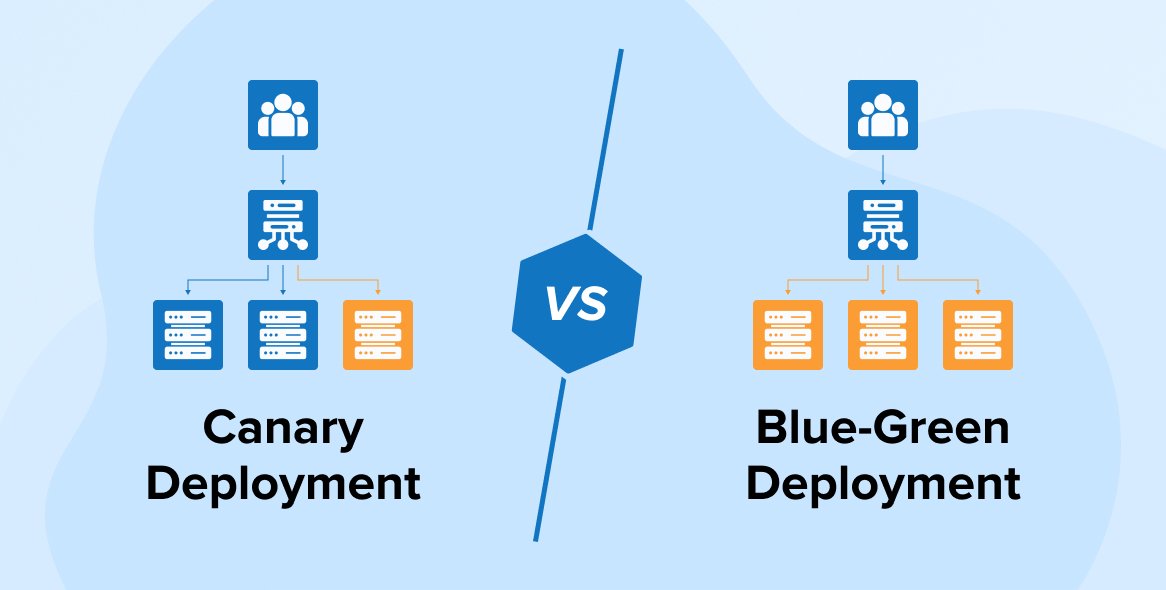
A Canary Deployment is a release strategy where a new application version is gradually introduced to a small percentage of users before being released to everyone. Instead of sending all production traffic to the updated version immediately, only a limited group of users receives the new release initially.
Engineering teams closely monitor performance metrics, application stability, and user behavior during the rollout. If the deployment performs well, traffic is gradually increased until the new version becomes fully live. This approach minimizes production risk because problems can be identified early without affecting the entire user base.
Canary deployments are widely used in cloud-native environments, microservices architectures, and continuous delivery pipelines. They are particularly useful for organizations that release updates frequently and rely heavily on monitoring and observability tools to make deployment decisions.
What is a Blue-Green Deployment?
Blue-Green Deployment is a strategy that uses two identical production environments. The “Blue” environment contains the current live application version, while the “Green” environment hosts the new release. After the new version is deployed and tested in the Green environment, all production traffic is switched from Blue to Green almost instantly. If any issue occurs after deployment, traffic can quickly be redirected back to the Blue environment, making rollback simple and fast.
Blue-Green deployments are commonly adopted in mission-critical applications where downtime must be avoided. This strategy provides near-zero downtime and allows teams to validate the new release before exposing users to it. However, maintaining two production environments can increase infrastructure costs significantly.
Practical Comparison Between Canary and Blue-Green Deployments –
Both deployment strategies improve software reliability and reduce release-related risks, but they are designed for different operational requirements. Canary deployments focus on gradual exposure and production validation, while Blue-Green deployments emphasize instant switching and fast rollback capabilities. Organizations with strong monitoring systems and cloud-native infrastructures often prefer canary releases, whereas enterprises requiring high availability and rapid recovery commonly use Blue-Green deployments.
| Feature | Canary Deployment | Blue-Green Deployment |
|---|---|---|
| Deployment Approach | Gradual rollout to small user groups | Full traffic switch between environments |
| Risk Exposure | Low due to limited initial exposure | Medium during complete cutover |
| Rollback Speed | Fast | Extremely fast |
| Infrastructure Requirement | Moderate | High because duplicate environments are needed |
| Monitoring Dependency | Very high | Moderate |
| Deployment Duration | Longer because rollout is progressive | Faster due to instant switching |
| Traffic Management | Complex traffic routing required | Simpler traffic switching |
| Downtime | No downtime | Near-zero downtime |
| Best For | Continuous delivery and microservices | Mission-critical applications |
| Cost | Moderate operational cost | Higher infrastructure cost |
| User Exposure | Partial exposure during rollout | All users exposed after switch |
| Common Use Cases | SaaS platforms, APIs, e-commerce | Banking, healthcare, enterprise systems |
Advantages of Canary Deployments –
Canary deployments provide excellent risk management because only a small percentage of users interact with the new release initially. This allows engineering teams to detect errors, performance issues, or infrastructure bottlenecks before a full rollout. Canary releases also enable real-world production testing, making them highly effective for modern DevOps workflows. Additionally, organizations can monitor business metrics such as conversion rates, response times, and customer engagement during deployment.
However, canary deployments require advanced monitoring systems, sophisticated traffic routing mechanisms, and mature CI/CD automation pipelines. Without proper observability, deployment issues may remain undetected during the rollout process.
Advantages of Blue-Green Deployments –
Blue-Green deployments are highly effective for minimizing downtime and simplifying rollback operations. Since both environments exist simultaneously, organizations can switch traffic instantly between versions. This provides excellent recovery capabilities during failed releases. Blue-Green deployments also allow teams to test the new environment thoroughly before exposing it to users.
The primary drawback is infrastructure cost because organizations must maintain duplicate production environments. Database synchronization can also become challenging, especially when schema changes are introduced between releases.
Conclusion –
Both Canary and Blue-Green deployments are valuable strategies for improving software release reliability and reducing production risk. Canary deployments are best suited for organizations practicing continuous delivery, frequent feature releases, and gradual production validation. Blue-Green deployments are ideal for businesses that prioritize zero downtime, rapid rollback, and stable production switching.
The choice between these deployment models depends on factors such as infrastructure budget, monitoring capabilities, deployment frequency, and application criticality. Many modern enterprises even combine both strategies to achieve safer, more resilient, and highly automated software delivery pipelines.