


Introduction –
The Human-in-the-Loop Marketing Model is becoming increasingly important as artificial intelligence changes how businesses create content, analyze customer behavior, personalize campaigns, automate workflows, and make marketing decisions. AI can process enormous amounts of data, generate content within seconds, identify patterns, and automate repetitive tasks that once required significant human effort. However, the rapid adoption of AI does not mean that marketing can become completely automated. In many situations, human judgment remains essential for understanding context, evaluating risk, protecting brand reputation, and making strategic decisions.
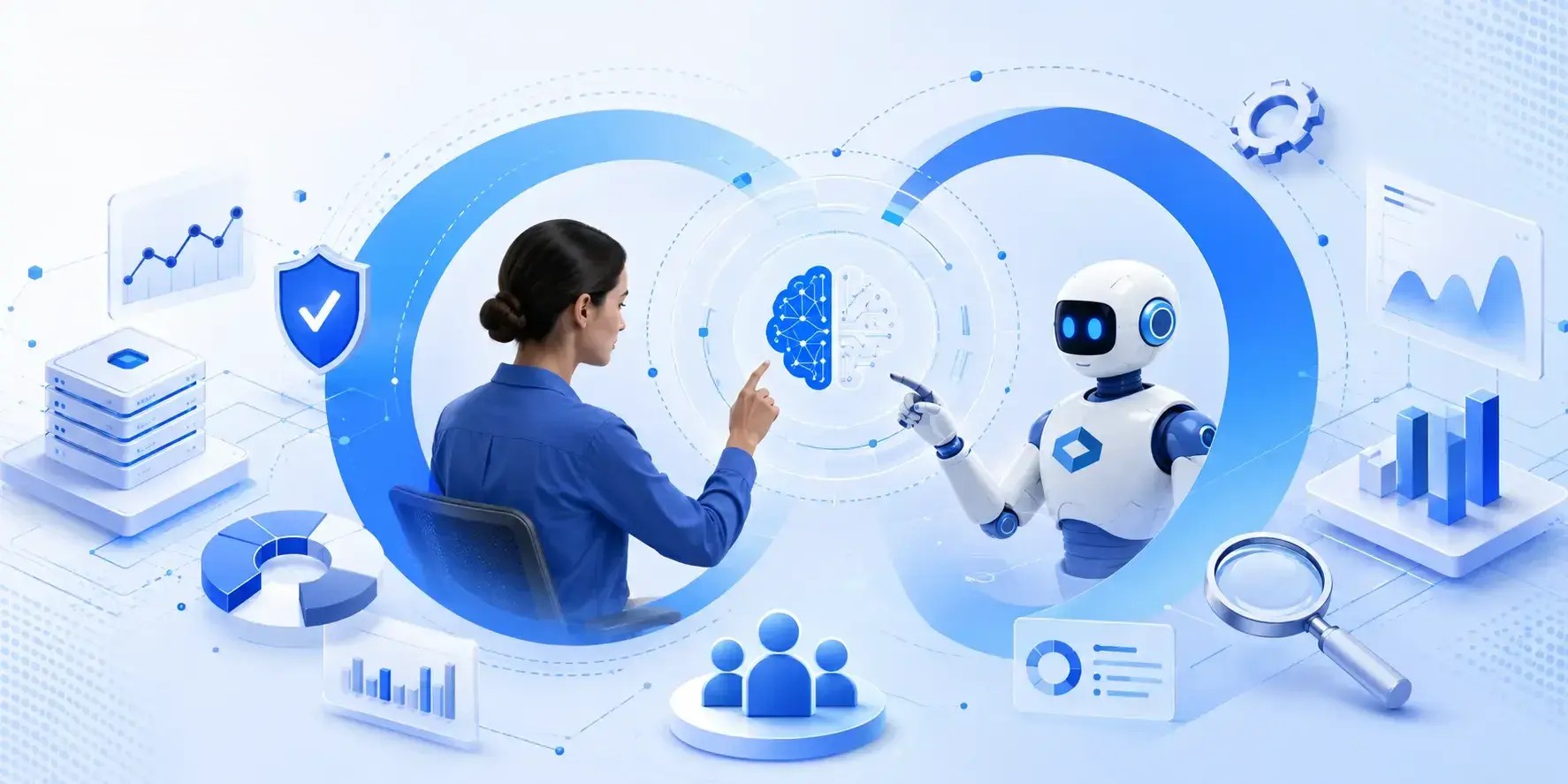
The idea behind a human-in-the-loop marketing model is simple: AI handles tasks where speed, scale, and pattern recognition are valuable, while humans remain involved where judgment, creativity, empathy, accountability, and business understanding matter most. Instead of treating AI as a replacement for marketers, organizations can use it as a collaborative layer that helps marketing teams work faster and make better-informed decisions.
This approach is especially relevant as organizations move from basic automation toward AI-powered marketing systems. The more autonomous these systems become, the more important it is to determine where human oversight should remain. Successful companies will not necessarily be those that automate the most tasks. They may be those that create the best balance between machine efficiency and human intelligence.
What Is the Human-in-the-Loop Marketing Model?
The human-in-the-loop marketing model is an approach in which AI systems participate in marketing processes while humans retain responsibility for important decisions, approvals, exceptions, and strategic direction. AI may generate campaign ideas, analyze customer segments, recommend audiences, produce content variations, identify trends, or optimize campaign performance. Human marketers then review, modify, approve, reject, or redirect those outputs based on business context.
This model creates a partnership between technology and people rather than establishing a completely automated marketing environment. For example, an AI system might generate ten versions of an advertising message based on historical campaign performance, but a marketer can determine which version fits the brand voice and whether the message is appropriate for the target audience. Similarly, AI might identify a customer segment with high purchase potential, while a marketing strategist evaluates whether targeting that group aligns with the company’s broader positioning and customer experience strategy.
The objective is not to keep humans involved in every individual task. Instead, human involvement should be concentrated where it adds the greatest value.
Why Human Oversight Still Matters –
AI systems are powerful, but they do not automatically understand every business situation. They can identify patterns from available information, but patterns do not always explain why customers behave in a particular way. Marketing decisions often involve cultural context, emotional nuance, changing market conditions, brand perception, and ethical considerations that cannot always be reduced to historical data.
Human oversight provides a layer of contextual understanding. A marketer may recognize that a campaign message could be interpreted differently by a particular audience or that an apparently successful strategy could damage long-term customer trust. Humans can also challenge AI recommendations when they conflict with business objectives or common sense.
This becomes particularly important when marketing decisions affect brand reputation. An automated system may optimize for clicks or conversions, but a human marketer must consider whether those results are being achieved in a way that supports the organization’s long-term reputation.
AI Is Excellent at Scale –
One of AI’s greatest advantages in marketing is its ability to operate at a scale that would be difficult for humans alone. AI can analyze large datasets, identify patterns, generate content variations, summarize customer feedback, classify leads, and monitor campaign performance continuously.
For example, an AI system can evaluate thousands of customer interactions and identify recurring themes that marketers may not have time to review manually. It can also generate multiple versions of an email subject line, advertisement, landing page, or product description for testing.
This creates significant efficiency gains.
However, scale without judgment can create problems. Generating thousands of pieces of content does not automatically create thousands of valuable customer experiences. Human marketers still need to determine which ideas deserve attention and whether automated outputs align with the company’s goals.
Humans Provide Context –
Marketing rarely exists in isolation. A campaign may be technically optimized but poorly timed because of an unexpected market event, cultural development, customer issue, or organizational change.
Humans are particularly valuable when context changes quickly.
An AI system may recommend increasing promotional activity because historical data suggests that a particular period generates strong engagement. A marketing leader may decide against that recommendation because the company is dealing with a customer service issue or because the market environment has changed.
Context can be difficult to capture in historical datasets. Human marketers can combine data with current events, organizational knowledge, customer sentiment, and strategic priorities.
AI vs. Human Strengths in Marketing –
| Marketing Area | AI Strength | Human Strength |
|---|---|---|
| Data analysis | Processing large datasets | Interpreting business context |
| Content creation | Speed and scale | Creativity and brand judgment |
| Personalization | Pattern recognition | Understanding emotional nuance |
| Campaign optimization | Continuous testing | Strategic decision-making |
| Customer segmentation | Identifying behavioral patterns | Understanding customer motivations |
| Trend detection | Monitoring large information sources | Determining strategic relevance |
| Brand voice | Generating variations | Protecting authenticity |
| Risk management | Identifying certain patterns | Evaluating consequences |
| Strategy | Supporting recommendations | Setting business direction |
| Ethics | Applying defined rules | Making contextual judgments |
Human Creativity Still Has a Role –
AI can generate headlines, campaign concepts, images, scripts, social media posts, and other marketing assets. This can significantly increase creative output, but marketing creativity is not simply the ability to produce content.
Great marketing often comes from understanding people, culture, emotions, contradictions, and unexpected ideas.
Human marketers can challenge assumptions and introduce perspectives that may not be obvious from historical data. They can connect seemingly unrelated concepts, understand cultural references, and develop campaigns around broader brand narratives.
AI can become a powerful creative partner by producing ideas quickly, but humans can provide the creative direction that determines which ideas are meaningful.
The Difference Between Generation and Judgment –
One of the most important distinctions in AI-powered marketing is the difference between generating an answer and deciding whether that answer is good.
AI can produce a campaign concept in seconds. That does not mean the concept is strategically appropriate.
It can write a product description. That does not guarantee that the description is accurate.
It can generate a personalized email. That does not mean the message is appropriate for the recipient.
It can recommend an audience. That does not mean targeting that audience is commercially or ethically appropriate.
Human marketers therefore remain important as evaluators. Their role increasingly shifts from creating every individual output manually toward reviewing, refining, prioritizing, and directing AI-generated work.
Human-in-the-Loop Does Not Mean Human-at-Every-Step –
There is a potential misconception that human-in-the-loop means a person must manually approve every AI decision.
That would undermine many of the efficiency benefits of automation.
Instead, organizations can establish different levels of human involvement depending on the risk and importance of a task.
Low-risk tasks can be highly automated. Medium-risk tasks can involve sampling or periodic review. High-risk decisions can require explicit human approval.
For example, automatically categorizing marketing leads may require limited human involvement, while launching a campaign involving sensitive customer data may require multiple levels of review.
This approach allows organizations to scale AI while maintaining appropriate oversight.
Building Risk-Based Marketing Automation –
A practical human-in-the-loop model should classify marketing activities based on risk.
Low-risk activities could include generating internal campaign ideas, summarizing meeting notes, or suggesting headline variations. These activities can often be automated with limited oversight.
Medium-risk activities might include customer segmentation, personalized recommendations, or automated campaign optimization. These may require monitoring and periodic human review.
High-risk activities could include decisions involving sensitive customer information, regulated industries, financial claims, healthcare-related marketing, or potentially controversial messaging. These activities should generally receive stronger human oversight.
The objective is to match the amount of human involvement with the potential consequences of an error.
AI Can Improve Human Decision-Making –
The human-in-the-loop model is not only about humans correcting AI mistakes. AI can also help humans make better decisions.
Marketing teams often struggle with information overload. They may have data from CRM systems, advertising platforms, websites, customer support tools, surveys, social channels, and analytics platforms.
AI can synthesize this information and highlight patterns that deserve human attention.
For example, an AI system might analyze thousands of customer comments and identify a recurring complaint about onboarding. A human marketer can then investigate the issue and determine whether it should influence messaging, product positioning, or customer education.
In this model, AI becomes a decision-support system, while humans remain responsible for interpreting and acting on its insights.
Human Oversight Protects Brand Voice –
Brand consistency is another reason humans remain important.
AI can reproduce patterns in existing content, but brand identity involves more than vocabulary and tone. It includes positioning, values, personality, cultural awareness, and the emotional relationship a company wants to build with its audience.
Without human oversight, AI-generated content can become repetitive, generic, or disconnected from the brand.
Marketing teams should therefore establish clear brand guidelines and use human review for important customer-facing content. AI can produce the first draft, but experienced marketers can ensure that the final output actually sounds like the brand.
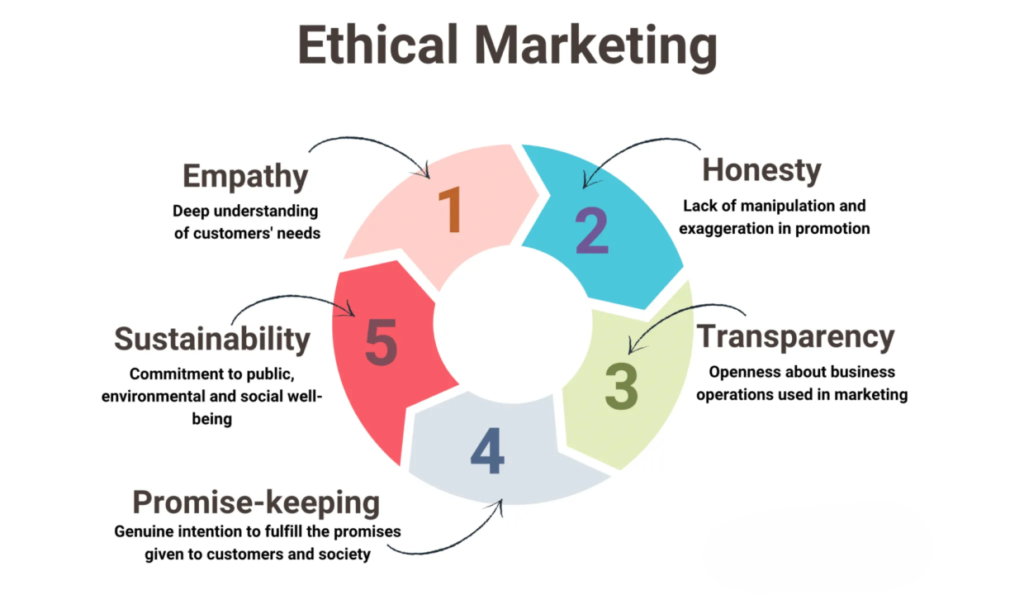
The Importance of Ethical Marketing –
AI can make targeting and personalization more sophisticated, but greater personalization also creates ethical questions.
How much customer data should a company use? When does personalization become intrusive? Should an algorithm treat different customer groups differently? How should automated decisions be explained?
These questions cannot always be solved by technical optimization.
Human leaders need to establish ethical boundaries and determine what the organization is comfortable doing with customer information. AI can help enforce these policies, but humans should remain accountable for defining them.
Avoiding Automation Bias –
One of the risks of AI adoption is automation bias, where people assume that an AI recommendation must be correct simply because it came from an intelligent system.
Marketing teams should actively encourage critical evaluation.
If AI recommends changing a campaign audience, marketers should ask why. If it predicts that a customer segment will convert at a higher rate, teams should examine the evidence. If it generates a claim about a product, someone should verify that the claim is accurate.
AI should be treated as a highly capable assistant, not an unquestionable authority.
Training Marketers for the Human-in-the-Loop Era –
The adoption of AI changes the skills marketing teams need.
Marketers increasingly need to understand how AI systems work, how to evaluate AI-generated content, how to interpret model outputs, and how to identify potential errors or biases.
They also need strong traditional marketing skills. Understanding customers, positioning, messaging, storytelling, market research, and brand strategy remains important.
The most valuable marketers may therefore become those who can combine marketing expertise with AI literacy.
They do not need to become AI engineers. They need to understand how to use AI effectively and where human judgment is essential.
Measuring the Success of Human-AI Collaboration –
Organizations should measure more than the amount of content generated by AI.
Useful metrics can include campaign performance, production time, cost per campaign, content quality, error rates, customer engagement, conversion rates, brand consistency, and the number of human interventions required.
Organizations can also measure whether AI helps marketers spend more time on strategic activities.
If AI reduces repetitive work and allows marketers to spend more time on customer research, creative strategy, experimentation, and decision-making, the value extends beyond simple cost savings.
The Future of Marketing Will Be Collaborative –
The future of marketing is unlikely to be purely human or purely automated. Instead, it will increasingly involve collaboration between marketers and intelligent systems.
AI will handle more repetitive and analytical work. It will generate more content, monitor more signals, and automate more decisions. Humans will increasingly focus on strategic direction, creativity, judgment, relationships, ethics, and accountability.
This shift could actually make marketing more human.
When AI handles repetitive administrative tasks, marketers can spend more time understanding customers and developing meaningful experiences. The objective should not be to remove humans from marketing but to remove unnecessary manual work so humans can focus on the activities where they create the greatest value.
Conclusion –
The Human-in-the-Loop Marketing Model recognizes that AI and humans have different strengths. AI can provide speed, scale, automation, pattern recognition, and data processing, while humans provide context, creativity, empathy, strategic judgment, ethical reasoning, and accountability.
The organizations that benefit most from AI-powered marketing will not necessarily be those that automate every possible activity. They will be the organizations that understand where automation creates value and where human involvement protects quality and creates differentiation.
The future marketing team may therefore look very different from today’s team. Marketers will increasingly become orchestrators of AI systems, reviewers of machine-generated outputs, interpreters of customer signals, and strategic decision-makers.
The competitive advantage will come from finding the right balance.
“AI can generate more marketing. Humans determine what is worth saying.”
Frequently Asked Questions –
The human-in-the-loop marketing model combines AI automation with human oversight. AI performs tasks such as data analysis, content generation, segmentation, and optimization, while humans provide strategic direction, review important outputs, and make high-impact decisions.
Humans provide context, creativity, empathy, ethical judgment, strategic thinking, and accountability. AI can identify patterns and generate content, but human marketers are often needed to determine whether an output is appropriate for a specific audience, brand, or business situation.
Not necessarily. The model is designed to automate appropriate tasks while keeping humans involved where judgment or accountability is important. Low-risk activities can be highly automated, while higher-risk decisions can receive greater human oversight.
Businesses can classify marketing activities according to their potential risk and business impact. Routine, low-risk activities can receive limited oversight, while decisions involving sensitive data, major campaigns, brand reputation, or regulatory concerns should receive stronger human review.
AI can automate many marketing tasks, but replacing entire marketing teams is a different question. Marketing involves strategy, customer understanding, creativity, positioning, relationships, and judgment. A human-in-the-loop approach uses AI to augment marketers rather than assuming that all marketing decisions can be automated.
Marketers increasingly need AI literacy alongside traditional marketing skills. They should understand how to use AI tools, evaluate AI-generated outputs, work with data, identify potential errors, and apply human judgment to automated recommendations.