



Synthetic Data and AI are creating a new opportunity for B2B sales organizations that want deeper analytics without relying entirely on sensitive, incomplete, or limited real-world datasets. B2B sales teams have more data than ever before, but having large volumes of customer and prospect information does not automatically produce better decisions. CRM records can contain missing fields, inconsistent activity histories, outdated contact information, and limited examples of important buying events. At the same time, privacy requirements and internal data-governance policies can restrict how organizations use customer information for experimentation and advanced analytics.
Synthetic data offers another path. Instead of using only records collected from actual customers, organizations can generate artificial datasets that reproduce selected statistical patterns, relationships, and characteristics of real-world sales data. When combined with artificial intelligence, these datasets can be used to test models, simulate scenarios, develop analytics workflows, and explore potential sales strategies without exposing every underlying customer record.
The opportunity is particularly interesting in B2B sales because enterprise buying journeys are complex. A single opportunity can involve multiple stakeholders, long decision cycles, different engagement patterns, procurement processes, and uncertain outcomes. Synthetic data and AI can help sales organizations experiment with these patterns at scale and potentially discover insights that are difficult to identify from historical CRM data alone.
What Is Synthetic Data?
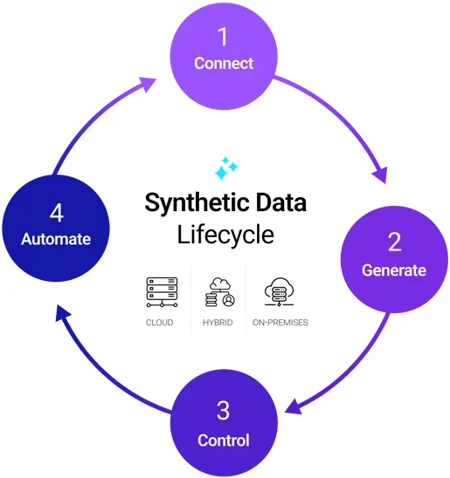
Synthetic data is artificially generated information designed to resemble real-world data while not being a direct copy of actual records. It can be generated using statistical techniques, machine learning models, generative AI, or combinations of these approaches.
For a B2B sales organization, a synthetic dataset could contain fictional accounts, contacts, opportunities, activities, deal stages, engagement events, buying committees, sales cycles, and outcomes. The records would not represent actual customers, but the dataset could be designed to reproduce useful characteristics of a real sales environment.
For example, a company could create a synthetic dataset representing thousands of B2B opportunities across different industries and company sizes. The dataset could include variables such as account size, sales cycle length, number of stakeholders, meeting frequency, content engagement, opportunity stage progression, and deal outcome.
This allows data scientists and sales operations teams to test analytics models without necessarily giving every analyst or development environment access to production CRM records.
Why B2B Sales Analytics Needs a New Data Approach –
Traditional B2B sales analytics generally depends on historical data. Sales teams analyze closed-won and closed-lost opportunities, conversion rates, pipeline velocity, customer interactions, campaign engagement, and other CRM signals. This approach remains important, but historical data has inherent limitations.
One major problem is that historical data reflects what has already happened. If an organization has experienced only a limited number of enterprise deals in a particular market segment, there may not be enough examples to build reliable models for that segment. Rare events create another challenge. A sales organization may have thousands of opportunities but only a small number involving a particular combination of stakeholders, contract values, procurement conditions, or competitive situations.
Synthetic data can help organizations create controlled datasets for experimentation. Rather than waiting for more real-world observations, teams can model different conditions and examine how analytical systems behave under those conditions.
This does not mean synthetic data should replace real customer data. Its value is often greatest when it complements real data by expanding testing environments, enabling simulations, and supporting model development.
How AI Makes Synthetic Sales Data More Useful –
Artificial intelligence changes synthetic data from a relatively narrow data-generation technique into a broader analytical tool. Modern AI systems can model relationships between multiple variables and generate complex datasets that resemble the structure of real business environments.
Consider an enterprise opportunity involving a CIO, CFO, procurement leader, security team, and business sponsor. Each stakeholder may interact with the vendor differently. One person may attend a product demonstration, another may review security documentation, and another may focus on financial justification. The timing and combination of these interactions can influence how an opportunity progresses.
An AI-powered synthetic data system could generate thousands of fictional buying journeys containing different stakeholder combinations and engagement patterns. Sales analytics teams could then use those datasets to test whether their models correctly identify meaningful signals.
AI can also support scenario generation. Teams could simulate what might happen when a sales cycle becomes longer, a champion becomes inactive, additional stakeholders enter the opportunity, or procurement becomes involved earlier than expected.
The result is a more experimental approach to sales analytics.
Synthetic Data vs. Real Sales Data –
Synthetic and real sales data serve different purposes. The objective is not necessarily to decide which one is better, but to understand where each type of data provides value.
| Area | Real Sales Data | Synthetic Sales Data |
|---|---|---|
| Source | Actual customer and prospect interactions | Artificially generated records |
| Business realism | Directly represents actual behavior | Designed to reproduce selected patterns |
| Privacy exposure | Can contain sensitive information | Can reduce direct exposure when properly generated |
| Historical analysis | Highly valuable | Limited for understanding actual past events |
| Scenario testing | Constrained by available examples | Can generate many controlled scenarios |
| Rare-event simulation | Often limited | Can deliberately model uncommon situations |
| Model development | Essential for real-world validation | Useful for experimentation and development |
| Data sharing | May require strict controls | Can facilitate safer controlled environments |
| Bias | Can inherit historical business biases | Can reproduce or introduce modeled biases |
| Production validation | Necessary | Should generally be supplemented with real-world testing |
The distinction is important because synthetic data can look realistic while still being unsuitable for every analytical purpose. A model trained or tested primarily on synthetic data must eventually be evaluated against appropriate real-world data to determine whether it performs effectively under actual operating conditions.
B2B Sales Forecasting With Synthetic Data –
Sales forecasting is one area where synthetic data can support experimentation. Forecasting models often depend on historical opportunity data, but organizations may have limited examples of certain deal types.
Suppose an enterprise software company wants to understand how its forecasting model behaves when large opportunities have unusually long procurement cycles. There may not be enough historical deals to confidently test every possible scenario.
A synthetic dataset could generate fictional opportunities with different contract sizes, sales stages, stakeholder counts, engagement patterns, and procurement timelines. The organization could then evaluate whether its forecasting methodology remains stable when those variables change.
This type of simulation can reveal weaknesses in analytical systems before they become operational problems. It can also help sales operations teams test new forecasting approaches without manipulating production CRM data.
The key is to treat synthetic forecasting experiments as scenario analysis rather than as proof of future sales performance.
Simulating the B2B Buying Committee –
Modern B2B sales rarely involve only one decision-maker. Enterprise purchases can involve executives, technical teams, finance, procurement, legal, security, operations, and end users. This makes buying-committee analysis particularly suitable for simulation.
Synthetic data can represent different stakeholder configurations and engagement patterns. For example, one scenario might contain a strong executive sponsor but limited technical engagement. Another might involve strong technical interest but no financial stakeholder. A third might contain multiple active stakeholders but a procurement process that begins very late.
AI models can analyze these simulated environments to explore questions such as:
- How does stakeholder diversity affect opportunity progression?
- What happens when engagement becomes concentrated around one person?
- How does the timing of procurement involvement change the sales cycle?
- What signals appear when a buying committee becomes inactive?
- How do multiple stakeholder interactions affect opportunity-stage progression?
- Which combinations of engagement signals should sales teams investigate further?
These simulations can help organizations design better analytical frameworks for complex enterprise sales processes.
AI-Powered Sales Simulation –

Synthetic data can also create a foundation for sales simulation. Instead of analyzing only completed opportunities, organizations can construct virtual sales environments where different conditions can be tested.
A sales organization could simulate account segmentation, lead scoring, opportunity progression, engagement strategies, or pipeline changes. AI models could then evaluate different scenarios against predefined objectives.
For example, a team could compare hypothetical scenarios where:
- An SDR increases account coverage.
- An account receives additional executive engagement.
- A sales opportunity is multi-threaded earlier.
- A high-value prospect receives more technical content.
- Procurement is engaged earlier in the buying journey.
- An opportunity remains inactive for several weeks.
The purpose is not to ask AI to predict exactly what a real customer will do. Instead, simulation can help teams understand relationships between variables and identify situations that deserve additional investigation.
Improving AI Model Development –
Synthetic data can be especially valuable during the development lifecycle of AI-powered sales tools. Data scientists often need large datasets to test pipelines, APIs, feature engineering, dashboards, recommendation systems, and machine learning models.
Using production CRM data for every stage of development can introduce privacy, security, and governance challenges. Synthetic datasets can provide a safer environment for early experimentation.
Development teams can use synthetic data to test whether a model handles missing information, unusual opportunity patterns, changing account characteristics, and other edge cases. They can deliberately introduce scenarios that may be rare in production but important from a business perspective.
This can make testing more comprehensive because teams are no longer limited to whatever historical cases happen to exist in their production dataset.
The Privacy and Governance Advantage –
One of the strongest arguments for synthetic data is its potential to reduce direct exposure to sensitive information. B2B sales databases can contain contact details, customer information, contract values, purchasing behavior, commercial terms, and other confidential business data.
Synthetic datasets can create analytical environments where teams can work with realistic structures without distributing raw customer records throughout development and experimentation environments.
However, synthetic data is not automatically anonymous or risk-free. Poorly generated synthetic datasets can potentially preserve identifiable patterns from their source data. Organizations therefore need appropriate privacy testing, governance processes, access controls, and validation before treating synthetic datasets as safe for broader use.
Data governance teams should evaluate how synthetic data is generated, what source information was used, who can access it, and whether the resulting dataset creates any privacy or confidentiality risks.
Synthetic Data Can Help Address Data Imbalance –
Sales datasets often contain imbalanced outcomes. For example, an organization may have many low-value opportunities but relatively few large enterprise transactions. There may also be significantly more closed-lost opportunities than closed-won opportunities for particular segments.
Such imbalance can affect machine learning models and analytical experiments. Synthetic data can be used to create additional examples of underrepresented scenarios, allowing teams to test how models behave when different classes or conditions are more evenly represented.
The important distinction is between data augmentation and data invention. Generated examples should not automatically be treated as equivalent to real observations. Synthetic records can help analytical systems learn or test patterns, but teams must validate whether those patterns actually exist in production environments.
The Risk of Synthetic Data Becoming Too Synthetic –
Synthetic data introduces an important analytical risk: realism does not guarantee accuracy.
A generated dataset may successfully reproduce the statistical characteristics that its designers specify while failing to represent important behaviors that were not modeled. For example, a synthetic sales environment might represent opportunity stage progression accurately but fail to capture organizational politics, unexpected procurement delays, competitive pressure, or sudden changes in customer priorities.
There is also a risk of amplifying existing assumptions. If a synthetic data generator learns from historical CRM data containing bias, those biases can potentially appear in the generated dataset.
Organizations should therefore use synthetic data with clear validation criteria. The question should not simply be, “Does this data look real?” A more important question is, “Does this data preserve the relationships and constraints that matter for the analytical problem we are trying to solve?”
Building a Synthetic Data Strategy for B2B Sales –
Organizations considering synthetic data should begin with specific analytical use cases rather than attempting to generate an artificial copy of the entire CRM.
A practical strategy can start with a narrow workflow:
Define → Generate → Validate → Test → Compare → Govern → Deploy
First, define the business problem. This might involve forecasting, lead scoring, buying-committee analysis, sales simulations, or AI model testing.
Next, generate synthetic records that represent the variables relevant to that problem. The dataset should be designed around the analytical objective rather than simply maximizing record volume.
Validation is then critical. Teams should compare statistical distributions, relationships, correlations, rare events, and business constraints between real and synthetic datasets. Analytical models can subsequently be tested against both environments.
Organizations should also establish governance around synthetic data generation, storage, access, retention, and acceptable use. Once a process becomes repeatable, synthetic data should be treated as part of the enterprise data lifecycle rather than as an isolated data-science experiment.
How Sales Teams Could Use Synthetic Data in Practice –
The strongest applications of synthetic data may emerge when data science and sales operations work together. Instead of generating artificial records simply because they are technically possible, teams can identify specific decisions where simulation could improve analytical understanding.
Potential use cases include:
- Forecast model testing: Evaluate how forecasting systems behave under different pipeline conditions.
- Lead-scoring experiments: Test scoring logic against controlled account and engagement scenarios.
- Buying-committee analysis: Simulate different stakeholder structures and engagement patterns.
- Sales-cycle simulation: Explore the effect of changes in opportunity progression.
- AI assistant testing: Evaluate AI-generated recommendations against controlled sales scenarios.
- CRM quality testing: Create edge cases for testing integrations and workflows.
- Training environments: Provide sales operations teams with realistic but fictional datasets.
- Privacy-conscious development: Reduce reliance on raw customer data during early development.
- What-if analysis: Examine hypothetical changes in pipeline composition and sales activity.
- Model robustness testing: Test systems against unusual or underrepresented scenarios.
These applications demonstrate why synthetic data is becoming more relevant to B2B analytics. Its value lies not simply in producing more records, but in giving organizations greater control over the conditions under which analytical systems are tested.
The New Role of Sales Operations –
Synthetic data and AI may also change the role of sales operations. Historically, sales operations teams have focused heavily on CRM administration, reporting, territory management, pipeline analysis, and process optimization.
As analytics becomes more sophisticated, sales operations can increasingly become an experimentation function. Teams can test new scoring models, simulate opportunity scenarios, examine potential process changes, and identify weaknesses in analytical workflows before deploying them broadly.
This requires stronger collaboration between sales operations, data science, revenue operations, IT, security, and business leadership. The organizations that gain the most value from synthetic data will likely be those that treat it as part of a broader analytical operating model rather than as a standalone AI initiative.
What the Future of B2B Sales Analytics Could Look Like –
The next generation of B2B sales analytics is likely to combine several types of data rather than relying exclusively on historical CRM records. Real customer data can provide evidence about actual market behavior, while synthetic data can expand experimentation and simulation.
AI can sit across this environment, helping teams identify patterns, generate scenarios, test hypotheses, and surface potential risks. This creates a more dynamic analytical model in which sales organizations can ask not only what happened, but also what could happen under different conditions.
That shift is significant. Traditional analytics is often retrospective: which opportunities converted, which accounts engaged, and which campaigns generated pipeline. AI-enabled synthetic analytics can introduce a more experimental dimension: what happens if stakeholder engagement changes, if the sales cycle lengthens, or if a particular account profile becomes more common?
The answers will still require real-world validation, but the ability to explore these questions before making operational changes can become an important competitive capability.
“The value of synthetic data is not that it replaces reality. Its value is that it gives sales organizations a controlled environment in which to experiment with the possibilities that reality does not provide enough examples to test.”
Conclusion –
Synthetic Data and AI could become an important part of the next generation of B2B sales analytics. As sales organizations become increasingly dependent on predictive models, AI assistants, automated recommendations, and advanced revenue intelligence, the ability to test these systems across diverse scenarios becomes increasingly important.
Real customer data will remain essential because it represents actual market behavior. Synthetic data adds another dimension by enabling controlled experimentation, rare-event simulation, model testing, data augmentation, and privacy-conscious development.
The organizations that approach synthetic data strategically will focus less on creating the largest possible artificial dataset and more on creating datasets that are useful, validated, governed, and connected to specific business questions. Combined with AI, synthetic data can help sales teams move from purely retrospective reporting toward more flexible experimentation and scenario-based decision support.
The future of B2B sales analytics may therefore not be about choosing between real data and synthetic data. It may be about creating an analytical ecosystem where real data provides evidence, synthetic data provides experimentation, and AI connects the two.
Frequently Asked Questions –
Synthetic B2B sales data is artificially generated information designed to reproduce useful characteristics of real sales environments. It can represent fictional accounts, contacts, opportunities, engagement events, sales stages, stakeholders, and outcomes for analytics and testing.
No. Real CRM data remains essential for understanding actual customers, prospects, sales processes, and market behavior. Synthetic data is better viewed as a complementary resource for experimentation, simulation, development, and testing.
AI and machine learning techniques can learn relationships among variables in a dataset and generate new records that reproduce selected characteristics of the original environment. The specific approach depends on the use case, data structure, privacy requirements, and validation criteria.
Synthetic data can help teams test forecasting methodologies under controlled scenarios, particularly when historical datasets contain limited examples of certain deal types or unusual conditions. Forecasting models still need validation using appropriate real-world data.
Synthetic data can reduce direct exposure to customer information, but it is not automatically privacy-safe. Organizations should assess the generation method and test whether generated records retain information that could create privacy or confidentiality concerns.