


SASE vs. Traditional Network Security is no longer simply a comparison between two networking models. It represents a broader shift in how enterprises think about connectivity, security, users, applications, devices, and data. Traditional network security was largely designed around a model in which employees worked from corporate offices, applications were hosted inside company data centers, and security controls could be placed around a relatively defined network perimeter. Modern enterprises operate very differently. Employees work from multiple locations, applications run across public and private clouds, contractors and partners require controlled access, and business-critical data moves across environments that organizations do not fully own.
This transformation has exposed the limitations of security architectures that depend heavily on centralized network perimeters. Organizations increasingly need security controls that can follow users, devices, applications, and data regardless of where a connection originates. Secure Access Service Edge (SASE) addresses this requirement by combining networking and security capabilities into a cloud-delivered architecture. Instead of treating the corporate network as the primary security boundary, SASE moves toward an identity-, context-, and policy-driven approach to secure access.
The difference between SASE vs. Traditional Network Security therefore extends beyond technology. It changes where security controls are deployed, how policies are enforced, how remote users connect to applications, and how IT teams manage distributed infrastructure. For enterprises undergoing cloud migration and digital transformation, understanding this difference is becoming an important part of long-term network strategy.
What Is Traditional Network Security?
Traditional network security is built around the concept of a controlled corporate network. Firewalls, VPN concentrators, intrusion prevention systems, secure web gateways, and other appliances are typically positioned at strategic points between trusted internal networks and untrusted external networks. Employees often connect to corporate resources through office networks or VPN infrastructure, while security policies are enforced primarily at centralized gateways.
This model made considerable sense when enterprise applications and data were concentrated in corporate data centers. If most employees were physically located inside company offices and most applications were hosted behind the corporate firewall, controlling access to the network perimeter provided an effective security strategy. Network segmentation, firewall rules, VPN authentication, and endpoint controls could collectively establish multiple layers of defense.
The challenge is that modern enterprise infrastructure is no longer concentrated in one place. SaaS applications, cloud workloads, remote offices, mobile devices, third-party services, and distributed employees have expanded the number of locations from which business activity takes place. Sending all traffic back through a centralized corporate security stack can introduce additional latency, complexity, and operational overhead.
Traditional security technologies are still useful and remain part of many enterprise architectures. The issue is not that conventional controls have suddenly become obsolete. Instead, organizations increasingly need to combine them with architectures that are better suited to distributed environments.
What Is SASE?
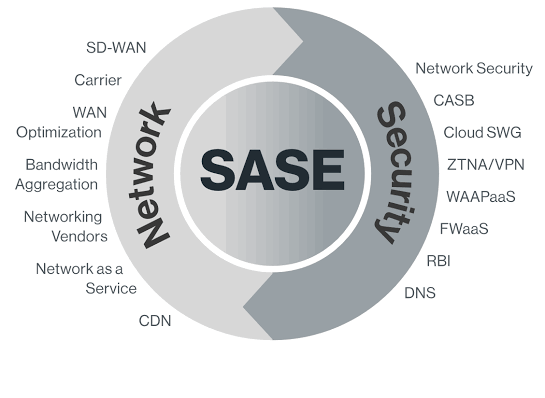
Secure Access Service Edge, commonly abbreviated as SASE, is an architecture that brings networking and security capabilities together through cloud-delivered services. Rather than requiring organizations to route every user and application connection through a centralized physical network perimeter, SASE enables security policies to be enforced closer to users, devices, applications, and points of access.
SASE commonly brings together capabilities such as software-defined wide area networking (SD-WAN), secure web gateways, cloud access security broker functionality, zero trust network access, firewall-as-a-service, and other security services. The exact combination can vary between vendors and implementations, but the architectural principle remains consistent: networking and security should work together through a distributed, policy-driven service model.
A SASE architecture can evaluate multiple aspects of a connection before allowing access. Instead of simply asking whether a user is connected to the corporate network, policies can consider identity, device posture, application, location, risk signals, and other contextual information. Access can then be granted according to the specific resource being requested.
This approach is particularly relevant to organizations with hybrid workforces and cloud-first application environments. Users may never need to become part of a traditional corporate network to access the resources they are authorized to use.
Why Enterprise Networks Are Changing –
The transformation from traditional network security toward SASE is being driven by several structural changes in enterprise IT. Cloud adoption has moved applications outside traditional data center boundaries, while remote and hybrid work have reduced the importance of the corporate office as the default location for business computing.
At the same time, organizations increasingly rely on contractors, suppliers, partners, and temporary workers. These users may need access to specific applications without requiring broad connectivity to internal networks. Modern security architectures therefore need to distinguish between accessing a particular application and accessing an entire network.
The proliferation of connected devices creates another challenge. Laptops, smartphones, IoT devices, operational technology, branch-office equipment, and other endpoints may connect from different environments and have different security characteristics. A static network boundary is often insufficient for determining whether a connection should be trusted.
These changes have pushed enterprises toward security models based on identity, least privilege, continuous verification, application-level access, and centralized policy management.
SASE vs. Traditional Network Security: Key Differences –
The most important difference between SASE and traditional network security is where the security boundary is established. Traditional architectures often place significant emphasis on the network perimeter, while SASE moves toward securing individual access sessions based on identity and context.
| Area | Traditional Network Security | SASE Architecture |
|---|---|---|
| Security model | Primarily perimeter and network based | Identity, context, and policy based |
| Infrastructure | Often appliance and data-center centric | Primarily cloud delivered |
| Remote access | Commonly VPN based | Commonly uses Zero Trust Network Access |
| Traffic routing | Frequently backhauled through centralized gateways | Can route traffic through distributed cloud enforcement points |
| Application access | Network-level connectivity is common | Application-specific access is emphasized |
| Policy management | May span multiple security appliances | Designed for centralized policy management |
| Scalability | Hardware capacity can influence expansion | Cloud infrastructure can support distributed scaling |
| Cloud environments | Often requires additional security layers | Designed for distributed and cloud-centric environments |
| User experience | Can be affected by VPN and traffic backhaul | Can provide closer security enforcement points |
| Operations | Multiple appliances and management systems | Greater convergence of networking and security services |
The table illustrates the architectural difference, but enterprises should avoid treating SASE as a simple replacement exercise. Most organizations will operate hybrid environments for an extended period. Existing firewalls, identity platforms, endpoint controls, data protection systems, and network infrastructure may continue to play important roles alongside SASE services.
The Role of Zero Trust in SASE –
Zero Trust is one of the concepts most closely associated with SASE. The basic principle is that network location should not automatically establish trust. Instead, access should be evaluated according to identity, authorization, device condition, application requirements, and other relevant signals.
For example, an employee accessing an internal HR application from a managed laptop may receive access based on their identity and role. The same employee attempting to access a sensitive administrative system from an unmanaged device may receive a different policy outcome. A contractor might be allowed to access a specific application without being given broad access to the underlying corporate network.
This application-level approach can reduce the need to expose large portions of an enterprise network simply because a user needs one resource. It also supports more granular access policies and can make security controls more closely aligned with business requirements.
SASE does not automatically create a Zero Trust environment. Successful implementation still depends on strong identity management, accurate access policies, endpoint visibility, security monitoring, and governance. SASE provides an architectural framework; organizations still need to design effective security policies within that framework.
How SASE Changes Remote Access –
VPN technology has historically been one of the primary mechanisms for connecting remote employees to corporate networks. VPNs remain useful, but they can create an architectural mismatch when users primarily need access to cloud applications rather than internal network segments.
A SASE-based approach can use Zero Trust Network Access to provide access to specific applications according to identity and policy. The user does not necessarily need broad network-level connectivity simply to reach a particular business service.
This can simplify the remote-access experience while also reducing unnecessary exposure. Instead of treating remote users as extensions of the internal network, organizations can treat each access request as an individual transaction that must satisfy defined security requirements.
For enterprises with thousands of remote and hybrid workers, this distinction can have significant operational implications. Security teams can focus policies around applications and identities rather than maintaining increasingly complex collections of VPN access rules.
SASE and Cloud Security –
Cloud adoption is another major reason enterprises are evaluating SASE. Traditional security architectures can struggle when users, applications, and data are distributed across multiple cloud providers and SaaS platforms. Routing cloud traffic through centralized corporate infrastructure may introduce unnecessary complexity.
SASE can provide cloud-delivered security controls closer to the user and destination. This can be particularly valuable when employees access SaaS platforms, public-cloud applications, and internet-based services throughout the working day.
A unified policy layer can also help security teams manage access consistently across different environments. Instead of creating entirely separate security approaches for branch offices, remote users, cloud applications, and internet traffic, organizations can work toward a more consistent policy framework.
However, cloud security should not be reduced to network security alone. Identity governance, data protection, workload security, endpoint security, application security, and cloud configuration management remain important components of an enterprise security program.
The Operational Impact on IT and Security Teams –
One of the potential benefits of SASE is operational convergence. Traditional enterprise environments can contain separate systems for WAN connectivity, firewalls, VPN access, web filtering, cloud access, and remote access. Each platform may have its own management interface, policy structure, logs, and administrative processes.
SASE attempts to consolidate many of these capabilities into a more integrated architecture. This can reduce operational fragmentation and make it easier for teams to apply consistent policies across different user populations and locations.
The transition itself, however, requires planning. Security teams need to understand existing traffic patterns, application dependencies, identity systems, endpoint requirements, and compliance obligations. Poorly planned migrations can introduce connectivity problems or create policy gaps.
Enterprises should therefore treat SASE adoption as an architectural transformation rather than a simple product deployment.
Where SASE Can Deliver Business Value –
The business case for SASE is broader than security alone. By bringing networking and security closer together, organizations may be able to simplify infrastructure, improve remote access, and reduce the number of independently managed security services.
Potential areas of value include:
- Simplifying remote and hybrid workforce connectivity.
- Applying consistent security policies across users and locations.
- Supporting cloud-first application environments.
- Reducing dependence on centralized network backhauling.
- Improving application-level access controls.
- Consolidating selected networking and security services.
- Increasing visibility across distributed traffic and access patterns.
- Supporting more granular Zero Trust policies.
- Scaling connectivity across branches and remote locations.
- Reducing operational complexity over time.
The actual financial and operational impact depends on an organization’s existing architecture, licensing arrangements, network topology, workforce distribution, application environment, and implementation strategy. SASE should therefore be evaluated against measurable business and technical requirements rather than treated as a universal cost-saving technology.
Challenges of Moving From Traditional Security to SASE –
SASE adoption comes with challenges. Organizations may already have significant investments in firewalls, VPN infrastructure, SD-WAN, identity systems, endpoint security, and other technologies. Replacing everything at once may create unnecessary risk and operational disruption.
Another challenge is architectural complexity. Although SASE is often described as a converged architecture, implementing it across a large enterprise still requires careful integration. Identity providers, endpoint management platforms, security operations tools, cloud environments, and existing network infrastructure must work together.
Vendor selection can also become complicated because SASE offerings can differ considerably in architecture, capabilities, integration depth, and licensing. Enterprises need to evaluate how individual services work together rather than selecting a platform based only on feature counts.
Finally, organizational change matters. Network teams and security teams may have historically operated separate environments and responsibilities. SASE increasingly requires collaboration between networking, security, cloud, identity, and endpoint teams.
How Enterprises Can Prepare for SASE –
Organizations considering SASE should begin with architecture and business requirements rather than technology procurement. The first step is understanding where users, applications, devices, and data currently exist.
A practical assessment should examine:
- Remote-access and VPN dependencies.
- SaaS and public-cloud usage.
- Current WAN and branch architecture.
- Identity and authentication infrastructure.
- Endpoint security and device-management capabilities.
- Existing firewall and secure web gateway infrastructure.
- Application dependencies and traffic flows.
- Regulatory and data-residency requirements.
- Security monitoring and incident-response processes.
- Existing technology contracts and investments.
Once the current environment is understood, organizations can identify specific areas where a SASE architecture could address existing limitations. Some enterprises may start with remote access and Zero Trust Network Access. Others may prioritize SD-WAN integration, secure web access, or cloud application security.
A phased migration generally provides an opportunity to validate policies and user experience before expanding the architecture across the organization.
What the Enterprise Network Could Look Like Next –
The enterprise network is increasingly becoming less about connecting users to a physical corporate location and more about securely connecting identities to applications. This represents a fundamental architectural change.
Future enterprise environments are likely to combine multiple technologies rather than depend on one security model. SASE may provide the networking and security foundation, while identity platforms, endpoint security, cloud security, data protection, security operations, and application controls provide additional layers.
The resulting architecture can be thought of as a distributed security fabric. Users connect from different locations, applications run across different environments, and policies follow the access request rather than being tied exclusively to a physical network perimeter.
This does not mean the traditional network disappears. Data centers, private networks, firewalls, branch infrastructure, and physical connectivity will continue to exist. The transformation is that these components become part of a broader architecture in which the network is no longer the only or primary source of trust.
“The modern enterprise network is moving from a place employees connect to, toward a security framework that determines what each identity can access, from wherever the connection originates.”
SASE vs. Traditional Network Security: Making the Transition –
The comparison between SASE and traditional network security ultimately reflects two different assumptions about enterprise computing. Traditional security assumes that the network perimeter can serve as a major security boundary. SASE assumes that enterprise resources and users are distributed and therefore security must be distributed as well.
For organizations operating primarily from centralized data centers and offices, traditional technologies may continue to satisfy many requirements. For enterprises with significant cloud adoption, remote work, distributed branches, SaaS applications, and complex third-party access, SASE can provide an architecture designed around these modern operating conditions.
The most important consideration is not whether an organization should immediately abandon its existing security infrastructure. Instead, security and network leaders should determine which parts of their current architecture are creating operational friction, unnecessary exposure, poor user experiences, or limited scalability.
SASE can then be introduced incrementally where it addresses those specific requirements. Over time, the enterprise network can evolve from a collection of perimeter-based security controls into a more integrated, identity-aware, cloud-delivered security architecture.
Frequently Asked Questions –
Traditional network security generally emphasizes network perimeters, centralized infrastructure, and network-level access. SASE combines networking and security services through a distributed, cloud-delivered architecture that can apply policies based on identity, application, device, and context.
No. Zero Trust is a security model based on continuous verification and least-privilege access, while SASE is an architecture that combines networking and security capabilities. Zero Trust Network Access is commonly one component of a SASE implementation.
Not necessarily. SASE may provide firewall-as-a-service capabilities, but organizations can continue using existing firewalls where appropriate. The goal is to determine which security functions should remain on-premises and which can be delivered through cloud-based services.
SASE can be particularly relevant to remote and hybrid workforces because security policies can be applied without requiring every user to connect through a traditional corporate network perimeter.
Conclusion –
SASE vs. Traditional Network Security represents more than a technology comparison. It reflects the transformation of the enterprise itself. As applications move into the cloud, employees work from different locations, and organizations depend on increasingly distributed ecosystems, security architectures must adapt to a world where the corporate network is no longer a single, clearly defined boundary.
Traditional security controls will continue to have a role, but enterprises are increasingly looking for ways to connect networking, identity, application access, and security policy into a more unified architecture. SASE provides one approach to that transformation by bringing security and connectivity together through distributed, cloud-delivered services.
For technology leaders, the practical objective is not simply to adopt SASE because it is a modern architecture. The objective is to build a network and security environment that can support the organization’s users, applications, data, and business model with appropriate levels of security, visibility, scalability, and operational control.