

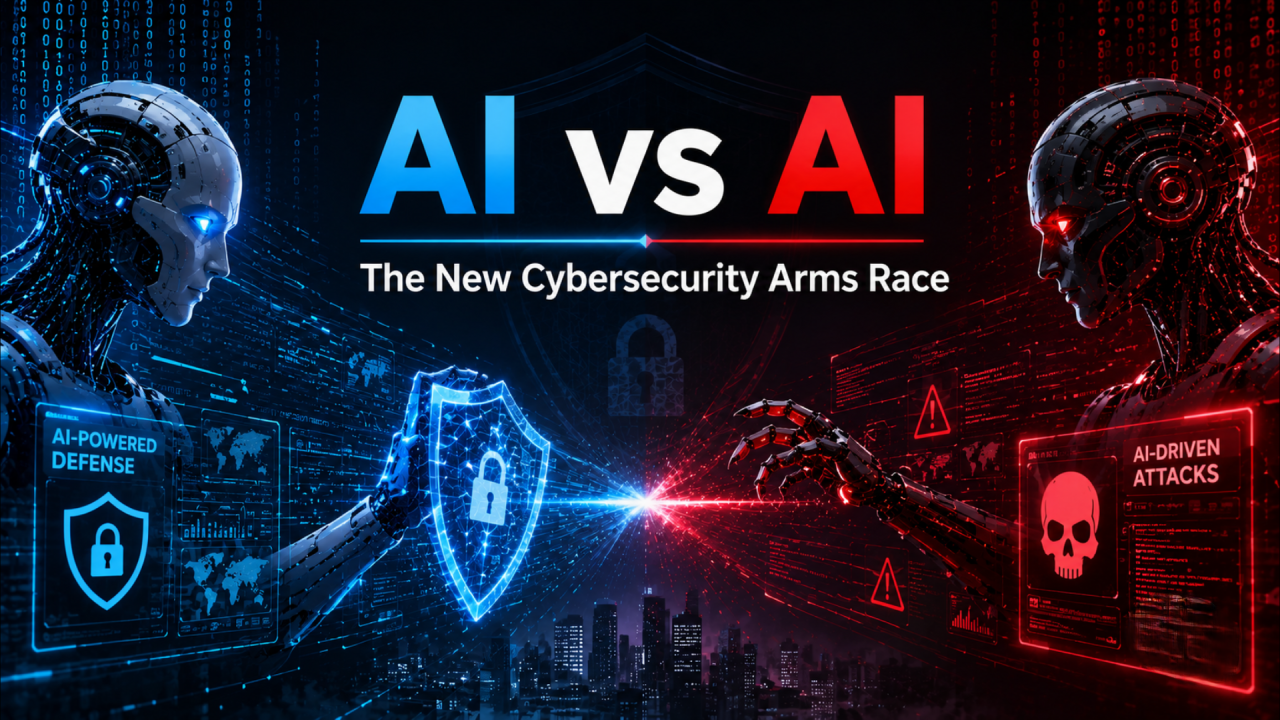

AI vs. AI in Cybersecurity describes a new phase of enterprise security in which artificial intelligence is increasingly being used on both sides of the security equation. Security teams are deploying AI to detect suspicious behavior, analyze enormous volumes of telemetry, identify vulnerabilities, automate investigations, and respond to incidents. At the same time, attackers can use AI to accelerate reconnaissance, generate convincing phishing content, automate parts of their operations, and adapt malicious activity more rapidly. The result is an increasingly automated security environment in which organizations must defend against threats that can move at machine speed.
For years, cybersecurity was largely a contest between human defenders and human-operated attacks. Security analysts reviewed alerts, investigated suspicious activity, and manually developed defenses, while attackers relied heavily on human effort to discover targets and execute campaigns. Automation gradually changed that model, but the rapid development of generative AI and AI-enabled security tooling is accelerating the transformation.
The important question for enterprise security leaders is therefore no longer simply whether AI should be used in cybersecurity. AI is already becoming part of the security stack. The more important question is how organizations can use AI to improve defensive speed and resilience while preventing attackers from gaining greater advantage from the same technological capabilities.
What Does AI vs. AI in Cybersecurity Mean?
The phrase “AI vs. AI” does not mean that every cyberattack is conducted by an autonomous AI system or that every security operation is fully automated. Instead, it describes an environment in which AI capabilities increasingly influence both offensive and defensive cyber operations.
On the defensive side, organizations can use AI for threat detection, security analytics, vulnerability prioritization, identity monitoring, incident investigation, malware analysis, and security operations automation. AI can help security teams process information that would be difficult to analyze manually at enterprise scale.
On the offensive side, AI can potentially help adversaries generate content, research targets, automate repetitive tasks, identify information, and adapt campaigns. The exact capabilities available to attackers vary considerably, but the broader trend is clear: AI can reduce the amount of human effort required for some activities.
This creates an arms-race dynamic. When defenders become faster, attackers have incentives to become faster as well. When attackers automate a particular technique, defenders need better detection and response mechanisms.
Why AI Is Changing the Cybersecurity Equation –
Enterprise environments generate enormous quantities of security information. Endpoint systems, identity platforms, cloud infrastructure, applications, network devices, email systems, security tools, and SaaS platforms can all produce telemetry.
Traditional security systems often depend on predefined rules, signatures, correlation logic, and human investigation. These approaches remain important, but the volume and complexity of modern environments can overwhelm analysts with alerts and fragmented evidence.
AI can help by identifying relationships across large datasets. Instead of examining every event individually, an AI-enabled security system may analyze patterns across identities, devices, applications, locations, and behaviors.
For example, a login from an unusual location might not be suspicious by itself. A login from that location followed by abnormal privilege escalation, unusual file access, and unexpected cloud activity may represent a much stronger signal.
AI can help connect these events and prioritize them for investigation.
How Attackers Can Use AI –
The defensive benefits of AI are significant, but the same technology can also be applied offensively. Attackers can potentially use AI to accelerate activities that previously required substantial manual effort.
One example is social engineering. Generative AI can help produce highly customized messages that appear more natural and contextually relevant. Instead of sending obviously generic phishing messages, attackers may be able to create communications tailored to specific organizations, roles, or business situations.
AI can also assist with reconnaissance by helping organize publicly available information about potential targets. In more sophisticated operations, AI-enabled tools could support automation across multiple stages of an attack.
However, AI does not eliminate the need for attacker infrastructure, access, operational knowledge, or other capabilities. The impact of AI depends on how it is integrated into a broader attack process.
The important enterprise security implication is that organizations should assume that attackers can increasingly automate portions of their workflows.
How Defenders Are Using AI –
Security teams have several defensive applications for AI. Some are already integrated into modern security products, while others are emerging through security operations experimentation.
Common areas include:
- Threat detection and anomaly identification.
- Security alert prioritization.
- Incident investigation.
- Malware and file analysis.
- Vulnerability prioritization.
- Identity and access monitoring.
- Phishing detection.
- Endpoint behavior analysis.
- Security knowledge retrieval.
- Incident-response assistance.
- Threat intelligence analysis.
- Security operations automation.
AI can be particularly useful when it reduces the amount of repetitive analytical work performed by security analysts. Instead of replacing the analyst, an AI system can summarize an incident, correlate relevant events, identify potentially related alerts, and present the evidence required for investigation.
This can allow human analysts to spend more time on complex judgment and response decisions.
AI vs. AI: The Enterprise Security Comparison –
The emerging security environment can be understood by comparing how AI affects offensive and defensive operations.
| Area | AI-Enabled Attacks | AI-Enabled Defense |
|---|---|---|
| Speed | Can accelerate reconnaissance and content generation | Can accelerate detection and investigation |
| Scale | Enables automation across larger target sets | Enables analysis across larger telemetry volumes |
| Personalization | Can support customized social-engineering content | Can personalize risk analysis and response recommendations |
| Detection | Attackers attempt to evade security controls | AI identifies anomalies and suspicious patterns |
| Vulnerabilities | Can help identify potential weaknesses | Can prioritize vulnerabilities based on risk |
| Human involvement | Humans can supervise automated offensive workflows | Analysts supervise AI-supported security decisions |
| Adaptability | Attack techniques can change quickly | Detection models can learn from new signals |
| Primary risk | Faster and more scalable malicious activity | Incorrect automation or excessive trust in AI |
| Key requirement | Operational control and infrastructure | Quality data, governance, validation, and oversight |
The table highlights an important reality: the AI advantage is not automatically determined by who has the most sophisticated model. Security outcomes depend on data quality, integration, operational processes, human expertise, and the ability to respond effectively.
The New Speed Requirement for Security Operations –
Historically, cybersecurity teams often measured performance through metrics such as mean time to detect and mean time to respond. As AI accelerates both attacks and defense, response speed becomes even more important.
An attacker does not necessarily need to maintain access for weeks to create significant damage. Automated actions can compress parts of the attack lifecycle.
Defenders therefore need systems capable of detecting and responding to suspicious activity quickly. AI can help by continuously analyzing telemetry and identifying potentially significant events without requiring an analyst to manually review every signal.
But faster response does not automatically mean better response. An AI system that takes an incorrect action at machine speed can create operational disruption. Blocking legitimate users, disabling critical systems, or isolating important infrastructure based on a false positive can be costly.
The goal should therefore be fast, controlled, and explainable response, not automation for its own sake.
AI and the Security Operations Center
The Security Operations Center, or SOC, is likely to be one of the areas most affected by AI.
Security analysts traditionally spend substantial time triaging alerts, searching logs, gathering context, documenting incidents, and performing repetitive investigations. AI can assist with many of these tasks.
For example, an AI security assistant could summarize an alert, identify related events, retrieve relevant historical incidents, explain why a detection was triggered, and suggest investigation steps. Analysts can then review the evidence and determine the appropriate action.
This creates a human-AI operating model rather than a purely automated SOC.
The human remains responsible for decisions that require context, risk assessment, business knowledge, or significant operational impact. AI handles information processing and repetitive analysis where appropriate.
AI Can Help Reduce Alert Fatigue –
Alert fatigue has been a long-standing problem in cybersecurity. Security teams can receive thousands of alerts, but only a fraction may represent genuinely important incidents.
AI can potentially improve prioritization by considering multiple contextual signals. An alert involving a privileged identity, sensitive application, unusual device, and abnormal behavior may receive higher priority than an isolated low-risk event.
This can help analysts focus their attention on the incidents that require deeper investigation.
However, organizations need to measure whether AI actually improves detection quality. A system that reduces the number of alerts by suppressing legitimate signals is not necessarily improving security.
Security leaders should therefore monitor both efficiency and accuracy.
AI-Powered Vulnerability Management
Vulnerability management is another area where AI can support enterprise security teams. Large organizations may have thousands of vulnerabilities across applications, operating systems, containers, cloud resources, and devices.
Treating every vulnerability equally is rarely practical. Security teams need to determine which weaknesses create the greatest risk in their specific environment.
AI can assist by combining vulnerability information with asset criticality, exposure, exploit intelligence, configuration data, identity relationships, and business context.
This can help organizations prioritize remediation based on potential risk rather than simply ranking vulnerabilities according to severity scores.
Again, AI should support prioritization rather than replace security judgment. The business impact of a vulnerability depends heavily on the organization’s architecture and operational environment.
AI and Identity Security –

Identity has become one of the most important security boundaries in modern enterprises. Employees, contractors, applications, service accounts, and machines may all require access to business resources.
AI can analyze identity behavior and detect unusual patterns. A user’s normal activity may involve specific applications, locations, devices, and access times. A significant deviation could trigger additional verification or investigation.
This approach becomes increasingly valuable as enterprises adopt cloud applications, remote work, and distributed infrastructure.
AI can therefore contribute to adaptive access controls in which risk signals influence authentication and authorization decisions.
However, organizations need strong identity foundations before AI can provide meaningful value. Poor identity data, excessive privileges, incomplete asset inventories, and weak authentication controls cannot be solved simply by adding an AI layer.
The Problem of AI Hallucinations in Cybersecurity –
One of the biggest challenges with generative AI in security is that AI systems can produce inaccurate or unsupported outputs.
In a cybersecurity context, an incorrect summary or recommendation can have serious consequences. An AI assistant might misinterpret a log, incorrectly classify an event, or recommend an inappropriate response.
This means security organizations need validation mechanisms around AI-generated information. Critical decisions should not depend entirely on an unverified AI response.
AI systems should be evaluated against known security scenarios, monitored for errors, and deployed according to risk. Low-impact analytical assistance may require less oversight than automated actions that affect production infrastructure.
The principle is straightforward: the greater the consequence of an AI decision, the stronger the required validation and human control should be.
The Data Advantage in AI Security –
AI effectiveness depends heavily on data. Security models require relevant, high-quality information to identify meaningful patterns.
Organizations with fragmented security telemetry may struggle to obtain the full context required for accurate AI analysis. Data from identity platforms, endpoints, cloud systems, network infrastructure, applications, and security tools may exist in separate environments.
This makes data integration a strategic security priority.
Organizations should focus on creating reliable telemetry pipelines, consistent identities, asset inventories, event normalization, and appropriate data retention. The objective is not simply to collect more data, but to ensure that AI systems have access to the right information at the right time.
Better data can make AI-based detection and investigation more useful.
The Human-in-the-Loop Security Model –
Despite the rapid development of AI, human expertise remains essential in cybersecurity.
Security incidents often involve business context that cannot be inferred from technical telemetry alone. An unusual login could represent an attack, an executive traveling internationally, an approved administrative action, or a newly deployed business process.
Human analysts can interpret these contextual differences.
A strong enterprise security model therefore combines AI speed with human judgment. AI can detect patterns, summarize evidence, prioritize incidents, and recommend actions. Security professionals can validate conclusions, investigate ambiguous cases, approve high-impact actions, and make decisions based on organizational context.
This hybrid model can provide a more balanced approach than either manual security operations or unrestricted automation.
Building an AI-Ready Cybersecurity Architecture –
Organizations preparing for AI-driven security should begin with their existing architecture rather than immediately purchasing AI products.
Several foundational capabilities are particularly important:
- Strong identity and access management.
- Comprehensive endpoint visibility.
- Centralized security telemetry.
- Cloud and SaaS visibility.
- Reliable asset inventories.
- Security data integration.
- Well-defined incident-response procedures.
- Clear AI governance.
- Human approval for high-impact automated actions.
- Continuous model and detection validation.
Organizations should also establish clear rules about how AI systems can access security data. Security logs can contain sensitive information, credentials, identifiers, and operational details. AI tools must therefore be integrated according to appropriate security and privacy controls.
Measuring AI Security Performance –
Traditional security metrics remain important, but organizations adopting AI can introduce additional measures that evaluate whether AI actually improves security operations.
Useful measurements can include:
- Detection accuracy.
- False-positive rates.
- Mean time to detect.
- Mean time to respond.
- Analyst investigation time.
- Alert-triage efficiency.
- Percentage of incidents receiving AI assistance.
- Quality of AI-generated summaries.
- Human override frequency.
- Automated-response accuracy.
- Vulnerability prioritization effectiveness.
- AI-related security incidents.
The objective is to measure outcomes rather than AI usage. A security team should not celebrate deploying an AI system simply because analysts use it frequently.
The more meaningful question is whether the technology helps the organization detect threats earlier, investigate them more efficiently, reduce operational workload, and make better security decisions.
The New Cybersecurity Arms Race Is Also a Data Race –
The AI security arms race is often described as a competition between models. In practice, enterprise advantage may depend just as heavily on data and operational integration.
An AI system with sophisticated capabilities but incomplete security telemetry may struggle to identify threats. A less complex system with high-quality data, strong identity context, comprehensive endpoint visibility, and well-designed workflows may provide more useful results.
This makes security data architecture increasingly important.
Organizations should therefore think beyond the AI model itself. The surrounding ecosystem—including telemetry, identity, asset information, threat intelligence, detection engineering, response automation, and human expertise—determines how effectively AI can operate.
What Security Leaders Should Do Next –
Enterprise security leaders should approach AI adoption through controlled experimentation and risk-based deployment.
Start with use cases where AI can assist analysts without making irreversible decisions. Alert summarization, threat-intelligence analysis, investigation assistance, and security knowledge retrieval can provide opportunities to evaluate AI capabilities while keeping humans in control.
Organizations can then gradually introduce higher levels of automation where evidence demonstrates that the system performs reliably.
Governance should evolve alongside deployment. Security leaders should define which actions AI can recommend, which actions require human approval, what data AI systems can access, how outputs are logged, and how errors are investigated.
The objective should be to build trust through measurable performance, not through assumptions about AI capability.
The Future of AI vs. AI in Cybersecurity –
The AI-driven security arms race is unlikely to be a short-term trend. As AI becomes more capable, both attackers and defenders will continue to experiment with automation, intelligence, and adaptive systems.
This does not necessarily mean cybersecurity will become entirely autonomous. Security is fundamentally an adversarial and contextual discipline, and organizations will continue to need human expertise.
Instead, the likely transformation is toward security operations in which humans supervise increasingly capable machine systems. AI will analyze more information, identify more patterns, and automate more routine actions, while security professionals focus on architecture, governance, complex investigations, risk decisions, and strategic defense.
The organizations that prepare for this environment will need more than AI tools. They will need strong security fundamentals, reliable data, clear governance, skilled professionals, and operating models designed for continuous machine-assisted defense.
“The cybersecurity advantage will not belong simply to the organization with the most powerful AI. It will belong to the organization that combines AI speed with better data, stronger security foundations, and disciplined human judgment.”
Conclusion –
AI vs. AI in Cybersecurity represents a significant change in the enterprise threat landscape. Artificial intelligence can help defenders analyze more data, detect unusual behavior, prioritize threats, accelerate investigations, and automate selected security operations. At the same time, attackers can use AI to increase the speed, scale, and personalization of parts of their activities.
This creates a new security environment in which speed matters, but speed alone is not enough. Organizations need accurate data, resilient infrastructure, strong identity controls, comprehensive monitoring, effective incident-response processes, and governance that determines where automation is appropriate.
The most effective approach is unlikely to be humans versus AI or AI versus humans. It is more likely to be humans working with AI against AI-assisted threats.
For enterprise security leaders, the priority should therefore be building an AI-ready security architecture that combines automation with oversight. AI should accelerate the work of security professionals while remaining subject to validation, accountability, and business context.
The cybersecurity arms race is becoming increasingly intelligent. Enterprises that prepare now can focus not only on adopting AI, but on building the data, governance, talent, and operational foundations required to use it responsibly and effectively.
Frequently Asked Questions
AI vs. AI describes the growing use of artificial intelligence by both cybersecurity defenders and attackers. Defenders can use AI for detection, analysis, investigation, and response, while attackers can potentially use AI to automate or accelerate parts of their operations.
AI can automate many repetitive security tasks, but complete automation is generally inappropriate for every cybersecurity decision. High-impact actions often require human validation because AI systems can make mistakes and may lack important business context.
Generative AI can potentially assist attackers with activities such as creating convincing social-engineering content, organizing reconnaissance information, automating repetitive tasks, and adapting communications. Its capabilities depend on the tools, access, infrastructure, and expertise available to the attacker.
Organizations can use AI for threat detection, alert prioritization, incident investigation, vulnerability analysis, identity monitoring, threat-intelligence analysis, phishing detection, and security operations assistance.
One major risk is excessive trust in AI-generated conclusions. Incorrect detections, summaries, classifications, or recommendations can lead to missed threats or inappropriate security actions. Validation and human oversight are therefore important.
AI can automate or accelerate portions of security analysts’ work, but analysts remain important for complex investigations, contextual judgment, incident decisions, threat hunting, architecture, governance, and risk management.