


Introduction –
For years, the prevailing belief in business was simple: better data leads to better decisions. Organizations invested heavily in customer analytics, business intelligence platforms, AI-powered dashboards, market research, competitive intelligence, and predictive analytics with the expectation that more information would reduce uncertainty and accelerate decision-making. In many areas, these investments have delivered tremendous value. Yet within enterprise purchasing, a different reality is emerging.
Modern B2B buying teams have access to more information than ever before. They can compare dozens of vendors online, analyze analyst reports, review customer testimonials, examine pricing models, attend webinars, evaluate product demonstrations, monitor social media discussions, and use AI assistants to summarize vast amounts of research within minutes. Ironically, this abundance of information has not made enterprise buying significantly faster. Instead, many organizations are experiencing longer buying cycles, more stakeholder disagreements, and increased hesitation before making major purchasing decisions.
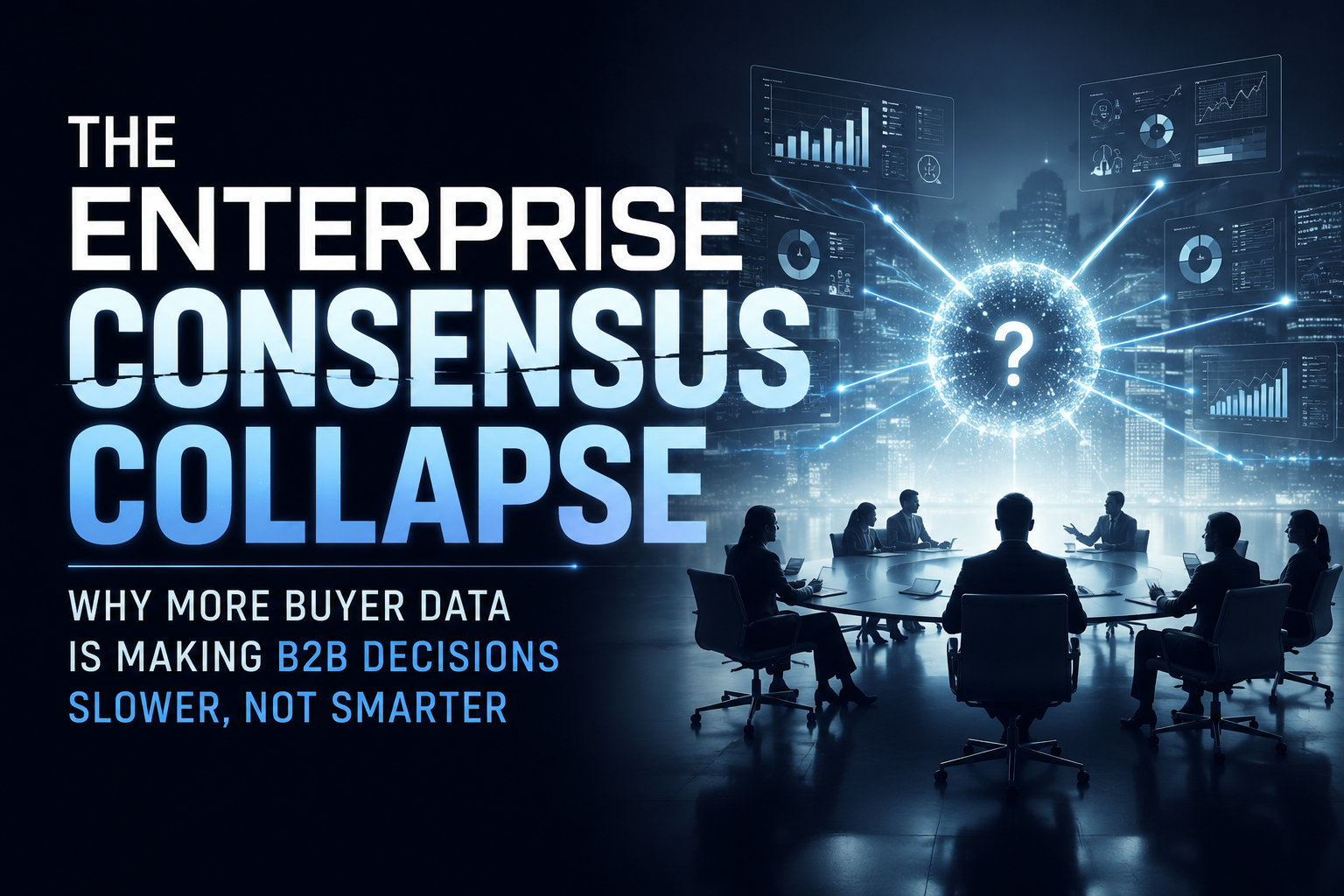
This growing challenge can be described as the Enterprise Consensus Collapse. Rather than creating clarity, excessive buyer information often creates competing interpretations, conflicting priorities, and analysis paralysis among cross-functional buying committees. As enterprise decisions become increasingly collaborative, reaching agreement becomes more difficult, even when everyone has access to the same data.
Understanding this phenomenon is essential for sales leaders, marketers, procurement teams, and executives seeking to improve enterprise decision-making in an increasingly data-rich business environment.
Understanding the Enterprise Consensus Collapse –
The Enterprise Consensus Collapse refers to the growing difficulty organizations face in achieving stakeholder agreement despite having access to abundant buyer information, market intelligence, and analytical tools. Instead of reducing uncertainty, increasing volumes of data often create multiple interpretations of the same situation, making consensus harder to achieve.
Enterprise purchasing rarely depends on a single decision-maker. Modern buying committees typically include representatives from business operations, finance, procurement, legal, cybersecurity, IT, compliance, and executive leadership. Each stakeholder analyzes available information through different objectives, responsibilities, and risk tolerances.
As more data becomes available, each department can selectively emphasize the evidence that best supports its own priorities, making alignment increasingly challenging.
Traditional Enterprise Buying vs. Modern Data-Driven Buying –
| Buying Characteristic | Traditional Enterprise Buying | Modern Enterprise Buying |
|---|---|---|
| Information Sources | Limited vendor materials | Extensive digital research |
| Decision Makers | Small leadership group | Cross-functional committees |
| Evaluation Criteria | Product features and pricing | Security, compliance, ROI, integration, ESG, scalability |
| Decision Speed | Relatively predictable | Often extended |
| Data Availability | Moderate | Extremely high |
| Consensus Complexity | Low | High |
| Risk Assessment | Basic | Comprehensive |
More Information Does Not Always Create Better Decisions –

The assumption that more information automatically improves decision quality overlooks an important reality: human decision-making has cognitive limits. As the volume of available information increases, stakeholders often struggle to distinguish essential insights from unnecessary detail.
The assumption that more information automatically improves decision quality overlooks an important reality: human decision-making has cognitive limits. As the volume of available information increases, stakeholders often struggle to distinguish essential insights from unnecessary detail.
Instead of simplifying purchasing decisions, excessive reports, benchmarks, analyst opinions, competitive comparisons, customer reviews, technical documentation, and AI-generated recommendations may introduce additional uncertainty. Every new piece of information creates another variable that stakeholders must evaluate before reaching agreement.
This information overload frequently delays purchasing without significantly improving decision quality.
The Rise of Cross-Functional Buying Committees –

Enterprise buying has evolved from departmental purchasing into organizational decision-making. Large technology investments often require approval from finance, procurement, cybersecurity, legal, operations, IT, risk management, and executive leadership.
Each participant evaluates vendors using different success criteria. Finance emphasizes return on investment. Procurement focuses on commercial terms. Cybersecurity examines risk. IT evaluates integration requirements. Legal reviews contractual obligations. Business leaders prioritize operational outcomes.
While this collaborative model improves governance, it also increases the number of perspectives that must align before approval can occur.
“Enterprise buying rarely fails because of insufficient information—it fails because too many stakeholders interpret the same information differently.”
Information Overload Creates Analysis Paralysis –
The digital economy has dramatically expanded the amount of research available to enterprise buyers. Organizations can now access product comparison platforms, analyst evaluations, customer communities, industry forums, implementation guides, technical documentation, benchmark studies, AI-generated summaries, and independent reviews before ever contacting a vendor.
Although these resources improve transparency, they also encourage prolonged evaluation. Buying committees may repeatedly revisit previously resolved questions after discovering new reports or alternative opinions.
The result is analysis paralysis—a situation where the pursuit of additional certainty delays action without substantially improving confidence.
Artificial Intelligence Is Both Helping and Complicating Decisions –
Artificial intelligence has transformed enterprise research by enabling buyers to analyze enormous quantities of information within seconds. AI assistants summarize vendor documentation, compare products, generate implementation recommendations, estimate ROI, and answer technical questions.
However, AI also accelerates information consumption. Instead of reviewing ten documents, stakeholders can now analyze hundreds. While this improves access to knowledge, it also exposes buying committees to a greater diversity of perspectives and recommendations.
Without effective governance, AI may unintentionally amplify decision complexity by presenting multiple equally plausible conclusions rather than a single definitive recommendation.
How Different Stakeholders Interpret Buyer Data –
| Stakeholder | Primary Focus | Preferred Data |
|---|---|---|
| Finance | Cost and ROI | Financial models |
| Procurement | Commercial value | Pricing comparisons |
| Cybersecurity | Risk reduction | Security assessments |
| IT | Technical integration | Architecture documentation |
| Operations | Productivity | Workflow improvements |
| Legal | Compliance | Contract terms |
| Executive Leadership | Business strategy | Long-term business outcomes |
Trust Has Become More Valuable Than Information –
As information becomes increasingly abundant, trust emerges as the true differentiator in enterprise decision-making. Buyers may review hundreds of pages of documentation, but they ultimately seek confidence that a vendor can successfully deliver promised outcomes.
Customer references, measurable success stories, implementation transparency, executive relationships, independent certifications, and demonstrated expertise often influence purchasing decisions more than additional technical documentation.
Organizations that consistently build credibility reduce the need for excessive internal debate because stakeholders share greater confidence in the vendor’s ability to execute successfully.
Revenue Operations Can Improve Buying Alignment –
Revenue Operations (RevOps) traditionally focuses on aligning sales, marketing, and customer success. Increasingly, RevOps also contributes to improving buyer alignment by providing structured decision frameworks, standardized business cases, ROI models, implementation plans, and stakeholder-specific messaging.
Rather than overwhelming buyers with every available asset, RevOps helps sales teams deliver the right evidence to the right stakeholder at the appropriate stage of the buying journey.
This targeted approach reduces unnecessary information while improving organizational consensus.
Sales Teams Must Become Consensus Builders –
Traditional enterprise sales emphasized product demonstrations, competitive positioning, and commercial negotiation. Modern sales professionals must also become facilitators of organizational alignment.
This requires understanding stakeholder priorities, identifying conflicting objectives early, creating shared business cases, and helping buying committees navigate internal disagreements. Rather than simply answering questions, successful sales teams proactively guide discussions toward measurable business outcomes that resonate across departments.
Consensus building is becoming as important as solution selling.
The Hidden Cost of Delayed Consensus –
Extended decision cycles affect both buyers and vendors. Customers postpone operational improvements, productivity gains, and competitive advantages while evaluating alternatives. Vendors experience longer sales cycles, less accurate forecasting, higher acquisition costs, and increased competitive exposure.
Delayed consensus also creates greater risk that organizational priorities will change before purchasing decisions are finalized. Budget reallocations, executive turnover, mergers, regulatory changes, or market disruptions may eventually eliminate opportunities that initially appeared highly promising.
Reducing decision friction therefore benefits every participant in the buying process.
Building a Consensus-First Sales Strategy –
Organizations seeking to improve enterprise sales performance should design buying experiences that simplify decision-making rather than increasing information volume. Sales enablement should prioritize clarity over content quantity, ensuring stakeholders receive concise, relevant, and role-specific information.
Executive summaries, implementation roadmaps, measurable business outcomes, customer references, ROI models, and risk mitigation plans should replace lengthy presentations and generic product collateral wherever possible.
Technology also plays an important role. AI-powered sales platforms can identify stakeholder concerns, recommend relevant content, predict approval risks, and monitor buying committee engagement throughout the sales cycle.
Ultimately, successful enterprise sales organizations recognize that their role extends beyond presenting information—they help organizations reach confident, timely decisions.
Best Practices for Preventing Enterprise Consensus Collapse –
- Map buying committee stakeholders early in the sales process.
- Tailor messaging to each stakeholder’s business priorities.
- Replace lengthy presentations with concise executive summaries.
- Support every major claim with measurable customer evidence.
- Provide customized ROI models for financial stakeholders.
- Use AI to prioritize relevant insights instead of overwhelming buyers.
- Facilitate workshops that align cross-functional teams.
The Future of Enterprise Decision-Making –
Enterprise decision-making will continue evolving as artificial intelligence, digital collaboration platforms, predictive analytics, and automation reshape how organizations evaluate technology investments. While access to information will continue expanding, competitive advantage will increasingly depend on the ability to simplify complexity.
Future enterprise sales organizations will distinguish themselves by helping customers filter information, prioritize evidence, and achieve internal consensus more efficiently. AI will assist by identifying stakeholder concerns, recommending personalized content, and highlighting decision risks before they delay approvals.
The organizations that thrive in this environment will understand a simple but powerful principle: in the age of unlimited information, clarity is becoming the scarcest business resource.
Conclusion –
The Enterprise Consensus Collapse highlights one of the most significant challenges facing modern B2B organizations. Although enterprise buyers have access to unprecedented amounts of information, more data does not automatically produce better decisions. Instead, it often increases complexity, extends buying cycles, and makes stakeholder alignment more difficult.
Organizations that succeed in this new environment will shift their focus from delivering more information to enabling better decisions. By simplifying communication, aligning stakeholder priorities, leveraging AI responsibly, and emphasizing trust through measurable evidence, businesses can reduce decision friction and accelerate enterprise buying.
The future of B2B sales belongs not to organizations that provide the most data, but to those that help customers achieve consensus with confidence.
Frequently Asked Questions (FAQs) –
The Enterprise Consensus Collapse refers to the increasing difficulty of achieving agreement among enterprise buying committees despite having access to large amounts of buyer data and market information.
Excessive information creates information overload, multiple interpretations, conflicting stakeholder priorities, and analysis paralysis, making consensus harder to achieve.
AI helps buyers analyze and summarize information quickly but can also increase decision complexity by exposing stakeholders to more perspectives and recommendations.
Modern sales teams act as consensus builders by aligning stakeholders, simplifying information, providing relevant evidence, and guiding organizations toward shared business outcomes.