



Introduction –
Sales enablement in the AI era is transforming how organizations prepare, support, and empower their sales teams to engage prospects and close deals. Traditional sales enablement focused on providing sales representatives with product information, presentations, training materials, and marketing resources. While these elements remain important, modern B2B sales environments demand much more.
Today’s buyers conduct extensive research before speaking with a salesperson. They compare vendors, evaluate product capabilities, read customer reviews, consult industry experts, and use AI-powered tools to understand potential solutions. By the time they engage with a sales representative, they may already have a shortlist and a clear set of expectations.
This shift creates new challenges for sales organizations. Representatives must understand buyer intent, personalize conversations, respond to objections, coordinate with multiple stakeholders, and deliver relevant information at the right moment. At the same time, sales leaders need better visibility into pipeline health, team performance, and deal progression.
Artificial intelligence is helping address these challenges by making sales enablement more intelligent, contextual, and measurable. From AI-powered coaching and automated content recommendations to predictive analytics and conversation intelligence, organizations can equip sales teams with the information and guidance they need throughout the sales cycle.
The objective is no longer simply to give salespeople more resources. It is to help them make better decisions, have more meaningful conversations, and move opportunities toward successful outcomes faster.
What Is Sales Enablement?
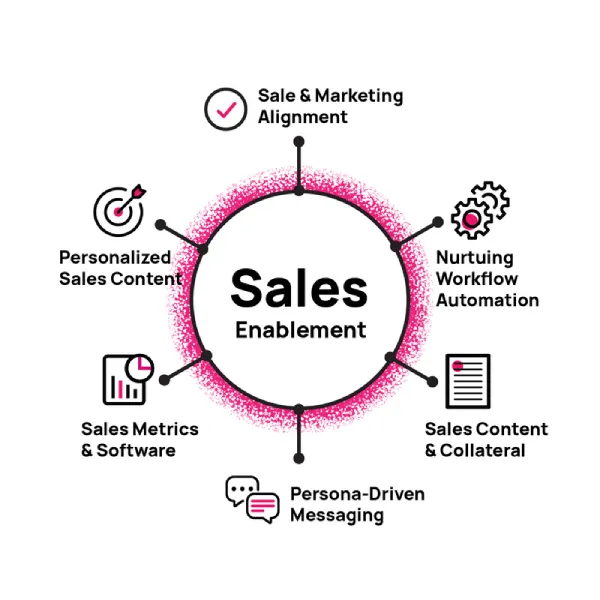
Sales enablement is a strategic business function that provides sales teams with the knowledge, content, tools, training, processes, and insights required to engage buyers effectively and improve sales performance.
It connects marketing, sales, product, customer success, and revenue operations to ensure that representatives have access to consistent information throughout the customer journey.
A traditional sales enablement program typically includes:
- Product training and competitive positioning.
- Sales presentations, brochures, and case studies.
- Prospecting guides and email templates.
- Sales playbooks and objection-handling resources.
- CRM systems and sales technology.
- Coaching, onboarding, and performance management.
- Buyer personas and industry-specific messaging.
In the AI era, these capabilities are becoming more dynamic. Instead of searching through folders for a presentation or manually reviewing sales calls, representatives can use AI-powered systems to identify relevant content, receive conversation recommendations, and understand which actions are most likely to advance an opportunity.
Sales enablement is therefore evolving from a resource distribution function into an intelligent support system that helps salespeople perform throughout the entire revenue process.
Why Traditional Sales Enablement Is No Longer Enough –
Traditional enablement models were designed for a sales environment in which representatives controlled much of the information flow. Buyers depended heavily on salespeople to understand products, compare solutions, and obtain relevant business information.
That environment has changed.
1. Buyers Are More Independent –
Modern B2B buyers research solutions through websites, online communities, analyst reports, customer reviews, webinars, and AI-powered search platforms.
Sales representatives must therefore bring meaningful insights to conversations rather than simply repeat information already available online.
2. Sales Content Is Growing Rapidly –
Organizations produce large volumes of presentations, case studies, whitepapers, product documents, competitive comparisons, and campaign materials.
However, having more content does not necessarily improve sales performance. Representatives often struggle to identify which resource is most relevant to a particular buyer, industry, or stage of the sales cycle.
3. Sales Cycles Involve More Stakeholders –
Enterprise purchases frequently involve executives, IT leaders, finance teams, procurement professionals, legal departments, and operational stakeholders.
Each participant evaluates the purchase differently. Sales teams need tailored messaging that addresses different priorities while maintaining a consistent value proposition.
4. Manual Sales Administration Reduces Selling Time –
Representatives spend considerable time updating CRM records, writing follow-up emails, preparing meeting notes, researching prospects, and generating reports.
These activities are necessary, but excessive manual work reduces the time available for customer engagement.
5. Sales Leaders Need Better Performance Visibility –
Traditional sales reporting often emphasizes outcomes such as revenue, quota attainment, and conversion rates.
Although these metrics are important, they do not always explain why opportunities progress or stall. Sales leaders need deeper insights into buyer engagement, conversation quality, competitive objections, and sales execution.
AI-powered enablement helps address these gaps by connecting information, workflows, and recommendations.
How AI Is Transforming Sales Enablement –
AI is introducing intelligence across nearly every stage of the sales process. Its greatest value comes from helping sales teams understand what to do, when to do it, and how to communicate more effectively.
1. AI-Powered Sales Content Recommendations –
One of the biggest enablement challenges is helping representatives find the right content at the right time.
A salesperson preparing for a meeting with a financial services company may need a relevant case study, a security overview, an industry-specific presentation, and a competitive comparison.
Traditional systems require representatives to search through multiple folders or content repositories.
AI-powered content recommendation systems can analyze contextual information such as:
- Prospect industry and company size.
- Buyer role and business priorities.
- Opportunity stage.
- Previous customer interactions.
- Frequently asked questions.
- Content engagement patterns.
Based on this information, the system can recommend relevant resources for a particular conversation.
For example, when a prospect expresses concerns about implementation complexity, AI may recommend a technical deployment guide, a customer implementation case study, and an integration overview.
This reduces content search time and improves the relevance of sales conversations.
2. Personalized Sales Communication at Scale –
Personalization has become an important part of B2B selling. However, creating customized messages for every prospect requires time and research.
Generative AI can help representatives prepare personalized emails, LinkedIn messages, meeting agendas, and follow-up communications using available customer and account information.
For example, an AI assistant can help transform a generic product introduction into a message that addresses a prospect’s specific operational challenges.
Instead of sending the same message to every IT leader, a salesperson can tailor communication around cloud costs, infrastructure complexity, security requirements, or operational efficiency.
AI-generated communication should always be reviewed for accuracy, relevance, tone, and compliance. Personalization should be based on reliable information rather than invented assumptions about a prospect.
3. Intelligent Sales Coaching –
Traditional sales coaching often depends on manager observations, periodic reviews, and individual feedback sessions.
AI-powered coaching tools can analyze sales conversations and identify patterns that influence performance.
These systems may evaluate:
- How representatives introduce business value.
- Whether discovery questions are sufficiently detailed.
- How frequently prospects raise objections.
- Whether representatives address buyer concerns.
- How effectively next steps are established.
- Whether competitors are mentioned during conversations.
Managers can use these insights to identify coaching opportunities and provide targeted feedback.
For example, if a representative consistently struggles to respond to pricing objections, an AI coaching system may identify the pattern and recommend relevant training material or role-play exercises.
The goal is not to replace sales managers. It is to provide them with better evidence for coaching decisions.
4. Conversation Intelligence and Meeting Summaries –
Sales representatives participate in discovery calls, product demonstrations, technical discussions, negotiations, and follow-up meetings.
Remembering every detail across multiple conversations can be difficult.
Conversation intelligence tools can transcribe supported meetings, summarize discussions, identify action items, and capture important buyer signals.
They can help sales teams understand:
- The prospect’s primary business challenges.
- Product requirements and technical concerns.
- Budget and purchasing considerations.
- Competitor references.
- Decision-making processes.
- Agreed follow-up activities.
These insights can be transferred into CRM systems and shared with relevant team members, subject to consent, privacy, and organizational recording policies.
This improves continuity across sales conversations and reduces the risk of important information being lost.
5. Predictive Sales Analytics –
AI can analyze historical sales data, opportunity activity, customer engagement, and pipeline patterns to identify trends that may influence deal outcomes.
Predictive models can help sales leaders estimate:
- Which opportunities are more likely to convert.
- Which deals may be at risk.
- Which accounts require additional engagement.
- Which activities are associated with successful outcomes.
- Where pipeline coverage may be insufficient.
For example, an opportunity that has stopped progressing, has limited stakeholder engagement, and has unresolved technical concerns may receive a higher risk indicator.
Sales managers can use these signals to prioritize intervention instead of relying exclusively on subjective pipeline updates.
Predictive recommendations should support, not replace, human judgment. Historical patterns do not guarantee future outcomes.
AI-Powered Sales Enablement Across the Sales Funnel –
AI can support sales representatives throughout the buyer journey, from identifying potential accounts to negotiating contracts and expanding existing relationships.
| Sales Stage | Traditional Enablement | AI-Powered Enablement |
|---|---|---|
| Prospecting | Manual research and lead lists | AI-assisted account research and prioritization |
| Outreach | Standard email templates | Context-aware personalized messaging |
| Discovery | Manual note-taking | Conversation transcription and insight extraction |
| Qualification | Manual lead scoring | Predictive scoring and intent analysis |
| Product demonstration | Standardized presentations | Buyer-specific content recommendations |
| Objection handling | Static sales playbooks | Contextual recommendations and AI coaching |
| Negotiation | Manual deal tracking | Opportunity risk signals and stakeholder insights |
| Follow-up | Manually written emails | AI-assisted summaries and follow-up drafts |
This approach allows sales enablement to become a continuous capability rather than a collection of disconnected resources.
The Role of Sales Enablement Content in AI-Driven Selling –
Content remains one of the most important components of sales enablement. AI changes how content is created, organized, recommended, and measured.
However, content effectiveness depends on whether it answers the buyer’s actual questions.
1. Build Content Around Buyer Challenges –
Sales content should address the problems customers are trying to solve rather than focus exclusively on product features.
For example, a cloud infrastructure provider should equip its sales team with materials covering cloud cost optimization, infrastructure reliability, security requirements, and operational scalability.
2. Create Industry-Specific Resources –
Different industries have different purchasing priorities and compliance requirements.
A healthcare organization may prioritize data protection and interoperability, while a manufacturing company may focus on operational continuity and integration with industrial systems.
AI can help representatives identify which industry-specific resources are most relevant to an opportunity.
3. Develop Role-Based Messaging –
The same solution may need to be positioned differently for different stakeholders.
| Buyer Role | Primary Concern | Recommended Sales Content |
|---|---|---|
| CIO | Technology strategy and scalability | Architecture and transformation roadmap |
| CFO | Financial impact and ROI | Business case and cost analysis |
| CISO | Risk and information security | Security documentation and compliance overview |
| Operations Leader | Productivity and efficiency | Workflow demonstrations and implementation case studies |
| Procurement | Commercial terms and vendor risk | Pricing, service agreements, and vendor documentation |
This helps representatives communicate business value in terms that matter to each stakeholder.
4. Measure Content Effectiveness –
AI-assisted analytics can help organizations understand which content is used, shared, viewed, and associated with meaningful buyer engagement.
However, content views alone do not establish commercial impact. Organizations should connect content engagement with opportunity progression, stakeholder participation, and conversion outcomes.
Building an AI-Powered Sales Enablement Technology Stack –

Successful AI-driven enablement requires more than purchasing an AI writing assistant. Organizations need an integrated technology environment that connects customer data, sales content, workflows, and performance insights.
Important technology categories include:
Customer Relationship Management (CRM): The central system for managing accounts, contacts, activities, opportunities, and customer interactions.
Sales Engagement Platforms: Tools that help manage outreach sequences, email communication, calling workflows, and prospect engagement.
Sales Content Management: Platforms that organize presentations, case studies, product information, competitive materials, and approved sales resources.
Conversation Intelligence: Solutions that analyze supported sales meetings, calls, transcripts, and engagement patterns.
AI Sales Assistants: Tools that help representatives research accounts, prepare communications, summarize meetings, and retrieve relevant information.
Sales Analytics and Forecasting: Platforms that analyze pipeline performance, identify risks, and support revenue planning.
Learning and Coaching Platforms: Systems that provide onboarding, product training, sales simulations, and ongoing skill development.
These technologies should work together rather than create additional silos.
For example, conversation intelligence insights should be accessible within the CRM workflow, while AI content recommendations should draw from an approved content repository.
Organizations should also establish appropriate permissions, data governance, retention rules, and integration controls before connecting AI systems to customer information.
How AI Helps Sales Teams Close Deals Faster –
AI does not automatically shorten every sales cycle. Its value comes from reducing delays, improving information quality, and helping representatives focus on actions that move opportunities forward.
1. Faster Prospect Research –
AI-assisted research can summarize company information, identify potential business challenges, and help representatives prepare for meetings.
This reduces manual preparation and allows salespeople to spend more time engaging prospects.
2. Quicker Follow-Up –
Meeting summaries and AI-generated follow-up drafts help representatives respond more quickly after customer conversations.
A timely follow-up can reinforce important discussion points, clarify outstanding questions, and establish the next step.
3. Better Stakeholder Engagement –
AI can help identify gaps in stakeholder participation and highlight which buyer roles have not yet been engaged.
Sales representatives can then develop targeted communication for technical, financial, operational, and executive stakeholders.
4. Faster Objection Resolution –
AI-powered coaching and content recommendations can help representatives respond to common objections using approved product information, customer evidence, and competitive positioning.
This reduces the time spent searching for answers and improves consistency.
5. Earlier Identification of At-Risk Deals
Predictive insights can identify opportunities showing signs of inactivity, weak engagement, or unresolved concerns.
Sales managers can intervene earlier with executive support, technical resources, or revised account strategies.
The result is a more proactive sales process that focuses on removing obstacles rather than simply reporting pipeline status.
Sales Enablement and Sales Operations: Understanding the Difference –
Sales enablement and sales operations work closely together, but they serve different purposes.
Sales enablement focuses on improving sales effectiveness through training, content, coaching, and buyer engagement support.
Sales operations focuses on the processes, systems, analytics, planning, and infrastructure required to run the sales organization efficiently.
| Area | Sales Enablement | Sales Operations |
|---|---|---|
| Primary objective | Improve sales effectiveness | Improve sales process efficiency |
| Core responsibilities | Training, coaching, content, and messaging | CRM administration, forecasting, territory planning |
| Main users | Sales representatives and managers | Sales leadership and revenue operations |
| AI applications | Conversation coaching and content recommendations | Forecasting and workflow automation |
| Success indicators | Ramp time, content effectiveness, win rates | Forecast accuracy, process efficiency, data quality |
In the AI era, these functions increasingly overlap through shared data and intelligent workflows. Collaboration between them helps organizations build a more consistent revenue operation.
Measuring the Success of an AI-Powered Sales Enablement Program –
Sales enablement should be evaluated through business outcomes rather than the number of tools deployed or training sessions completed.
Organizations should establish baseline metrics before introducing new AI capabilities and compare performance over time.
| KPI | What It Measures | Why It Matters |
|---|---|---|
| Sales cycle length | Average time from opportunity creation to closure | Indicates whether processes are becoming faster |
| Win rate | Percentage of opportunities successfully closed | Measures sales effectiveness |
| Quota attainment | Percentage of sales representatives achieving targets | Shows overall team performance |
| Time to productivity | Time required for new representatives to become productive | Measures onboarding effectiveness |
| Content utilization | How frequently sales resources are used | Indicates content adoption |
| Follow-up response time | Time taken to complete post-meeting follow-ups | Measures responsiveness |
| Forecast accuracy | Difference between projected and actual revenue | Supports better planning |
| Opportunity conversion rate | Percentage of opportunities progressing to the next stage or closing | Identifies funnel effectiveness |
Organizations should also track AI-specific measures, such as recommendation acceptance, generated-content correction rates, coaching adoption, and the accuracy of AI-generated summaries.
A balanced measurement approach helps determine whether AI is improving actual sales performance or simply increasing activity.
Challenges of Implementing AI in Sales Enablement –
Despite its potential, AI-powered enablement introduces challenges that organizations must address.
1. Poor CRM Data Quality –
AI recommendations are only as reliable as the information used to generate them.
Incomplete contact records, outdated account details, inconsistent opportunity stages, and duplicate data can reduce recommendation quality.
Organizations should establish CRM data standards, ownership, validation rules, and regular data quality reviews.
2. Information Security and Customer Privacy –
AI systems may process sensitive customer information, sales recordings, contracts, pricing details, and internal business documents.
Organizations must evaluate data access permissions, vendor security, retention policies, regulatory obligations, and whether customer information may be used for model training.
Recording and analyzing customer conversations should also follow applicable consent and privacy requirements.
3. Over-Reliance on AI Recommendations –
AI-generated insights can be incomplete, inaccurate, or misleading. A predictive score should not become the sole basis for deciding whether an opportunity deserves attention.
Sales representatives should validate recommendations using customer conversations, business context, and their own judgment.
4. Fragmented Sales Technology –
Using multiple disconnected AI tools can increase complexity and create inconsistent information.
Organizations should prioritize integration, shared data standards, and clear ownership of enablement workflows.
5. Employee Adoption and Change Management –
Sales representatives may resist AI tools if they add extra steps or appear to monitor employee performance without providing meaningful value.
Organizations should involve sales teams in tool selection, explain how AI supports their work, and provide practical training.
6. Maintaining Authentic Customer Relationships –
Automation should not make customer interactions feel generic or impersonal.
AI can support research, content creation, and administrative work, but salespeople must continue to demonstrate empathy, credibility, and an understanding of customer priorities.
Best Practices for Implementing AI-Powered Sales Enablement –
Organizations should introduce AI capabilities through a structured implementation strategy.
1. Identify the Biggest Sales Productivity Gaps –
Begin by understanding where representatives lose time. Common problems include manual research, poor content discovery, slow follow-ups, inconsistent CRM updates, and limited coaching.
Prioritize use cases that address measurable business challenges.
2. Establish a Reliable Data Foundation –
Clean CRM records, standardize opportunity stages, maintain accurate account information, and establish clear data ownership.
This creates a stronger foundation for AI-driven recommendations.
3. Organize and Govern Sales Content –
Create a centralized content repository with clear ownership, version control, access permissions, and approval processes.
Remove outdated resources and ensure representatives can find current, approved materials.
4. Introduce AI in High-Value Workflows –
Start with practical use cases such as meeting summaries, account research, content recommendations, and follow-up preparation.
These applications can demonstrate value without requiring a complete transformation of the sales organization.
5. Train Representatives and Managers –
Provide hands-on training that explains how to use AI recommendations, validate generated content, interpret insights, and protect customer information.
Managers should also learn how to use AI-generated coaching insights constructively.
6. Establish Governance and Human Oversight –
Define which tasks can be automated, which require approval, and which must remain under human control.
Create policies for customer data, meeting recordings, generated content, and access to confidential information.
7. Measure Results and Improve Continuously –
Track sales productivity, adoption, conversion, deal progression, and customer engagement. Use these findings to refine workflows and expand successful use cases.
The Future of Sales Enablement: From AI Assistance to Agentic Sales Support –
The next stage of sales enablement will move beyond individual AI assistants toward more connected systems capable of coordinating multiple sales activities.
AI agents may help research accounts, monitor customer engagement, prepare meeting briefs, recommend relevant content, draft follow-ups, and update CRM records within approved workflows.
For example, an AI-enabled sales workflow could identify an account showing increased engagement, summarize relevant company developments, prepare a meeting brief, and recommend questions for the representative.
After the meeting, it could summarize the discussion, identify unresolved objections, prepare a follow-up draft, and suggest the next action.
Human representatives would remain responsible for validating information, managing relationships, negotiating commercial terms, and making important customer-facing decisions.
This development could make sales enablement more proactive. Instead of waiting for representatives to search for resources, intelligent systems will increasingly surface relevant information when it is needed.
However, organizations must ensure that AI agents operate within clear permissions and approval boundaries. Access to customer records, pricing information, contracts, and external communication should be carefully governed.
The competitive advantage will not come from automating every sales activity. It will come from combining intelligent automation with human expertise at the moments that matter most.
Conclusion –
Sales enablement in the AI era is changing how organizations prepare representatives, support customer conversations, and manage opportunities. AI-powered content recommendations, personalized communication, conversation intelligence, predictive analytics, and intelligent coaching are helping sales teams work more efficiently and make better decisions.
However, technology alone cannot guarantee faster deal closures. Organizations need reliable data, relevant sales content, connected workflows, clear governance, and strong employee adoption.
The most successful sales organizations will use AI to remove administrative friction while allowing representatives to focus on customer relationships, business challenges, and value-based conversations.
Ultimately, modern sales enablement is not about giving salespeople more tools. It is about giving them the right information, guidance, and insights at the right time.
In an increasingly intelligent sales environment, the teams that combine AI-driven efficiency with human judgment and relationship-building will be better equipped to turn opportunities into long-term customer relationships.
“The future of sales enablement is not about replacing the salesperson. It is about removing everything that prevents the salesperson from selling effectively.”
Frequently Asked Questions (FAQs) –
Sales enablement in the AI era uses artificial intelligence, automation, analytics, and digital content platforms to equip sales representatives with the information, training, and insights required to engage buyers and close deals more effectively.
AI improves sales enablement through automated research, personalized communication, content recommendations, conversation intelligence, predictive analytics, and intelligent coaching. These capabilities help reduce administrative work and improve sales decision-making.
AI can help reduce delays by improving prospect research, accelerating follow-ups, identifying stakeholder gaps, supporting objection handling, and highlighting at-risk opportunities. Actual results depend on sales processes, buyer behavior, implementation quality, and team adoption.
Useful categories include AI sales assistants, conversation intelligence platforms, sales content management systems, CRM-based AI capabilities, sales engagement tools, and predictive analytics platforms. The right combination depends on the organization’s existing technology stack and business requirements.
Sales training focuses on developing the knowledge and skills required to sell effectively. Sales enablement is broader and includes training, content, technology, coaching, processes, and information that support representatives throughout the sales cycle.