


For nearly three decades, enterprise dashboards have been regarded as the foundation of business intelligence. Organizations across industries have invested heavily in dashboard platforms to monitor revenue, sales performance, marketing campaigns, customer acquisition, employee productivity, financial health, inventory, and operational efficiency. These tools transformed business reporting by replacing static reports with real-time visualizations, enabling leaders to make faster and more informed decisions.
Despite these advancements, businesses continue to face a fundamental challenge. They are collecting more data than ever before but often struggle to convert that information into meaningful business actions. The problem is no longer access to data—it is interpreting that data quickly enough to make the right decisions.
Every dashboard still depends on human interpretation. Executives and analysts must identify trends, connect information from multiple systems, determine priorities, and decide what actions should follow. As Artificial Intelligence (AI) becomes increasingly capable of understanding business context and analyzing millions of interconnected data points simultaneously, this traditional model of business intelligence is beginning to show its age.
The future of enterprise intelligence is not about creating dashboards with more charts. It is about building intelligent systems that understand organizational data, identify what matters most, and proactively deliver insights before anyone even thinks to ask.
Why Traditional Enterprise Dashboards Are Reaching Their Limits –
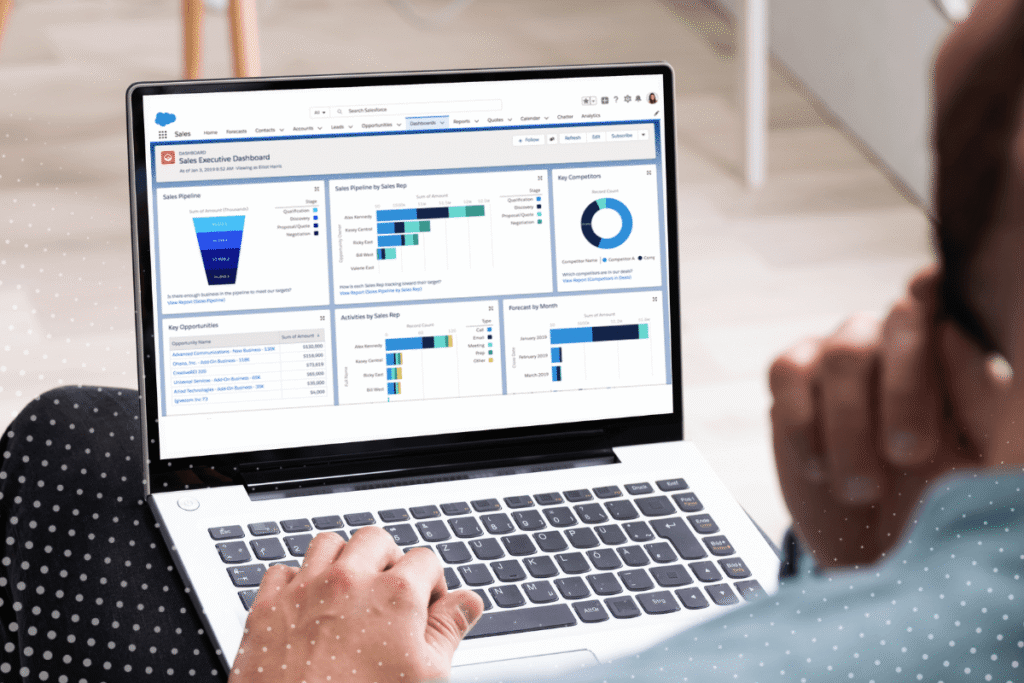
Enterprise dashboards revolutionized business reporting because they centralized information that was previously scattered across multiple systems. Sales teams monitored their pipelines, finance departments tracked revenue and expenses, HR measured workforce performance, marketing teams analyzed campaign
effectiveness, and operations managers optimized supply chains through real-time analytics.
However, digital transformation has also introduced new challenges. As organizations adopted specialized software for every department, dashboards multiplied instead of simplifying decision-making. Finance teams work with financial reporting platforms, sales rely on CRM analytics, marketing uses campaign dashboards, HR monitors workforce metrics, and cybersecurity teams operate entirely separate monitoring systems.
Executives are now expected to interpret information from numerous disconnected sources before making strategic decisions. Rather than reducing complexity, modern dashboards often require leaders to spend valuable time switching between platforms and manually connecting insights that should already be linked.
The challenge becomes even greater because today’s business environment changes far more rapidly than traditional dashboards were designed to support. Customer behavior evolves daily, supply chains experience unexpected disruptions, competitors introduce new products, regulations change frequently, and economic conditions shift much faster than in the past.
Knowing that customer acquisition costs increased by twelve percent yesterday is certainly useful. However, understanding why those costs increased, which departments are affected, what is likely to happen next, and what actions should be taken immediately is far more valuable. This is where Artificial Intelligence begins to outperform traditional reporting.
Traditional Dashboards vs AI-Powered Business Intelligence –
| Traditional Enterprise Dashboards | AI-Powered Business Intelligence |
|---|---|
| Displays historical metrics | Predicts future outcomes |
| Requires manual interpretation | Explains the reasons behind business changes |
| Passive reporting | Proactively recommends actions |
| Department-specific insights | Connects data across departments |
| Users search for information | AI delivers insights automatically |
| Reactive decision-making | Predictive and preventive decision-making |
From Reporting to Intelligent Decision-Making –
Artificial Intelligence is fundamentally changing how organizations interact with enterprise data. Instead of displaying hundreds of charts and expecting executives to identify meaningful relationships, AI can analyze information from multiple business systems simultaneously and produce understandable recommendations.
Modern AI platforms can correlate customer relationship management data, marketing campaigns, customer support interactions, product usage, pricing strategies, logistics performance, and even external market conditions to identify hidden patterns that would be extremely difficult for humans to discover manually.
Rather than asking executives to investigate dozens of dashboards, AI provides a concise explanation of what happened, why it happened, what impact it may have on the business, and what actions should be considered next.
Some of the enterprise data sources AI commonly analyzes include:
- CRM and sales platforms
- Marketing automation systems
- Customer support data
- ERP and finance applications
- Supply chain and inventory systems
This ability to connect information across departments transforms business intelligence from simple reporting into continuous decision support.
A Real-World Example of AI in Action –
Consider a global B2B software company that experiences a six percent increase in customer churn during a quarter. A traditional dashboard simply reports that the churn rate has increased, leaving analysts and executives to investigate the reasons.
An AI-powered intelligence platform approaches the problem very differently. It identifies that customer support response times gradually increased over the previous three months, customer success engagement declined because of staffing shortages, product adoption dropped after a recent interface redesign, renewal conversations started later than normal, and competitors launched attractive migration incentives during the same period.
Instead of presenting these findings as isolated metrics, AI combines them into a clear business narrative explaining that customer dissatisfaction resulted primarily from operational challenges rather than product quality alone. The system can then recommend actions such as increasing customer success resources, improving onboarding processes, accelerating executive outreach, and revising renewal strategies.
The dashboard becomes supporting evidence, while the AI-generated insight becomes the real value.
Conversational Business Intelligence Is Changing Everything –
Large Language Models are making enterprise analytics far more accessible by allowing business users to interact with data using natural language. Instead of navigating multiple dashboards or building complex reports, executives can simply ask questions and receive immediate explanations.
Examples include:
- Why did revenue decline in Europe?
- Which customers are most likely to renew this quarter?
- What caused marketing costs to increase?
- Which products are generating the highest long-term value?
Behind the scenes, AI retrieves relevant information from multiple enterprise systems, performs complex reasoning, and produces recommendations that are easy for decision-makers to understand. This conversational approach removes technical barriers and allows leaders to focus on strategy rather than data exploration.
Proactive Intelligence Instead of Reactive Monitoring –
One of the biggest limitations of traditional dashboards is that they remain passive until someone decides to check them. AI-powered business intelligence changes this relationship completely.
Instead of waiting for executives to discover problems, intelligent systems continuously monitor organizational operations around the clock. When unusual business patterns emerge, AI immediately notifies stakeholders and explains the potential consequences before they become major issues.
Organizations can receive proactive alerts about:
- Increasing employee attrition
- Declining customer satisfaction
- Rising cybersecurity risks
- Supply chain disruptions
- Cash flow concerns
Rather than simply reporting what happened yesterday, AI predicts what is likely to happen tomorrow, giving organizations valuable time to respond before problems escalate.
Building Trust Through Explainable AI –
Although AI is becoming increasingly capable of supporting business decisions, organizations cannot rely on recommendations they do not understand. Trust and transparency remain essential for enterprise adoption.
Future business intelligence platforms must clearly explain why a recommendation has been generated, which business variables influenced the conclusion, how confident the prediction is, and what evidence supports the proposed action.
Explainability ensures that AI becomes a trusted advisor rather than an unquestioned decision-maker. Strong governance, auditability, and human oversight will remain essential as organizations increasingly depend on AI for strategic decision-making.
The Evolving Role of Business Analysts –
The rise of AI does not mean business analysts will disappear. Instead, their responsibilities will evolve significantly.
Rather than spending countless hours preparing reports and maintaining dashboards, analysts will increasingly focus on higher-value activities such as:
- Validating AI-generated insights
- Improving enterprise data quality
- Developing predictive models
- Supporting executive decision-making
This shift allows analysts to contribute more strategically while leaving repetitive reporting tasks to intelligent systems.
The Future of Enterprise Intelligence –
Enterprise software vendors are already embedding AI directly into everyday business applications. CRM platforms now recommend sales opportunities, ERP systems identify operational risks, HR applications detect workforce trends, and cybersecurity platforms automatically prioritize threats based on business impact.
As these capabilities mature, organizations will spend less time searching for information and more time acting on meaningful insights. Companies that successfully integrate enterprise data into unified AI-powered intelligence ecosystems will gain a significant competitive advantage by making faster, more informed decisions than their competitors.
Enterprise dashboards are not disappearing overnight. They will continue to support governance, compliance, and operational reporting. However, their role is shifting from being the primary destination for business intelligence to becoming supporting evidence within broader AI-driven decision ecosystems.
The future belongs to organizations where AI continuously monitors business performance, understands relationships across departments, predicts emerging challenges, and recommends the most effective actions before leaders even begin searching for answers.
Key Takeaways –
- AI is transforming business intelligence from reporting into reasoning.
- Enterprise dashboards will remain valuable but will play a supporting role.
- Predictive insights help organizations respond before problems occur.
- Business analysts will become strategic advisors rather than report creators.
- Explainable AI will be critical for trust, governance, and enterprise adoption.
Conclusion –
Enterprise dashboards transformed business intelligence by making organizational data more accessible, but today’s fast-moving business environment demands more than visualization alone. Leaders need systems that not only present information but also understand context, explain changes, predict future outcomes, and recommend the best course of action.
Artificial Intelligence is making this evolution possible by shifting business intelligence from descriptive reporting to proactive decision support. While dashboards will continue to play an important role in governance and operational monitoring, they will increasingly serve as supporting evidence rather than the primary source of insight.
Organizations that embrace AI-powered business intelligence will be better equipped to respond to change, uncover opportunities, and make faster, more confident decisions. The future of enterprise intelligence is not about creating another dashboard—it is about building systems intelligent enough to speak first, allowing leaders to focus on strategy instead of searching for answers.
Frequently Asked Questions (FAQs) –
No. Dashboards will continue to support reporting, governance, and compliance, but AI-powered insights are expected to become the primary decision-support mechanism.
AI analyzes enterprise data across multiple systems, identifies hidden relationships, predicts future outcomes, explains root causes, and recommends actions automatically.
Autonomous business intelligence uses AI to monitor business operations continuously, detect emerging trends, predict risks, and deliver proactive recommendations without requiring manual analysis.
No. AI will automate repetitive reporting tasks, allowing analysts to focus on strategic analysis, predictive modeling, and business advisory responsibilities.
Explainable AI provides transparency into how recommendations are generated, helping organizations build trust, comply with regulations, and make informed decisions with confidence.